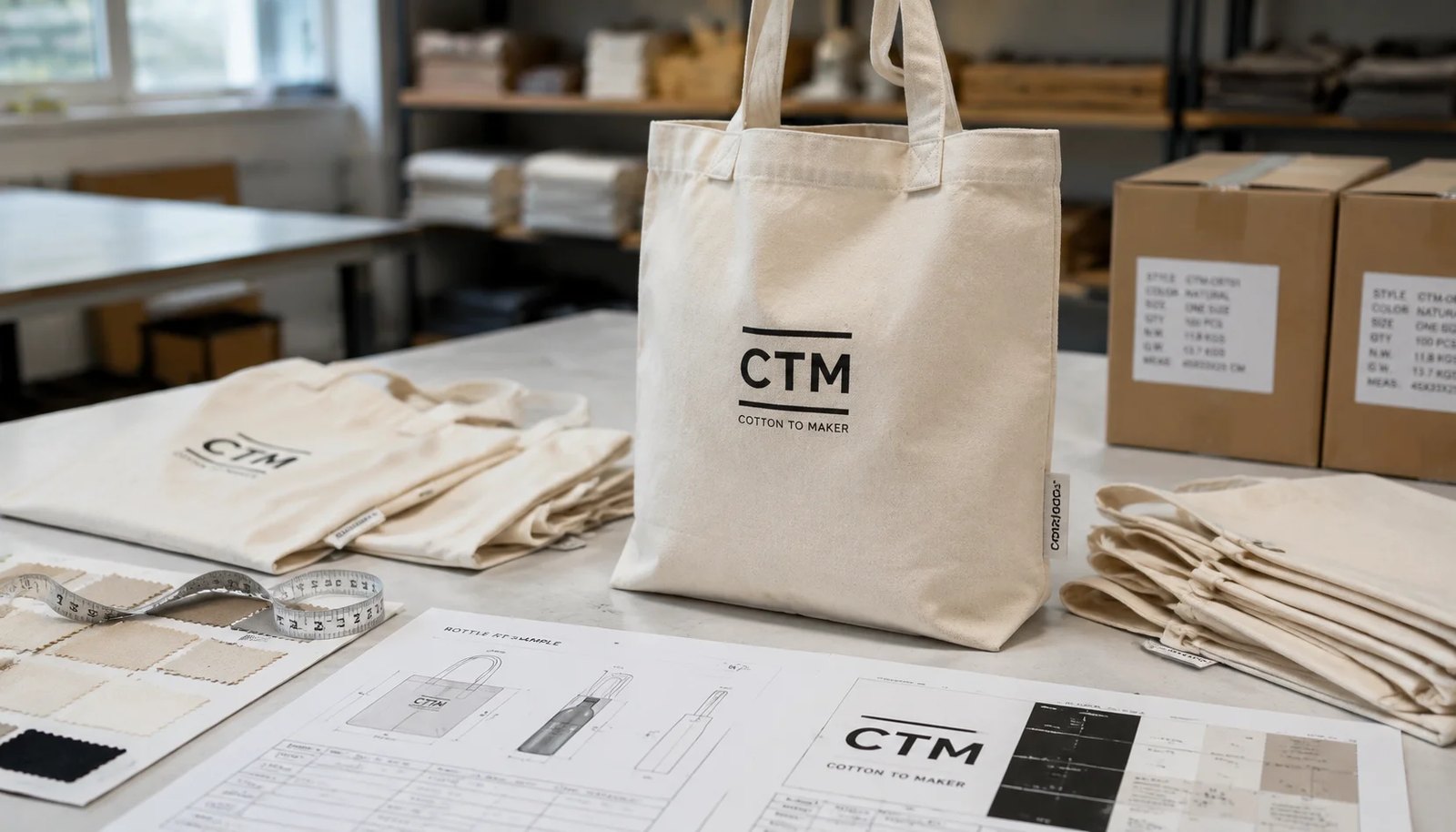
Start With the Retail Use Case
Wholesale organic cotton totes for liquor retailers are not ordinary promotional bags. They carry heavy glass, may show alcohol brand artwork, often include a sustainability claim, and may move through retail distribution centers with strict receiving rules. A generic tote quote can look cheap until the buyer discovers that the handle stitching is weak, the organic claim is unsupported, or the carton labels do not match the retailer's inbound requirements.
Begin the RFQ with the business use. A checkout tote, paid reusable bag, holiday spirits gift bag, tasting event giveaway, and brand-owner gift-with-purchase item all need different decisions. A gift-with-purchase tote may need alcohol brand approval and campaign timing discipline. A paid reusable retail tote may need barcode labeling, price-ticket placement, and stronger durability testing because the customer expects repeat use.
- State whether the tote is sold, given away, packed with a bottle, or used only at events.
- Confirm whether the bag carries store branding, alcohol brand artwork, legal text, or sustainability claims.
- List the receiving channel: direct to stores, retailer DC, distributor warehouse, event venue, or 3PL.
- Keep the first quote tied to one use case so suppliers do not price different assumptions.
Control the Organic Cotton Claim
The word organic needs evidence, not just natural-colored fabric. For procurement teams, the first question is whether the claim is about certified organic cotton fiber, certified fabric, a certified finished product, or a broader marketing message. Those are not the same. A supplier may have access to organic cotton fabric but may not be certified for every downstream process, such as dyeing, printing, sewing, or packing.
Common evidence frameworks include GOTS, OCS, transaction certificates, scope certificates, material declarations, and chain-of-custody records. A GOTS or OCS scope certificate shows what a certified organization is approved to do. A transaction certificate is more order-specific and may be needed to connect a material lot to a shipment. The buyer's claim wording must stay inside the evidence. For example, 'made with organic cotton fabric' may be easier to support than 'certified organic tote bag' if the finished bag process is not fully covered.
Do not accept expired certificates, screenshots with no certificate number, documents belonging to an unrelated mill, or generic sales letters as the full claim file. The compliance package should connect the certificate holder, material supplier, production factory, and order lot as far as the supply chain allows.
- Ask for valid GOTS or OCS scope certificates before relying on organic language.
- Request transaction certificates when the program requires lot-level organic traceability.
- Confirm which processes are inside the certification scope and which sit outside it.
- Approve exact claim wording for hangtags, product pages, carton labels, and invoices.
- Keep a document log showing certificate number, holder name, validity date, material, and related PO.
Engineer the Bag for Bottles
Liquor totes fail when they are designed from flat artwork instead of bottle geometry. A bottle creates point load, movement, and leverage at the handles. A flat tote can work for a single bottle in a light-use campaign, but a gusseted tote is usually better for boxed spirits, wine bottles, gift sets, or multi-item retail purchases. The buyer should test the tallest bottle, the widest bottle, and the heaviest bottle expected in the program.
Handle drop deserves the same attention as bag size. Short handles are tidy for hand carry but awkward over winter clothing. Long handles are more comfortable but add stress at the handle attachment point. The RFQ should name the reinforcement method rather than relying on the phrase 'strong handles.' Box stitch, cross stitch, bar tack, double folded top hem, and reinforcement patches all carry different cost and durability implications.
- Give dimensions as finished width x height x gusset, not just flat panel size.
- Specify handle width, handle length, finished drop, and reinforcement stitch.
- Use actual filled bottles or weight-equivalent dummies for approval testing.
- For two-bottle bags, test bottle movement and bottom stability, not only static weight.
- Require first-piece photos of handle reinforcement before full bulk sewing.
Choose Fabric by Performance
GSM affects strength, appearance, folding bulk, print result, and freight cost. For light promotional liquor events, 180-220 GSM organic cotton may be sufficient if the bag carries leaflets, small accessories, or one bottle for a short distance. For store checkout and reusable liquor retail programs, 240-280 GSM is a more practical starting range. Premium spirits packaging or two-bottle gift programs may justify 300 GSM or higher, with the tradeoff of thicker seams, larger cartons, and higher freight volume.
Weave and finish also matter. Plain weave canvas, twill, and drill do not have the same hand feel or seam behavior. Natural unbleached cotton may show seed flecks and shade variation. That can support an organic visual style, but it should be approved as a controlled appearance rather than discovered during delivery. If the fabric is dyed, add shade tolerance, colorfastness, and dye-lot control to the RFQ.
- 180-220 GSM: light campaigns, lower cost, less load confidence.
- 240-280 GSM: balanced retail option for reusable bottle carry.
- 300 GSM and above: premium feel and strength, higher carton volume and freight cost.
- Ask the supplier to test GSM from the production lot before cutting.
- Approve natural cotton shade range with physical swatches, not only photos.
Match Print Method to Compliance
Screen printing remains the most common choice for wholesale organic cotton totes because it is efficient for repeat logos and limited-color artwork. Water-based and pigment inks can give a softer hand on natural cotton, while heavier ink systems may improve opacity but change feel and curing requirements. Digital printing and heat transfer can work for short runs or complex art, but they require careful approval for edge feel, wash behavior, cracking, and appearance on unbleached fabric.
Liquor retail adds brand-control risk. If an alcohol brand owner supplies artwork, the supplier should not start bulk printing until the brand approval workflow is complete. Confirm logo size, clear space, legal copy, and color under normal store lighting. For gift-with-purchase programs, campaign artwork may also need distributor, retailer, or state-level promotional approval depending on the market and channel. The tote supplier is not the legal reviewer, but the buyer should freeze approved artwork before screens are made.
- Approve a print strike-off on actual bulk fabric before production.
- State Pantone targets and acceptable visual difference under standard lighting.
- Include rub, fold, and curing checks for natural cotton surfaces.
- Reject bulk printing from unapproved artwork, low-resolution files, or missing legal copy.
- Record who approved alcohol brand artwork and when the approval was given.
Handle Liquor Retail Labeling Rules
Retail labeling is broader than the label sewn into the side seam. The buyer may need country-of-origin marking, fiber content wording, care instructions, barcode or SKU labels, price stickers, carton marks, PO numbers, and campaign identifiers. If the tote is sold as merchandise, labeling expectations can differ from a free promotional item. If it is part of a gift-with-purchase program, brand-owner and state-by-state alcohol promotion rules may affect copy, timing, and distribution.
Because liquor regulations vary by jurisdiction and sales channel, procurement should not ask a bag factory to interpret state alcohol laws. Instead, the buyer should provide an approved label file and a rule sheet. The supplier's job is to place the correct label on the correct unit and carton, keep SKU separation clean, and provide photos before shipment. Any supplier that improvises legal wording or substitutes labels without approval creates avoidable risk.
- Separate product labels, hangtags, carton labels, and pallet labels in the artwork package.
- Confirm whether the tote is a retail item, packaging component, or promotional giveaway.
- Provide approved state, chain, or brand-owner copy when alcohol promotion rules apply.
- Require barcode scans and carton-label photos during final inspection.
- Reject labels with unapproved organic claims, wrong COO, wrong SKU, or altered legal text.
Build a Quote That Can Be Compared
Price comparison only works when every supplier quotes the same tote. The RFQ should lock the material, dimensions, reinforcement, print method, claim evidence, sample stages, packing, inspection standard, and incoterm. Otherwise, the lowest quote may exclude certification administration, screen charges, carton labels, stronger handles, or third-party inspection.
Ask suppliers to break out costs that often disappear inside unit price. Screens, sample courier fees, test reports, certification document fees, recycled cartons, individual polybags, paper bands, barcode labels, inland freight, and export paperwork can change the landed cost. MOQ should be stated by size, color, artwork, label, and shipment because a 5,000-piece order with five store designs may not behave like one 5,000-piece production run.
- Request price levels such as 1,000, 3,000, 5,000, and 10,000 pieces if realistic.
- Clarify whether MOQ applies per logo, per fabric color, per size, or per PO.
- Ask for FOB, EXW, and DDP only when the supplier can support the documents behind the term.
- Compare carton volume and gross weight, especially when moving from 240 GSM to 300 GSM.
- Do not treat testing, inspection, and compliance documents as optional if the retail channel requires them.
Use Numeric QC Thresholds
Final inspection should be agreed before production, not negotiated after defects appear. For most tote orders, ANSI/ASQ Z1.4 or ISO 2859-1 general inspection level II is a practical starting point. Typical AQL limits are critical defects 0.0, major defects 2.5, and minor defects 4.0. Premium retail programs, legal label risk, or high-value brand artwork may justify tighter limits.
Defect definitions must be written for this product. Critical defects include unsafe handle failure, mold, sharp contamination, wrong legal label, wrong alcohol brand artwork, or unsupported organic claim printed on the product or packing. Major defects include open seams, missing reinforcement, holes, severe stains, wrong dimensions outside tolerance, incorrect carton quantity, and print placement beyond the approved limit. Minor defects include removable lint, small thread ends, slight fold marks, or shade variation within the approved range.
Load testing should use finished pieces pulled from packed bulk, not only the pre-production sample. A useful rule is no seam opening, handle tear, fabric rupture, or severe deformation after holding 1.5 times the stated carry load for 30 minutes, followed by 20 lift cycles. For a two-bottle tote, the test should place bottle-weight dummies where bottles actually sit.
- Use general inspection level II unless the retailer manual states another sampling plan.
- Set AQL at critical 0.0, major 2.5, minor 4.0 as the default commercial baseline.
- Measure width, height, gusset, and handle drop against written tolerances.
- Check print position, print color, rub resistance, curing, and ink transfer risk.
- Require inspection photos for defects, measurements, carton marks, and load-test results.
Control Packing and Distribution
Packing affects both sustainability goals and retail receiving cost. Organic cotton totes can be folded flat, paper-banded, bulk packed, individually polybagged, or grouped in inner cartons. A plastic-free instruction is not enough; the buyer must confirm cleanliness, moisture protection, barcode access, carton strength, and whether store teams need individual units protected from dust.
Liquor retailers and distributors often care about maximum carton weight, pallet height, mixed SKU rules, carton marks, and appointment receiving. The supplier should provide estimated carton size and gross weight before freight is booked. During inspection, the inspector should verify carton count, pieces per carton, folding method, SKU separation, label placement, and carton condition. If the front print is folded through the logo or packed before ink is fully cured, the product can fail even when the sewing is acceptable.
- Define pieces per carton and maximum gross weight before quotation.
- Approve folding method with photos from the supplier.
- Specify paper bands, bulk inner bags, or polybags based on the receiving channel.
- Use moisture protection where needed without contradicting plastic-reduction goals.
- Check carton labels against PO, SKU, barcode, destination, and country-of-origin requirements.
Set Approval Milestones
A clean workflow prevents late surprises. Start with document review for organic claim feasibility, then approve fabric swatches, blank construction samples, print strike-offs, pre-production samples, and packing samples. The sealed approval sample should include actual fabric, print, label, stitching, folding, and representative packing. Keep one sealed sample with the supplier and one with the buyer or inspection company.
Lead time should be quoted by stage. Organic cotton fabric booking, dyeing, printing, sample courier time, compliance document review, inspection booking, export documents, and vessel space can all affect delivery. For seasonal liquor promotions, store openings, or brand launches, the timeline should show the last date for artwork approval, sample approval, label approval, and packing approval. Any change to GSM, artwork size, label wording, carton configuration, or organic claim evidence after approval should reset the affected stage.
- Freeze fabric, construction, artwork, label, and packing before bulk cutting.
- Attach approved claim wording and compliance documents to the PO file.
- Book third-party inspection before the production finish date.
- Reject shipment release if the inspection report lacks sample size, AQL, defect photos, and carton checks.
- Keep final artwork, sealed sample photos, inspection report, and shipping documents together for reorder control.
Specification comparison for buyers
| Supplier option | What to verify | Commercial advantage | Buyer risk to control |
|---|---|---|---|
| Direct sewing factory | fabric batch documents, dye-lot photos, approved sample archive, and final QC record | Better sample-to-bulk control and faster production feedback | May be weaker on export paperwork or branded packing unless checked early |
| Trading company | Factory name, production photos, trim-source proof, and who owns QC decisions | Can coordinate small mixed orders and extra services | Markup can hide real factory capability and slow defect decisions |
| Specialized bag workshop | seam allowance, handle reinforcement, label attachment, fabric pre-shrink note, and batch shade control | More practical for detailed construction, trims, and repeat programs | Capacity may be limited during peak seasons |
| Low-price general supplier | organic cotton canvas, batch documentation where available, undyed or low-impact dyed fabric, and shrinkage control | Useful for simple promotional runs with loose specs | Material downgrades, weak packing, and vague inspection scope can erase savings |
| Retail-ready supplier | plastic-reduction request, recycled carton note, bundle count, carton mark, and moisture protection without overpacking | Can handle labels, SKU separation, carton marks, and receiving rules | Higher unit cost must be compared against reduced warehouse work |
| Compliance-focused supplier | Fabric records, labeling review, test plan, and production traceability | Safer for retail programs and repeat brand orders | Documentation claims need evidence, not only sales language |
| Local sample room plus bulk factory | Signed sample, bulk factory handoff, first-piece photos, and deviation owner | Good for complex branding before large production | Sample room quality may not match bulk line unless handoff is controlled |
Buyer checklist before sampling
- Define the use case: single bottle carry, two-bottle carry, boxed gift set, gift-with-purchase, reusable checkout bag, tasting kit, staff event bag, or paid retail merchandise.
- Specify finished width, height, gusset, handle width, handle drop, top hem, seam type, and reinforcement method instead of asking for a generic cotton tote.
- Set fabric requirements by GSM and weave. Common starting points are 180-220 GSM for light promotional use, 240-280 GSM for reusable liquor retail carry, and 300 GSM or higher for premium bottle programs.
- State the organic cotton evidence required: GOTS or OCS scope certificate, transaction certificate where applicable, fabric lot records, material declaration, and approved claim wording.
- Confirm whether the organic claim applies only to main fabric or also to sewing thread, labels, dyeing, printing, and finished product handling.
- Attach artwork with Pantone references, print size, number of colors, logo placement, legal text, and brand-owner approval status.
- Identify any state-by-state or chain-specific retail label constraints, including alcohol brand rules, promotional item disclosures, country-of-origin marking, and whether the tote is sold or given away.
- Request samples in stages: fabric swatch, blank size sample, print strike-off, pre-production sample, and sealed approval sample using actual materials.
- Require QC thresholds before production: inspection standard, AQL level, sample size code, defect definitions, measurement tolerances, print tolerances, and load-test pass criteria.
- Specify carton quantity, maximum gross weight, carton strength, barcode or SKU labels, pallet configuration, moisture protection, and plastic-reduction requirements.
Factory quote questions to send
- Which legal entity is quoting, which factory will cut and sew, which facility will print, and which steps are subcontracted?
- What fabric GSM, weave, yarn type, shrinkage range, dye or natural color option, and tolerance are included in the price?
- Can you provide GOTS or OCS scope certificates, transaction certificates for the relevant lot where applicable, and chain-of-custody documents connected to this order?
- Does the certification scope cover fabric only, finished bag production, dyeing, printing, labeling, or packing?
- What organic cotton wording do you allow the buyer to use, and what wording would you reject as unsupported?
- What MOQ applies per size, fabric color, print design, label, carton configuration, and shipment?
- What reinforcement is included for liquor bottle carry: box stitch, cross stitch, bar tack, double folded top hem, or added reinforcement patch?
- What load test can you perform on finished packed-bulk pieces, at what weight, for how long, and with what pass or fail rule?
- Which inspection standard will you accept: ANSI/ASQ Z1.4 or ISO 2859-1, general inspection level II, with AQL limits stated in the purchase order?
- What documents will ship with the order, including commercial invoice, packing list, certificate of origin if needed, test reports, inspection report, and carton label file?
Quality-control points to confirm
- Use ANSI/ASQ Z1.4 or ISO 2859-1, general inspection level II for final random inspection unless the buyer's retailer manual requires another plan.
- Set typical AQL limits before production: critical defects 0.0, major defects 2.5, and minor defects 4.0. Tighten these for premium retail merchandise or legal labeling risk.
- Define sample size by lot quantity using the agreed inspection table. For example, a 5,000-piece lot at general level II often uses sample size code L, meaning 200 units inspected under standard single sampling.
- Classify critical defects as unsafe handle failure, wrong country-of-origin or legal label, unsupported organic claim on product or packing, sharp contamination, mold, or wrong alcohol brand artwork.
- Classify major defects as open seams, skipped handle reinforcement, severe stains, holes, wrong dimensions outside tolerance, off-position print beyond tolerance, barcode errors, or carton count mismatch.
- Classify minor defects as loose threads, light shade variation within approved range, small removable lint, slight print hand variation, or minor fold marks that do not affect saleability.
- Measure finished bags flat after sewing. Practical tolerances are often plus or minus 10 mm for width and height, plus or minus 8 mm for gusset, and plus or minus 15 mm for handle drop unless the buyer sets tighter rules.
- Check fabric GSM from production fabric, not only showroom swatches. A practical tolerance is often plus or minus 5 percent when agreed before cutting.
- Set print placement tolerance, commonly plus or minus 5 mm for small front logos and plus or minus 8 mm for large graphics, with color matched to approved strike-off under standard lighting.
- Run a load test on finished bags from packed bulk. A common liquor tote rule is no seam opening, handle tear, or fabric rupture after holding 1.5 times the stated carry load for 30 minutes, followed by 20 lift cycles.