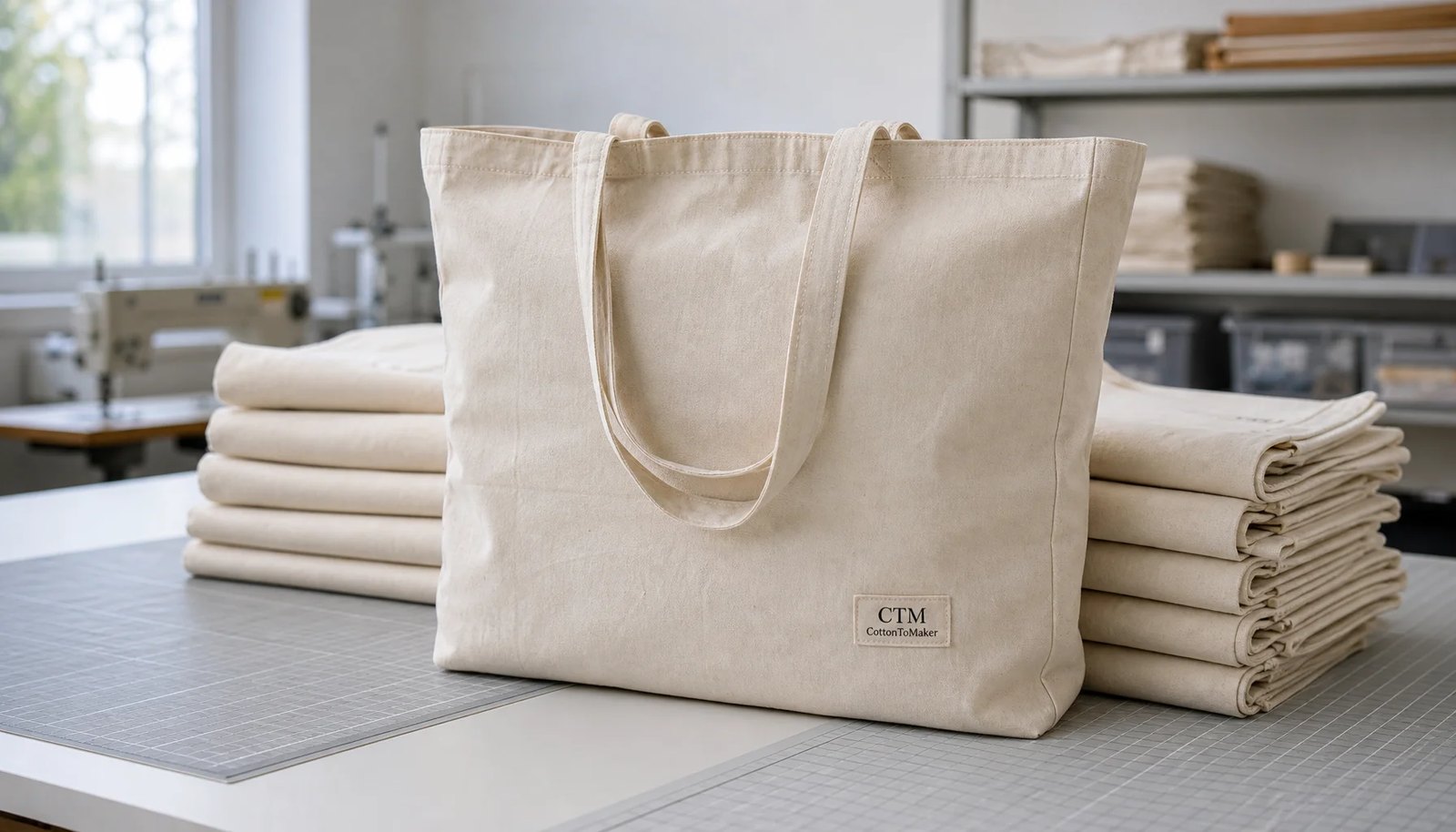
Why subscription-box totes need a different buying spec
Wholesale organic cotton totes for subscription boxes are not bought like a generic promotional bag. They sit inside a fixed box format, move through a repeatable fulfillment process, and are judged by the customer the moment the carton opens. That means the tote is doing three jobs at once: it has to be a packaging component, a branded item, and a logistics item. Those requirements pull in different directions, so the spec needs to be deliberate rather than broad.
The box program also changes how buyers should think about value. A tote that looks inexpensive on paper can still be the wrong choice if it wrinkles badly, arrives too soft to hold shape, or forces a larger carton. Conversely, a slightly heavier tote can still be the better option if it packs flat, prints cleanly, and creates a better unboxing result. Procurement should measure the bag against the subscription flow, not against a standalone promo order.
The most common mistake is treating the tote as a late-stage add-on after the box is already finalized. By then, the choices are constrained and the supplier is quoting against assumptions. Build the bag spec early enough that the tote, the carton, and the packing method are designed together. That is the difference between a clean first run and a launch held together by exceptions.
A procurement-ready tote spec should answer four basic questions before RFQ: what size it must be, how it will be printed, how it will be packed, and what quality standard makes it acceptable. If those are clear, the supplier can price with confidence and the buyer can compare quotes without decoding hidden assumptions.
- Use the tote as a designed component of the box, not as a loose branded giveaway.
- Prioritize box fit, foldability, and handling over unit price alone.
- Set the spec before sampling so the first quote is usable instead of approximate.
- Align procurement, fulfillment, and brand teams on the same finished bag requirements.
Start with a procurement spec the factory can actually quote
The fastest way to get comparable pricing is to send every supplier the same RFQ package. Include finished size, fabric composition, GSM, weave, finish, print method, artwork count, handle construction, packing method, target quantity, destination, and launch date. If one of those items is missing, the factory will fill in a default. That default may be sensible from their point of view, but it will make the quotes hard to compare.
For subscription-box programs, dimensions matter more than many buyers expect. A tote that is too wide can crowd the carton and a tote that is too tall can create an awkward fold or compress the box lid. Write the finished size in centimeters and state the reference point. If you need a flat-bottom tote or gusseted body, say so explicitly. Do not assume the factory will infer the intended shape from a photo or a brand reference image.
Handle length deserves the same treatment. A handle measured from stitch point to stitch point is not the same as a handle measured from the top edge. The difference can affect insertion, stacking, and the end-user’s carry comfort. When a buyer writes these points clearly, the factory can build the cutting pattern correctly and price the labor accurately.
A useful RFQ also includes the business rules. Ask the supplier to quote on one quantity, one artwork file, one shipping destination, one packaging method, and one Incoterm. That removes the noise that usually turns a sourcing comparison into a debate over what was or was not included.
- Specify finished size in centimeters and define the measurement method.
- State whether the tote is flat, gusseted, boxed, lined, or reinforced.
- Include the target shipper box dimensions if the tote must fit a fixed insert route.
- Use one RFQ version for every supplier so the pricing basis stays identical.
Fabric weight, weave, and finish are the main price drivers
Most buyers land in the 140-180 GSM range for organic cotton totes used in subscription programs. Around 140-150 GSM is usually enough for lighter inserts and lower freight pressure. Around 160 GSM is often the practical center point because it gives the bag a more substantial handfeel without creating unnecessary weight. Once you move into the upper end of the range, the fabric itself is not the only cost change. Sewing time, carton weight, and shipping cost all rise with it.
The weave and finish matter as much as the GSM number. A tight plain weave or a compact canvas generally prints more cleanly than a loose fabric, especially for small logos or simple line art. A calendered surface can improve print crispness, but it may also change feel and folding behavior. If the bag is meant to look soft and natural, a heavily finished surface can work against the product story. Ask the factory what finish they are quoting, because the finish affects both appearance and repeatability.
Construction choices can also shift the price. A bag with a flat bottom and reinforced handle anchors may cost more than a simpler tote, but it may perform better in fulfillment and end use. If the bag will be reused after the subscription delivery, the handle and seam design matter more than buyers sometimes expect. Weak handle anchoring is a small saving that can turn into a customer complaint later.
Do not accept a vague GSM reference. Ask whether the quoted number is finished fabric weight or raw fabric weight, and ask for a tolerance band. If the supplier cannot tell you what is being measured, the quote is not yet ready for award.
- Ask for the finished GSM, not just the mill specification.
- Request a written tolerance, such as +/- 5%, on fabric weight.
- Confirm whether the fabric is natural, bleached, enzyme-washed, or brushed.
- Verify seam allowance, stitch density, and handle reinforcement on the quote.
- If the bag must stand up inside the box, request a sample with the intended base structure.
Print method and artwork controls need tighter language than most RFQs use
For bulk subscription runs, one-color screen print is usually the most predictable option. It is straightforward to repeat, easy to inspect, and typically economical once the setup is complete. If the design is more detailed, a transfer print may preserve small elements better, but it tends to add sensitivity around curing, placement, and acceptance. The right answer depends on the artwork, the fabric texture, and the speed at which you need to replenish stock.
The commercial problem is not just print quality. It is quote structure. One supplier may quote a very low tote price and then add separate line items for each color, each screen, each sample, and each additional side of print. Another may present one all-in price but quietly quote a heavier fabric or a looser tolerance. To compare honestly, procurement has to isolate the setup cost, per-unit print cost, and any hidden assumptions around artwork complexity.
Artwork language should be as precise as the bag measurements. Specify the exact print size, number of colors, placement from the top edge and centerline, and whether the design can rotate slightly on natural cotton. Natural cotton is not a synthetic billboard surface. Some variation is normal. The job of the spec is to define how much variation is acceptable and where it becomes a defect.
Before mass approval, require a strike-off or pre-production print sample. That sample should show color, placement, density, and edge sharpness on the same fabric that will be used in production. If the supplier approves the art only from a digital file, the buyer is still guessing.
If your brand uses a specific tone, ask the supplier how they match color. A simple Pantone reference is often not enough unless the supplier confirms the matching method, the acceptable delta, and whether the substrate texture affects the final appearance. A natural cotton tote will not behave like coated paper, so the print expectation needs to reflect that.
- Request a strike-off before bulk approval.
- Set placement tolerance in millimeters, not in general terms.
- Ask whether curing, crocking, or wash performance is tested after printing.
- Separate setup charges from unit pricing so the quote stays comparable.
- Confirm whether the artwork is one-sided or two-sided and whether both sides are priced.
MOQ, price breaks, and a usable bulk pricing plan
MOQ for organic cotton totes is usually driven by fabric lot, sewing efficiency, print setup, and packing format. A factory may quote a low entry MOQ if you keep one size, one color, and one artwork. The moment the program splits into tiers, seasonal variants, or different insert sizes, the minimum can change quickly. That is not a problem by itself. The problem is discovering it after launch planning is already fixed.
For subscription boxes, MOQ should be planned as a replenishment cycle, not a single purchase event. A first run that is too large creates inventory and cash pressure. A first run that is too small creates repeat setup charges and a stockout risk. The best bulk pricing plan is built around launch quantity, reserve stock, and reorder timing, not just around the lowest unit price. Procurement should decide how often the bag will be replenished before asking for final quotes.
A practical way to compare offers is to ask for price breaks at 1,000, 3,000, 5,000, and 10,000 units if those levels are realistic for the program. Then test those prices against freight, duty, and warehouse storage. Sometimes the lower unit price is only attractive if you are willing to hold inventory for months. If the next price break creates excess stock, the quote is not truly better.
Also ask what drives the minimum. Is the MOQ based on fabric dye lot, screen setup, sewing line efficiency, carton count, or packaging labor? The answer matters because it shows whether the MOQ is structural or just a supplier preference. If the supplier can explain the reason, it is easier to negotiate a realistic replenishment model without putting pressure on quality.
- Separate launch volume from reorder volume.
- Ask for price breaks at realistic planning levels, not only at headline quantities.
- Check whether MOQ changes by color, artwork, size, or gusset depth.
- Ask the supplier to explain what makes the MOQ binding.
- Model inventory carrying cost before chasing a lower unit price.
Supplier route affects traceability, flexibility, and how cleanly you can reorder
A direct factory usually gives the buyer more control over sewing quality, fabric handling, and packing discipline. That is useful when the tote has to match a box insert route and the program is going to repeat. A trading company can be useful when the sourcing program includes several formats or when the buyer wants one commercial contact across multiple products. Neither route is automatically better. The question is which one gives the buyer the right level of traceability and control for the program being run.
The risk to manage is source drift. A quote can look attractive if the supplier is not fully explicit about which site is printing, which site is sewing, and who signs off the final inspection. If the actual production source changes between runs, the tote can drift in shade, texture, or construction. That is especially relevant for recurring subscription boxes where customers may compare one month’s insert with the next. Buyers should ask for the production chain in writing before award.
If you are buying organic cotton totes as an organic claim, do not rely on marketing language alone. Ask the supplier what certification scope covers the product and what transaction documents can accompany the shipment if needed. The details matter because a claim is only as strong as the documentation chain behind it. If the supplier cannot answer clearly, the issue should be resolved before the PO is issued.
Hybrid sourcing can work, but only when the actual production path is stable and documented. The buyer should know where the fabric comes from, where the tote is sewn, where it is printed, and who owns the final inspection result. That is the level of traceability that prevents confusion when the same tote is reordered later.
- Direct factory fits buyers who need tighter process control and repeatability.
- Trading company fits buyers who need broader coordination across products or markets.
- Ask for the actual production site, not only the commercial office address.
- Request a written traceability chain for fabric, printing, sewing, and final inspection.
- If the order is sold as organic, confirm the certification scope and document flow early.
Compare quotes on landed cost, not just on the factory price
The quote that matters is the one that lands in the warehouse in usable condition. For subscription-box totes, landed cost includes the tote price, print setup, packing materials, carton spec, inland freight, export or import charges, brokerage, and any expected sorting or relabeling cost. A low unit price can disappear quickly if the tote ships in oversized cartons, requires repacking, or comes with a high defect rate.
Build a simple comparison sheet with four cost buckets: product, packing, freight and duty, and quality loss. Quality loss is not a theoretical line item. If a batch needs inspection sorting because the handles are inconsistent or the logo is off-center, that labor belongs in the sourcing comparison. A slightly higher unit price from a more disciplined supplier may still win when the full landed cost is calculated.
The landed-cost view also has to account for warehouse flow. If the bag arrives flat-packed in a clean carton that is easy to scan and insert, the operational cost is lower than a cheaper bag that takes extra handling. This matters in subscription fulfillment, where labor efficiency is part of the margin model. A sourcing decision that saves a few cents at the factory but adds time in the warehouse is usually the wrong trade.
Use the same currency, same Incoterm, same quantity, and same delivery point when comparing quotes. If a supplier does not disclose carton dimensions and gross weight, ask for them. Those numbers drive freight, stacking, and warehouse fit, and they are often more important than the base bag price when the shipment scale increases.
- Normalize every quote to the same Incoterm and delivery location.
- Ask for carton dimensions, gross weight, and pack count alongside unit price.
- Add inspection/sorting cost to the comparison when quality risk is material.
- Treat warehouse handling time as a real cost in the buying decision.
- Do not compare ex-factory and delivered quotes as if they were the same number.
Packing and cartonization can make or break subscription fulfillment
Packing is where many tote programs become inefficient. A tote that folds cleanly into a standard carton can save freight and simplify warehouse handling. A tote packed too tightly can develop permanent creases, while a loose pack increases carton volume and wastes space. Subscription-box buyers should define the fold method before production starts so the tote arrives in the same orientation every time.
Be explicit about what is included in the packing quote. If the tote needs a barcode label, a size sticker, an insert card, or individual polybag protection, those details should appear on the quote line by line. Do not assume they are included. Factories often pack to the minimum requirement unless the buyer states otherwise. That can be fine for bulk storage, but not for a consumer-facing unboxing experience.
The packing method should also match the downstream warehouse process. If the tote is destined for direct-to-consumer fulfillment, make sure the carton count and fold orientation support fast picking. If the tote is inserted into a monthly box, the flat pack should be easy for the fulfillment team to grab without reopening the tote or restacking it. The best spec is one that a new line worker can follow without interpretation.
If moisture protection matters for long transit, spell it out. A simple bulk carton may be enough for some routes, while other lanes need additional protection. The point is not to over-package the product. The point is to make sure the tote arrives clean, flat, and ready for the box line without surprise rework.
- Define the fold direction and whether handles sit inside or outside the fold.
- Specify carton count, carton dimensions, and maximum carton weight.
- State whether individual polybags are required or not.
- List any barcode, size label, or insert card requirements explicitly.
- Align packing with the fulfillment workflow before bulk production begins.
Sampling, QC, and reorder controls should be written down before award
The sample stage should prove three things: the tote fits the box, the print looks right on the chosen fabric, and the sewing is stable enough for the intended use. A sample that is only visually approved is not enough. Measure the bag, check the handle length, inspect the print placement, and confirm the fabric feel against the approved reference. If the sample is not measured, production drift is likely to slip through unnoticed.
Use measurable QC thresholds. A workable starting point is finished dimensions within +/- 10 mm, with a tighter handle-length tolerance if the tote must fit a fixed insert route. Print placement should be stated in millimeters from the agreed references, not in vague approval language. Sewing defects should be defined in advance: skipped stitches, open seams, loose threads, and weak handle reinforcement should each have a clear pass/fail rule.
AQL is useful only if the buyer also defines the critical defects. A tote with the wrong size may be a major defect even if the stitching is fine. A tote with a crooked logo may be a major defect if brand presentation matters. A supplier should know that before production starts. Otherwise, the factory and the buyer will be using different definitions of acceptable quality.
For recurring programs, keep one sealed golden sample and one approved strike-off on file. That gives procurement a reference point for reorder checks, receiving inspections, and disputes. It also helps if the factory changes a fabric lot or adjusts a packing method later. Reorders are easier to control when the approved standard is visible, physical, and signed off.
If the tote will be reordered repeatedly, ask whether the supplier can reserve the approved fabric lot or commit to a matched-equivalent policy. That is one of the simplest ways to reduce shade drift between runs. Without it, the buyer may save time on the first order and lose it later trying to reconcile small but visible differences.
Use photo evidence from the first article sample if the program is sensitive to appearance. A measured sample with visible reference marks gives both sides a factual record. That is more useful than a subjective approval email that does not say what was actually checked.
- Approve the fabric swatch, printed strike-off, and pre-production sample separately.
- Measure size, handle length, and print placement before the bulk order is released.
- Define major and minor defects in the buying file.
- Keep a sealed golden sample for receiving inspections and future reorders.
- Ask whether the supplier can reserve the approved fabric lot or match it on repeat runs.
A practical RFQ workflow for cleaner bids and faster awards
A good RFQ removes ambiguity before price is discussed. Send one artwork file, one finished-size spec, one packing request, and one delivery destination to every supplier. Ask for separate pricing on product, print setup, packing, and freight assumptions if applicable. The goal is not to make the document long. The goal is to prevent hidden assumptions from hiding inside the unit price.
Include the commercial question that most buyers forget to ask: what changes the price? If a wider handle, a gusset change, a second print location, or an alternate carton size modifies the quote, have the supplier write that down. That makes the bid easier to compare and reduces the chance of variation charges after approval. If a supplier will not state the drivers, the risk sits with the buyer.
The best quote process is the one that gives procurement enough detail to challenge anomalies. If two quotes differ by more than expected, ask what is driving the gap. Sometimes the difference is legitimate and useful. Sometimes it is a missing print setup, a lighter fabric, a packaging omission, or an unrealistic MOQ. The RFQ should make those differences visible before the award.
A clean RFQ also names the contact points. The person managing samples, the person managing production, and the person managing shipping should all be identifiable. That sounds administrative, but it matters. Subscription-box launches move quickly, and a missing response on sample approval can ripple into packing and fulfillment dates.
- Use a single RFQ version for all suppliers.
- Ask for separate cost visibility on fabric, printing, sewing, packing, and freight assumptions.
- Require the supplier to name the price drivers for any spec change.
- Make the approval point and start-of-production trigger explicit.
- Keep a named contact for sampling, production, and shipping updates.
Specification comparison for buyers
| Spec decision | Recommended option | When it fits | Buyer risk to check |
|---|---|---|---|
| Fabric weight | 140-180 GSM finished organic cotton canvas or drill, with a typical working target around 160 GSM | Best for subscription boxes that need a durable handfeel without pushing freight too high | Confirm whether the quoted GSM is finished weight or raw fabric weight, and ask for an allowed tolerance such as +/- 5% |
| Weave and finish | Tight plain weave or canvas; calendered only if the print needs a smoother face | Good when you want cleaner print edges and consistent folding | Ask whether the fabric is natural, bleached, enzyme-washed, or brushed because each affects shade, shrinkage, and handfeel |
| Print method | 1-color screen print or 1-2 color transfer for repeatable bulk runs | Works well for simple logos, monthly drops, and stable carton quantities | Require a strike-off and define placement tolerance in millimeters, not vague approval language |
| Supplier route | Direct factory with in-house sewing and printing | Best when the buyer needs tighter control over GSM, stitching, and carton packing | Verify whether the factory outsources printing, embroidery, or sewing to another site |
| Supplier route | Trading company with documented factory source | Useful when the program includes several bag formats or region-specific delivery needs | Risk of spec drift if the actual factory changes by order; request source traceability in writing |
| MOQ strategy | MOQ by color, artwork version, and size, not one blended minimum | Works for subscription programs with one core design and planned seasonal refreshes | Low MOQ can hide high setup fees and weak price breaks |
| Packing method | Flat pack with a controlled fold and carton spec | Good for warehouse efficiency and keeping totes insertion-ready | Incorrect folding can create wrinkles and slow fulfillment |
| Lead time model | 7-10 days for sampling and 25-40 days for bulk after artwork and sample approval | Reasonable for planned launches and replenishment runs | Confirm what starts the clock: artwork signoff, fabric receipt, or deposit |
| QC control | AQL 2.5 major / 4.0 minor with measured size and placement tolerances | Appropriate for appearance-critical reusable goods | Without written tolerances, you may receive mixed handle lengths or skewed prints |
Buyer checklist before sampling
- Confirm finished size, gusset depth, handle length, and whether the tote needs a flat base, boxed corners, lining, or self-fabric reinforcement.
- Specify fabric composition, finished GSM, weave type, and finish, then ask whether the supplier can support an organic claim with the right certificate scope and transaction documents if needed.
- Lock logo size, Pantone references if applicable, print count, and placement tolerance before sampling.
- Define packing exactly: flat fold method, carton count, carton dimensions, inner pack count, polybag yes or no, barcode label, and insert card details.
- Ask for a fabric swatch, a printed strike-off, and a pre-production sample before bulk approval.
- Compare quotes on the same basis: same quantity, same Incoterm, same delivery location, same artwork, and same packaging.
- Require a QC plan that states size tolerance, print placement tolerance, seam defect limits, and the acceptance standard used for inspection.
- Ask whether the factory can reserve the approved fabric lot or source a matched equivalent for reorder consistency.
- Request the exact lead time split for sampling, production, inspection, and transit so launch dates are realistic.
- Keep one signed golden sample on file for reorder checks and dispute resolution.
Factory quote questions to send
- What is the exact fiber content, fabric construction, and finished GSM, and can you confirm whether the GSM is measured on finished fabric or raw fabric?
- Do you have the relevant organic certification scope for this product, and if the order is sold as organic, what documentation can you provide with shipment?
- What are the finished dimensions, seam allowance, handle width, handle length, and gusset depth in centimeters?
- Is the quoted price for one-side print or two-side print, and what setup charge applies per color, screen, or transfer plate?
- What placement tolerance do you hold for the logo from the top edge and centerline, and how do you measure it on the production line?
- What sewing construction is included: side seam type, bottom seam type, top hem width, handle reinforcement, and bar tack length?
- What stitch density do you use on load-bearing seams, and do you have a standard for loose threads and skipped stitches?
- What packing is included in the quote: flat fold, bulk carton, individual polybag, size sticker, barcode label, or insert card?
- What are the MOQ and price breaks per color, artwork version, and size, and how do those change if we add a gusset or change the handle length?
- What are the sample lead time, bulk lead time, and the exact approval point that starts mass production?
Quality-control points to confirm
- Fabric weight stays within the agreed range, typically +/- 5% of the approved GSM, with no thin patches, holes, or obvious weave breaks in the body panel.
- Finished size stays within agreed tolerance, such as +/- 10 mm on width and height and a tighter tolerance on handle length if the bag must fit a box insert route.
- Handle length, symmetry, and reinforcement are consistent across the batch, with left and right handles measured against the same reference point.
- Print position stays within the approved placement tolerance, such as +/- 5 mm from the centerline or top edge, and the logo is not visibly skewed.
- Print density, edge sharpness, and color match the approved strike-off within the defined range for natural cotton variability.
- Side seams, bottom seams, and handle attachment points show no skipped stitches, open seams, or excessive loose threads, and loose ends are trimmed.
- Cartons are strong enough for stacking and transit, with a carton spec that matches the bag count and prevents crushing or excessive carton bulge.
- Labels, barcodes, and country-of-origin markings match the purchase order, artwork file, and compliance request.
- Random sample inspection follows the agreed AQL or equivalent defect threshold, and the supplier records the inspection lot and result.
- A sealed golden sample is kept for receiving inspection, reorder checks, and dispute resolution.