1. Why tote RFQs fail when they are written too loosely
A poor RFQ invites inconsistent quotes. If the request only says “organic cotton tote with logo,” each supplier can assume a different fabric weight, construction, print method, packing format, and documentation level. The result is a set of prices that look comparable but are actually based on different products. For procurement, that is the fastest way to waste time on clarifications and sampling loops.
Eco apparel brands need the tote to do more than carry items. It may be sold as a retail accessory, bundled with garments, used as a carrier at pop-ups, or added to wholesale orders as a branded insert. That means the RFQ should cover both appearance and function. A tote that looks acceptable in a photo can still fail on handle strength, print clarity, carton presentation, or retail compliance.
The strongest RFQs separate must-have requirements from optional preferences. If organic documentation is mandatory, say so. If a specific handle stitch is preferred but not required, say that too. This helps suppliers quote with fewer assumptions and gives buyers a cleaner basis for comparison. It also reduces the back-and-forth that usually appears after the first round of quotes.
A good RFQ is not long for the sake of being long. It is long enough to eliminate guesswork. That means clear measurements, material detail, artwork files, packing instructions, and quote assumptions in one place. When these basics are missing, the buyer ends up comparing samples instead of comparing quotes.
- Do not request only a product name; request a production specification.
- Mark each line item as required, preferred, or optional.
- Keep the RFQ version-controlled so every supplier quotes the same brief.
- Include documentation, packing, and sample expectations in the first request.
2. Start with use case, sales channel, and order pattern
Before you ask for pricing, define how the tote will be used. A tote sold at retail has different expectations from a tote used in wholesale packaging or event merchandising. Retail resale usually needs a cleaner finish, more stable shape, and better print appearance. Packaging use may prioritize low cubic volume and clean handling. Event use may favor cost control and quick replenishment.
The channel matters too. If the tote ships to a distributor or retailer, carton marks, barcode placement, and consistent fold style become important. If it will be shipped with apparel orders, you may need a flatter fold, less lint, and a packing method that does not crush garments. If it is a seasonal launch item, the supplier may need a short lead time but a more flexible MOQ. If it is a repeat SKU, you should care more about stability and reorder consistency.
This is where a buyer can prevent expensive mismatch. A supplier can usually make a tote look good, but not every tote is suitable for every channel. A soft, light canvas may be fine for a promo item but too flimsy for retail resale. A premium heavy canvas may be great on shelf but too costly for pack-in programs. The RFQ should say which trade-off matters most.
Keep the use case short and practical. One paragraph is enough if it includes the selling channel, expected contents, desired feel, repeat or one-time order pattern, and the launch window. That context helps suppliers recommend realistic adjustments without rewriting the product for you.
- Define the channel: retail resale, wholesale packaging, event merch, or customer gift.
- State the tote contents or expected load: folded apparel, books, notebooks, or light accessories.
- Say whether this is a launch buy, seasonal order, or repeat replenishment SKU.
- Tell suppliers if presentation, price, or durability is the top priority.
3. Specify the fabric and organic claim without ambiguity
Fabric is the biggest driver of tote value and one of the easiest places for quotes to drift. Organic cotton canvas and organic cotton twill are not interchangeable. Canvas is usually the better fit when the brand wants structure and a familiar retail look. Twill can feel softer and drape differently. If the RFQ only says cotton, the supplier may choose the lowest-cost option that still fits the words on the page.
Weight should be stated in GSM or ounces, with a range if you can accept one. For many eco apparel retail programs, 10–12 oz, roughly 340–410 GSM, is a practical starting point for a bag that feels credible without becoming too heavy or expensive. Lighter cloth can work for lighter-duty uses, while heavier cloth can justify a premium position. The point is not to choose the heaviest bag; it is to match the bag to the brand and the channel.
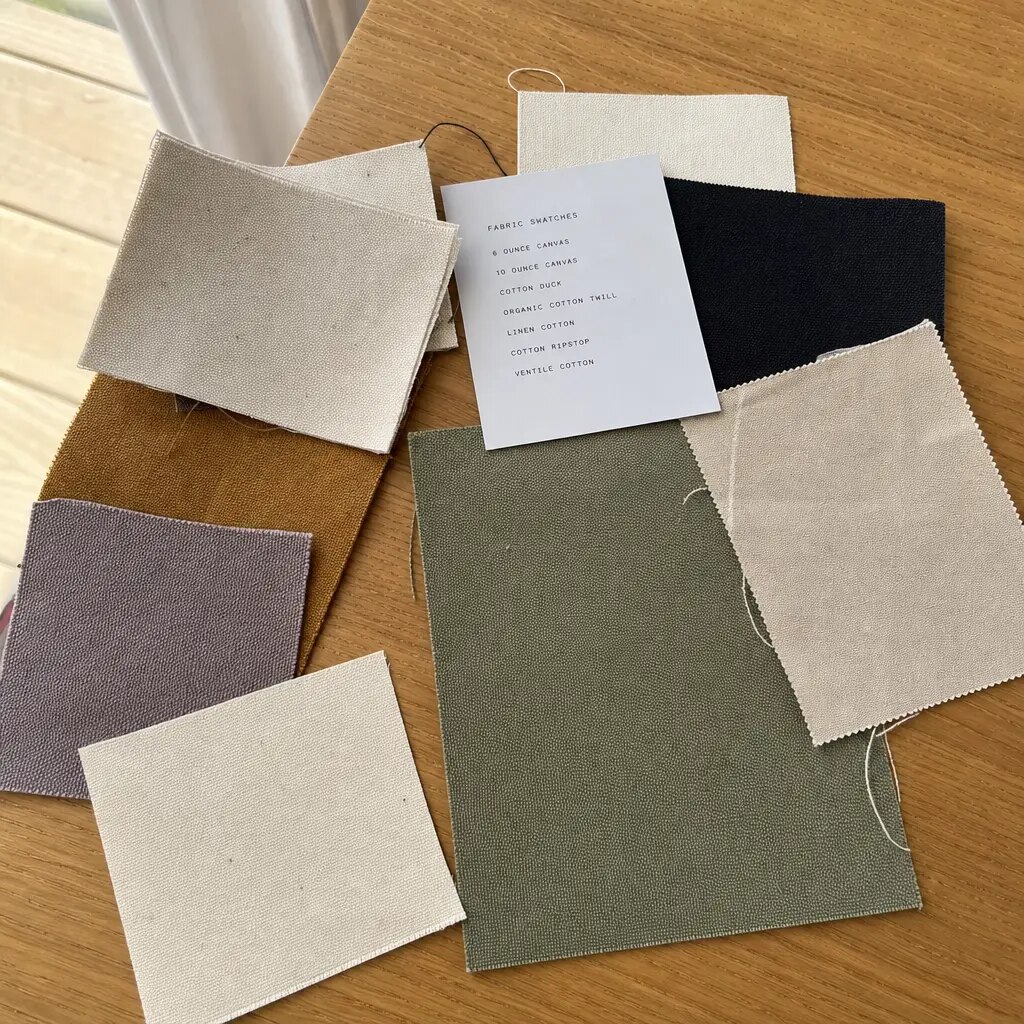
Color route needs the same clarity. Natural unbleached fabric is often the simplest option because it avoids additional dye development. Dyed fabric adds color approval, shade consistency control, and sometimes MOQ by color. If the tote needs black, navy, olive, or another branded color, ask whether the fabric is piece-dyed, yarn-dyed, or another route, and require lab dips or swatches before bulk approval.
If the word organic appears in customer-facing copy, make the documentation request explicit. Different buyers and channels may need different records, so the RFQ should ask what the supplier can provide and whether those records are part of the quote. Do not leave that assumption until after sample approval, when switching mills or paperwork can become expensive.
- State fabric as organic cotton canvas or organic cotton twill, not only “cotton.”
- Use GSM or oz and say whether the weight is pre-finish or finished.
- For dyed programs, require lab dip or swatch approval before bulk fabric is ordered.
- Ask what organic documentation is available and whether it is included in the price.
- Note whether you accept natural, bleached, or dyed fabric only.
4. Lock the dimensions, construction, and carry performance
A tote should be defined by finished size, not by an idea of size. The RFQ should give width, height, gusset depth, handle drop or total handle length, and an acceptable tolerance for each. That protects you from quotes that silently change the bag size to reduce cost. It also gives sampling and inspection teams a clear reference later in the program.
Construction detail is where durability is won or lost. Flat totes are simple and cost efficient. Bottom-gusset totes give more volume and are better for apparel, shoes, or thicker folded items. Side gussets can improve capacity, but they require tighter sewing control. The RFQ should state the body style, seam allowance target, stitch density, and whether bottom reinforcement is required. If you care about load, name it.
Handles deserve special attention because they drive how the tote actually feels in use. Specify strap width, attachment method, and reinforcement such as bar tacks or X-stitching. If the tote will be carried over the shoulder, the handle drop must work with a coat or folded garment inside. A handle that looks fine on paper but twists in packing or feels too short on body will become a complaint later.
Finished size and load expectations should be tied together. If the tote is meant to carry folded apparel for retail or wholesale use, a short practical load check is more useful than a vague “strong enough” note. Ask the factory how it tests handles and seams, and mirror that in the RFQ so their sample and bulk output can be judged against the same standard.
- Use finished size with tolerance, not cut size.
- Define flat, bottom-gusset, or side-gusset construction.
- Specify handle length or drop, strap width, and reinforcement method.
- State seam allowance, stitch density target, and any bottom reinforcement.
- Tie approval to the tote’s real load use.
5. Control print, labels, and trim costs before the quote is accepted
Decoration can make one quote look cheaper than another when the real cost is simply being hidden elsewhere. For simple logos and clean artwork, screen print is often the most practical option because it scales well for bulk and is predictable once the screens are made. But the RFQ should state the number of colors, the print size, the print area, and the placement distance from edges and seams. That keeps the supplier from quoting against a looser version of your artwork.
If the artwork is more complex, you may need another method, but it should be a deliberate choice. Digital print, transfer, or embroidery can make sense in some cases, yet each changes cost, lead time, and hand-feel. Fine lines can soften on textured canvas. Transfers can feel different after folding. Embroidery adds texture but can distort lighter fabrics. Buyers should ask the supplier to quote the chosen method and explain any setup charges clearly, rather than letting the factory decide later.
Labels and trims need the same treatment. A woven label, care label, hangtag, barcode sticker, paper band, or retail insert may look small, but each one affects price, labor, and inspection. List them separately and define size, artwork, material, and placement. If the barcode must scan at receiving, that requirement belongs in the RFQ and in the QC plan, not just in warehouse instructions after production.
The easiest way to prevent surprises is to ask for a quote that separates base tote cost, print setup, recurring print cost, trim cost, and packing cost. Once those lines are visible, procurement can see where the real cost is coming from and decide whether a simpler version is worth the savings.
- Provide vector artwork, color references, print size, and placement in the RFQ.
- Ask whether screen setup, artwork setup, or strike-off charges are included.
- List every trim as a separate line item.
- Confirm whether each logo version or trim version creates a separate MOQ.
- Specify where barcode labels and retail labels must be placed.
6. Build MOQ and pricing logic that procurement can actually compare
MOQ is usually tied to real production constraints, not just supplier preference. Fabric purchasing, dye lot size, cutting efficiency, screen setup, label sourcing, and packing labor all influence the minimum order. If the buyer asks for a very low MOQ, the supplier may still accept it, but the unit price may rise or the scope may narrow. The RFQ should make those trade-offs visible rather than hidden.
Ask for MOQ by the variables that move cost: fabric color, fabric weight, print artwork, size, label version, and packing version. If one tote comes in three colors with two print versions, the supplier should not be allowed to quote that as one flat number without explaining where the extra cost sits. The buyer needs to know whether mixed colors can share the same base material order and where a new setup fee starts.
Price breaks matter more than buyers sometimes admit. Ask for at least three numbers: a launch quantity, your target quantity, and a reorder quantity. That gives procurement a better sense of how price changes with scale. A slightly higher launch order may be worth it if the per-unit cost drops enough, but you can only see that if the supplier quotes structured quantities instead of one line item.
Low MOQ is not bad when it is intentional. It can make sense for a first drop, an event program, or a limited seasonal test. The key is to understand whether the supplier is using stock fabric, simplified packing, or extra setup fees to make the number work. If that is acceptable, fine. If not, the RFQ should require the supplier to disclose it.
- Request MOQ by color, artwork, size, label version, and packing version.
- Ask for launch, target, and reorder price breaks.
- Separate setup costs from recurring unit price.
- Check whether low MOQ depends on stock fabric or simplified packing.
- Keep the same incoterm and freight assumption across all bids.
7. Compare supplier quotes on total value, not just the lowest unit price
A lower unit price does not always mean a better quote. One supplier may omit screens, packing materials, or documentation; another may include them. One may quote a lighter fabric weight than requested; another may price the exact spec. For a buyer, the real comparison is landed, sellable cost, not just ex-factory price. That is especially true when the tote is part of an apparel brand’s customer-facing experience.
A simple scorecard helps procurement stay objective. Score each quote against fabric accuracy, construction detail, print capability, organic documentation, packing clarity, lead time, communication quality, and cost transparency. This is not about choosing the most expensive supplier. It is about knowing why one quote is cheaper and whether that difference comes from an acceptable trade-off or a hidden assumption.
Supplier route also matters. A factory-direct quote can be easier to manage if sewing, printing, and packing are in one controlled flow. A trading route can work well if the seller is honest about where production happens and how quality is controlled. The buyer should ask what is in-house and what is subcontracted, because that affects lead time, accountability, and sample consistency.
Make sure every supplier quotes from the same RFQ version. If one supplier sees revised artwork or revised packing instructions and another does not, the comparison is no longer clean. Keep the RFQ date, version number, and any clarifications in writing so the final PO matches the approved quote basis.
- Compare fabric, construction, print, documentation, packing, lead time, and cost transparency together.
- Ask each supplier to disclose in-house versus subcontracted work.
- Use one RFQ version for every quote.
- Flag exclusions clearly: screens, samples, labels, cartons, testing, freight, or duties.
- Judge the quote on landed sellable value, not the lowest number alone.
8. Use a sample sequence that locks the product before bulk production
A sample should do more than look good. It should lock the spec. For wholesale organic cotton totes, the approval path is usually safer when it starts with fabric or color confirmation, moves to a blank construction sample, then a printed sample, and ends with a pre-production sample as the final reference. If the tote is dyed, approve the color first. If the tote is natural and standard, you may move faster, but the sample still needs to match the quoted spec.
The blank sample should confirm the bag shape, finished dimensions, handle length, seam finish, and hand-feel. The printed sample should confirm artwork placement, ink density, edge sharpness, and overall appearance on actual canvas. The pre-production sample should match the final packing method and include all agreed trims. If the supplier wants to change a label, handle width, or carton count after that point, the change should be written down and re-approved.
Measurement records matter. Photograph the sample flat with marked points for width, height, gusset, handle drop, and print location. Keep the photos with the approved sample. That makes later inspection easier because there is no debate about what was accepted. It also gives the factory a fixed reference when bulk production begins.
Do not assume the sample room represents bulk quality automatically. Sample makers often work more carefully than production lines. The written sample approval should therefore include tolerances, accepted variations, and any non-negotiable points such as print placement or label location. That prevents a sample from being treated as inspiration instead of a binding reference.
- Approve fabric or lab dip first when color consistency matters.
- Use a blank sample to lock construction and size.
- Use a printed sample to approve artwork and print method.
- Seal the pre-production sample as the golden reference.
- Treat any post-approval change as a formal revision.
9. Write QC checks into the RFQ before the order is released
Quality control should be planned before production starts, not after cartons arrive. The RFQ should tell the supplier exactly what will be checked and what defects matter. That includes fabric quality, sewing quality, decoration quality, trim accuracy, and packing accuracy. If those expectations are not written down, the supplier may rely on a generic internal standard that does not match your retail or wholesale requirements.
On the material side, check weight, weave, color route, surface cleanliness, odor, and visible defects. On the sewing side, focus on handle attachment, bar tacks or X-stitching, seam straightness, skipped stitches, loose threads, and seam allowance at stress points. On the decoration side, inspect print placement, color density, registration, curing, and rub resistance after folding. For dyed goods, compare the bulk output with the approved swatch under consistent lighting.
A practical load check is useful if the tote is meant for apparel or retail carry. The exact weight depends on the use case, but the test should mirror real use rather than an abstract strength claim. The QC plan should also include barcode readability, label placement, carton marks, and packing count. Those details are often treated as logistics, but they are also quality issues because a mislabeled carton or unreadable barcode creates receiving delays and chargebacks.
The best QC language is short and measurable. It should tell the factory what to inspect, what tolerance applies, and what happens if a lot fails. That reduces interpretation later and helps your inspection team compare bulk goods against the approved sample instead of against memory.
- Include fabric, sewing, print, trim, and packing checks in the RFQ.
- Define tolerances for size, print placement, and label placement.
- Use a load check that reflects actual use.
- Check barcode readability and carton marks as quality items.
- Keep inspection photos with the approved sample for reference.
10. Cover packing, carton planning, and shipping assumptions in the quote
Packing changes both freight cost and receiving behavior. The same tote can be bulk packed, inner packed, or individually packed depending on the buyer’s needs. Bulk packing is usually the leanest option for wholesale and distribution. Individual packing may be needed for retail presentation or clean e-commerce handling. The RFQ should state which format is acceptable and what materials are allowed, especially if the brand is trying to reduce plastic use.
Carton planning should be part of the quote, not an afterthought. Ask for pieces per carton, carton dimensions, gross weight, net weight, and master carton marks. These numbers affect freight estimates, warehouse handling, and how quickly goods can be received. For bulky canvas totes, carton cube can matter as much as unit price. A cheap tote that ships inefficiently may be more expensive than a slightly higher-priced tote packed better.
If the tote is going to retailers or distribution centers, the quote should also address barcode placement, SKU labeling, and routing instructions. If there are special carton mark requirements, those need to appear in the RFQ. Late changes to packaging are expensive because they can require relabeling, re-folding, or re-cartoning after production is already complete.
The buyer’s goal is simple: quote the tote in a way that matches the actual receiving process. If the supplier knows the final packing and shipping assumptions from the beginning, the quote is more accurate and the order is less likely to drift between approval and shipment.
- State whether bulk, inner packed, or individual packed is acceptable.
- Ask for carton size, gross weight, net weight, and pieces per carton.
- Define barcode placement, SKU labels, and carton marks in advance.
- Align packing with sustainability goals and warehouse requirements.
- Confirm freight assumptions and incoterm before comparing landed cost.
Specification comparison for buyers
| RFQ field | Good buyer-facing spec | Why it matters in the quote | Risk to verify before PO |
|---|---|---|---|
| Fabric weight | 10–12 oz / 340–410 GSM organic cotton canvas for most retail totes; heavier only when the brand wants a firmer premium hand-feel | Directly affects cost, structure, print performance, and carton weight | Confirm whether the supplier quoted finished fabric weight or greige/pre-finish weight |
| Finished size and tolerance | State width, height, gusset depth, handle drop, and an acceptable tolerance for each | Prevents one supplier quoting a larger or smaller bag than another | Ask for a measurement sheet and a pre-production sample with marked dimensions |
| Body construction | Flat tote or bottom-gusset tote with reinforced side seams and handle stress points | Impacts load capacity, use case, sewing time, and fabric usage | Check whether seam reinforcement and bottom reinforcement are included or optional |
| Handle spec | Handle width, total length or drop, stitch pattern, and reinforcement method | A weak or short handle is one of the most common return causes | Verify the quoted handle length against the intended carry style |
| Print method | 1–2 color screen print for simple logos; other methods only when artwork requires them | Changes setup cost, hand-feel, durability, and lead time | Ask what setup, screen, or artwork charges are included |
| Organic documentation | State whether you need fabric traceability, certificate copies, testing reports, or channel-specific records | Keeps the organic claim aligned with your retail or compliance needs | Confirm which documents are available before approving the order |
| MOQ structure | Quote MOQ by fabric color, print version, size, and packing version | Avoids hidden cost when one design change forces a new batch | Ask for price breaks at launch, test, and reorder quantities |
| Packing format | Bulk packed, inner packed, or individual packed; define carton count and barcode location | Packing can change freight cost, warehouse handling, and retail readiness | Check carton dimensions, gross weight, and master carton marks |
| Lead time and trade term | State production lead time, sample lead time, incoterm, and freight assumption | Makes quotes comparable and prevents false landed-cost comparisons | Verify whether the quote is ex-works, FOB, or includes local handling |
Buyer checklist before sampling
- Define the tote by finished dimensions, not by a vague product name; include width, height, gusset depth, handle drop, and tolerance.
- Specify the fabric as organic cotton canvas or organic cotton twill, with GSM or oz and whether the weight is before or after finishing.
- State whether your channel needs organic traceability documents, certificate copies, or testing records, and make that a quote requirement.
- Describe the bag construction clearly: flat or gusseted body, seam allowance target, stitch density, bottom reinforcement, and handle reinforcement.
- Provide artwork as vector files when possible and define print method, print size, color references, placement, and placement tolerance.
- List every trim separately: woven label, care label, hangtag, barcode sticker, swing tag, paper band, or inner pack label.
- Ask suppliers to quote MOQ by size, color, print version, label version, and packing version so you can see what changes the price.
- Request at least three price points: launch quantity, target quantity, and reorder quantity.
- Set sample stages in order: fabric swatch or lab dip, blank construction sample, printed sample, and final pre-production sample.
- Define packing and carton details in the RFQ: fold method, inner pack, pieces per carton, carton size, carton weight, and master carton marks.
Factory quote questions to send
- What exact finished dimensions are included in your quotation, and what tolerance do you apply for width, height, gusset, and handle drop?
- Is the fabric organic cotton canvas, organic cotton twill, or another weave, and what GSM/oz is quoted after finishing?
- Is the fabric natural, bleached, dyed, or piece-dyed, and what shade approval step is included before bulk?
- What documentation can you provide for the organic cotton claim, and is it included in the quoted price or charged separately?
- What print method is assumed, how many colors are included, and what setup or screen charge applies per artwork version?
- What artwork file format do you require, what is the printable area, and what placement tolerance do you hold in production?
- Are handle reinforcement, bar tacks, X-stitching, and bottom seam reinforcement included in the standard quote?
- What is the MOQ by fabric color, print version, size, and label version, and how does the unit price change at lower or higher volume?
- Are labels, hangtags, barcode stickers, retail cards, or inner pack labels included in the base price or quoted separately?
- What packing method is assumed, including folding style, inner pack or polybag, carton quantity, carton dimensions, and carton marks?
Quality-control points to confirm
- Measure the finished tote flat and unstretched: width, height, gusset depth, handle drop, handle width, and print placement should match the approved sheet.
- Check fabric against the agreed weight, weave, color route, and hand-feel; confirm the supplier’s fabric record matches the quote.
- Inspect for stains, oil spots, heavy slubs, holes, lint, odor, and visible contamination before printing or packing.
- Verify handle attachment, bar tacks or X-stitch location, stitch density, backstitching, seam allowance, and loose threads at stress points.
- Run a practical load test based on the tote’s actual use, such as folded apparel or retail carry, and check for handle stretch or seam pop.
- Inspect print registration, color density, edge sharpness, curing, and rub resistance after folding.
- For dyed fabric, compare bulk panels, handles, and labels to the approved lab dip or swatch under consistent light.
- Check label content, label placement, barcode readability, SKU accuracy, and any retailer-compliance text.
- Verify folding method, inner pack count, carton quantity, carton dimensions, gross weight, and carton strength before shipment release.
- Reconcile the packed carton count, packing list, and master carton marks against the PO before final approval.