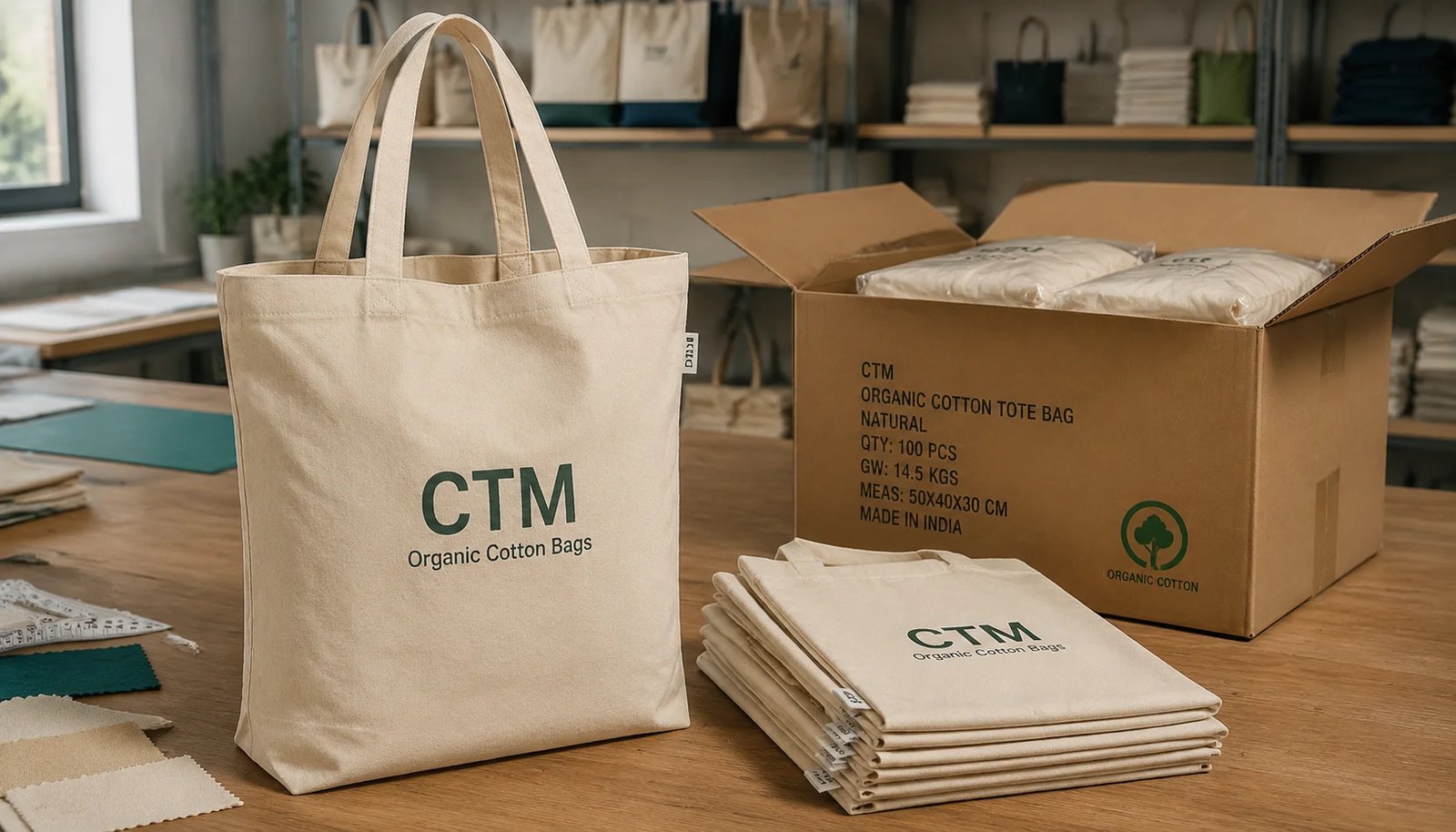
Start with the buying use case
A natural grocer does not buy organic cotton totes for one reason only. The same bag category can be a low-cost event giveaway, a paid reusable checkout bag, a produce program accessory, a loyalty gift, or a year-round branded item. Each use case changes the right GSM, handle length, print method, carton count, and quality threshold. Procurement should define that use before asking suppliers for pricing, because otherwise every factory fills the gaps with its own assumptions.
For a paid reusable bag, the buyer usually needs a more substantial hand feel, cleaner print registration, and more consistent folding because the item may sit near checkout or on a retail display. For a free giveaway, the buyer may accept a lighter fabric and simpler bulk pack if count accuracy and print readability are good. For a distribution-center program, carton marks and bundle counts can matter as much as the tote itself because the bags may be split across stores or regions. The RFQ should tell suppliers the commercial role of the bag, not just the size and logo.
This is also where the keyword-level idea of a carton packing plan becomes practical. The carton plan is not just shipping data entered after production. It should be part of the product brief because it affects folding, print cure, inner bundle size, handling weight, allocation accuracy, and freight cube.
- Define whether the tote is for resale, giveaway, store operations, produce, or loyalty before setting GSM.
- Connect the use case to inspection priorities: paid retail needs better visual consistency; high-volume promo needs count accuracy and durable seams.
- Ask suppliers to quote the product and packing together so the FOB price is tied to measurable logistics assumptions.
Build the base tote spec around real grocery loads
The most useful starting range for reusable grocery totes is often 8 oz to 10 oz organic cotton canvas, roughly 270 to 340 GSM. That range is not a universal requirement, but it gives procurement teams a sensible RFQ baseline. It has more body than light promotional cotton while still folding efficiently for export cartons. If the tote will be sold at checkout or expected to carry jars, bottles, produce, and boxed goods, buyers should be careful about going too light. If the order is mainly for a short event, a lighter option may be acceptable, but it should be compared honestly on feel and durability.
Size should be specified as a finished dimension, not as a general description. A flat 15 x 16 inch tote is easy to source and pack. A 15 x 16 inch tote with a 3 to 4 inch gusset carries groceries better, but the folded unit becomes bulkier and carton density drops. A smaller 13 x 15 x 4 inch bag may work for checkout or specialty categories where full grocery capacity is not required. Buyers should request samples in the actual intended size because a one-inch change can affect both shopper usefulness and carton math.
Handle construction deserves the same detail. A shoulder-friendly grocery tote commonly uses a 24 to 26 inch total handle length, often creating about a 10 to 12 inch drop depending on attachment point. The handle width, reinforcement pattern, stitch density, and handle-root placement should be written into the spec so every supplier quotes the same labor and material.
- Use finished dimensions: width, height, gusset, handle width, handle length, and handle drop.
- Treat gusset depth as both a product-value decision and a carton-volume decision.
- Ask for the actual fabric standard, because some suppliers use the word canvas for fabric that feels too light for grocery use.
Make organic-claim comparability explicit
Organic cotton is not a complete sourcing specification by itself. One supplier may quote certified organic fabric from a known fabric source. Another may quote cotton described as organic without including finished-product handling, transaction documentation, or label support. A third may assume the buyer will nominate and supply the fabric. Those quotes are not commercially comparable even if the price column looks similar. Procurement should state what the organic claim must support and what documents must travel with the order.
The buyer also needs to decide whether the tote will make a consumer-facing organic claim on a hangtag, printed label, woven label, invoice, or product page. If the claim is only an internal purchasing preference, the documentation requirement may be different from a retail claim. The factory should not be left to decide this. The RFQ should ask what certification scope is included, which party holds it, what transaction evidence is available, and whether the cutting, sewing, packing, and labeling steps are covered or excluded.
This is not about asking every tote program to carry the same certification structure. It is about comparability. A lower quote that excludes required documentation can become unusable if the buyer later discovers the claim cannot be supported. For natural grocers, where shoppers may scrutinize sustainability language, the safest approach is to keep the wording conservative and the documentation clear.
- State whether the requirement is certified organic fabric, certified finished handling, or buyer-supplied organic material.
- Ask which documents are included before comparing price.
- Do not approve printed organic wording until the claim basis and label responsibility are confirmed.
Choose print method before approving carton density
Water-based screen printing is usually the practical first choice for high-volume organic cotton totes with one to three solid colors. It gives a softer, matte hand feel on natural fabric and works well for natural grocer logos, checkout messages, and simple produce or sustainability graphics. It is also generally easier to cost at scale than digital print when artwork is simple. The buyer should still provide actual artwork size, color targets, position, and coverage area because these details change print setup, drying time, and defect risk.
Print method and carton packing are connected. A large solid print area may need more curing and resting time before folding. If printed bags are packed too soon, ink offset, surface tack, or fold marking can appear inside the carton. Fine lines, small type, and tight registration should be discussed before sampling, especially on textured cotton canvas where the surface is not as smooth as paper or coated synthetic fabric. The approved strike-off should use the real fabric, not only a digital mockup.
For procurement comparison, each quote should name the print route, included color count, maximum print size, and any surcharge for large coverage. If one supplier prices a small one-color chest logo while another prices a large front-panel print, the unit prices should not be compared as equal offers. The same issue applies to side labels, woven labels, hangtags, and barcode stickers. Each added branding element affects labor, inspection, and packing separation.
- Best baseline: one to three color water-based screen print on actual organic cotton canvas.
- Require a print strike-off before production and compare it under normal store lighting if color matters.
- Ask how long printed totes rest before folding when artwork has heavy coverage.
Structure MOQ around production drivers
MOQ problems usually appear when a buyer wants several regional logos, seasonal messages, or store-group variants under one program. The total order might be large, but the factory still has to manage fabric booking, cutting spreads, print setup, sewing flow, label separation, carton marks, and final packing by SKU. If each variant changes several of those drivers, the order becomes less efficient even when the finished tote looks simple.
The cleanest MOQ structure is one base tote with controlled artwork variation. That means one fabric color, one GSM, one size, one handle spec, one print method, one folding method, and multiple logo versions where practical. Four one-color artwork versions on the same ecru bag can be much easier to quote than two versions that use different dyed fabrics, different labels, and different carton marks. Procurement should ask the supplier to break MOQ by driver so the team can see what is truly causing the minimum.
This also helps avoid overbuying slow variants. If a natural grocer wants smaller local-market messages, the buyer can ask whether those variants can share fabric and sewing runs while carrying separate screen charges and carton marks. The answer may still depend on factory capacity and artwork complexity, but it gives the buyer a real operating model instead of a single vague MOQ number.
- Keep the base bag constant where possible: fabric, size, handle, fold, and carton count.
- Separate true production MOQ from print setup charges and carton-mark separation.
- Use the quote sheet to show MOQ by fabric lot, colorway, artwork, label, barcode, and packing route.
Approve samples that prove the carton plan
A good-looking tote sample does not prove that the order will pack well. Procurement should approve the product and the packing as separate sample steps. The product sample confirms fabric, dimensions, handle construction, sewing, and print appearance. The folded packing sample confirms how the tote is folded, how many units fit in each inner bundle, whether the print is protected, and whether the master carton dimensions are realistic.
This matters because grocery totes can fail commercially after they pass visual product approval. Handles may protrude against carton corners. Fold lines may run through the logo. Top layers may collect dust if no liner is used. A carton may fit 200 pieces in theory but become too heavy or too compressed for manual handling. These are not abstract risks; they are the types of details that create receiving complaints, repacking labor, or store-level dissatisfaction.
The sample path can stay simple. Request a fabric swatch or standard, a print strike-off on actual fabric, one pre-production bag, and one folded packing sample. For larger programs, ask for a mini carton or a photographed pack-out with dimensions, inner bundle count, and gross weight estimate. The buyer should sign off on the folding direction and carton marks just as clearly as the artwork.
- Approve fabric, print, finished bag, and folded pack as separate checkpoints.
- Do not accept carton quantity without seeing the fold method and bundle count.
- Keep a signed sample or photo standard for fold direction, logo protection, and carton mark layout.
Plan carton count, dimensions, and bundle logic together
Carton planning should balance four variables: pieces per carton, carton size, gross weight, and product protection. A dense carton is not automatically better. If the carton becomes difficult to lift, bulges at the seams, crushes handles, or rubs the print, the higher count may cost more after arrival. As a starting range, many organic cotton tote programs model 100 to 200 pieces per master carton, but the correct count depends on GSM, tote size, gusset, fold, individual packing, and carton board strength.
Carton length around 55 to 60 cm and gross weight around 14 to 16 kg are often practical planning targets for manual handling, but they should be treated as buyer-side limits to confirm, not universal rules. Some warehouses accept heavier cartons; some retail back rooms prefer smaller cartons; some carrier or pallet plans require different dimensions. The point is to write the handling target into the RFQ so suppliers do not quote an efficient-looking carton that fails your warehouse process.
Inner bundle counts help receiving teams. Bundles of 25 or 50 pieces are easy to count and split, especially when cartons are opened for store allocation. If the order includes several artwork versions, the carton should not mix SKUs unless the buyer has approved a clear mixed-carton plan. Outer marks should identify PO, SKU, item description, fabric color, artwork version, quantity, country of origin, carton number, and allocation code if needed.
- Quote carton plan as: pieces per carton, carton dimensions, net weight, gross weight, inner bundle count, and board strength.
- Use 25-piece or 50-piece bundles when cartons will be opened for allocation or recounting.
- Confirm any carton weight target with the buyer's warehouse, forwarder, and store-handling requirements.
Compare landed cost instead of FOB alone
Wholesale organic cotton totes are often low unit value relative to their volume, so freight cube and handling labor can change the real sourcing decision. A supplier with a slightly lower FOB price may be more expensive after freight if the carton count is poor, the carton dimensions are inefficient, or the warehouse must relabel and recount stock. Procurement should compare price per usable bag, not only invoice price per bag.
A practical quote comparison sheet should include FOB price, fabric spec, print method, sample charges, MOQ by driver, pieces per carton, carton dimensions, gross weight, inner bundle count, carton mark format, and estimated lead time. If the forwarder can estimate freight cube from the carton plan, the buyer can see the landed-cost effect before placing the PO. This is especially important for grocer programs with many store allocations, because a carton that is easy to identify and split may reduce warehouse labor even if the factory price is not the lowest.
The same logic applies to quality risk. A cheaper supplier that cannot show a clear inspection plan, print strike-off, or packing sample may create more claims than it saves. Buyers do not need to overcomplicate the scorecard. They need to make the hidden assumptions visible enough that suppliers are compared on the same scope.
- Compare FOB plus freight cube, receiving labor, relabeling risk, and expected defect control.
- Ask each supplier to quote at least two packing options when freight cost is a major factor.
- Give extra weight to repeatable carton discipline for programs likely to reorder.
Write QC around cotton, sewing, print, and packing
Organic cotton totes have a different inspection profile from synthetic bags. Natural ecru fabric can show shade variation, seed specks, slubs, dust, and oil marks more visibly. Some natural variation may be acceptable, but it should be judged against an approved standard. The PO should define whether shade shifts, stains, large slubs, and surface contamination are critical, major, or minor defects. Leaving this to a generic inspection form increases disagreement at shipment release.
Sewing QC should focus on handle-root strength, open seams, skipped stitches, reinforcement pattern, loose threads, and consistent dimensions. A tote can look clean on a table but fail during first heavy use if the handle stitching is weak. Print QC should check placement, color, opacity, registration, smudging, ghosting, pinholes, and ink transfer. When bags are packed without individual polybags, inspectors should also check clean folding surfaces, carton liner use if specified, top-layer protection, moisture exposure, and carton seal strength.
Inspection should include carton-level accuracy. Count errors, mixed SKUs, wrong carton marks, or missing allocation codes can create more downstream cost than minor cosmetic defects. The final inspection should verify carton quantity, bundle count, SKU separation, carton numbering, gross weight, and carton condition. If organic documentation is part of the purchasing requirement, it should be reviewed before shipment release, not after the goods arrive.
- Critical checks: wrong fabric, wrong artwork, missing required organic documents, wrong SKU, or serious carton quantity error.
- Major checks: open seams, weak handle reinforcement, severe stains, print offset, shade mismatch beyond approved standard, and incorrect carton marks.
- Packing checks: fold direction, bundle count, carton liner, seal strength, gross weight, and legible export marks.
Control lead time with stage-level approvals
A tote lead time is not one block of time. It includes fabric booking, organic documentation flow if required, print setup, strike-off approval, cutting, sewing, finishing, inspection, packing, and export booking. Delays often come from fabric and print rather than sewing. Organic cotton fabric may not be available in the exact GSM or weave as stock. Large print coverage may need more production control before folding. Revised carton marks or late barcodes can also delay packing even when the bags are finished.
The RFQ should ask suppliers to show lead time from final approval and deposit, with assumptions stated clearly. A realistic schedule might separate fabric readiness, sample approval, mass printing, sewing, inspection, packing, and handover. This does not require a complex project plan; it requires enough detail to see where the risk sits. If the supplier promises a short ex-factory date but has not included folded packing sample approval or final inspection, the date should be challenged.
For natural grocers, timing can be tied to seasonal launches, store openings, or promotional windows. Missing the receiving date may reduce the value of the entire order. Procurement should therefore freeze artwork, organic wording, carton marks, and packing method before mass production. Late changes should be treated as schedule changes, not absorbed silently into the factory timeline.
- Ask for lead time by stage: fabric, samples, print, sewing, inspection, packing, and export handover.
- Freeze artwork, barcodes, claim wording, and carton marks before production.
- Use final approval date as the clock start, not the first informal quote date.
Specification comparison for buyers
| Spec decision | Recommended option | When it fits | Buyer risk to check |
|---|---|---|---|
| Fabric weight | 8 oz to 10 oz organic cotton canvas, about 270-340 GSM | Reusable checkout, grocery carry, produce programs, and paid retail bags where the tote must feel dependable | Confirm actual finished GSM, weave, and tolerance in the PO; lightweight plain cotton may be quoted as canvas but feel too soft for jars and bottles |
| Bag format | 15 x 16 in flat tote or 15 x 16 x 3-4 in gusseted tote | Flat packs better for high-volume promotional use; gusseted works better for groceries and paid reusable programs | Gussets improve fill volume but reduce pieces per carton and may raise freight cube |
| Handle spec | Self-fabric handles, about 1 in wide, 24-26 in total length, reinforced with box stitch or cross stitch | Shoulder carry and everyday grocery loads | Short handles reduce shopper acceptance; weak handle-root stitching is a common failure point |
| Print method | Water-based screen print for 1-3 solid colors on natural cotton | Brand logos, store messages, produce programs, and high-volume natural grocer orders | Large solid ink areas need curing time before folding; fine detail may require different art prep or a different print route |
| Organic claim basis | State whether certified organic fabric, certified finished product handling, or buyer-nominated fabric is required | Programs using organic cotton as a purchasing requirement or consumer-facing claim | Quotes are not comparable unless certification scope and shipment documents are defined |
| Packing format | Bulk packed with inner bundles of 25 or 50 pieces | Distributor and chain-store programs where cartons are opened for allocation or store replenishment | No individual polybag reduces packaging but raises the importance of clean folding, liners, and moisture control |
| Carton count | Model 100-200 pieces per carton, then confirm by sample based on GSM, gusset, fold, and carton strength | Useful starting range for RFQ comparison and warehouse planning | Do not accept carton quantity without carton size, net weight, gross weight, and folded pack sample |
| Carton handling target | Keep carton gross weight within the buyer's warehouse limit; many teams target about 14-16 kg for manual handling | Importer warehouses, store back rooms, and mixed LCL shipments | This is a planning target, not a universal rule; check local handling policy and carrier requirements |
| Carton markings | PO, SKU, item description, fabric color, print version, quantity, country of origin, carton number, and allocation code if needed | DC receiving, split-store allocation, and repeat reorder control | Generic marks create relabeling, recounting, and allocation mistakes |
Buyer checklist before sampling
- Define the commercial use first: free promotion, paid checkout bag, loyalty item, produce bag alternative, or year-round reusable grocery tote.
- Specify finished bag size in inches and centimeters, including gusset depth, handle width, handle drop, and seam allowance expectations.
- State fabric construction, finished GSM or ounce weight, weave type, color, shrinkage expectation if relevant, and acceptable tolerance.
- Define the organic cotton claim basis and the transaction documents, certificates, labels, or declarations required with shipment.
- Provide artwork with print size, position, Pantone or color target, ink type preference, coverage area, and acceptable hand feel.
- Ask for MOQ by fabric lot, body color, print color count, artwork version, woven label, barcode, and carton mark instead of only total order quantity.
- Request a fabric swatch, print strike-off, pre-production sample, and folded packing sample before mass production approval.
- Compare flat fold, bundle fold, and retail-ready fold options using carton size, pieces per carton, gross weight, and labor needs at receiving.
- Set target units per carton, inner bundle count, maximum carton gross weight, and any pallet or warehouse restrictions before PO release.
- Approve carton marks before production if cartons will be split by region, distribution center, store group, or promotional event.
Factory quote questions to send
- What fabric are you quoting exactly: weave, yarn construction if available, finished GSM or ounce weight, color, and tolerance?
- Is the organic claim based on certified fiber, certified fabric, certified cut-and-sew handling, or buyer-nominated material?
- What certification documents, transaction records, declarations, or labeling approvals are included and which are excluded?
- What is the MOQ by fabric color, size, print artwork, print color count, woven label, barcode, and carton mark?
- Can multiple logo versions share one fabric lot and one sewing run if the body spec and packing remain identical?
- What print method is included, and what are the limits for line thickness, ink coverage, registration, curing, and wash or rub expectations?
- How many pieces per carton are quoted, and what are the carton length, width, height, net weight, gross weight, and carton board strength?
- Can you quote both a dense bulk fold and an easier-to-count bundle pack so we can compare freight cube against warehouse labor?
- What sample stages are available: fabric swatch, lab dip if dyed, print strike-off, pre-production sample, and folded carton packing sample?
- What lead time is assumed for fabric booking, print screen setup, sample approval, mass printing, sewing, inspection, packing, and export booking?
Quality-control points to confirm
- Finished fabric GSM should match the PO tolerance, commonly written as a defined percentage or numeric range rather than left to supplier habit.
- Finished bag width, height, and gusset should be measured after sewing, with tolerances stated in both inches or centimeters where the buyer uses both systems.
- Handle length, handle drop, handle width, and handle attachment position should match the approved production sample across cartons.
- Handle-root reinforcement should match the approved stitch pattern, with no skipped stitches, open seams, broken threads, or weak back-tacking.
- Print color, size, placement, opacity, and edge quality should match the approved strike-off or signed standard.
- Screen prints should be checked for smearing, ghosting, pinholes, offset from premature folding, ink cracking, and unacceptable hand feel.
- Natural ecru shade should be compared against an approved fabric standard so normal variation is not confused with mixed-lot inconsistency.
- Oil marks, dirt, dust, needle damage, loose threads, and fabric slubs outside the approved standard should be sorted before packing.
- Carton quantity, inner bundle count, SKU separation, carton marks, barcode labels if any, and carton numbering should be verified during final inspection.
- If individual polybags are not used, the inspector should check carton liners, clean folding tables, moisture protection, and top-layer protection.