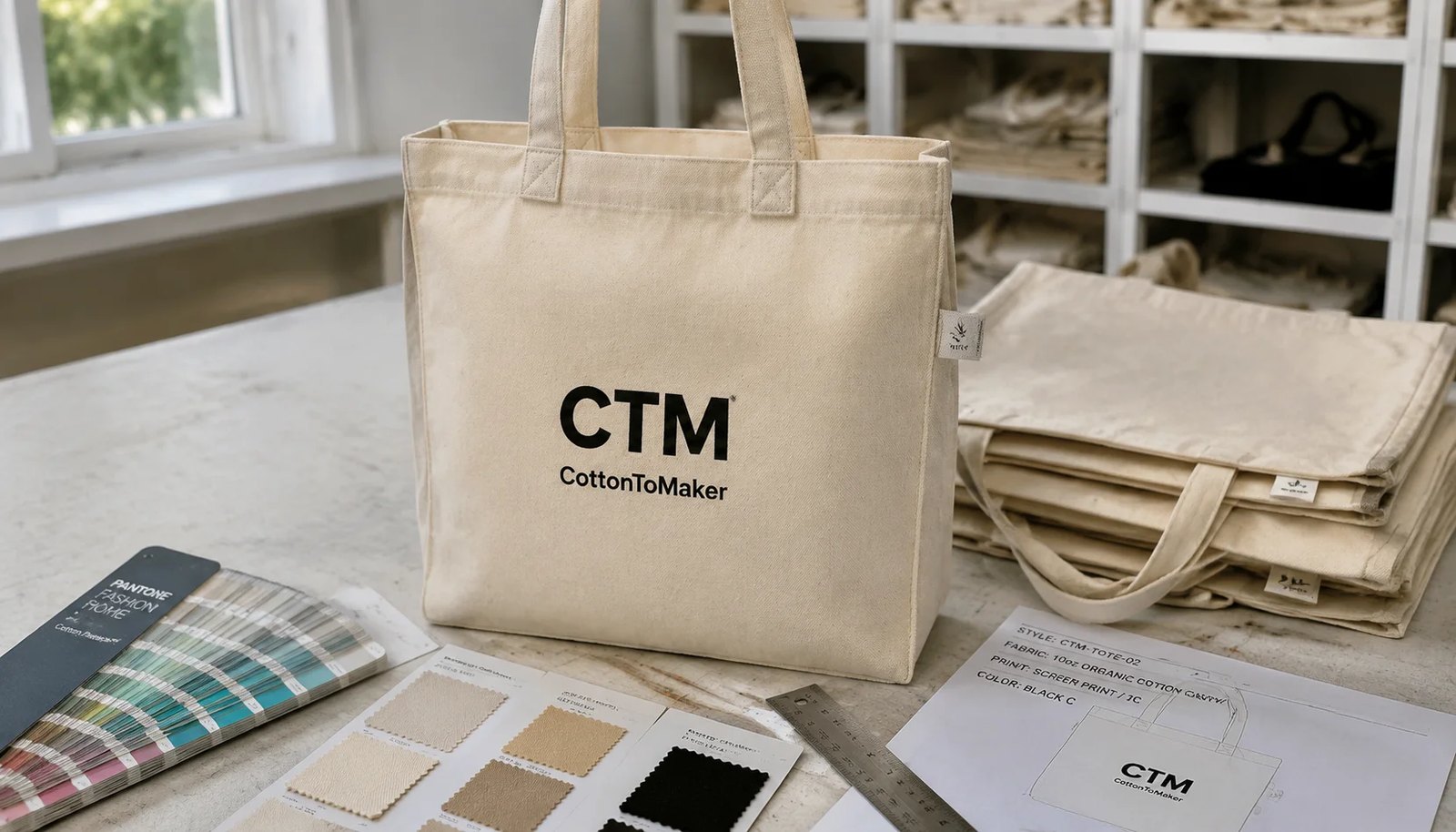
Define the Retail Use Before the Artwork
Liquor retailers often start the tote project from a campaign logo or store opening date, but the first buying decision is the carrying job. A tote used at checkout for two glass bottles needs different fabric, handle reinforcement, and print durability than a lightweight giveaway used at a tasting event. The RFQ should describe the expected load, retail handling, and whether the bag will be resold, gifted, or given free with purchase.
Organic cotton adds another layer because buyers usually want a cleaner material story, but the physical performance still comes from GSM, weave, sewing, and finishing. A natural 10 oz organic cotton tote can be a good daily retail option, while a thin 5 oz bag may only suit brochures or miniatures. If the buyer writes only "organic cotton tote with logo," suppliers may quote different products that look similar in photos but perform very differently in stores.
- For checkout carry: specify two 750 ml bottles or equivalent weight as the load reference.
- For gift packaging: state whether the tote must stand neatly when filled or only carry after purchase.
- For distributor programs: clarify if multiple store logos share one fabric and bag size.
- For retail sale: include hangtag, barcode, and visible finishing requirements in the first RFQ.
Choose GSM That Matches Bottle Weight
Fabric weight is one of the fastest ways to separate a real liquor retail tote from a low-cost promotional bag. For wholesale organic cotton totes, 5 oz to 6 oz fabric can work for flyers, cans, or light merchandise, but it usually feels too weak for glass bottles. Around 8 oz can be acceptable for short-term promotions. For most liquor retailers, 10 oz to 12 oz organic cotton canvas gives a better balance of hand feel, print surface, and load support.
A heavier tote is not automatically better. At 14 oz and above, sewing becomes slower, carton weight increases, and freight cost rises. Thick seams can also affect print registration if the artwork sits close to folded edges or handle stitching. Procurement teams should request actual GSM, ounce weight, and finished sample weight because mills and factories may describe fabric differently. If the tote is dyed or washed, weight after finishing may not match the greige fabric weight.
- Light promotion: 5-8 oz, usually not recommended for glass bottle carry.
- Standard liquor retail tote: 10-12 oz, roughly 280-340 GSM depending on construction.
- Premium reusable tote: 14 oz or higher, but review freight, sewing, and carton limits.
- RFQ wording: "Please quote 10 oz and 12 oz organic cotton canvas separately with finished bag weight."
Set the Print Proof Standard Early
Print proofing is the main risk in this project because liquor retail artwork often uses strong black marks, metallic-looking label graphics, fine serif type, or brand colors that customers recognize. Natural organic cotton is not a flat white printing surface. It has fiber flecks, slight shade variation, and more ink absorption than coated paper or synthetic fabric. A perfect PDF on screen can become a soft-edged print if the factory uses the wrong mesh, ink thickness, or curing temperature.
The practical sequence is artwork review, digital layout, fabric strike-off, pre-production sample, then bulk approval. A digital mockup is useful for checking size and placement, but it does not prove ink color, edge sharpness, rub resistance, or fabric show-through. For one-color logos, screen printing is usually the stable choice. For multi-color label-style artwork, suppliers should explain whether they will use screen print separations, heat transfer, or DTG, and what each method does to hand feel and durability.
- Require vector artwork in AI, EPS, or PDF with outlined fonts.
- State final print size in millimeters, not only "large logo" or "center print."
- Use Pantone coated or uncoated references, then approve against the fabric strike-off.
- Keep fine lines above the factory's minimum printable width on canvas.
- Avoid placing artwork too close to seams, gusset folds, or handle reinforcement.
Control Logo Placement and Tolerance
A tote can pass a quick photo review and still fail at retail because the logo is slightly tilted or too low. This is common when the bag panel is soft, the operator loads fabric by hand, or the print frame is not aligned to the finished seam. Liquor retailers with store logos or premium spirits graphics should define placement from measurable points, such as top edge to print top and side seam to print center.
Tolerance should be written into the purchase order before production. For many cotton totes, +/-5 mm horizontally and +/-8 mm vertically is a workable standard for centered front-panel prints. More complex panels, large artwork, or handmade sewing may need wider tolerance. If the buyer expects luxury packaging accuracy, that must be priced and sampled accordingly because slower loading, extra inspection, and higher rejection rates may apply.
- Measure from the finished bag edge, not from the cutting panel.
- Approve one front print and one back print separately if both sides are used.
- For gusseted totes, confirm whether artwork appears centered when the bag is flat or filled.
- For chain stores, keep the same placement rule across all branch logo versions.
Understand MOQ Logic Before Comparing Quotes
MOQ for wholesale organic cotton totes is driven by fabric purchasing, dyeing, cutting efficiency, printing setup, and sewing line changeover. A supplier may offer a low MOQ for natural in-stock fabric but require a higher MOQ for custom dyed organic cotton. The same applies to print versions: one shared bag size with several one-color logo changes is easier than several sizes, fabric colors, handle colors, and print methods.
When comparing quotes, procurement teams should separate MOQ per order, per fabric color, per size, and per print design. A distributor serving many liquor stores may be able to consolidate one natural 12 oz tote and print separate store logos in batches. That can lower fabric waste and keep the total order attractive to the factory. However, each print design still needs artwork setup, screen preparation, proofing, and batch control.
- Better MOQ structure: one size, one fabric, several print versions.
- Higher-cost structure: multiple dyed fabrics, mixed handle colors, many small logo runs.
- Quote comparison point: screen charge per design versus included setup.
- PO control point: list quantities by SKU, artwork code, and carton mark.
Read the Quote Beyond Unit Price
A low unit price can hide missing items that later become urgent charges. For print proofing, the quote should show sample fee, print screen charge, artwork separation cost, courier cost, bulk unit price, packing method, carton quantity, and validity period. If the supplier quotes only "organic cotton tote with print," the buyer cannot tell whether the price includes the same fabric weight, print area, or packing requirement as another supplier.
Landed cost matters for liquor retailers because heavy cotton totes can move freight cost quickly. A 12 oz canvas tote packed 100 pieces per carton may create a carton that is heavy for warehouse handling. A premium 14 oz version may look reasonable at FOB price but become expensive once CBM, gross weight, and inner packing are included. Ask for estimated carton size and gross weight during quotation, not after production.
- Quote data to require: FOB unit price, fabric weight, bag size, print method, print colors, MOQ, sample cost, lead time, carton quantity, carton dimensions, gross weight, and CBM.
- Cost driver: large print coverage uses more ink and can slow production.
- Cost driver: individual polybagging adds material, labor, and carton volume.
- Cost driver: dyed organic cotton needs dye lot control and may require higher fabric MOQ.
Approve Samples With Measurable Criteria
The pre-production sample should be treated as a production contract, not just a photo. It should use the actual organic cotton fabric, actual handle construction, actual print method, and intended packing fold if folding affects the print. A sample made from substitute fabric is only useful for shape review. It should not be used to approve color, ink absorption, or final hand feel.
Sample review should record pass, revise, or reject decisions against defined points. Buyers should measure bag dimensions, handle drop, fabric weight, print size, print position, stitching, and odor. For liquor retail, handle strength and rub resistance deserve special attention because glass bottles are heavy and printed surfaces may touch labels, counters, dark shelves, and customer clothing.
- Dimension check: width, height, gusset, handle length, and handle drop.
- Print check: color, size, placement, edge sharpness, opacity, curing, and hand feel.
- Sewing check: stitch density, handle reinforcement, loose threads, seam allowance, and symmetry.
- Handling check: dry rub, wet rub, fold mark, odor, and load test.
- Approval record: signed sample photos, date, artwork version, and material specification.
Prevent Common Production Mistakes
Most tote production problems are preventable if the RFQ and proofing process are specific. The common failures include underweight fabric, crooked logo placement, ink color mismatch, weak handles, excessive lint, wrong carton marks, and mixed artwork versions. These issues are difficult to solve after bulk production because the bag is low unit value but high quantity, and rework can cost more than the original margin.
Liquor retailers also face category-specific details. Dark bottle labels can pick up loose lint from unfinished cotton. Wet bottles from chilled sections can contact printed areas. Gift packs may have sharp carton corners that stress seams. If the tote will be used with cold beverages or heavy spirits cartons, the buyer should not rely only on standard promotional bag inspection. The sample should be tested under the closest practical retail condition.
- Mistake: approving a digital proof only. Prevention: approve a strike-off on actual fabric.
- Mistake: choosing fabric by ounce name only. Prevention: request GSM and finished bag weight.
- Mistake: putting fine artwork on coarse canvas. Prevention: test minimum line width before bulk.
- Mistake: using narrow handles for heavy bottles. Prevention: define handle width and load test.
- Mistake: shipping cartons too heavy. Prevention: review carton gross weight before packing approval.
Plan Packing for Store Operations
Packing should match how the totes will be received and used. Bulk packing is usually enough for backroom replenishment or checkout use. Inner bundles of 10, 25, or 50 pieces can help store staff count stock quickly. Individual polybags are useful when bags are resold as clean retail merchandise, but they add plastic, labor, carton space, and unpacking time. A retail buyer should decide this before quotation because packing changes both price and lead time.
Carton marks also need control when there are multiple store logos, seasonal graphics, or distributor SKUs. Each carton should identify item code, artwork code, quantity, carton number, destination, and any barcode requirement. For larger programs, packing lists should match the buyer's allocation plan so warehouse teams do not open every carton to identify branch logos.
- For checkout use: bulk pack with clear carton marks is usually sufficient.
- For resale: consider individual polybag, hangtag, barcode sticker, and cleaner folding.
- For distributor allocation: use carton labels by store code or artwork code.
- For heavy canvas: keep carton gross weight within warehouse handling limits.
Build a Realistic Proofing Schedule
Print proofing consumes calendar time even when bulk production is simple. Artwork clarification, screen making, strike-off, courier transit, buyer review, sample revision, and final approval can easily add one to three weeks before production starts. If the tote is for a holiday liquor promotion, store opening, or supplier-funded campaign, the latest sample approval date should be fixed backward from the required delivery date.
Bulk lead time depends on fabric availability, order quantity, print complexity, and sewing capacity. Natural organic cotton in a common weight is usually faster than dyed-to-order fabric. Multi-version artwork requires better batch scheduling and inspection. The buyer should avoid releasing production with unresolved artwork notes because factories will follow the latest approved proof, not a conversation thread spread across emails.
- Schedule artwork review before sample development, not during bulk production.
- Reserve time for one sample revision if color or placement matters.
- Approve the final sample with written version control: artwork file name, date, and Pantone references.
- Ask the factory for an ex-factory date, not only a production duration.
- Lock carton packing data before freight booking.
Specification comparison for buyers
| Spec decision | Recommended option | When it fits | Buyer risk to check |
|---|---|---|---|
| Fabric weight for liquor retail checkout tote | 10 oz to 12 oz organic cotton canvas, roughly 280-340 GSM | Good balance for wine, spirits, gift packs, and repeat retail use without making freight weight excessive | Below 8 oz can feel promotional and may sag under bottle weight; above 14 oz increases unit cost, carton weight, and sewing thickness |
| Fabric construction and shrinkage control | Plain weave canvas with pre-shrunk or controlled-shrinkage finishing | Useful when artwork must stay square and logo size must remain stable after pressing and handling | Uncontrolled shrinkage can distort print position and make approved pre-production samples differ from bulk goods |
| Print method for one or two color liquor logos | Screen print with water-based or low-odor ink tested on natural cotton | Best for solid brand marks, store logos, event names, and simple liquor category graphics | Ink absorption on organic cotton can soften edges; request strike-off approval before bulk printing |
| Print method for detailed label-style artwork | Heat transfer or DTG only after wash, rub, and fold testing | Suitable for small runs, complex artwork, gradients, or campaign graphics that cannot be separated cleanly | Transfers may crack on heavy canvas folds; DTG color can look muted on natural unbleached fabric |
| Handle construction | Self-fabric handles with cross-stitch reinforcement, 2.5-3 cm width, load-tested | Works for two bottles, canned cocktail packs, or gift merchandise carried from store to car | Narrow handles cut into the hand; weak bartacks or shallow stitch boxes can fail even when fabric weight is adequate |
| Logo placement tolerance | Center position with +/-5 mm horizontal tolerance and +/-8 mm vertical tolerance agreed before production | Appropriate for front-panel liquor store branding where crooked placement is immediately visible | Factories may quote without placement tolerance; inconsistent loading on print pallets can create visible batch variation |
| MOQ and colorway planning | Consolidate one fabric color and vary print color only when possible | Helps distributors and retail chains meet factory MOQ while keeping branch or event versions separate | Too many fabric colors or handle colors split material purchasing and can trigger higher MOQ or surcharge |
| Retail packing format | Bulk pack 50-100 pcs per export carton with inner polybag only if required by the buyer or warehouse | Best for store replenishment, distributor delivery, and lower packing cost | Individual polybags add labor, plastic, carton volume, and unpacking time; carton strength must match gross weight |
Buyer checklist before sampling
- Define bag size in width x height x gusset, not only volume or bottle count; include target bottle configuration if the tote is meant to carry wine or spirits.
- Specify organic cotton standard required by your market or brand policy, and request the certificate scope that covers the fabric or finished bag.
- Choose fabric weight by use case: 8 oz for light promotional carry, 10-12 oz for liquor retail checkout, 14 oz or higher for premium reusable gift totes.
- State whether the fabric must be natural, bleached, dyed, or custom Pantone dyed; dyed fabric affects MOQ, lead time, and colorfastness testing.
- Send vector artwork with Pantone references, print size in millimeters, placement from bag edges, and orientation on the finished tote.
- Require a print strike-off on the actual organic cotton fabric before approving a full pre-production sample.
- Set acceptance tolerances for print position, print size, color variation, sewing dimensions, handle length, and carton packing quantity.
- Confirm whether ink must pass dry rub, wet rub, tape pull, fold, odor, or wash testing for your retail environment.
- Approve the pre-production sample with the same fabric weight, handle construction, stitching thread, print method, and packing method planned for bulk.
- Request carton dimensions, gross weight, net weight, CBM, HS code, and packing photos before shipment booking.
Factory quote questions to send
- What organic cotton fabric weight and construction are included in the quote, and is the GSM measured before or after finishing?
- Is the quoted fabric in stock, greige, natural, bleached, or dyed to order, and what MOQ applies to each option?
- Which print method is quoted, how many colors are included, and what is the maximum print area without surcharge?
- Can the factory provide a strike-off on the same fabric before making the full pre-production sample?
- What print color tolerance will be used: Pantone visual match, Delta E value, or approved sample as the standard?
- What is the handle width, handle length, stitching pattern, and minimum load test result for the finished tote?
- Are sample fees, screen charges, mold charges, artwork separation, and courier cost included or listed separately?
- What is the production MOQ per size, per fabric color, and per print design, and can branch logos be combined under one fabric order?
- What packing method is included: bulk pack, inner bundle, individual polybag, retail belly band, hangtag, barcode label, or master carton mark?
- What are the current sample lead time, bulk lead time after sample approval, and latest artwork approval date for the requested ship window?
Quality-control points to confirm
- Fabric weight measured from random panels should stay within the agreed tolerance, commonly +/-5% unless a tighter range is written into the PO.
- Finished bag dimensions should be measured after sewing and pressing; use a tolerance such as +/-1 cm for width and height and +/-0.5 cm for gusset when appropriate.
- Print placement should be checked from fixed seams or folded edges, not by eye; record horizontal and vertical deviation on inspection sheets.
- Ink color should be compared under consistent light against the approved strike-off or Pantone reference, with natural cotton shade variation considered.
- Dry rub and wet rub tests should not show obvious ink transfer that would stain bottles, labels, counters, or customer clothing during normal handling.
- Handle attachment should show complete cross-stitch or box-stitch reinforcement with no skipped stitches, broken thread, loose ends, or needle damage.
- Load testing should match the expected retail use, for example two 750 ml glass bottles plus margin, held for a defined period without seam failure.
- Cartons should be weighed and drop-checked where required, especially when using heavy canvas and 100-piece packing that can exceed comfortable manual handling weight.