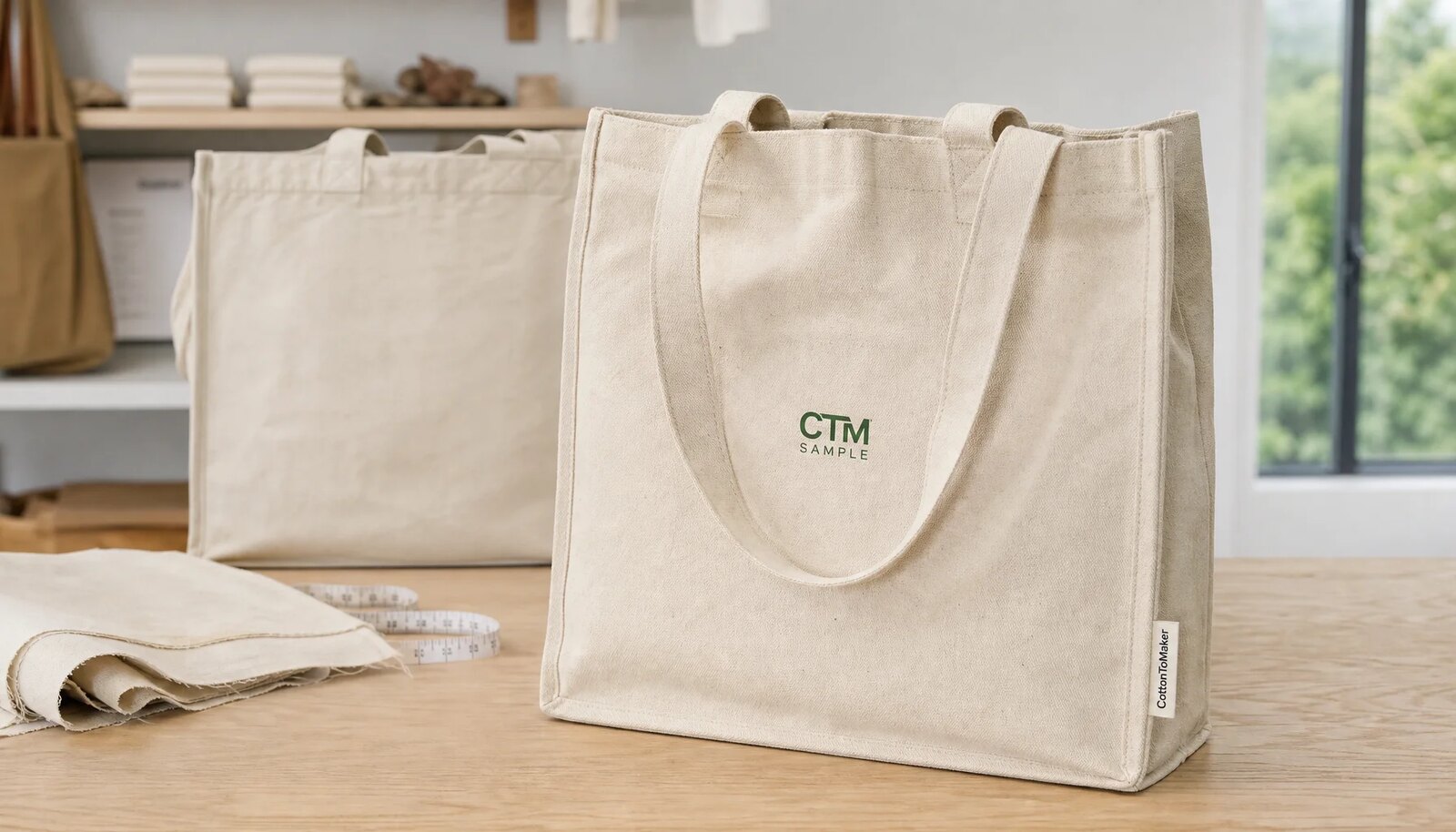
Start with the retail role, not the tote description
Wholesale organic cotton totes for hotel retail should be specified as sellable merchandise, not as generic promotional bags. A tote in a resort shop, spa boutique, destination store, or hotel lobby market has to look intentional on display, carry the right product claim, scan correctly at POS, and arrive in cartons the receiving team can handle. That is why the first buying decision is commercial: what job will this tote do?
A flat 200 GSM tote can be right for a city hotel shop selling postcards, books, or small apparel. A 260 GSM gusseted tote may suit a resort boutique where guests buy towels, bottles, sandals, and packaged gifts. A heavier 300 GSM canvas-like tote can feel premium, but it also increases fabric cost, sewing time, carton weight, and storage volume. The best option is not the heaviest bag; it is the construction that supports the retail price, shelf plan, and expected load.
Procurement should define the tote as a SKU before requesting bulk pricing. That means identifying the target retail price band, expected display method, order quantity, number of properties, barcode needs, artwork versions, and sustainability claim. Once those points are known, suppliers can quote a comparable product instead of interpreting a loose phrase such as organic cotton tote bag.
- Use a flat tote when low landed cost, wall display, and easy folding matter most.
- Use a bottom-gusset tote when capacity and perceived retail value are more important.
- Avoid upgrading GSM without checking carton CBM, freight impact, and retail price support.
- Treat each artwork or property version as its own SKU for pricing, packing, and inspection.
- Decide whether the tote must be retail-ready on arrival or finished by the hotel team locally.
Build a specification that suppliers cannot reinterpret
A useful RFQ starts with finished product details. State the finished width, height, gusset depth, handle length, handle drop, handle width, top hem depth, fabric GSM, weave, finish, color, seam type, reinforcement, print area, print placement, label package, hangtag, barcode, fold method, inner packing, carton quantity, and required documents. If a detail is optional, ask for it as a separate add-on line instead of allowing it to disappear inside a single unit price.
Finished size is especially important. A tote described as 38 x 42 cm may mean cut panel size to one supplier and finished sewn size to another. For hotel retail, the finished size after sewing and pressing is what matters because it affects shelf presentation and guest use. The RFQ should include practical tolerances, such as +/-1.0 cm for width and height and +/-0.5 cm for gusset depth, unless the factory confirms tighter control.
The same discipline applies to handles. A shoulder handle total length of 55-65 cm is common for many retail totes, but the buyer should approve handle drop on a physical sample. A sample that looks balanced in a photo can feel too short over a coat or too long on a compact tote. Handle reinforcement should also be named: bartack, box stitch, box-X, or another approved method.
- Define dimensions as finished measurements after sewing and pressing.
- Name the fabric type: plain weave, canvas, twill, natural, bleached, dyed, washed, or finished.
- Specify reinforcement, not just handle length.
- Set print position from measurable reference points, not visual centering alone.
- Keep optional items visible: woven label, care label, hangtag, paper band, barcode, polybag, and carton marks.
Choose GSM and construction with cost tradeoffs in view
Fabric weight is one of the biggest cost and feel drivers. For accessible hotel retail, 180-220 GSM organic cotton is often enough for a foldable tote that still feels substantial. For premium spa and resort retail, 240-280 GSM gives more structure and a stronger hand feel, especially with a gusset. Above 300 GSM, the tote starts to behave more like structured canvas, which can be right for premium merchandise but is rarely the cheapest way to improve perceived value.
Construction changes cost as much as fabric. A flat tote is efficient to cut, sew, fold, and carton. A bottom gusset improves capacity but adds sewing and folding steps. A side-and-bottom gusset can stand better when loaded, but it needs more precise construction and may take more carton space. If the tote will carry bottles or boxed gifts, the added cost may be justified. If it will mostly carry postcards and T-shirts, it may not.
Ask suppliers to quote two controlled options when the team is unsure: for example, a 200 GSM flat tote and a 260 GSM bottom-gusset tote with the same artwork and packing term. Require carton dimensions, pieces per carton, and total CBM for both. That makes the tradeoff visible. A lower factory unit price is less useful if the carton volume, local handling, or retail presentation does not match the program.
- 180-220 GSM: foldable, lighter, usually better for entry retail price points.
- 240-280 GSM: stronger hand feel for resort, spa, and gift-focused retail.
- 300+ GSM: structured canvas feel, higher material and freight exposure.
- Flat construction: simpler and efficient for display and replenishment.
- Gusseted construction: better for capacity, gifts, bottles, and higher perceived value.
Make organic cotton claims document-led
Organic cotton language should be resolved before artwork approval. A supplier stating that fabric is organic is not automatically the same as a finished tote being eligible to carry a certification logo, certification number, or formal claim. The allowable wording depends on the certification route, facility scope, chain-of-custody documentation, label approval rules, and where the claim will appear.
Procurement should write the intended claim in the RFQ. There is a difference between internal purchasing language, a hangtag claim, a product-page statement, a care label, an invoice line, and retail signage. If the hotel wants to reference OCS, GOTS, or another formal route, the supplier must confirm whether scope certificates, transaction certificates, and label approvals can support that exact use. If the documents do not support the wording, revise the claim before sampling packaging.
This is also a timing issue. Certificate review, transaction certificate requests, and label approval can add time after sampling. Do not leave claim wording until shipment. Keep the approved wording with the artwork file, purchase order, and inspection checklist so the factory does not print an outdated or unsupported version.
- State the exact claim and every location where it appears.
- Ask what documents are order-specific and what documents are facility-level only.
- Do not use certification logos until permitted use is confirmed in writing.
- Keep claim wording consistent across hangtags, labels, product pages, invoices, and cartons.
- If documentation is limited, use internal purchasing language rather than consumer-facing claims.
Request price breaks that reveal the real cost drivers
Bulk pricing should show how cost changes as volume changes. A 500-piece order often carries more setup cost per tote. At 1,000 pieces, printing and sewing are usually easier to schedule. At 2,500 or 5,000 pieces, cost may improve if the same fabric, size, artwork count, and packing method are maintained. If those variables change between quotes, the price ladder is not meaningful.
Ask for identical-spec pricing at 500, 1,000, 2,500, and 5,000 pieces. Then ask for separate add-ons: second print position, extra print color, woven side label, care label, hangtag, barcode sticker, paper band, individual protection, inspection support, and special carton marking. This lets the retail team decide which elements increase perceived value and which only add handling.
A simple landed-cost check can prevent bad awards. Suppose one supplier quotes a lower unit price but packs fewer pieces per carton because the tote is bulkier or individually protected. Freight, storage, and receiving labor can erase the unit saving. For hotel groups, landed cost per sellable tote is the number to compare: unit price plus packing, documentation, inspection, freight, duty where applicable, inland delivery, and any relabeling or local merchandising labor.
- Keep GSM, size, print area, packing, Incoterm, and payment terms identical across price breaks.
- Separate one-time setup charges from repeat-order unit costs.
- Quote each artwork version separately, even when the tote body is shared.
- Ask for carton CBM and gross weight before approving the pricing ladder.
- Compare landed cost and receiving effort, not factory price alone.
Match branding method to hotel retail quality
Branding changes both cost and perceived value. Water-based screen print is usually a strong fit for simple hotel artwork: property names, destination graphics, line icons, monograms, and one-to-three color marks. It can create a softer hand feel than heavier print systems, but only if the ink is cured correctly and tested on the actual cotton fabric.
Heat transfer can help with sharper detail or small runs, but it should be tested for edge feel, adhesion, and behavior on textured cotton. Embroidery can add a premium cue for a small mark on heavier fabric, but large embroidery on light cotton can pucker, distort, and cost more than it returns in perceived value. A woven side label is often a quieter way to add retail polish without making the tote feel like a giveaway.
Placement should be specified in numbers. If the logo must sit 9 cm below the top edge and centered between side seams, write that into the artwork sheet. If a label belongs 2 cm above the bottom seam, include that measurement. Production teams cannot inspect against taste; they inspect against tolerances.
- Use water-based screen print for simple, soft-hand hotel graphics.
- Use heat transfer only after adhesion and edge-feel testing on actual fabric.
- Use embroidery for small premium marks on heavier bags, not large dense designs without sampling.
- Approve print strike-offs for color, opacity, hand feel, curing, and placement.
- Set placement tolerance, commonly +/-0.5 cm to +/-1.0 cm depending on artwork size.
Use sampling to lock the production standard
Sampling should move from concept to production control. A stock sample may help the buyer compare silhouettes, but it should not approve the bulk order if the final fabric, GSM, print method, labels, hangtags, or packing will differ. The true pre-production sample should use the actual materials and construction intended for bulk production.
The approval record should include measurements and photos, not only a note that the sample looks good. Record finished width, height, gusset depth, handle length, handle drop, print size, print position, label placement, hangtag attachment, barcode position, fold method, and carton orientation. If the tote uses natural unbleached cotton, approve the acceptable shade, seed flecks, and texture. If dyed fabric is used, approve the shade range and lot control method.
Both buyer and factory should retain matching signed samples. The factory sample guides production; the buyer sample guides inspection and reorders. If a change is made after approval, record the version, date, and reason. This avoids disputes where one team compares bulk goods to the first prototype while another compares them to the final email revision.
- Identify the sample type: stock reference, fit sample, print strike-off, packing mockup, or pre-production sample.
- Approve actual GSM, fabric finish, seam construction, handle reinforcement, and print process.
- Test the folded and packed tote as it will arrive at the hotel.
- Scan barcode samples before bulk printing if POS control is required.
- Keep signed samples for inspection, claims, and reorder consistency.
Set QC rules for retail, not just production
Hotel retail totes need inspection rules that protect saleability. The inspection checklist should cover fabric, construction, print, labels, barcodes, packing, and carton allocation. Good quality is not enough as a standard. The factory and buyer should agree measurable tolerances before cutting begins.
Useful baseline tolerances include GSM within +/-5%, finished width and height within +/-1.0 cm, gusset depth within +/-0.5 cm, handle drop within +/-0.5 cm where feasible, and print placement within +/-0.5 cm to +/-1.0 cm depending on artwork. These are practical starting points, not universal rules. If the hotel needs tighter tolerances for a premium retail program, confirm feasibility at sampling.
Defect classification keeps inspection decisions objective. Critical defects include mold, unsafe contamination, sharp objects, strong chemical odor, wrong fiber claim, unauthorized certification mark, unreadable required label, or a barcode that will not scan. Major defects include stains, holes, open seams, weak handles, wrong size, wrong GSM, crooked print, severe shade variation, wrong label, or wrong carton quantity. Minor defects include small loose threads or light wrinkles within agreed limits.
- Inspect against the signed pre-production sample, not a rendering.
- Check fabric for GSM, shade, weave, stains, holes, odor, and contamination.
- Check construction for seam finish, handle reinforcement, stitch quality, and loose threads.
- Check retail data: labels, hangtags, SKU, barcode, price sticker, language, and attachment method.
- Check cartons for quantity, SKU segregation, property marks, gross weight, numbering, and damage.
Let packing and replenishment shape the final award
Packing affects landed cost and hotel labor. Bulk carton packing is usually the lowest-cost route when the property team can unpack, steam, fold, price, and merchandise locally. Paper bands can work well for eco-positioned folded displays, but they should be tested for transit movement and humidity. Individual protection can reduce dirt and handling damage, but it adds material, labor, carton volume, and possible plastic-policy concerns.
Carton data is especially important for hotel groups. The quote should state pieces per carton, carton dimensions, gross weight, net weight, total CBM, inner bundle count, carton strength, carton marks, carton numbering, and property allocation. If one order includes multiple properties, cartons should be marked clearly by SKU and destination to avoid receiving errors.
Replenishment planning prevents the common mistake of buying too much only to chase a lower unit price. Set opening quantity, minimum display stock, reorder trigger, production lead time, freight time, and redesign risk. A slightly higher unit cost can be better than excess inventory if the property changes branding, updates artwork, or learns that a different size sells better.
- Choose packing from the shelf plan: hanging, folded table, spa counter, minibar retail, or back-of-house stock.
- Require carton dimensions and CBM before comparing landed cost.
- Standardize the base tote across properties where possible, then vary artwork or hangtags carefully.
- Keep each artwork version separated for cartons, inspection, and reorder history.
- Set reorder points from sell-through, lead time, and minimum display quantity rather than MOQ alone.
Specification comparison for buyers
| Hotel retail scenario | Practical specification target | Likely cost impact | Buyer control point |
|---|---|---|---|
| Opening order for one boutique hotel | 1,000 pcs, 38 x 42 cm flat tote, 200 GSM natural organic cotton, 1-color water-based front print, bulk carton packing | Usually lower risk than 500 pcs because setup cost is spread over more units; keeps carton volume moderate versus heavy canvas | Keep the first run simple; request 500, 1,000, and 2,500 pc pricing with identical GSM, print size, packing, and Incoterm |
| Premium resort shop tote | 2,500 pcs, 38 x 35 x 10 cm gusseted tote, 260 GSM, shoulder handles, woven side label, hangtag and barcode | Higher unit cost from heavier fabric, gusset sewing, label, hangtag labor, and larger carton CBM; better perceived value for higher retail price points | Approve a physical sample loaded with towels, bottles, or boxed gifts; confirm handle reinforcement and carton dimensions before award |
| Multi-property group buy | 5,000 pcs total using one tote body, 5 artwork versions of 1,000 pcs each | Body standardization can improve fabric and sewing efficiency, but separate screens, labels, carton marks, and inspection references add cost | Quote each artwork version separately and require SKU/property carton segregation to prevent receiving errors |
| Low-volume urgent fill-in | Under 500 pcs from stock organic cotton blanks with local decoration | Fastest route, but fewer GSM, size, packing, and documentation choices; may not support order-specific certification claims | Confirm blank source, actual GSM, country of origin, organic documentation, and whether retail claim wording is allowed |
| GSM upgrade decision | Move from 200 GSM flat tote to 260 GSM gusseted tote | Material usage, sewing time, carton weight, and CBM can all rise; the price gap is not only fabric cost | Ask suppliers to quote both options side by side with carton CBM and gross weight, not just unit price |
| Retail-ready packing decision | Bulk packed versus paper band, hangtag, barcode sticker, or individual protection | Retail finishing can add labor and material cost and may reduce pieces per carton; it can also reduce hotel receiving and merchandising labor | Decide packing from the shelf plan: hanging, folded table display, spa counter, minibar retail, or back-of-house allocation |
| Organic claim route | Internal organic preference, organic cotton wording, OCS, GOTS, or other permitted chain-of-custody claim | Documentation and label approval can affect lead time and artwork approval; unsupported logos create compliance risk | Confirm scope certificate, transaction certificate support, label approval route, and exact permitted wording before printing tags |
| Landed-cost check | Example: 2,500 pcs at $2.40 FOB plus $0.18 retail packing plus freight, duty, inspection, and inland delivery | A $0.10 unit saving can disappear if carton CBM is higher, packing is incomplete, or local relabeling is required | Compare estimated landed cost per sellable tote, not only factory unit price; include cartons, inspection, documents, and receiving labor where known |
Buyer checklist before sampling
- Define the tote role: boutique retail SKU, spa merchandise, resort shop staple, guest welcome gift, conference resale, minibar add-on, or property-specific souvenir.
- Choose the starting construction: flat tote for lower landed cost and wall display, or gusseted tote for capacity, structure, and higher perceived value.
- Lock finished size, gusset, handle length, handle drop, handle width, fabric GSM, weave, finish, color, seam type, reinforcement, print size, label, hangtag, barcode, fold method, and packing before comparing quotes.
- Write the exact organic cotton claim and where it will appear: internal file, care label, woven label, hangtag, retail sign, product page, invoice, or packaging.
- Request identical-spec pricing at 500, 1,000, 2,500, and 5,000 pieces, with separate lines for each artwork version and each packing method.
- Ask suppliers to separate base bag, print, setup, label, hangtag, barcode, paper band, individual packing, carton packing, sample, inspection support, documents, and freight term.
- Require carton dimensions, pieces per carton, gross weight, net weight, total CBM, carton marks, SKU/property allocation, and barcode scanning plan before final landed-cost approval.
- Approve a pre-production sample made with actual fabric, actual GSM, actual construction, actual print process, actual label placement, and actual folded packing method.
- Set written QC tolerances for GSM, finished dimensions, handle drop, print placement, print color, seam defects, stains, odor, labels, barcodes, carton quantity, and SKU segregation.
- Classify defects before inspection: critical for safety, legal, claim, odor, contamination, or barcode failure; major for visible retail or functional defects; minor for small workmanship issues within agreed limits.
Factory quote questions to send
- What exact organic cotton documentation can you provide for this order: scope certificate, transaction certificate, fabric certificate, invoice statement, or other chain-of-custody evidence?
- Does the documentation support the exact claim we plan to use on the hangtag, care label, product page, invoice, packaging, or retail sign?
- Are any certification logos, certification numbers, or claim phrases permitted on this finished tote, and is label approval required before printing?
- Is the quoted fabric natural unbleached, bleached, dyed, pigment dyed, enzyme washed, or otherwise finished, and how will shade variation be approved?
- What weave and GSM are included, what GSM tolerance will you hold, and is the weight measured before or after finishing?
- What are the finished dimensions after sewing and pressing, including width, height, gusset, handle length, handle drop, handle width, seam allowance, and top hem depth?
- What construction is included: overlock seam, French seam, folded top edge, bottom gusset, side gusset, boxed corners, bartack, box-X, or other handle reinforcement?
- Which print method is included, how many colors are included, what maximum print area is quoted, and what setup or screen charges apply?
- What print placement tolerance can production hold, measured from top edge, side seam, center line, or gusset edge?
- What are the unit prices at 500, 1,000, 2,500, and 5,000 pieces using identical specification, identical artwork count, identical packing, Incoterm, and payment term?
Quality-control points to confirm
- Fabric GSM should be checked against the approved specification, commonly within +/-5% unless the buyer and factory agree another tolerance before cutting.
- Finished width and height should be measured after sewing and pressing; a practical sewn-goods tolerance is often +/-1.0 cm for width/height and +/-0.5 cm for gusset depth.
- Handle length and handle drop should be measured on the finished tote, with written tolerances such as +/-1.0 cm for total handle length and +/-0.5 cm for handle drop when feasible.
- Print placement should be controlled from fixed points such as top edge, side seam, center line, or gusset edge; +/-0.5 cm to +/-1.0 cm is a common practical range depending on artwork size.
- Print color should be approved by physical strike-off, Pantone target, or signed production sample, with allowance for natural cotton shade, seed flecks, and fabric texture.
- Print durability should be checked on actual fabric by rub resistance, tape or adhesion check where relevant, and damp-cloth or wash behavior if the tote is marketed as reusable.
- Handle stitching should match the approved reinforcement method and must not show broken stitches, skipped stitches, weak thread tension, loose ends, or misaligned attachment.
- Critical defects should include mold, unsafe contamination, sharp objects, strong chemical odor, wrong fiber claim, unauthorized certification mark, unreadable required label, or retail barcode failure.
- Major defects should include wrong size outside tolerance, wrong GSM outside tolerance, crooked print, severe shade variation, stains, holes, open seams, broken stitches, weak handles, wrong label, or incorrect carton quantity.
- Minor defects should include small loose threads, light wrinkles, minor shade variation within approved range, or small sewing irregularities that do not affect retail appearance or function.