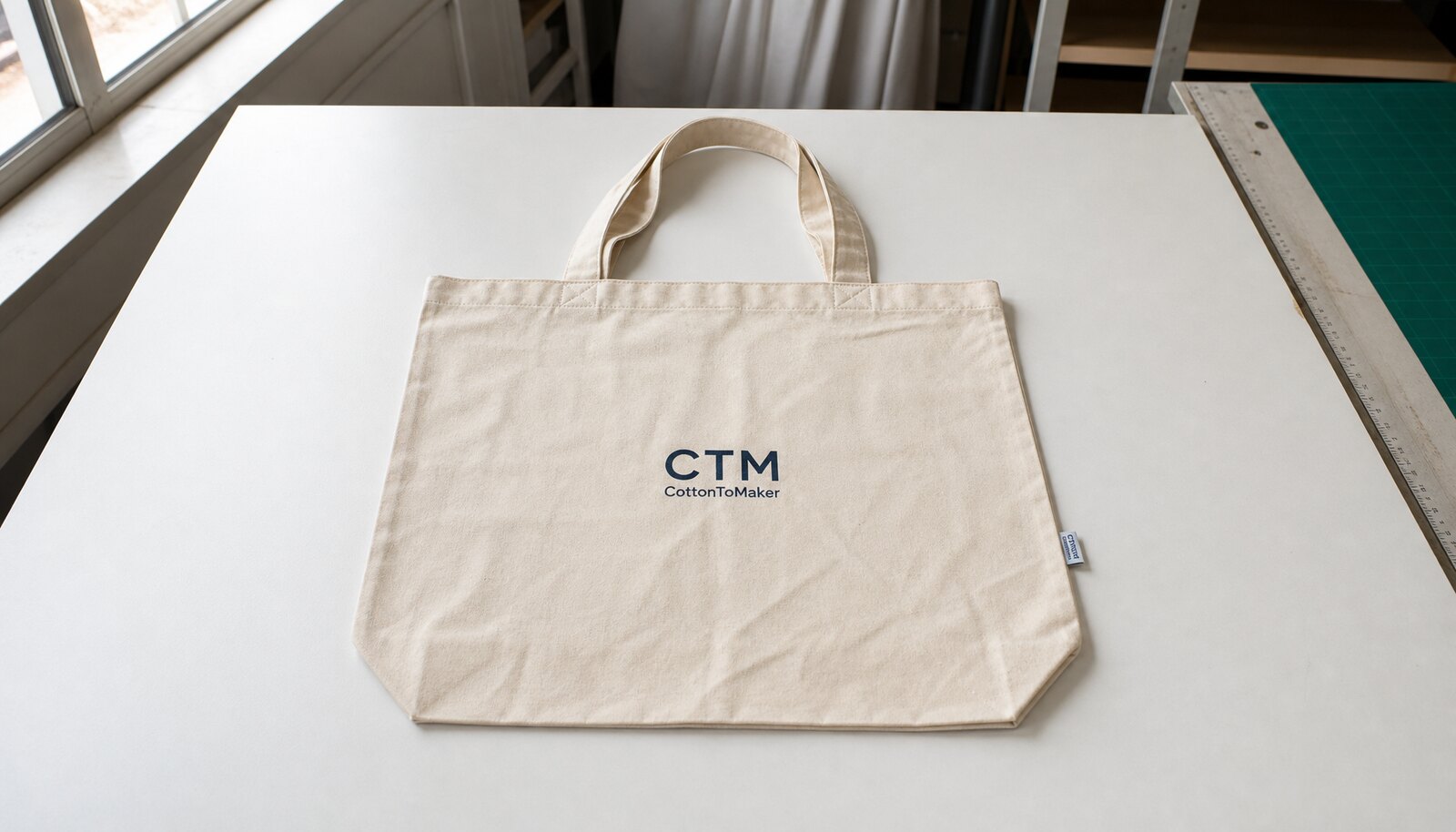
Why logo placement matters more on organic cotton totes than buyers often expect
For gift shops, an organic cotton tote is usually a visible retail product, not just a utility bag. That means the logo has to do three jobs at once: read cleanly from a distance, sit well on the shelf or hook, and survive sewing, folding, packing, and customer handling. A mark that looks fine in a flat artwork file can become awkward once the bag is sewn, gusseted, and packed flat for shipment.
Placement also affects the commercial side of the order. A logo near the seam may require a larger safe zone, which reduces usable decoration area and can push the factory toward a different print setup. A logo that sits too close to the top hem can be swallowed by handle stitching or fold lines. For procurement, the placement choice changes the approved spec, the sample process, the rejection risk, and sometimes the unit price.
The most useful way to think about placement is not “where should the logo look nice?” but “where will the logo stay readable after production and retail handling?” That question leads to better RFQs, fewer back-and-forth revisions, and fewer surprises when the first bulk cartons arrive.
- Treat logo placement as a measurable production spec, not a design preference.
- Match the placement to how the tote will be displayed: folded, hung, stacked, or handed out at checkout.
- Build enough blank space around the logo so the print still looks intentional after stitching and folding.
Start with the bag specification, not the artwork file
Before you ask a factory to quote the decoration, lock the base tote spec. The most common variables are size, fabric weight, weave density, handle length, handle drop, side gusset depth, and whether the bag has a bottom gusset or lining. These details define the available print field. Without them, two suppliers can quote the “same” tote while imagining very different construction methods.
Fabric GSM matters because it changes both feel and print behavior. A lighter 150–160 GSM bag is easier to keep cost-effective for seasonal gift programs, but it can wrinkle more and show the contents more easily. A 170–180 GSM bag usually holds shape better, prints more cleanly, and feels more substantial at retail. If the tote will carry boxed gifts or heavier merchandise, the heavier cloth often reduces complaints about thinness and transparency.
Handle construction should be reviewed at the same time. A long handle can crowd the upper print zone, while a short handle can change how the bag hangs on a peg. In procurement practice, the base spec and the logo layout should be approved together. If one changes, the other may need to change as well.
- Confirm final size in finished dimensions, not cut size.
- Ask whether the quoted GSM refers to finished fabric, not just yarn count or a generic marketing description.
- Request handle stitching details and handle drop before approving logo height.
Choose the logo position by retail use case
The most common and safest option is front-center placement. It is easy to manufacture, easy to inspect, and easy for the customer to recognize. For gift shops, this is often the best choice when the bag itself is the product and the brand mark should be visible from a hanging display. The print area can be optimized around the tote width so the logo feels balanced rather than oversized.
A lower-front placement can be useful when the buyer wants a softer retail feel. It leaves more blank space above the logo and can make the bag look less promotional and more lifestyle-oriented. This works well when the tote is being sold beside premium gift items or when the buyer wants the design to feel understated. The tradeoff is that the logo may be less visible when the bag is partly filled or folded.
Side-panel branding is possible, but it is more sensitive to sewing accuracy and seam control. It can look sharp if the supplier uses a placement jig and the production line has tight registration control. If not, side-panel work can drift more easily than front-center printing. For most wholesale organic cotton totes for gift shops logo placement guide decisions, front-center remains the most procurement-friendly choice unless the brand brief clearly demands something different.
- Front-center: best visibility and simplest QC.
- Lower-front: better for premium or lifestyle presentation.
- Side-panel: useful for subtle branding, but only with a strong placement jig and clear seam margins.
Use a real print-area diagram in every RFQ
Many buyer problems start when the supplier receives a logo file but not a measured print-area diagram. A practical RFQ should show the tote front, the hem line, side seam, handle stitch points, and the safe decoration area in millimeters. That diagram is more useful than a general note like “center logo please.” It reduces interpretation errors and gives the factory a consistent reference for quoting and sampling.
A good print-area diagram does not need to be fancy, but it should answer the questions the production team will ask: How far from the top hem should the logo start? How much space is left on each side? Is the logo allowed to cross the centerline? Is the print meant to sit above the gusset fold or partly over it? The more specific the drawing, the less chance of a sample that looks acceptable only because everyone is guessing differently.
This is also where procurement can save time. If the buyer sends one approved spec sheet and one annotated image, the factory can quote with fewer assumptions. That usually leads to fewer round trips between sales, artwork, and production.
Compare suppliers by process control, not by headline price
A low unit price is not enough if the supplier cannot control placement or prove material traceability. For organic cotton tote programs, the better comparison is process control. Does the supplier sew and print in the same site, or do they send panels to another workshop after sewing? Do they use a fixed placement jig, or do they mark each bag by hand? Can they show a physical pre-production sample and the corresponding spec sheet version?
Direct factories usually have an advantage when the buyer needs repeatable placement. Because sewing and printing are closer together, the factory can see how the sewn panel behaves before bulk starts. Trading companies can still be useful when the buyer needs flexible order handling or multi-item consolidation, but the buyer should ask exactly who is making the bag and where the print is applied. Without that, a quote can look simple while the supply chain is actually fragmented.
For procurement, the right supplier is often the one that can show evidence, not just assurance. If a supplier cannot explain how the logo position is checked, how the organic cotton status is documented, and who signs off the first run, the order may still be possible, but the buyer should treat the risk as higher even if the price is attractive.
- Ask where sewing and printing happen and whether the same plant controls both.
- Request a placement jig photo or first-article template if the logo position is critical.
- Compare suppliers on evidence quality, not just quoted price.
What supplier verification should include for organic cotton bags
Organic cotton sourcing needs more than a verbal claim. Buyers should ask for the documentation chain that supports the organic cotton statement used in the quote or on the product. Depending on the market and the supplier’s role in the chain, this may include a scope certificate, transaction certificate, or equivalent chain-of-custody records. If the bag will carry an organic claim in retail or e-commerce, the buyer should also confirm what wording is permitted and whether any certification mark use needs prior approval.
It is also worth asking about traceability from yarn to finished bag. A supplier should be able to explain whether the cotton is certified at fiber, yarn, fabric, or final product level, and whether the printer or sewing unit is inside the certified scope. For procurement teams, the important question is not merely “is it organic?” but “can this specific order be traced and documented in a way that matches our compliance requirements?”
Verification should extend beyond paper. Ask whether the supplier can share recent audit documents, social compliance records if relevant to your sourcing policy, and any quality or process documents showing how they manage finished goods. If your retail customer requires a restricted-substances policy, ask for the testing standard or the lab reports the supplier can provide for inks, labels, or trims. Organic cotton status does not automatically cover every component on the bag.
- Request scope / transaction documents where applicable to the supply chain.
- Confirm whether printing, labeling, and sewing operations are inside the certified or documented chain.
- Ask what claims can legally or contractually be made on the retail label or hangtag.
- Check whether trims, labels, and inks meet the buyer’s own restricted-substances or packaging rules.
A supplier comparison table should show tradeoffs, not just specs
Many procurement documents list product specs well but do a weak job of comparing supplier routes. A useful comparison should help the buyer decide which source model fits the order. For example, direct factory sourcing gives more control but may require a longer onboarding process. A trading company may respond faster and handle mixed SKUs, but may be less transparent on first-article control. A local printer may be excellent for urgent short runs but less competitive on volume or on organic traceability records.
When comparing suppliers, assign a weight to the criteria that matter most for the program. For a gift shop chain reorder, placement accuracy and packing consistency may matter more than a small unit-price difference. For a one-off seasonal promotion, lead time may be the biggest factor. For a premium retail program, packaging presentation and certification documents may rank above the absolute cheapest quote.
The table below is the kind procurement teams can actually use. It combines decision criteria, tradeoffs, and suggested weighting so the comparison becomes actionable rather than descriptive.
Write the quote so it can be compared line by line
A supplier quote should read like a production summary, not a catalog reply. The buyer should be able to see the bag size, GSM, handle spec, print method, print area, setup fee, sample cost, packing method, carton pack, lead time, and validity period. If those items are hidden inside one all-in price, the comparison process gets messy very quickly. A slightly lower price can hide a higher setup fee, a smaller print area, or a cheaper packing method that creates retail headaches later.
For gift shop orders, packing details matter more than many buyers expect. Is the bag flat-packed or folded to a retail standard? Is there tissue, a belly band, or a polybag? Are cartons packed for warehouse efficiency or for presentation? The quote should make each of those items visible so the procurement team can compare the real landed cost and the retail-ready finish at the same time.
Quote structure also helps with negotiation. If one supplier charges more on print setup but offers a better packing method or more consistent placement, that may be the better commercial choice. Procurement is easier when the quote is specific enough to support that decision.
- Break out base bag cost, print cost, setup cost, and packing cost separately.
- Ask for quantity breaks at 1,000 / 3,000 / 5,000 pcs or the closest practical levels.
- Confirm whether sample charges are refundable or credited against bulk.
- Make sure the quote states the version number of the spec or artwork being priced.
Sample approval is where placement risk is really decided
A blank sample can confirm dimensions, fabric hand-feel, and handle construction, but it does not prove logo placement. For that, the buyer needs a pre-production sample made with final or near-final fabric, final print method, and final placement marks. If the supplier only sends a PDF proof, procurement is still guessing about how the printed logo behaves on stitched cotton. The sewn sample is the reference that should control bulk production.
Measure the sample in writing. Record the distance from top hem to logo top edge, from side seam to logo edge, and from handle stitch line to the printed area. Check whether the print is centered visually or mathematically, because both can differ once the bag is sewn and folded. Review the sample under the same lighting used for incoming goods inspection, not just under a camera flash.
This is also the moment to ask practical questions: does the print crack when the fabric is folded? Does the ink sit cleanly on the cotton weave? Does the placement still look balanced when the bag is stuffed lightly with paper or folded flat? A sample that answers those questions is much more useful than a pretty picture.
- Approve with a marked physical sample, not only an email proof.
- Measure the approved sample and attach the measurements to the PO or spec sheet.
- Keep one signed reference sample in procurement and one in the factory file.
- If the artwork changes after approval, re-approve placement before bulk production restarts.
QC should cover print adhesion, shrinkage, seam pull, and lot consistency
The most common defects on branded cotton totes are visual, but they are often tied to production behavior. Print misalignment, weak opacity, ink smudging, and logo distortion near seams are the issues buyers notice first. A useful QC plan should therefore include both visual checks and a few simple performance tests. That matters because a tote can look acceptable on the line and still fail after folding, transit rubbing, or light washing.
Print adhesion should be checked with dry rub and, if relevant to the product use case, damp rub. This helps catch inks that sit on the surface but do not bond well to the cotton. Shrinkage matters when the final bag size is tight or when the buyer expects the bag to keep its shape after customer use or a care wash. Seam pull should be checked at handle attachment points and near any printed area that may experience stress during use. If the sewing line distorts the front panel, the logo can appear off-center even when the print itself was accurate.
For lot control, the buyer should define acceptable defect rates by carton or by inspection lot. A normal retail order may tolerate a small number of minor issues, but a critical defect should be clearly defined: wrong logo placement, wrong color, holes, stains, missing stitches, or the wrong certification label. This is where many disputes are avoided. If the supplier knows what counts as critical before shipment, they are more likely to inspect for it.
- Add dry rub and, where relevant, damp rub to the approval process.
- Test shrinkage if the bag may be washed, steamed, or folded very tightly.
- Check seam pull at handle points and around the printed panel.
- Define critical, major, and minor defects in advance and tie them to the order.
Specification comparison for buyers
| Decision area | Option A | Option B | What to compare / tradeoff |
|---|---|---|---|
| Supplier type | Direct factory with sewing + printing in one site | Trading company / distributor sourcing from multiple plants | Factory usually gives better placement control and faster first-article feedback; trading companies may be easier for small programs but need stronger proof of process ownership. |
| Placement control | Standard center-front print with template jig | Custom offset, lower-front, or side-panel branding | Standard center-front is easiest to repeat and inspect; custom placement can look better at retail but needs measured seam clearance and a physical marked sample. |
| Fabric weight | 150–160 GSM organic cotton | 170–180 GSM organic cotton | Lighter fabric lowers cost and freight weight; heavier fabric improves opacity, drape, and perceived quality but adds cost and carton weight. |
| Print method | 1-color screen print | Digital / heat transfer for complex art | Screen print is usually better for stable repeat runs; digital can suit short runs or multicolor art but must be validated on sewn fabric, not just artwork proof. |
| Organic proof | Supplier declaration + transaction certificate / scope docs | No organic chain-of-custody documents | Without traceability records, buyers cannot confirm organic claims for procurement or retail labeling. |
| Sampling plan | Pre-production sample with final fabric, final ink, final placement | Digital proof only or blank sample only | A real sewn-and-printed sample reduces risk on placement, color, and sewing distortion. |
| QC depth | Measure placement, seam clearance, and print rub / wash behavior | Visual check only | Visual-only inspection misses the most common tote failures: off-center print, bleeding, and print damage after handling. |
| Packing format | Flat-packed, folded to retail standard, optional tissue / belly band | Loose fold or mixed packing method | Retail-ready folding improves shelf presentation; overly tight packing can crease print areas and create carton rub damage. |
| Lead-time planning | Sample, bulk, inspection, and buffer included in schedule | Quoted production time only | A useful schedule includes sample approval, material availability, print queue, and pre-ship inspection time. |
Buyer checklist before sampling
- Confirm tote size, finished seam allowance, handle length, handle drop, and the exact logo position in millimeters from the top edge and side seam.
- Specify fabric weight in GSM before requesting quotes; compare at least two options, such as 150 GSM and 180 GSM, for opacity, drape, and print sharpness.
- State the decoration area in millimeters and state what is not printable because of seams, hems, and stitching lines.
- Define whether the bag is for shelf display, counter sale, gift packaging, or merchandise carry, because this changes folding, inserts, and carton packing.
- Ask the supplier to identify the exact organic cotton traceability documents available for this order, not just a general certification claim.
- Require a pre-production sample using production fabric, production ink, final handle length, and the final marked placement position.
- Request carton size, units per carton, gross weight, and packing method in the same quote so landed cost can be compared fairly.
- Ask for a first-run photo or video showing measured placement and print alignment before the bulk run is approved.
- Set acceptable defect levels in writing for print misplacement, stitching defects, stains, holes, and carton count variance.
- Keep one signed approval sample, one spec sheet version, and one quotation version tied together for auditability.
Factory quote questions to send
- What is the exact tote size, fabric GSM, weave, and shrinkage allowance included in the quote for the body and handles?
- Where exactly will the logo be placed, and what is the usable print area after seam allowance, hem, and handle stitching are deducted?
- Which print method is quoted, how many colors are included, and what setup, screen, or plate fees apply per design?
- Can you show the organic cotton traceability documents for this order, such as transaction certificate, scope certificate, or other chain-of-custody records used by your supply chain?
- Is the quoted MOQ per style, per color, per logo, or per order, and what changes at 1,000, 3,000, and 5,000 pieces?
- What sample will be made for approval: blank sample, printed sample, or pre-production sample using final fabric and final logo placement?
- How are bags packed for shipment, how many pieces per carton, and is an inner polybag, tissue insert, belly band, or hangtag included?
- What is the expected bulk lead time after sample approval, and which steps depend on fabric stock, print queue, or outside finishing?
- What inspection standard is used for logo placement, color tolerance, stitching, and carton count before dispatch?
- Can you provide wash-test, rub-test, and shrinkage-test records for the printed fabric or final bag construction if available?
Quality-control points to confirm
- Logo centerline should stay within the approved placement tolerance; for most gift-shop totes, ±5 mm is practical for visible retail consistency.
- The print must clear seams, hem folds, and handle stitching; the safe zone should be drawn on the spec sheet before production starts.
- Check print adhesion with a rub test on a production sample: dry rub first, then light damp rub, because surface ink problems often appear only after handling.
- Check print edge sharpness and opacity under both bright white light and natural daylight; cotton texture can hide weak ink coverage in photos.
- Measure shrinkage after washing or steam exposure if the bag will be laundered, reused, or sold with a care instruction that implies washability.
- Ask for seam-pull verification at the handle attachment and side seams; any visible deformation around the print zone should be reviewed before bulk approval.
- Inspect the first printed cartons for color consistency, alignment, and repeatability before the full run continues.
- Set an acceptable defect rate by lot or carton, such as zero critical defects and a limited minor-defect allowance, then define what counts as critical, major, and minor in writing.
- Verify carton count, carton marks, and packed quantities against the packing list at dispatch and receiving.
- Keep one sealed reference sample from the approved lot for color and placement comparison if a dispute arises later.