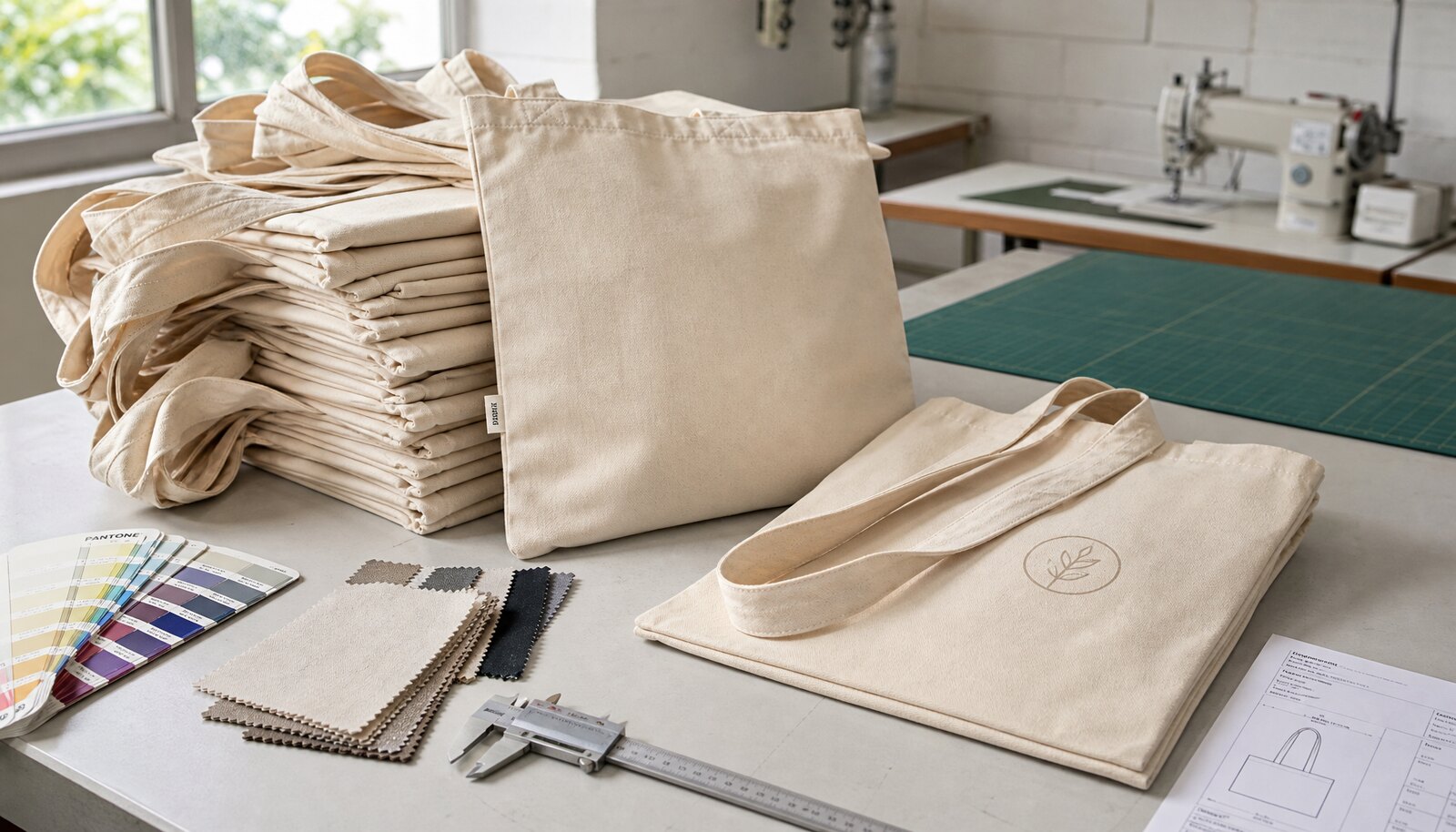
What gift shop buyers are actually buying
When a buyer searches for wholesale organic cotton totes for gift shops, the real objective is not just to source a canvas bag. It is to buy a retail-ready SKU that fits a display plan, supports the brand story, clears internal procurement review, and still leaves margin after freight, packing, and any relabeling work. The bag has to satisfy merchandising, operations, and finance at the same time, which is why a vague eco-bag quote usually fails somewhere after the sample stage.
The sourcing brief should start with the use case. A museum store, bookstore, botanical garden, tourist shop, or charitable retail counter all use tote bags differently. One may need a lightweight item that folds flat and works as an impulse add-on. Another may need a heavier bag with more structure, a cleaner print surface, and a better perceived value at shelf. If the supplier does not understand the commercial use, the quote tends to drift toward a generic tote instead of a product that can be bought, stocked, and sold.
- Define the retail setting before you define the bag.
- Treat the tote as a SKU with commercial requirements, not a craft item.
- Ask suppliers to quote the same use case you plan to sell.
Set the compliance bar before you ask for a quote
Organic compliance needs to be handled as a document chain, not as a marketing phrase. A natural-colored tote can look sustainable without being traceable enough for a retail claim. If your packaging, product page, or buyer line sheet says organic, the supplier should be able to connect the material source, the production lot, and the finished tote to the same paperwork trail. That usually means asking for the supplier scope certificate, the processor or factory scope certificate if there is more than one site, and the transaction certificate or order-level transfer document used for the specific purchase.
The other issue is claim scope. Buyers should not assume that a cotton body automatically makes every component claimable. Thread, woven labels, care labels, print inks, and hangtags can all sit outside the certificate scope or outside the language you plan to use in market. That is why the RFQ should ask the supplier to state exactly which parts of the tote are included in the organic claim and what labeling language they recommend for the target market. If you sell into the US, EU, or UK, the final wording also needs to fit local advertising and labeling rules, so the supplier should not be allowed to invent its own wording on the carton or hangtag.
- Ask for certificate numbers, not just a sustainability statement.
- Tie the order to the relevant transaction certificate or lot-level traceability record.
- Confirm whether the claim covers only the body fabric or the full finished tote.
Compare supplier routes on capability, not price alone
A direct sewing factory is usually the strongest route when you need repeatability. It gives you clearer visibility into fabric use, sewing standards, and what happens if the first sample does not match the approved version. A trading company can still be useful, especially for small or mixed orders, but then the buyer has to work harder to understand where the real bag is made, who owns QC decisions, and whether margin is hiding an unquoted change somewhere in the chain. If those basics are not disclosed, the buyer is comparing quotes without comparing risk.
Stock wholesalers and private-label specialists can be efficient when speed matters more than exact spec control. They are practical for seasonal programs, but they are not interchangeable with a factory that builds to your exact size, handle drop, and print placement. For a gift shop program, the sourcing choice should reflect how much variation the business can absorb without rework. If the bag has to arrive retail-ready on the first shipment, the buyer should pay for a route that can actually deliver that outcome.
- Use direct factory sourcing for repeat programs and tighter spec control.
- Use a trader only if the real maker and QC owner are disclosed in writing.
- Use stock inventory when speed matters more than exact spec control.
Write the RFQ so quotes can be compared line by line
Most weak RFQs do not fail because they forget to mention tote bags. They fail because they leave room for the supplier to interpret the order in several different ways. A strong RFQ should let two suppliers quote the same bag with very little ambiguity. That means the dimensions, fabric weight, print method, handle construction, packing method, certification scope, and commercial terms all need to sit in the same request. If any one of those is missing, the lowest quote may simply be the loosest quote.
Price breaks matter too. Ask for 1,000, 3,000, and 5,000 pieces on the same base spec so you can see whether the first tier is inflated to absorb setup cost or whether the price actually falls with volume. Separate setup charges from unit price. Then compare EXW and FOB at minimum, because a cheap unit price can become expensive once you add carton count, gross weight, inland moves, export docs, and the freight mode required to get the goods into your warehouse on time.
- Require one spec base across all price tiers.
- Separate setup charges from unit price.
- Ask for freight-sensitive data: carton size, carton weight, and pallet count if relevant.
Sample approval is a production gate, not a formality
Sampling should have stages. A sales sample is useful for feel and appearance, but it is not enough when the bulk order depends on exact fabric weight, final print curing, label placement, or retail packing. Ask for a pre-production sample that uses the final materials, then require first-piece photos before the line runs in volume. If the supplier only wants to send a generic sample, treat that as a warning that the bulk run may not follow the same standard.
The approval set should be simple and defensible: signed sample, approved artwork file, and packing reference. Keep those three items together so you can compare the bulk order later without debating memory or emails. If the tote has a woven label, care label, or hangtag, approve those items at the same time as the bag body. Rework after production is usually where time and margin disappear, so the sample stage needs to close the main variables before anyone cuts bulk fabric.
- Approve a pre-production sample, not only a sales sample.
- Use first-piece photos as a stop-go gate before the full run continues.
- Keep the signed sample, artwork, and packing reference in one control set.
Construction, branding, and packing choices that change the buy
For gift shop totes, a simple one-color screen print is often the safest commercial choice because it balances cost, durability, and visual clarity. That does not make it right for every brand, but it is the most predictable route when the logo is straightforward. If the artwork has fine lines, gradients, or several colors, the buyer should treat the print process as a separate risk item rather than assuming the sample will scale cleanly into production. Ask the supplier to state the exact print method, coverage area, setup cost, and any registration tolerance that will be used in bulk.
Construction details matter just as much as the decoration. A tote can look acceptable in a photo and still fail on shelf if the handle stitching is weak, the seam allowance varies, or the body twists after a few folds. Gift shop buyers should care about how the tote hangs on a hook, whether the handles stay even, and whether the print sits where a customer expects it when the bag is displayed flat. Packing follows the same logic. The right fold method, inner pack count, carton count, and carton mark format are part of the product spec because they affect receiving labor, shelf presentation, and freight cost.
- Approve only one print method unless you are intentionally quoting alternatives.
- Set the print placement tolerance in millimeters.
- Specify handle reinforcement and seam construction, not just the finished bag size.
Pricing, MOQ, and freight math buyers should check
MOQ should be read as a production signal, not a negotiation trophy. If the supplier asks for a higher minimum on custom print, that often reflects setup time, material control, or a less flexible line. If the MOQ looks unusually low, ask what was simplified to get there. Sometimes the answer is harmless, such as stock fabric or standard packing. Sometimes it points to hidden risk, like mixed lot packing or looser QC. The buyer should know which one it is before the PO is released.
The actual cost of a tote order is the sum of several pieces: fabric, cut-and-sew labor, print, labels, packing, cartons, internal handling, export paperwork, inland freight, and the ocean or air move. That is why EXW, FOB, and delivered quotes cannot be compared casually. If the supplier offers freight-inclusive pricing, ask for carton dimensions and gross weight so you can test the landed cost. At low MOQs, packing size and freight density can matter as much as the sewing price, especially on lighter totes where carton air eats margin fast.
- Ask for MOQ by size, fabric weight, and print method.
- Break the quote into fabric, labor, print, trim, packing, and freight.
- Compare landed cost using the same carton assumptions across suppliers.
QC plan with defect thresholds and pass/fail examples
Generic quality control language is not enough for procurement. A useful plan tells the factory what counts as acceptable and what happens when a check fails. If the first carton has a print shift, you do not need a philosophical discussion. You need a hold point, a re-inspection sample, and a decision on whether the run can be corrected or whether the batch should be sorted, reworked, or credited. Set those rules before production starts so there is no confusion after shipment.
For tote bags, the most useful checks are measurable: dimensions, shrinkage, seam construction, print alignment, fabric defects, shade consistency, carton count, and pack accuracy. A practical starting point is to classify defects as critical, major, or minor. Critical defects include the wrong organic claim language or a construction failure that makes the tote unusable. Major defects include broken seams, large print drift, or wrong dimensions outside tolerance. Minor defects include loose threads, small shading differences, or slight label misalignment that does not affect retail use. Common starting points for inspection are AQL 2.5 for major defects and 4.0 for minor defects, then adjust based on order value and retailer tolerance.
- Use a signed golden sample as the inspection reference.
- Set an action rule for each defect class: rework, sort, credit, or reject.
- Inspect the first pieces, not only the final cartons.
Production, logistics, and document handoff
The shipment plan should be part of the approval plan. Ask who owns the timeline from fabric booking to final docs, and make the critical path visible: fabric sourcing, print queue, sewing, packing, inspection, booking, and customs paperwork. The most common delay is not sewing; it is the handoff between steps. A supplier may finish the bags on time and still miss the ship date because carton marks are wrong, the packing list does not match the actual count, or the certificate paperwork was started too late.
The buyer should also decide early how the order will move. A small test order may make sense by air if the goal is sample-to-market speed, but that changes the freight math and often increases the risk of rushed packing. A larger retail program usually needs sea freight or a split plan with air for launch stock and sea for replenishment. Whatever the mode, ask for carton photos, final pack count, and document drafts before cargo leaves the factory. If the tote is retail-facing, the logistics plan should protect the shelf date as seriously as the product spec protects the bag itself.
- Map the production critical path before PO release.
- Request draft documents before cargo is handed over.
- Choose freight mode based on shelf date, not only on unit cost.
Use a decision framework for approval and reorders
The best sourcing decisions are easy to repeat because they are based on the same evidence every time. If a supplier delivered the right fabric, the correct organic documentation, stable print placement, and clean packing, that supplier can move into the approved set for reorders. If the supplier needed constant correction, the next order should not be treated as a simple repeat. It should be re-quoted with a tighter spec and more explicit inspection rules, or moved out of the approved list entirely.
The same logic applies to price negotiation. A buyer should push for better commercial terms when the quote is close but not quite aligned: a lower setup fee, clearer carton packing, better freight density, or a more practical MOQ. But if the supplier cannot produce a believable document chain or cannot hold basic construction tolerances, price is not the main issue. The bag is not operationally ready, and the buyer should avoid using discount as a substitute for control.
- Promote suppliers based on repeatable evidence, not just low pricing.
- Renegotiate weak commercial terms only after the spec and documents are stable.
- Treat document quality and QC performance as part of supplier scorecarding.
Specification comparison for buyers
| Supplier option | What to verify | Commercial advantage | Buyer risk to control |
|---|---|---|---|
| Direct sewing factory | fabric batch documents, dye-lot photos, approved sample archive, and final QC record | Better sample-to-bulk control and faster production feedback | May be weaker on export paperwork or branded packing unless checked early |
| Trading company | Factory name, production photos, trim-source proof, and who owns QC decisions | Can coordinate small mixed orders and extra services | Markup can hide real factory capability and slow defect decisions |
| Specialized bag workshop | seam allowance, handle reinforcement, label attachment, fabric pre-shrink note, and batch shade control | More practical for detailed construction, trims, and repeat programs | Capacity may be limited during peak seasons |
| Low-price general supplier | organic cotton canvas, batch documentation where available, undyed or low-impact dyed fabric, and shrinkage control | Useful for simple promotional runs with loose specs | Material downgrades, weak packing, and vague inspection scope can erase savings |
| Retail-ready supplier | plastic-reduction request, recycled carton note, bundle count, carton mark, and moisture protection without overpacking | Can handle labels, SKU separation, carton marks, and receiving rules | Higher unit cost must be compared against reduced warehouse work |
| Compliance-focused supplier | Fabric records, labeling review, test plan, and production traceability | Safer for retail programs and repeat brand orders | Documentation claims need evidence, not only sales language |
| Local sample room plus bulk factory | Signed sample, bulk factory handoff, first-piece photos, and deviation owner | Good for complex branding before large production | Sample room quality may not match bulk line unless handoff is controlled |
Buyer checklist before sampling
- Define the retail use case first: resale in gift shops, private-label merchandising, museum store, event giveaway, or bundled gift set. The spec should reflect the selling context, not just the bag shape.
- Lock the fabric target in GSM or ounces, then ask the supplier to state the acceptable tolerance in writing. A quote that leaves fabric weight vague is not comparable.
- Separate the organic claim from the product feel. Confirm whether the body fabric, thread, labels, and trim are included in the claim language you plan to use.
- Ask for the exact certificate numbers and the transaction certificate process for the order, not a generic sustainability statement. The paperwork should connect the quoted material lot to the finished goods.
- Approve one artwork placement, one print method, and one color standard before bulk. If the supplier offers alternatives, ask them to quote each option separately.
- Set dimensional tolerances before sampling. A workable baseline for a standard tote is body dimensions within plus or minus 1/4 in (6 mm), handle drop within plus or minus 1/4 in (6 mm), and shrinkage no greater than 5% unless you approve a different band.
- Specify seam expectations in the RFQ: seam allowance, reinforcement at handle joins, bartacks where needed, and a rule for skipped stitches or loose threads.
- Ask for packing details that match the receiving flow: fold method, inner pack count, carton count, carton size, carton marks, and whether a barcode label is required.
- Compare quotes on the same basis: EXW, FOB, or delivered. If freight is part of the offer, ask the supplier to show carton dimensions and gross weight so you can sanity-check the landed cost.
- Keep the approved sample, signed spec sheet, and packing reference together. If a batch needs to be disputed later, that set becomes the control record.
Factory quote questions to send
- What exact fabric composition, weave, GSM or ounce weight, and fabric width are you quoting for the tote body and handles?
- What is the target finished size, and what tolerance will you hold for body width, body height, gusset depth, and handle drop?
- Which organic certificate applies to the quoted material lot, and can you share the certificate number and transaction certificate process for this order?
- Which parts of the bag are included in the claim language: body fabric only, or body, thread, labels, and trim as well?
- Which print method is included, how many colors are covered, and what is the color-match tolerance or setup charge?
- What is your MOQ at 1,000, 3,000, and 5,000 pieces, and what changes in price are driven by fabric, print, labels, or packing?
- What are the sample stages, sample cost, sample turnaround time, and who signs off on the final pre-production sample?
- What carton size, inner pack count, and gross weight are you using, and how does that affect freight and pallet loading?
- What inspection standard do you use for stitching, print alignment, fabric defects, size tolerance, carton count, and label accuracy?
- What is the lead time after sample approval, and which step is most likely to delay shipping: fabric sourcing, print queue, sewing, packing, or documentation?
Quality-control points to confirm
- Fabric weight is within plus or minus 5% of the approved target GSM or ounce weight. If the incoming roll is outside that band, hold cutting until the supplier confirms a corrected lot.
- Finished body dimensions are within plus or minus 1/4 in (6 mm) for standard totes, or the tighter band written in the spec. If the first-piece sample misses the size, stop the line and remeasure the next five pieces.
- Shrinkage after the agreed test method is no more than 5% unless the buyer approved a different range in advance. If shrinkage exceeds the limit, reject the roll or require a re-cut plan.
- Handle drop is within plus or minus 1/4 in (6 mm), and both handles are matched within 1/8 in (3 mm) of each other. If the mismatch is visible in display orientation, do not release the lot.
- Seam construction shows no skipped stitches over a 1 in (25 mm) span, and bartacks or reinforcement at stress points are intact. If loose threads or open seams appear at the handle joins, inspect 100% of that carton group.
- Print placement is within plus or minus 2 mm of the approved location, with no obvious registration drift, pinholes, or under-cured ink. If the first carton shows drift, quarantine the print run before more cartons are packed.
- Shade and hand feel match the signed golden sample under retail lighting. If the shade shift is visible from one carton to the next, isolate the affected cartons and request lot sorting or credit.
- Carton count is exact, size mixing is not allowed unless the PO says otherwise, and carton labels match the order reference. If counts are short or mixed, hold shipment and require a corrected pack-out report before payment release.
- Use a common starting inspection plan such as AQL 2.5 for major defects and 4.0 for minor defects, then tighten or relax it based on order value and retailer tolerance. Reconfirm the sample size before production starts.
- Classify defects before inspection begins: critical for wrong organic claim language or a construction failure that makes the tote unusable, major for broken seams or wrong dimensions, and minor for loose threads or slight placement drift. That prevents disputes after the fact.