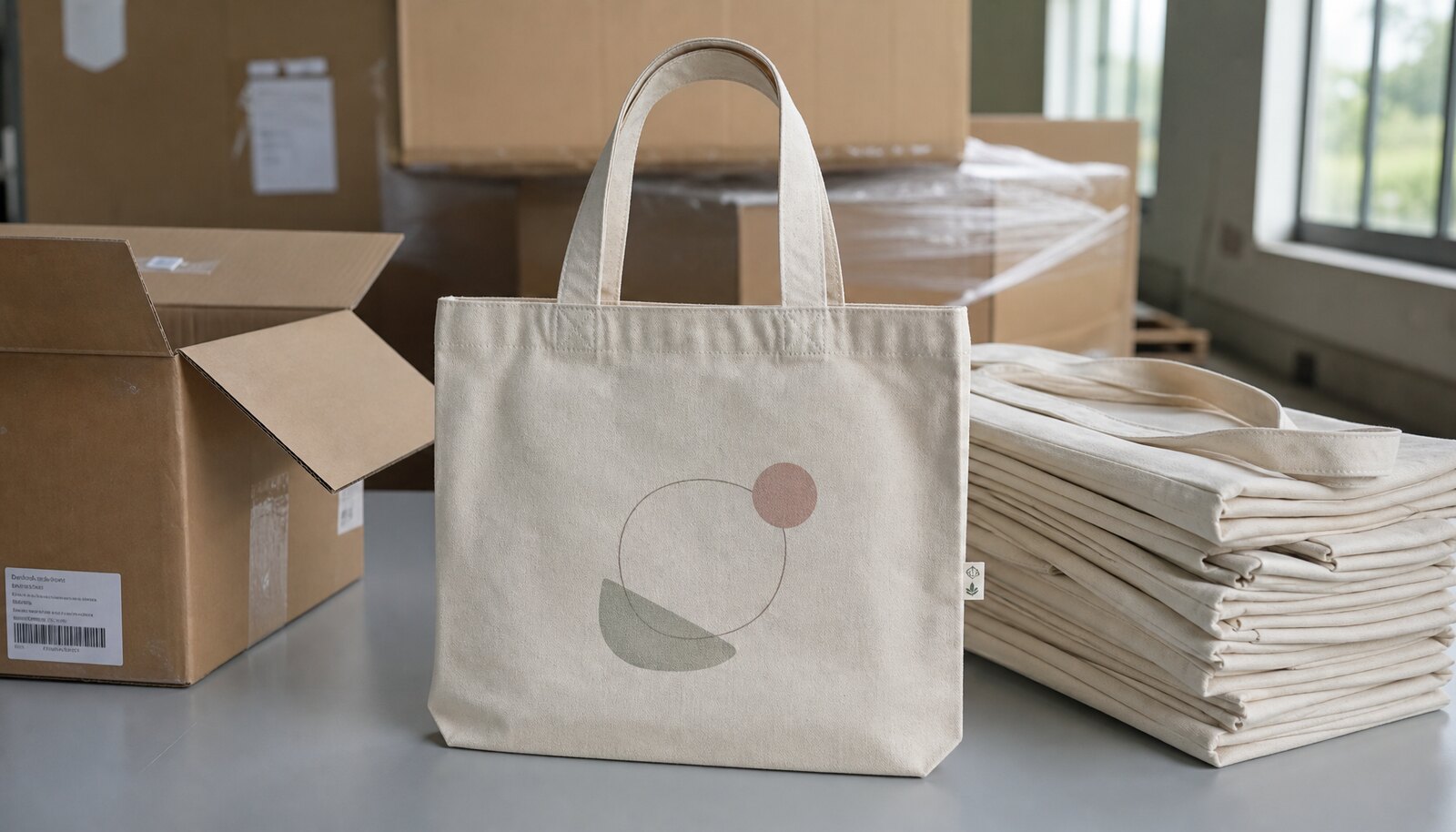
Start with landed cost, not the tote unit price
Gift shop buyers do not buy cotton totes in isolation. They buy a retail-ready item that has to arrive intact, meet the store's presentation standard, and fit into a receiving process that is usually tighter than the product itself. A low ex-works price can still become an expensive program if the carton plan is loose, the pack count is unstable, or the shipment consumes more cube than the warehouse can use efficiently.
That is why wholesale organic cotton totes for gift shops shipping carton planning should be treated as one buying problem, not two separate ones. The bag spec, the case pack, the carton size, and the pallet pattern all affect the final cost. If the carton is oversized, chargeable freight rises. If the carton is overfilled, the handles crease and the print suffers. If the carton count is inconsistent, receiving labor rises and the warehouse starts to distrust the product.
The procurement decision should therefore be made on landed cost by deliverable unit, not just on bag price. For a light textile item like a tote, even a modest change in pack efficiency can erase a small unit-price saving. The right question is not whether one supplier is five cents cheaper. The right question is whether the supplier can deliver the same bag quality in a carton that receives quickly, ships efficiently, and supports a repeat order without re-engineering the pack.
- Compare the bag price, carton plan, freight exposure, and receiving workload together.
- Treat carton dimensions and case pack as commercial variables, not packaging afterthoughts.
- If a supplier cannot state the pack spec at quote stage, the quote is incomplete.
Write the tote spec in procurement language
The most common reason tote quotes are hard to compare is that buyers send a concept instead of a spec. A useful spec should describe the finished bag, not just the idea of the bag. For this category, that means the finished size, whether the tote is flat or gusseted, the fabric weight, handle length and reinforcement method, print area, label type, fold method, and target carton size. If any of those points are left open, the factory will fill in the gap with its own assumption.
A retail tote for a museum shop or destination gift shop often needs a more deliberate handfeel than a basic souvenir bag. A 140 GSM fabric may be adequate for a low-price item, while 150 to 160 GSM is often better when the bag has to sit on shelf, hold its shape, and justify a higher shelf price. The right weight is not a fashion question. It is a merchandising and freight question. Heavier cloth improves body, but it also changes sewability, finished thickness, and carton count.
Construction matters just as much. A flat tote is simpler to sew, easier to fold, and usually easier to ship. A light gusset adds utility and gives the bag more visual presence, but it also adds bulk and can reduce the number of units per carton. If the tote is meant to hang or sit near a register, flat construction often wins. If it is meant to function like a reusable carry bag, a small gusset may be worth the extra pack volume.
- Use one-page specs with measured values, not marketing descriptions.
- Define tolerances for size, weight, and print position before you request pricing.
- Lock the fold method early because the fold changes carton count and freight cost.
Choose the supplier route that matches your control needs
Different supplier routes solve different procurement problems. A direct factory gives the clearest view of sewing quality, print execution, and packing discipline. It is usually the best route for repeat programs where the tote spec is stable and the buyer is willing to manage the details. A trading house or exporter can simplify communication and consolidate paperwork, but the buyer needs to check whether the original factory identity and certification trail are visible. A sourcing agent can help with sampling and follow-up, but they do not improve production quality unless they are truly controlling the factory side. A domestic stockist or wholesaler is the simplest route for urgent replenishment, but the buyer gives up almost all control over carton design and pack logic.
The supplier route should be chosen based on the level of control you actually need. If the tote is a core retail item, the direct factory route often produces the cleanest result because the buyer can set the carton dimensions, inspection standard, and label copy directly. If the order is mixed, time-sensitive, or spread across several SKUs, an exporter may be the easier commercial route. If the program is still being defined and the internal team needs more support, a sourcing agent can keep the project moving, but only if the buyer keeps control of the spec and the approval trail.
The key procurement habit is to separate commercial convenience from production control. A route that feels easier on the front end can create more work later if documents are incomplete or the carton spec was never truly approved. Buyers should compare routes on document visibility, ownership of the pack spec, and who is responsible if the packed carton does not match the approved sample.
- Use direct factory when you want the most control over sewing, print, and packing.
- Use an exporter when you want easier coordination but can still verify the original source documents.
- Use a domestic stockist when speed matters more than exact carton design or label control.
Request the right organic papers by market
Organic cotton claims live or die on traceability. A supplier saying the fabric is organic is not enough for procurement. Buyers should ask for the documents that connect the claim to the lot that is shipping. At a minimum, that usually means the factory or exporter scope certificate, the shipment-level transaction certificate or equivalent lot-level proof where applicable, the commercial invoice, the packing list, and the carton and label proofs that will be used on the shipment. If the claim language changes between documents, treat that as a red flag.
The exact paperwork depends on the market, but the principle is the same: the claim must be traceable from the source to the carton and the invoice. For the US, keep the textile label content, origin statement, and organic claim aligned with the supplier's certification trail and your own import documentation. For the EU and UK, make sure the shipment documents and label copy are consistent with the route you are using for the organic claim and any local language requirements. For Canada, Japan, Australia, and other markets, confirm with your broker or compliance team which label, declaration, and certificate documents they need before production starts. The buyer should not assume the same paper set works everywhere.
If a supplier cannot provide lot-level traceability, the claim should not be treated as verified for commercial purposes. That does not automatically mean the goods are unusable. It means the buyer should either remove the organic claim from labels and sales copy or switch to a supplier that can document the chain properly. The point is to avoid a situation where the tote is physically fine but the paperwork cannot support the market claim.
- Ask for the supplier scope certificate and the shipment-level paper trail for the lot you are buying.
- Keep the exact claim wording identical on the sample, carton label, invoice, and final artwork.
- If the market has special language or import rules, confirm them before print approval, not after.
Build an RFQ that produces comparable quotes
Most quote problems come from incomplete inputs. A usable RFQ for organic cotton totes should give every supplier the same assumptions so the answers are comparable. Include the finished size, whether the bag is flat or gusseted, the GSM target, handle length, print method, artwork count, fold method, target pack count, carton target, pallet target, destination, and Incoterm. If you want options, ask for them explicitly. For example, request pricing at 140, 150, and 160 GSM, or ask for separate pricing on flat and gusseted construction.
The quote itself should be broken into components. Ask for the bag price, print setup cost, per-piece print cost, packing cost, carton cost, sample charge, any testing or certification fees, and any overrun or underrun policy that affects how many pieces you actually receive. If the supplier returns only one lump sum, the quote is harder to compare and the hidden variables are usually sitting in the carton, freight, or rework assumptions.
A good quote also tells you where the risk sits. If a supplier wants to price on estimated folded size without a packed sample, the buyer should know that the pack count may move later. If the supplier quotes a favorable unit price but will not commit to carton dimensions or board grade, the freight savings may disappear in handling. A quote matrix should let you compare not just price, but control.
- Ask each supplier to quote the same spec, the same artwork, and the same destination.
- Require carton dimensions, gross weight, board grade, and case pack in the quote.
- Ask the supplier to identify any part of the quote that could change after sample approval.
Plan the carton from the folded bag outward
Carton planning should begin with the folded bag, not the finished bag. The key inputs are the folded length, width, and thickness of one tote, plus the carton's internal dimensions. That is the only way to estimate a practical case pack. A bag that looks small on paper may still pack thickly if the fabric is firm, the handle is long, or the print adds stiffness. The factory should be able to show its lay-count math instead of simply stating a carton quantity.
A simple flat tote example makes the logic clear. Suppose the approved folded profile is about 20 x 25 x 0.7 cm and the internal carton is 60 x 40 x 30 cm. The theoretical stack based on thickness alone is large, but the practical count must be reduced for compression, carton closure, and handling margin. In real production, the usable count might land around 36 to 38 pieces rather than a purely mathematical maximum. If the bag weight is about 110 g, the bag fill is roughly 3.96 kg at 36 pieces, before carton, tape, and inserts. That is a manageable gross carton weight for warehouse handling.
Now compare that with a gusseted tote. If the folded profile is closer to 21 x 26 x 0.9 cm, the same carton will usually take fewer pieces because the stack is thicker and less forgiving. A practical pack might be 24 to 26 pieces in a carton such as 58 x 38 x 28 cm, depending on how the handles are folded and whether the supplier bands the bags or inserts slip sheets between layers. The operational point is not the exact number. It is that the bag shape directly drives the count and the freight cube.
- Use internal carton dimensions, not outer dimensions, when checking fit.
- Reduce the theoretical count for compression and closure margin before you approve the pack.
- Approve a packed carton sample if the fold method, size, or artwork is new.
Turn carton size into pallet and freight decisions
Once the carton size is fixed, pallet planning becomes a straightforward commercial calculation. A 60 x 40 cm carton fits four-up on a 120 x 80 cm pallet. That is useful, but the real constraint is height. Many retail and warehouse receivers care more about loaded pallet height than about the number of cartons alone. If your carton is 30 cm high and your pallet adds roughly 15 cm, four layers bring the loaded height to about 135 cm. Five layers would push the pallet toward about 165 cm, which may be too tall for some receiving docks, especially if the cartons are light and top-heavy.
This is where freight and handling meet. A carton plan that looks efficient on a spreadsheet can become awkward if the pallet is too tall, too heavy, or too unstable to wrap tightly. For shipments that move by LCL, parcel, or air, cubic volume is the bigger issue. One 60 x 40 x 30 cm carton occupies 0.072 cubic meters, so 300 cartons consume 21.6 cubic meters before void space and pallet loss are considered. That is why a slightly smaller carton or a better fold can sometimes save more money than negotiating another discount on the bag itself.
For procurement teams, the practical rule is simple: decide the maximum loaded pallet height, the maximum gross carton weight, and the preferred pallet pattern before the PO is released. If the carton count changes, rerun the freight math. If the bag count per carton changes, rerun the pallet height check. If the route switches from sea to air or from full pallets to mixed freight, the whole carton plan should be revalidated. The cheapest tote on paper can become the most expensive tote to receive.
- Set a hard maximum for loaded pallet height and confirm it with the receiving warehouse.
- Check chargeable volume as well as gross weight before you accept a low unit price.
- For palletized orders, ask for the pallet pattern and stretch-wrap method in writing.
Set QC acceptance criteria before production starts
Quality control for organic cotton totes should be more specific than a simple visual check. The buyer should define what a major defect, minor defect, and critical defect look like before production begins. A common starting point is AQL 2.5 for major defects and 4.0 for minor defects, but the exact numbers should match your risk tolerance and sales channel. For a gift shop program, a wrong claim, a wrong label, or a badly mispacked carton is often more serious than a small thread trim issue, so defect classes need to reflect commercial reality.
The bag checks should cover the things that actually matter to the retail buyer and the warehouse. Confirm fabric weight, dimensions, seam quality, handle reinforcement, print registration, color consistency, contamination, and fold quality. Use daylight or a controlled light source to compare the goods to the approved sample. For printed bags, add a simple rub or fold check so the artwork does not crack at the crease. If the bag carries an organic claim, the label and invoice language should be checked as part of the same inspection, not as a separate document review after the shipment has left.
The carton itself needs inspection as well. Check board grade, tape adhesion, top-flap closure, label placement, count accuracy, and carton squareness. If the shipment is palletized, ask for a filled-carton drop check and a compression check when the cartons will be stacked or double-stacked. The method does not need to be complicated, but it does need to be agreed in advance. If the carton fails the test, the supplier should know whether to repack, relabel, or rework before the shipment is released.
- Classify a wrong organic or fiber claim as a stop-ship defect.
- Inspect the first production output, not just the final shipment, so problems can be corrected before packing finishes.
- Validate carton closure, stackability, and label readability before the shipment leaves the factory.
Use lead-time gates to prevent last-minute changes
Lead time is not one number. It is a chain of approvals. For a tote program, the normal decision gates are specification freeze, sample approval, material booking, cutting, printing, sewing, packing, inspection, carton labeling, and shipment release. If the artwork is still changing or the carton spec is not final, the schedule is not truly running yet. Buyers who treat the lead time as a single blanket date usually discover too late that one late revision has already reset the plan.
The most common delays are predictable. Artwork changes after proof approval force rework. Carton changes after the packed sample force repacking. Label language changes after production starts can create a relabeling bottleneck. Fabric shade questions near the end of the run often turn into extra waiting time while the factory tries to reconcile what the buyer expected versus what was approved. For seasonal gift shop launches, those delays matter more than they do for evergreen basics because the selling window is shorter.
The most disciplined teams write the calendar around stop points. If the sample is approved on Friday, the buyer should know exactly when material booking locks, when printing starts, when the first packed cartons should be photographed, and when final inspection occurs. Repeat orders can move faster, but only if the spec, artwork, carton plan, and documentation path are identical to the prior run. If any of those changes, the order should be treated as a new approval cycle.
- Ask for milestone dates for sample approval, cutting, printing, packing, inspection, and ex-factory release.
- Do not let artwork or carton changes land after the production schedule has been released.
- Treat any change to size, print, label, or carton count as a new approval event.
Use a simple buying workflow for repeat gift-shop orders
A strong tote program is built on a repeatable workflow. First, the buyer writes a one-page spec and quote matrix. Second, the team selects the supplier route based on how much control it needs over traceability, packing, and lead time. Third, the supplier returns a structured quote with bag, print, pack, carton, and document costs separated. Fourth, the buyer approves a loose sample and a packed carton sample. Fifth, the buyer inspects the first production output and confirms the carton labels, case count, and claim wording. Sixth, the warehouse receives the cartons and checks the count, closure, and stack quality on arrival.
That workflow keeps the commercial and operational pieces aligned. It also makes supplier comparison easier because every quote is judged against the same facts. If one supplier is cheaper but cannot provide carton dimensions, the difference is visible. If another supplier is slower but provides stronger documentation and cleaner palletization, that is visible too. For a gift shop buyer, the right supplier is usually the one that reduces surprises at receiving, not the one that merely offers the lowest bag price.
If you are building a seasonal range, the safest rule is to preserve what worked. Hold the bag size, GSM, label position, fold method, and carton spec steady wherever possible. Change only what the merchandise plan requires. The more variables you change in one run, the more likely you are to discover a pack problem when you have the least time to fix it.
- Keep one master spec sheet per SKU and one revision history for all quote and production changes.
- Track bag quality, carton performance, and document accuracy as separate approval steps.
- Reuse the prior approved carton spec when replenishing a successful program unless sales or freight requirements have changed.
Specification comparison for buyers
| Supplier route | Best use case | Documents to request | What you control | Main tradeoff |
|---|---|---|---|---|
| Direct factory | Repeat programs where you want the cleanest view of sewing, print, and packing | Scope certificate, transaction certificate if applicable, commercial invoice, packing list, carton spec, carton label proof, production photos | Bag spec, case pack, carton dimensions, inspection sign-off, rework path | Lowest commercial layering, but you must be precise on carton planning and QC |
| Trading house or exporter | Mixed programs, consolidated shipments, or buyers that want one point of contact | Original factory name, certification trail, shipment-level documents, carton spec, invoice, packing list, label proof | Commercial coordination and shipment paperwork, sometimes carton approval | Easier coordination, but traceability can become less transparent if documents are not reviewed carefully |
| Sourcing agent | Teams that need help with sampling, communication, or factory follow-up | Factory identity, sample records, certification trail, packed carton sample, final inspection report | Project management and issue chasing, not production ownership | Useful for coordination, but the buyer still owns quality and carton acceptance |
| Domestic stockist or wholesaler | Urgent replenishment, smaller runs, or buyers who need low lead-time risk | Country of origin, batch or stock records, product labeling, any available organic evidence tied to the stock | Delivery speed and service, not factory-level pack design | Fast and simple, but higher unit cost and less control over exact carton spec |
| Material | organic cotton canvas, batch documentation where available, undyed or low-impact dyed fabric, and shrinkage control | Before price comparison | Different cloth weights, backing, or certification claims make quotes hard to compare | |
| Construction | seam allowance, handle reinforcement, label attachment, fabric pre-shrink note, and batch shade control | Before sampling | Weak stress points create returns and failed inspections | |
| Decoration | water-based print, embroidery, woven organic label, or low-impact transfer checked against certification claims | Before artwork approval | The wrong method can crack, bleed, pucker, or fail on the chosen fabric | |
| MOQ | Base MOQ plus change drivers | During quote review | Custom colors, trims, and packing can change minimums |
Buyer checklist before sampling
- Send one RFQ pack with finished size, flat or gusseted construction, GSM target, handle length, print area, fold method, carton target, pallet target, destination, and Incoterm.
- State the tolerance you will accept for finished size, weight, and print placement so the factory is not quoting against vague dimensions.
- Ask for the exact organic traceability path for your market, including the scope certificate and any shipment-level transaction certificate or equivalent paper trail.
- Request a loose pre-production sample, a packed carton sample, and a carton label proof before bulk production starts.
- Ask the supplier to show the lay-count math used to determine the case pack, not just the final carton count.
- Confirm inner bundle count, master carton count, gross weight, carton board grade, and carton closure method in writing.
- Ask for pallet pattern, max pallet height, and whether the warehouse can accept the pallet wrapped and labeled as shipped.
- Lock the final artwork version, claim wording, label language, and carton copy before cutting begins.
- Ask for the overrun and underrun policy by size, color, print version, and carton configuration.
- Define the inspection standard in advance, including defect classes, sample size, and who pays for rework or relabeling if the order misses spec.
Factory quote questions to send
- What GSM range are you quoting, and what is the price difference between 140, 150, and 160 GSM organic cotton?
- Is the quote based on a flat tote or a gusseted tote, and what are the exact finished dimensions after sewing?
- What folded size are you using for packing, and what carton internal dimensions do you recommend from that folded size?
- How many bags per inner bundle and per master carton do you recommend, and what lay-count math did you use?
- What are the carton internal and external dimensions, carton board grade, gross weight per carton, and cartons per pallet?
- What print method is included, how many colors are covered, and what setup charge applies per artwork position?
- What is the MOQ by size, by color, by print design, and by carton pack configuration?
- Can you provide a loose pre-production sample, a packed carton sample, and a carton label proof before bulk shipment?
- What inspection standard do you use for stitching, print registration, size tolerance, and carton count accuracy?
- Which documents can you provide for the organic claim in our market, and how will the claim appear on labels, cartons, and invoices?
Quality-control points to confirm
- Fabric weight should stay within the agreed GSM range, not just a verbal claim about thickness.
- Finished dimensions should be checked against the approved sample so the fold and case pack remain stable.
- If you are using AQL, define the level in advance; many buyers start with AQL 2.5 for major defects and 4.0 for minor defects, then adjust to risk.
- Handle stitching should be even, reinforced at stress points, and strong enough to pass a practical pull check.
- The bag should be free from loose threads, needle damage, oil stains, lint, and visible contamination on the inside and outside surfaces.
- Print registration should match the approved sample, with no bleeding, ghosting, cracking, or distortion at fold lines.
- Shade variation should be controlled within the approved lot standard; if the program uses natural fabric, define what variation is acceptable before production.
- If the order uses an organic claim, the wording on labels, hangtags, cartons, and invoices must match the approved documentation path exactly.
- Master carton count should be verified against the packing list, and any mixed-size carton should be approved in writing before shipment.
- Carton closure should not crush handles, compress the print, or bow the carton lid outward.