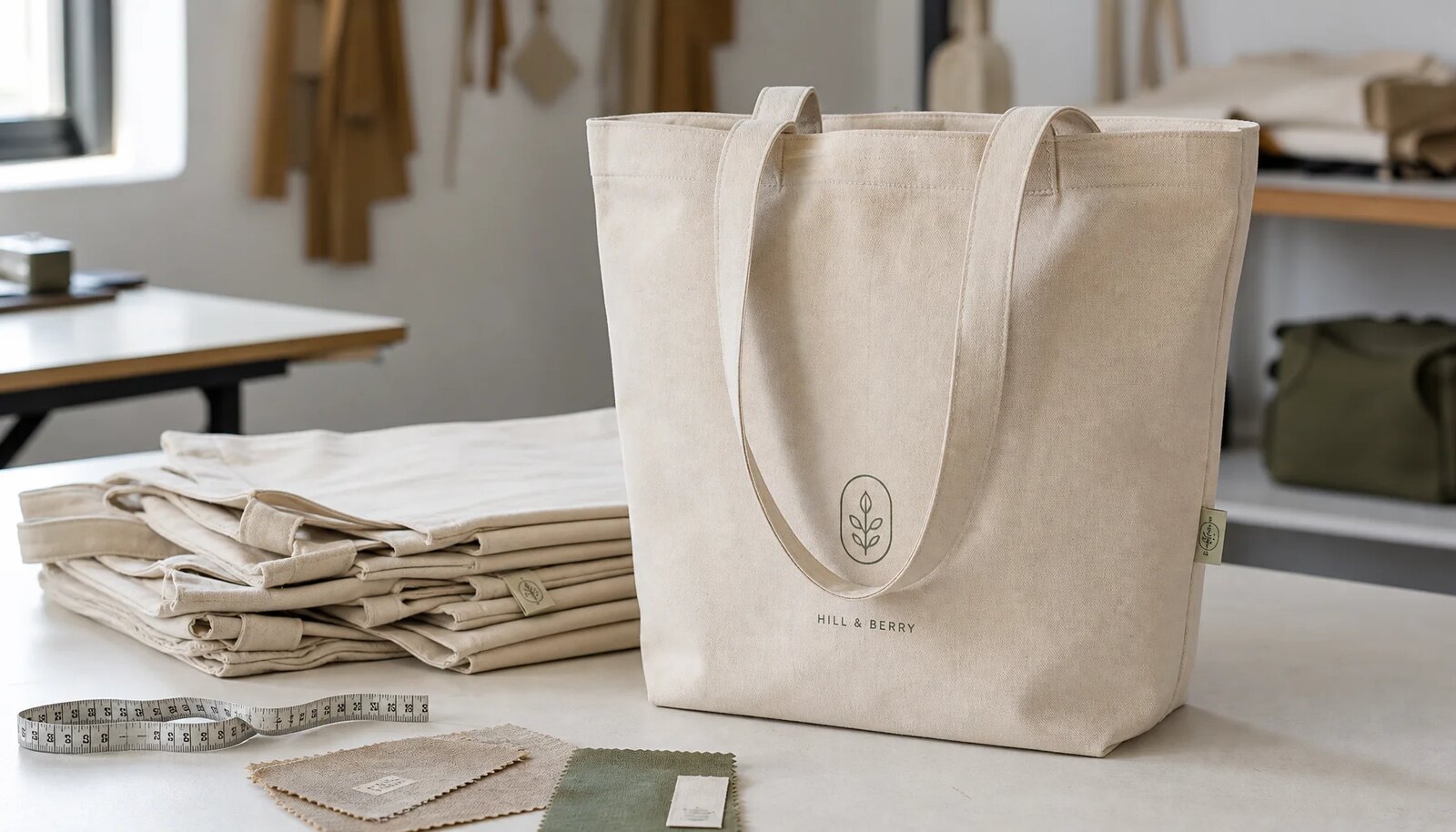
Why this tote is harder to source than it looks
A farmers market tote looks simple until procurement has to compare quotes. The base product is only one part of the order. The real sourcing variables are fabric weight, weave, handle reinforcement, print method, packing, and the amount of variation the factory must manage across SKUs. For wholesale organic cotton totes for farmers market vendors, those choices change MOQ, lead time, and the true landed cost more than the logo does.
The common failure mode is comparing supplier offers that are not built the same way. One factory may quote a 140 GSM plain-weave body with a single-color screen print and loose bulk packing, while another is pricing a 180 GSM canvas body with reinforced handles, paper wrap, and carton labeling. Those are different products. Procurement only gets a meaningful answer when the spec is fixed before the negotiation starts.
This is also why tote sourcing often feels more complex than buying a standard promotional item. The bag must be sturdy enough for repeated carry, clean enough for retail display, and cheap enough to hold margin for the vendor. If the sourcing brief does not define that balance clearly, every factory will optimize a different part of the product and the quotes will be noisy rather than useful.
- Treat the tote as a spec-led item, not a blank commodity.
- Compare build assumptions first, then compare price.
- The cheapest quote often hides the weakest seam, lightest fabric, or least protective packing.
Start with the use case and carry profile
The right tote spec depends on how the bag will be used, not just how it will look in the product photo. Farmers market vendors usually need one of three outcomes: a resale tote with brand value, a reusable carry bag handed out with purchase, or a sturdier utility bag for produce and bottles. Each use case points to a different balance of fabric weight, construction, and finishing.
For resale programs, the bag has to present cleanly on a table or shelf. That usually means consistent dimensions, neat folds, and print placement that is centered and repeatable. For a giveaway bag, unit cost may matter more, but the bag still needs to survive enough use that the brand does not look cheap. For produce carry, handle reinforcement and seam security become more important than premium finishing.
Carry profile matters as much as product category. Ask how much the bag is expected to hold, whether items will be wet or heavy, whether customers carry it by hand or over the shoulder, and whether the bag needs to stand upright when empty. A tote that must stand on a market table benefits from a firmer cloth and a more stable base. A tote that is only meant for light branded handout use can stay lighter, but that decision should be deliberate.
- Retail resale: prioritize shape consistency, print quality, and clean folding.
- Vendor giveaway: prioritize unit economics and acceptable durability.
- Produce carry: prioritize reinforced handles, seam strength, and load balance.
- If the bag must stand upright, require a firmer body and a flat, stable base.
The specs that move price and MOQ
For this category, GSM is one of the fastest ways to clarify the quote. A common working range is 140-180 GSM. Around 140 GSM, the bag stays economical and lightweight, which can suit promotional use or lighter carry loads. Around 160 GSM, you usually get a better balance of hand feel, print surface, and perceived quality. At 180 GSM, the bag becomes more structured and is generally better suited to heavier everyday use or resale programs that need a more substantial feel.
Fabric weight is only part of the spec. Weave type affects both appearance and print behavior. Plain weave can print cleanly and keep cost controlled. A more canvas-like weave often feels sturdier and can support a better retail perception, but it may increase sewing effort and alter the print surface. Gussets add capacity and improve shelf shape, but they also add dimensional complexity and more chance for variance if the cutting and sewing are not controlled.
Handle specification deserves its own line item. A long shoulder drop is useful for shoppers walking between stalls and cars, while a short hand-carry handle may look neat but is less practical for market use. Handle width, top hem reinforcement, and bar tacks all affect how the bag feels under load. If the print includes fine typography, the buyer should also tie artwork complexity to the fabric texture. A textured weave will not reproduce small type as cleanly as a smoother cloth.
- 140 GSM: suitable for lighter carry use and lower-cost promotions.
- 160 GSM: a practical middle ground for resale and repeat use.
- 180 GSM: better for heavier loads and a more premium hand feel.
- Gusseted bodies improve capacity but increase sewing and tolerance risk.
- Limit fine text if the fabric texture is coarse or highly open.
MOQ negotiation levers that factories will actually honor
MOQ on organic cotton totes usually comes from three places: fabric booking, print setup, and cutting efficiency. If the factory has to source custom fabric, the minimum climbs quickly. If the body spec is standard and only the print changes, the order is easier to spread across production. That is why buyers should ask which line item actually drives the minimum, rather than negotiating against a single headline number.
The most effective way to lower MOQ is to standardize what can stay standard. Keep the body fabric, size, and construction fixed across all colors or market versions, then vary only the print or woven label. Simple artwork also helps. One-color screen print is usually easier to absorb than a multi-color design, especially when the order is not large enough to justify expensive setup across several variations. If you need multiple SKUs, ask whether they can share one production base and only change the print file.
Reorder logic matters too. Some factories will quote a higher first-run MOQ but a lower reorder minimum if nothing in the spec changes. That can be a useful compromise when you want to test a market without locking yourself into a large first buy. The key is to write down which elements are fixed: fabric, size, print placement, label, and packing. The more stable the spec, the more likely the factory is to honor repeat production at a lower threshold.
- Ask which item drives MOQ: fabric, print, label, or packaging.
- Lower MOQ by standardizing the body spec across SKUs.
- Use fewer print colors to reduce setup cost and production friction.
- Negotiate a lower reorder minimum if the first run proves the spec.
- If needed, keep the body blank and add customization only where it is cheapest.
How to compare supplier quotes without getting fooled
The easiest way to misread tote quotes is to compare only the unit price. A useful quote should break out the tote body, printing, label, sample charge, packing, carton, and any special handling. When a supplier gives only one all-in number, you cannot see where the margin sits or what has been assumed away. The quote may look competitive simply because it excludes the details that will later be charged separately.
To compare suppliers properly, force each one to quote the exact same finished size, GSM, handle length, print count, packing method, and carton count. If Supplier A quotes a thinner cloth, looser tolerance, and bulk packing while Supplier B quotes a heavier cloth, paper wrap, and better carton protection, they are not competing on the same build. In practice, the more disciplined quote can be cheaper on landed cost because it reduces damage, rework, and warehouse friction.
A clean comparison also requires a list of exclusions. Ask what is not included in the quoted price: artwork changes, extra sample rounds, color matching fees, carton markings, palletization, inspection, or destination-side handling. The supplier who discloses exclusions clearly is often easier to work with because the commercial terms are easier to manage. The supplier who says everything is standard may simply be moving complexity into the next conversation.
- Normalize all quotes to the same GSM, size, print count, and packing method.
- Request separate sample and setup charges.
- Ask for exclusions in writing, not only inclusions.
- Use carton dimensions and gross weight as part of the quote review.
- Do not compare a loose-packing quote against a fully protected retail pack without adjusting for the difference.
A practical landed-cost view for buyers
A tote’s landed cost is shaped by more than sewing labor. Fabric weight affects freight and carton density. Print method affects setup and reprint exposure. Packing style affects how many units fit in a carton and how much handling labor the factory must absorb. A slightly thicker tote can be the right choice if it reduces complaint risk and improves resale value, but the buyer needs to see the freight impact before approving the spec.
A simple landed-cost model should include unit price, print setup, sample cost, inner packing, cartons, freight, duty if applicable, and destination receiving. Buyers often forget how much carton design changes the actual cost per usable unit. A tote that folds poorly or ships with excess wrap may reduce pieces per carton and raise the cost even if the sewing price stays flat. The bag is not just a sewn item; it is a packed and shipped unit.
For seasonal market programs, landed cost should also reflect time risk. A low-cost quote that arrives late is not cheap if it misses the launch window. Buyers should compare the real cost of a slower supplier against the cost of a more reliable one, especially when the bags are tied to a farmers market opening, retail event, or promotional rollout. On this product, schedule reliability is part of economics, not a separate issue.
- Ask for carton dimensions, gross weight, and pieces per carton.
- Include sample cost in the first-order landed cost model.
- Check whether a thicker tote changes carton density enough to alter freight.
- Factor in reprint or remake exposure if the first sample misses the target.
- Do not ignore destination receiving and unpacking labor.
Sample approval and QC checkpoints
A pre-production sample should prove the final build, not just the logo placement. It should verify fabric feel, finished dimensions, handle attachment, print alignment, label position, and folding behavior. For a farmers market tote, the sample should also show how the bag sits when empty and whether the base lies flat enough for display. If the sample feels flimsy, buyers should not assume production will magically feel firmer.
Sample approval works best when it is based on a written checklist. The buyer should confirm the target GSM, the approved artwork file, the placement measurement, the expected handle drop, and the packaging method. If the sample is off by a few millimeters in one area but the rest is correct, the buyer can decide whether that deviation is acceptable or whether the factory needs a revision. Without a written reference, the approval process becomes subjective and difficult to enforce later.
Quality control in bulk production should focus on the failure points that matter in use. Handle bar tacks, side seams, gusset corners, and print edges are the usual weak spots. A visual inspection is necessary, but not sufficient. Buyers should ask for a practical pull test on the handles and a check that the bag dimensions are still within tolerance after finishing and packing. If shrinkage is a possibility, the quotation should specify whether finished dimensions are measured before or after any washing or steaming step.
- Check fabric GSM and body firmness against the approved spec.
- Measure handle length, drop, and stitch reinforcement on the sample.
- Test print alignment, density, and bleed on fold lines.
- Verify the sample against a written spec sheet, not only a photo.
- If shrinkage matters, state whether measurements are taken pre-finish or post-finish.
Packing, cartonization, and freight
Packing is not a cosmetic detail. It changes warehouse efficiency, damage rate, and freight cost. Bulk packing is the cheapest option and often the easiest for the factory, but the fold must be consistent so the print area does not crease in the same place every time. Individual polybags protect presentation better, but they add material, labor, and carton volume. Paper wrap can be a good compromise if the buyer wants a more retail-friendly pack-out without adding plastic.
The right packing decision depends on how the tote will be received and sold. If the bags go to a warehouse before retail distribution, carton count and outer marking matter. If the bags are going directly to vendors for resale, the display appearance and folded shape may matter more than the lowest possible packing cost. Buyers should specify the fold direction so the logo opens correctly when the bag is unpacked, and they should confirm whether handles are tucked in or folded flat to reduce wrinkling.
Carton data should be part of the approved spec. Ask for carton dimensions, gross weight, pieces per carton, pallet pattern if applicable, and the outer mark format. That information lets logistics teams estimate freight and receiving effort before production starts. If the supplier cannot provide stable carton data, the order may still be possible, but the buyer should treat that as a risk rather than a minor detail.
- Specify fold direction so the logo faces correctly when unpacked.
- Set a fixed pieces-per-carton count for receiving efficiency.
- Use packing that protects the print without inflating carton size unnecessarily.
- Ask for outer carton marks showing style, color, and carton count.
- If palletized, confirm stack height and pallet pattern in advance.
Lead time planning and schedule risk
Lead time on organic cotton totes is often lost before sewing begins. The usual delay points are fabric booking, artwork approval, sample revision, carton confirmation, and packing sign-off. If the fabric is standard, the timeline can be moderate. If the order needs custom cloth or a special finish, the lead time can stretch quickly. Buyers who only ask for sewing days are ignoring the longest parts of the schedule.
A realistic timeline should include time for pre-production sample approval, not just mass production. The safest schedule is built backward from the event date: market launch, retail delivery window, or promotional release. If the bags must arrive for a seasonal farmers market program, even one sample correction can consume a meaningful part of the calendar. Buyers should also ask the factory where orders usually queue, because factory bottlenecks are often more important than nominal production capacity.
Multiple SKUs increase schedule risk. Every added color, label variant, or print change creates another point where proofing can stall. If the program needs several versions, it is often smarter to lock one shared body spec and vary only the print. That keeps the schedule simpler and reduces the chance that one variant delays the whole shipment.
- Common delay points: fabric booking, sample revision, print proof approval, carton sign-off.
- Seasonal launches need extra buffer beyond the sewing window.
- Ask the factory where orders usually queue, not just how many days they promise.
- Do not assume the quoted lead time includes sample approval and transit.
- Each extra SKU increases production and approval risk.
What a clean RFQ should include
A strong RFQ for wholesale organic cotton totes for farmers market vendors should read like a production specification, not a marketing brief. State the finished size, fabric GSM, weave type, handle length, gusset depth, print method, print area, label type, packing style, target MOQ, and target ship window. If you need multiple designs, say whether they share the same body spec or whether each one needs a separate build. That one line can change the supplier’s ability to hold MOQ down.
The RFQ should also tell the supplier what matters most. Is the priority lowest unit price, strongest presentation, fastest delivery, or highest durability? Factories can optimize for only one or two of those at once. For farmers market resale, durability and presentation usually matter more than saving a small amount on the bag body. For a promotional handout, a lighter cloth and simpler print may be the right tradeoff. The more precise the brief, the less time you waste untangling vague quotes later.
A good RFQ also asks for quote assumptions, not just a price. Ask the supplier to confirm tolerances, packaging, sample path, and exclusions. If they cannot do that clearly, the order can still be possible, but you should treat the commercial risk as higher. Clear RFQs usually get clearer quotes because the factory knows exactly what is expected and what will be judged at inspection.
- Include exact dimensions and acceptable tolerance.
- Specify artwork file type and number of print colors.
- State whether you need physical samples, sample photos, or both.
- Say whether all SKUs share one body or each design needs its own spec.
- Ask suppliers to confirm exclusions, not just inclusions.
Specification comparison for buyers
| Spec decision | Recommended option | When it fits | Buyer risk to check |
|---|---|---|---|
| Fabric weight | 140-180 GSM organic cotton canvas or plain weave | Farmers market resale, repeated carry use, and buyers who want a sturdier hand feel without excessive freight cost | Too light can show product through the bag; too heavy can raise carton weight and increase sewing cost |
| Bag construction | Gusseted body with reinforced side seams and bar-tacked handles | Retail programs that need a cleaner shelf shape and moderate MOQ | Unreinforced handle joins usually fail first; narrow reinforcement can tear when bags carry produce or jars |
| Print method | 1-2 color screen print for standard runs; heat transfer only for short sampling or complex artwork | Simple branding, seasonal campaigns, and lower unit-cost targets | Too many colors increase setup cost; fine text can fill in on coarse fabric if mesh and ink are not matched |
| Handle length | 60-70 cm total length, with 25-30 cm drop | Shoulder carry for vendors and customers walking between stalls and cars | Too short reduces usefulness; too long can drag, wrinkle in packing, and look sloppy on display |
| MOQ route | Factory standard fabric and blank body with custom print at 1,000-3,000 pcs per design | Brands testing a new market or ordering multiple SKU colors | Low MOQ may hide higher print, label, or carton surcharges; confirm what counts toward MOQ |
| Sample stage | Pre-production sample plus photo proof of print placement and dimensions | Programs where logo position, color match, and handle reinforcement matter | Skipping physical sample approval can cause off-center print, wrong stitch pitch, or misread gusset depth |
| Packing method | Bulk packed with inner poly or paper wrap, then cartonized by size/color | Wholesale shipments where carton efficiency and fast warehouse receiving matter | Loose folding can leave deep creases; over-wrapping increases packing labor and carton volume |
| Supplier route | Direct factory sourcing for repeat volume; trading company only when consolidating mixed categories | Buyers needing tighter cost control and direct spec ownership | Middle layers can blur accountability on fabric origin, sample revisions, and lead time control |
| Quote structure | Separated pricing for bag, print, label, sample, and carton | When comparing more than two suppliers or negotiating MOQ concessions | Bundled quotes hide where margin sits; it becomes hard to negotiate the real cost driver |
Buyer checklist before sampling
- Define the end use before requesting quotes: retail resale, vendor giveaway, produce carry, or paid promotional pack-in, because each one changes the fabric weight, print durability, and handle reinforcement you should specify.
- Lock the fabric target in GSM and weave type before negotiation, and state whether you accept natural organic cotton, certified organic cotton, or a blended substitute. If certification matters, ask for the exact document format the factory can provide.
- Specify finished size, gusset depth, handle length, print area, seam allowance expectation, and whether the bag must stand upright on a table display or collapse flat for retail shelving.
- Set a dimensional tolerance in the RFQ. A practical starting point is plus or minus 1 cm on body dimensions and plus or minus 1 cm on handle length, unless your display or packing format requires tighter control.
- Decide the print method up front: one-color screen print, two-color screen print, woven side label branding, or a simple combination. Keep artwork complexity aligned with the cloth surface and the order volume.
- Ask every supplier to separate sample cost, printing setup, bulk unit price, inner packing, carton price, and transit assumptions. If these are bundled, it is harder to compare true landed cost.
- Require a pre-production sample with written acceptance criteria for fabric hand feel, print placement, stitch quality, and folding method. Approve the sample against a spec sheet, not only against a photo.
- Confirm packing by carton count, fold direction, carton dimensions, gross weight, and whether the bags are poly-bagged, paper wrapped, or bulk inserted. Packing is part of the product because it affects damage rate and warehouse efficiency.
- Set a delivery window that includes fabric booking, print proof approval, inspection, and transit buffer, not only sewing time. A realistic schedule is safer than a fast quote that assumes zero revision.
Factory quote questions to send
- What GSM, weave type, and yarn construction are you quoting, and is the fabric natural, dyed, bleached, or certified organic cotton?
- What is the MOQ by fabric, by print color, and by design change? Which part of the order actually triggers the minimum?
- Can you separate the unit cost into fabric, sewing, print setup, label, packing, carton, and sampling?
- What are your standard tolerances for finished size, handle length, gusset depth, and print placement after production starts?
- Will you send a pre-production sample, and what exactly will it verify: fabric feel, print registration, seam strength, label placement, or packing method?
- What carton size and quantity per carton do you recommend to protect the tote shape while keeping freight density efficient?
- What is the standard lead time after sample approval, and where do orders usually slip in your production schedule?
- If we reduce print colors, simplify the label, or standardize the body spec across SKUs, how much can you lower the MOQ or unit price?
- Can you quote the same build in two packing options so we can compare warehouse efficiency against unit price?
- If we reorder later with the same spec, which elements stay standard so the reorder MOQ is lower and the color match stays stable?
Quality-control points to confirm
- Fabric should match the agreed GSM within the stated tolerance and feel dense enough that the bag does not distort when filled with produce, bottles, or small packaged goods.
- Finished body dimensions should stay within tolerance so shelf display, carton packing, and vendor resale consistency remain predictable. Check width, height, and gusset depth separately.
- Handle stitching must be straight, secure, and reinforced at the stress points. Bar tacks should not split thread after a reasonable pull test and normal loaded carry.
- Stitch density should be even and seams should not show skipped stitches, open ends, loose thread tails, or puckering at the handle attachment and side seams.
- Print should align within the approved placement window, with no major ink bleed, smudging, cracking, or color shift against the signed sample.
- If the artwork includes fine text or thin lines, confirm legibility on the actual fabric texture, not only on the digital proof. What reads clearly on screen can fill in on canvas.
- Bag folding and carton packing should protect the print face and keep the bags flat enough for warehouse counting and retail handoff. Creased logos and crushed gussets are avoidable defects.
- The woven side label or care label must be attached in the correct location and orientation, with clean edges and no fraying or twisted stitching.
- If the bag is meant for produce carry, test seams with a realistic load instead of a visual-only inspection. A tote can look correct and still fail under weight.
- If the order includes multiple SKUs, verify that all variants use the same approved body spec unless the contract explicitly calls for different constructions.