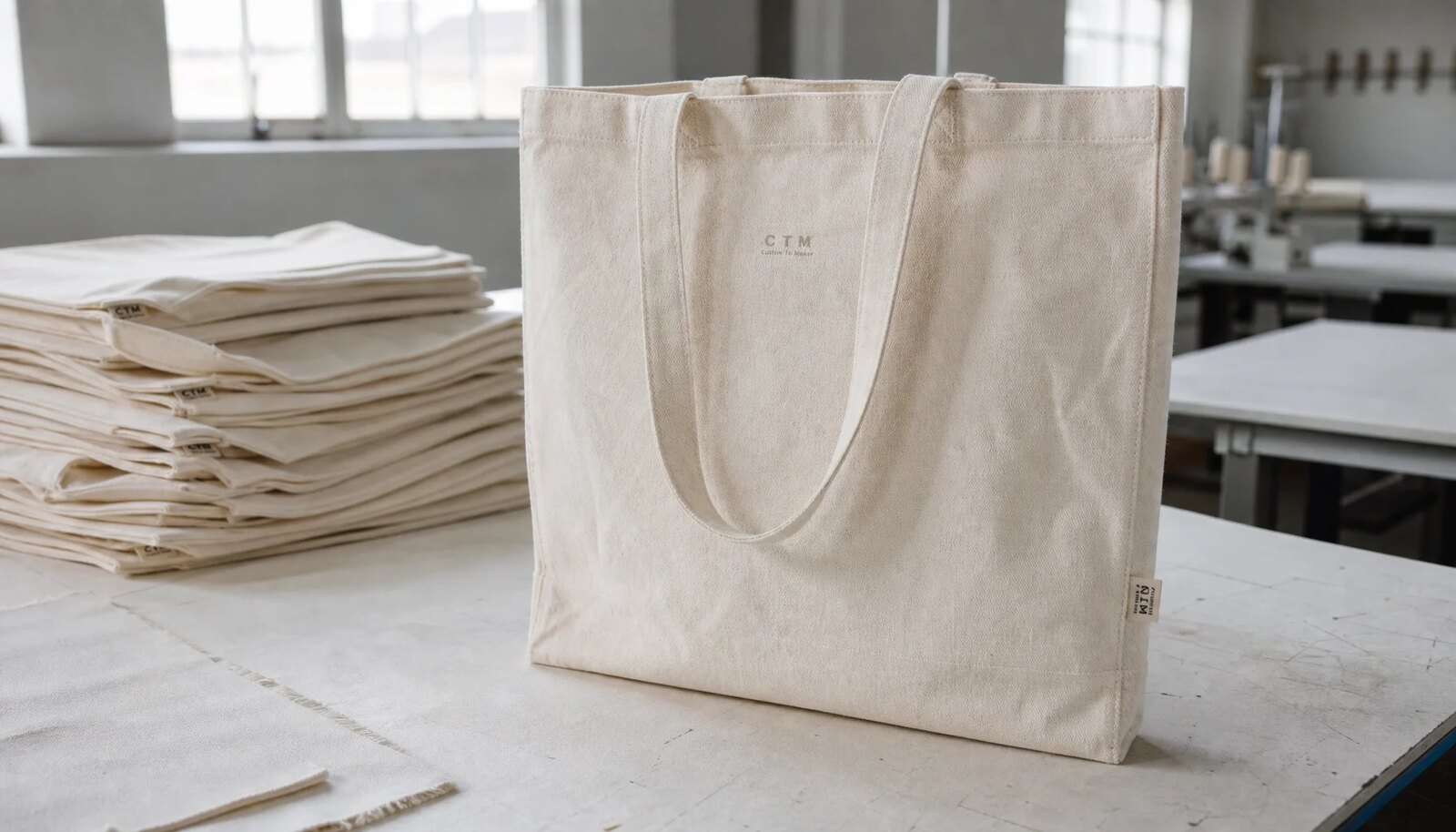
Start With the Use Case, Not the Logo
The main mistake in buying organic cotton totes for farmers market vendors is starting with artwork instead of load requirements. A market tote is not a fashion giveaway. It needs to carry produce, jars, bread, flowers, and sometimes a bottle or two without seam distortion. If you do not define the load first, the factory will quote to a look, not a function, and the result is often a bag that feels nice on the table but fails in use.
For procurement, the first decision is whether the tote is a light retail carrier, a durable weekly market bag, or a vendor-resale item bundled with store purchases. That decision affects fabric weight, handle build, and print method. A bag that will be handed out at checkout can sit at 6 oz to 8 oz. A bag that will be sold to shoppers as a reusable market carry piece should usually move into 8 oz to 10 oz, sometimes heavier if the tote is expected to replace a shopping basket.
- Define the real load: produce only, mixed groceries, or jars and bottles.
- Set the end use: giveaway, resale item, or vendor program pack-in.
- Match fabric weight to the load instead of choosing by price alone.
Choose the Fabric Weight by Carry Behavior
Organic cotton tote quotes usually start with fabric weight, but the number only matters when it is tied to use. In the 6 oz to 7 oz range, the bag folds flat and keeps unit cost low, but it will telegraph every seam and may feel underbuilt when filled with heavier produce. In the 8 oz to 10 oz range, the tote holds shape better, prints more cleanly, and gives buyers a more premium feel without moving into bulky canvas territory.
GSM and oz are often used interchangeably in supplier quotes, but buyers should insist on one measurement system in the spec sheet so comparisons stay clean. Ask the supplier to state the fabric weight, weave type, and shrinkage allowance together. A supplier who quotes only a generic 'organic cotton tote' is leaving too much undefined. If the bag is meant for repeated farmer market use, the handle and side seams should be engineered for load rather than just stitched for appearance.
- 6 oz to 7 oz: suitable for giveaways, lightweight produce, and low freight cost.
- 8 oz to 10 oz: better balance for reusable market carry and retail resale.
- Heavier than 10 oz: useful for premium positioning, but check carton weight and cost impact.
- Always request the measured fabric spec, not a descriptive label like 'heavy cotton.'
Compare Sourcing Routes Before You Compare Price
A quote from a cut-and-sew factory is not interchangeable with a trading company quote or a stock importer quote. The factory usually gives the best control over fabric weight, handle construction, and print placement, but only if they truly own the production schedule. A trading company can simplify communication and bundle documents, but the buyer needs to know where the real sewing happens and how that affects change requests. A stock importer may offer the fastest delivery, but the bag is constrained by existing dimensions and the supplier may not be able to match the exact retail brief.
For buyer teams, the best route depends on the program length. If this is a repeat farmers market campaign across multiple seasons, direct factory sourcing is usually the cleanest route because it supports stable reorders and tighter QC. If the buyer needs a quick market test, a stock-based route can reduce lead time, but only if the bag size, print area, and material are close enough to the final target to avoid rework later. Quotes should be compared on what is included, not just the unit price.
- Direct factory: strongest control, best for custom spec and repeat orders.
- Trading company: useful when the buyer needs coordination support and consolidated paperwork.
- Stock importer: fastest route, but limited customization and less precise fit to brand requirements.
Use the Print Method to Control Cost and Durability
For farmers market vendor totes, the artwork is usually simple: a logo, a line of text, or a single icon. That makes screen print the default commercial option because it is cost-effective, durable, and easy to repeat across reorders. For one- or two-color designs on natural cotton, it gives a clean result and keeps setup efficient. If the artwork includes gradients, fine type, or multiple colors, the buyer should expect more setup cost and a higher rejection risk during print approval.
Embroidery can work for premium resale totes, but it adds cost, thread bulk, and longer production time. Heat transfer is useful for short runs or more complex graphics, but buyers should be careful about wash durability and surface feel. On organic cotton, print opacity matters because the base fabric color can influence final color appearance. Request a strike-off on the actual fabric lot and specify the acceptable shade shift before bulk starts.
- Screen print: best for simple logos, lower cost, and reorders.
- Embroidery: premium look, but higher unit cost and more sewing time.
- Heat transfer: flexible for artwork complexity, but inspect adhesion and finish.
- Confirm curing, rub resistance, and exact print placement during sample approval.
Set the Construction Details That Prevent Failures
The right fabric is not enough if the tote fails at stress points. Handle width, handle length, seam allowance, and reinforcement are what keep the bag usable after repeated loading. For farmers market use, a self-fabric handle can be clean and economical, but it should be wide enough to spread pressure across the hand. A narrow handle may pass visual inspection and still create complaints after a few shopping trips. Reinforcement at the top edge and at the handle anchor is not optional for a bag that will carry weight.
The body shape matters as well. A flat tote folds well, stacks well, and ships efficiently. A shallow gusset adds volume without turning the bag into a rigid box. Deep box construction increases usability for bulky produce but also increases sewing complexity and carton bulk. Buyers should choose the structure based on what shoppers actually carry. If the tote will mostly hold leafy greens and bundled goods, a flat or shallow gusset is usually enough. If it must handle squash, bread, and glass jars, increase the depth and strengthen the bottom seam.
- Specify handle width and drop, not just total length.
- Require reinforcement at the handle anchor and top edge.
- Use a shallow gusset when you want more volume without high carton bulk.
- Ask the factory to confirm seam allowance and bottom stitch construction in the sample.
Build the MOQ Around Fabric, Print, and Size Mix
MOQ logic should be tied to production efficiency, not a random number printed on a quote. Organic cotton fabric is often purchased in rolls or lots, and print setup is usually the first cost that changes when the order is small. If the design has one color and one size, the MOQ can often stay reasonable because the factory can run a clean line. If the buyer wants multiple colors, multiple sizes, or mixed print positions, the MOQ rises because each variation adds setup time, cutting loss, and packing complexity.
Procurement teams should ask the supplier to break MOQ into three parts: fabric minimum, cut-and-sew minimum, and print minimum. That separates the true constraint from the sales shorthand. It also helps when comparing suppliers who quote the same tote but manage the production differently. A supplier with a low headline MOQ may be using stock fabric or a subcontracted printing step, which can be fine, but only if the buyer accepts the tradeoff in timing and control.
- Small runs are usually driven by print setup and fabric availability.
- Mixed sizes almost always add cost unless they share cutting efficiency.
- A low MOQ is only useful if the supplier can keep quality stable at that size.
Treat Samples as a Production Gate, Not a Courtesy
The sample stage should answer production questions, not just show the logo. A proper pre-production sample needs the actual fabric weight, the planned handle construction, and the real print method. Buyers should inspect the bag in daylight, load it with representative weight, and check whether the bottom corners pull, whether the handle stitching pucker is acceptable, and whether the bag sits upright the way the program requires. A flat mockup can be useful for artwork signoff, but it is not enough for final approval.
If color matters, ask for a strike-off or lab-dip on the actual cotton before bulk starts. Organic cotton can vary in natural tone from lot to lot, especially in undyed finishes. Buyers often accept the visual character of natural cotton, but the variation should still be within an approved range. The sample should also include packaging details if the bags are going to be redistributed to vendors or sold in retail-ready units. Many production mistakes appear only when the bag is folded, packed, or stacked.
- Test the sample with real load, not only by hand-feel.
- Check print placement, seam tension, and handle drop together.
- Approve actual fabric shade under daylight, not only on screen.
- Review one folded sample and one unpacked sample if packing matters to the program.
Packing and Carton Planning Affect Landed Cost
Packing is where a tote can quietly become expensive. Bulk-packed bags are efficient for factory throughput and freight, but they may need more handling at the destination. Retail-folded bags look cleaner on a shelf but increase labor and carton count. If the bags are going to farmers market vendors, many buyers choose bulk cartons with clear size labels and inner poly only when the destination climate or transit requires it. The key is to define the final handling step before the factory packs the first carton.
Carton size and carton weight matter more than many buyers expect. A tote that stacks compactly in the sample room can still create expensive air if the fold size is not optimized. Ask the supplier to quote with pack count per carton, gross weight, and carton dimensions. That lets your freight team estimate volumetric cost before production starts. If the program includes multiple sizes, keep carton labeling simple and consistent so receiving teams can sort inventory without opening every box.
- Bulk pack for distribution programs and lower handling cost.
- Retail fold only when the tote is sold as a shelf item.
- Request carton dimensions and gross weight with the quote.
- Label sizes and colors clearly to reduce receiving mistakes.
Compare Quotes on Real Cost, Not Unit Price Alone
A cheap tote quote can become the most expensive order if the assumptions are wrong. The real comparison should include fabric weight, print colors, sample fees, overrun tolerance, packing format, and lead time. If one supplier includes a pre-production sample and another does not, the unit price is not comparable. If one supplier quotes 6 oz fabric and another quotes 8 oz, the lower price may simply reflect a lighter bag that does not meet the program requirement.
Procurement teams should build a simple landed-cost view. Start with ex-works price, then add sample cost, inland freight, international freight, duty, and destination handling. Then compare that total against the expected useful life of the bag. For a farmers market vendor program, a slightly higher tote cost can still win if the bag lasts longer, prints cleaner, and reduces complaints. The buying decision should protect repeat demand and not just first-order margin.
- Compare the same fabric weight and the same print count.
- Include sample, freight, duty, and destination handling in the comparison.
- Do not accept a lower price if it comes with vague packing or loose quality terms.
- Ask the supplier to state overrun and underrun tolerance before PO placement.
Use a Short Acceptance Standard to Avoid Disputes
Before production starts, convert the buying brief into a short acceptance standard. It should state the fabric weight, size tolerance, print method, handle dimensions, seam reinforcement, and packing format. This does not need to be a long legal document. It needs to be clear enough that the factory and the buyer's receiving team can both judge the same order the same way. When that is missing, the first dispute usually appears after the goods land and the production team is already busy with the next order.
A strong acceptance standard also protects the reorder cycle. Farmers market vendor programs often repeat across seasons, and the second order should not require a fresh debate about bag tone or print placement. Keep one approved sample, one approved spec sheet, and one carton standard in the file. That gives the buyer a reliable baseline for future quotes and makes vendor programs easier to scale across different markets or retail chains.
- Write the acceptance standard before the PO, not after production starts.
- Keep one approved sample and one approved carton spec on file.
- Use the same baseline for repeat orders so reorders stay predictable.
Specification comparison for buyers
| Spec decision | Recommended option | When it fits | Buyer risk to check |
|---|---|---|---|
| Sourcing route | Direct cut-and-sew factory with organic cotton traceability documents | Best for recurring bulk programs, custom sizing, and controlled quality | Confirm who owns fabric procurement, whether GOTS or equivalent documentation is available, and whether the quote includes testing and trimming waste |
| Fabric weight | 8 oz to 10 oz organic cotton for everyday market carry | Best for shoppers carrying produce, jars, and mixed retail purchases | Too light can feel flimsy and print can distort; too heavy raises cost and can reduce foldability |
| Handle construction | Self-fabric handles reinforced with cross-stitch or box stitch | Best when the tote will carry heavier produce loads and needs a clean retail look | Check handle drop and stitch density; thin handles can cut into hands and fail at the seam |
| Print method | 1 to 2 color screen print for logos and simple artwork | Best for high-volume runs with consistent artwork and tight cost control | Ask for print opacity on natural cotton, curing method, and wash rub expectations |
| Body shape | Flat tote or shallow gusset, not deep box construction | Best for farmers market merchandising because it folds well and packs efficiently | Deep gussets add usable volume but can raise sewing time, carton bulk, and freight cost |
| Closure | Open top unless the buyer needs a pouch-style retail presentation | Best for vendor giveaways, checkout bags, and reusable carry programs | Closure hardware adds cost, longer assembly, and more points of failure in bulk production |
| Packing route | Bulk packed by size with carton labels and inner poly only if needed | Best when the tote is being redistributed to vendors or packed into kits | Retail folding and individual bags increase labor and carton count; check how that changes freight and handling |
| Sample approval route | Pre-production sample plus print strike-off or lab-dip where color matters | Best for branded programs that will reorder | Do not approve only from a flat mockup; verify seam shape, print placement, and actual fabric shade under daylight |
| Supplier selection | Factory that can document raw material, sewing spec, and QC points in one quote | Best for procurement teams comparing landed cost across multiple markets | Watch for vague quotes that hide fabric grade, stitch count, or packaging assumptions |
Buyer checklist before sampling
- Confirm the tote size in use terms, not just finished dimensions: how many apples, jars, bread loaves, or mixed items it must hold without seam strain.
- Set the target fabric weight in oz and GSM before requesting quotes, and do not let suppliers substitute a lighter weave without approval.
- Specify whether the artwork must sit on one side only, both sides, or a side panel, because print placement changes setup and scrap.
- Require handle drop, handle width, and reinforcement method in the spec sheet.
- State the packing format you want: bulk-packed, folded with tissue, or retail-ready if the bags go to stores.
- Ask for a pre-production sample from the actual fabric lot, not just a reference sample from a past job.
- Collect carton size, carton count per color or size, and gross weight before booking freight.
- Compare quotes on the same basis: fabric weight, print colors, sample charges, overrun tolerance, and lead time.
Factory quote questions to send
- What fabric weight, weave construction, and shrinkage allowance are included in the quote?
- Is the organic cotton material sourced under a traceable program, and what documents can you share with the order?
- What is the minimum order quantity per size and per print color, and can mixed sizes share the same production run?
- What is included in the sample stage: pre-production sample, print strike-off, or full-size sewn sample?
- What are the print method, print area limit, and curing process for the quoted price?
- What is the standard overrun or underrun tolerance, and how is it handled on final invoice?
- What carton pack plan do you recommend for this tote size, and what is the gross carton weight?
- What is the realistic production lead time after sample approval, and what can delay it?
Quality-control points to confirm
- Fabric weight must match the approved spec within an agreed tolerance; do not accept a lighter hand-feel as proof.
- Seam allowance should be consistent and reinforced at stress points, especially where handles meet the body.
- Handle length and drop must match the approved sample so the tote sits correctly on the shoulder or in hand.
- Print alignment should stay within agreed placement tolerance, with no obvious smearing, pinholes, or shade shift.
- Stitching must be straight and dense enough to prevent seam opening when the bag is loaded with produce and bottles.
- Organic cotton color should be consistent across the lot; natural variations are acceptable only if the buyer approves them in writing.
- Folded dimensions and carton pack count should match the packing plan so distribution teams can plan shelf or kit assembly.
- Random carton pull checks should confirm that the first, middle, and last cartons in the shipment match the approved sample.