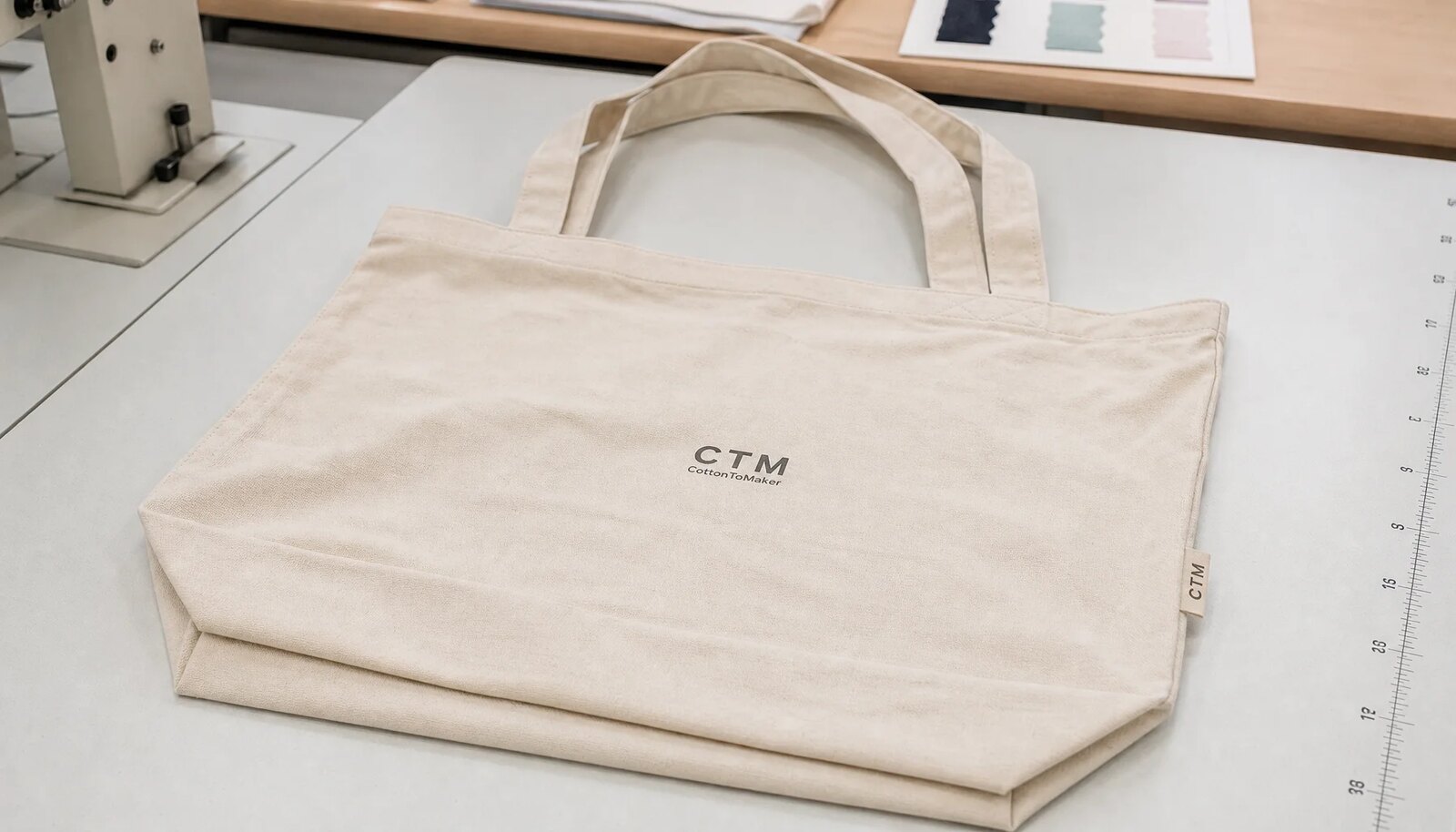
Start With the Viewing Distance
For event planners, the real job of a tote is not just carrying brochures and samples. It has to read clearly when someone walks through registration, stands in a photo line, or holds the bag at waist height in a crowd. That is why logo placement matters as much as the bag spec itself. A logo that looks balanced in a flat artwork file can disappear once the tote is filled, folded, or held at an angle. Center-front works because it gives the widest blank field and the most predictable visual result. If the event is premium, a smaller mark with more breathing room can look cleaner, but the logo still needs to be visible from a few meters away.
The biggest mistake buyers make is treating logo placement as a design decision only. In production, placement controls screen size, seam risk, artwork distortion, and the amount of usable print area. If the print lands too close to the top seam, the bag folds over the image. If it crosses the side seam or gusset, the shape becomes uneven and the printer may shrink the artwork to protect the edge. For a tote that will be handed out at a venue, a simple front panel print is usually safer than a complicated layout that wraps around the bag.
- Use center-front when the tote is a giveaway and brand recall matters.
- Use a smaller, lower placement when the bag should feel more retail than promotional.
- Avoid any print area that touches seams, gusset folds, or handle bar tacks.
Choose the Tote Before the Artwork
A good logo placement guide starts with the bag body, not the artwork. Organic cotton totes for events usually land in the 140-150 GSM range when the goal is a light handout that ships cheaply and stacks well. Move up to 180-220 GSM when the bag needs more structure, better opacity, and a longer usable life after the event. Natural undyed cloth usually gives stronger contrast for dark ink and keeps the look honest, but the weave must still be tight enough to hold fine letters. If the cloth is too open, small type can look fuzzy even when the screen print is technically correct.
Size matters just as much. A common event tote uses a body around 38 x 42 cm with a 10 cm gusset and a comfortable shoulder handle, but the right size depends on what the tote has to carry. A larger front panel allows a bigger logo, yet it also gives the fabric more room to distort when filled. If the bag is not pre-shrunk, expect some movement after steam, pressing, or first use. That is why a buyer should define a safe print area, not just the bag dimensions. A logo that looks centered on a sample can move visually once the tote is sewn, packed, and distributed.
- 140-150 GSM works for high-volume giveaways and lower landed cost.
- 180-220 GSM suits reuse-heavy conference kits and more premium event programs.
- Ask for seam construction details, handle reinforcement, and whether the fabric is pre-shrunk or left natural.
Logo Placements That Hold Up in Production
Center-front is the default for a reason. It gives the printer the largest flat area, keeps the logo readable from the aisle, and makes approval easier because the buyer can judge the result at a glance. For most organic cotton event totes, a front logo around 20 to 28 cm wide is practical, but the usable size depends on the tote body, gusset depth, and the art itself. If the logo includes a long event name, the safest move is often to shorten the copy or reduce the width rather than forcing a large print that sits too close to the seams. The cleaner the placement, the fewer surprises you will see in bulk.
There are cases where a different position is smarter. A lower-corner logo creates a more subtle, retail-style bag and leaves space for the tote to look premium in person, but it reduces visibility in crowded event photos. A gusset logo can work for a brand system, yet the print surface is narrower and more prone to distortion. Side labels, woven tabs, or small sewn patches are useful as secondary branding, especially if the main art is intentionally minimal. They are not a replacement for a visible front logo when the bag must advertise the event sponsor or organizer.
- Center-front is best for high visibility and simple artwork approval.
- Lower-corner placement is better when the tote should feel discreet and reusable.
- Gusset prints and side labels work as secondary branding, not as the only brand mark.
Match the Print Method to the Placement
For organic cotton totes, one-color screen print is still the most dependable option for bulk event orders. It gives sharp edges, reasonable setup cost, and good opacity on natural cloth. If the artwork is a clean logo with solid shapes, screen print is usually the fastest way to get a stable result across a large run. Water-based ink can feel softer on the hand and may suit a more premium brand look, but it still needs enough cloth density to keep the logo from bleeding into the weave. If the design uses multiple colors, each color usually adds setup, alignment risk, and a chance for the artwork to shift slightly between passes.
Heat transfer or DTF can handle detailed art, small gradients, or very fine type, but on a cotton tote the result may feel less integrated with the fabric. That matters when buyers want the bag to feel natural rather than promotional. Embroidery is only practical for smaller marks, side labels, or premium accents because a large stitched logo can pull the cloth and add unwanted stiffness. Woven labels and sewn patches are excellent for a subtle brand touch, but they should be treated as supplementary branding unless the customer explicitly wants a minimal logo system.
- Use screen print for flat logos and most conference or trade-show runs.
- Use transfer only when the artwork is too detailed for a clean screen print.
- Use embroidery for small marks, not for large front-panel graphics.
Read the MOQ Like a Factory Does
MOQ on a tote quote is rarely one number. A factory may have a minimum for fabric, another for printing, and another for carton packing, especially if the order includes custom labels or special folding. Buyers should read the quote as a chain of small decisions, not just a unit price. One-color, one-position printing usually has the best economics because it uses one screen, one alignment, and one production flow. Add a second print position and the quote may jump even if the bag body stays exactly the same, because the factory has to reset labor, screens, and inspection steps for the extra placement.
The cleanest way to compare quotes is to force every supplier to quote the same base spec. That means one tote size, one GSM target, one artwork file, one print size, one packaging format, and one incoterm. If the supplier tries to bundle those variables together, the number may look low but the risk moves into hidden extras. For procurement, the useful question is not only whether the bag meets the budget. It is whether the supplier can hold the same cost structure when the logo changes slightly, the pack format changes, or the event schedule gets tighter.
- Request price breaks at realistic volumes, such as 500, 1,000, 3,000, and 5,000 pieces.
- Separate bag cost from decoration cost whenever the supplier can show both.
- Make the quote list sample fee, reprint policy, and whether screens or tools are reusable for repeat orders.
Sample Approval Without Guesswork
Sampling should follow the same logic as production. A blank sample tells you the true hand feel, color tone, seam behavior, and whether the cloth looks like the GSM promised in the offer. A printed sample then shows how the ink sits on the weave, whether the logo stays square, and whether the chosen placement still works once the bag is sewn and folded. For a large event order, a pre-production sample is worth the extra time because it reflects the actual production line, not just a one-off lab piece. The sample should answer the question that matters most to buyers: will the bulk order look like the approved reference when it lands?
The approval note needs to be specific enough that the factory cannot interpret it two ways. State the logo position from fixed points on the bag, such as the top seam and centerline, not a general phrase like "centered on front." State the acceptable color reference, the logo width, and the packaging method. If the event uses photography or stage giveaways, even a few millimeters of drift can be visible in the final image. Practical acceptance criteria matter more than broad language. The buyer does not need lab language; the buyer needs a clear pass-fail line that the production team can follow under pressure.
- Approve blank, printed, and pre-production samples in the same sequence used for the PO.
- Measure placement from fixed points on the actual bag, not from the artwork file alone.
- Reject samples with loose threads, uneven handle length, smudged ink, or weak bartacks.
Packing for Events, Not Retail Shelves
Event totes are usually shipped and distributed in bulk, so packing should help the buyer hand them out quickly and avoid print damage. Flat folding is the default because it stacks cleanly and keeps the front panel readable when cartons are opened. If the print is on the front, fold the tote so the printed area is protected inside the fold rather than rubbing against carton surfaces. For conference kits or welcome bags, carton count matters as much as print quality because it determines how fast a venue team can stage the items. If the bags are split into multiple drops, the packing list should make it obvious which cartons belong to which event or venue.
Retail-ready packing is a different decision. Inner polybags, hangtags, barcode stickers, and neat stack orientation all add labor and can reduce carton density, but they may be necessary when the tote is going to stores or needs a more polished shelf presentation. For pure event distribution, keep the pack simple unless the buyer has a clear downstream reason to add each component. The wrong packing format can create more work on site than it saves in transit, especially when the venue team has to unpack hundreds of bags in a short setup window.
- Specify flat fold direction and carton count so handout teams can stage quickly.
- Keep one artwork version per carton unless the order is intentionally split.
- Add inner packs or retail labels only when the final use case justifies the labor.
Lead Time Risk Starts Before Production
The longest part of a tote order is often not sewing. Artwork cleanup, sample approval, screen preparation, fabric booking, and packing instructions all happen before the bulk line starts moving. If the event date is fixed, the buyer should ask the supplier to separate sample lead time from bulk lead time and show the start point clearly. A factory that promises a short bulk window but ignores artwork revision time is creating false confidence. The practical schedule question is whether the supplier already has the cloth, the sewing capacity, and the print method ready when the order is confirmed.
Shipping mode also changes the risk profile. Air freight can rescue a late event order, but it is expensive for bulky cotton bags and should be treated as an exception, not a default plan. Sea freight is normally better when the order volume is large and the calendar gives enough buffer. Either way, leave time for customs, port congestion, and a possible second sample if the first print is off by placement or color. Buyers who work backward from the event date tend to make better tradeoffs because they see the real slack in the schedule instead of assuming the factory clock starts the day the PO is signed.
- Build in artwork revision time before the factory starts screens or sampling.
- Do not release bulk production until the sample approval is signed off.
- Keep a freight fallback plan in case the event schedule shifts.
Compare Supplier Routes Before You Award
Direct factory sourcing usually gives the best control over fabric, sewing, decoration, and packing. It is often the right path for repeat programs, brand-heavy tote campaigns, and orders where logo placement must stay consistent across multiple events. The advantage is not only cost. It is that the same team can manage the cloth, the sewing line, and the print registration without handing the job across multiple companies. A trading company can still work well if the buyer needs one communication point, but the quote must stay transparent enough to show where the cost sits. Without that visibility, the buyer cannot tell whether the supplier is competitive or simply packaging several markups together.
Importing blank bags and finishing them locally can work for short schedules, regional events, or small runs that do not justify a full overseas production cycle. The catch is that the landed cost often rises once domestic print labor, split freight, waste, and rework are included. A low ex-factory price is not the same thing as a low delivered cost. The buyer should compare the full path: bag price, print setup, packing, inland transport, customs, freight, duty, local delivery, and a reprint reserve. That is the real sourcing decision. If the order is a one-time event and the venue is near the local decorator, the speed may justify the extra cost. For recurring programs, repeatability usually wins.
- Compare ex-factory, freight, duty, and local handling before you award the order.
- Ask who pays for reprints when the placement or color misses the approved sample.
- For repeat campaigns, prioritize stable placement and pack format over a small short-term saving.
Build an RFQ That Gives Comparable Quotes
A useful RFQ looks like a production brief, not a shopping list. Include the tote size, GSM target, fabric finish, handle length, exact logo position, print size, number of colors, packing method, destination, and the approval path for samples. If any of those items are missing, suppliers will fill in the blanks with their own assumptions, and the quotes will stop being comparable. Event buyers often lose time not because suppliers are unhelpful, but because the RFQ leaves room for interpretation. When the brief is complete, the supplier can quote the actual job instead of a guessed version of it.
The best quote format separates the cost blocks. Bag body, decoration setup, packaging, sample fees, and freight should be readable on the same page. That allows procurement to compare suppliers on a clean base and decide whether the difference comes from fabric quality, decoration complexity, or logistics. For event orders, the cheapest line item is rarely the cleanest option. The better quote is the one that protects the schedule, keeps the logo in the right place, and avoids a surprise charge after approval. If the supplier can quote the same tote with one placement, two placements, and a different pack format, you will learn quickly whether the factory understands the order or is just filling in a template.
- Send vector artwork and one flat preview with the exact print area marked.
- State the placement reference points, such as top seam, side seam, and centerline.
- Request line items for bag body, print setup, packing, sampling, and freight.
Specification comparison for buyers
| Spec decision | Recommended option | When it fits | Buyer risk to check |
|---|---|---|---|
| Direct factory with in-house screen print | Best all-in-one route for a single logo position and repeat orders | You want one production owner for fabric, sewing, print, and packing | Confirm the print room is on site; outsourced decoration adds another approval loop and can move your ship date |
| Direct factory with outsourced decoration | Use when the bag maker is strong on sewing but weak on decoration | The tote spec is right, but the factory cannot print your artwork in-house | Ask who owns color matching, placement correction, and reprints if the print shop makes an error |
| Trading company bundling bag and print | Useful when procurement wants one contact across multiple suppliers | You are buying mixed SKUs, small runs, or multi-market event programs | Demand a line-by-line quote or the margin may hide in decoration, packing, and domestic handling |
| Blank tote import plus local print house | Works for urgent events and short replenishment runs | You need a fast domestic print turn after the blanks land | Total landed cost can rise after split freight, local print labor, waste, and rework |
| 140-150 GSM organic cotton tote | Practical giveaway weight for high-volume event handouts | The bag is a carry item, not a retail merch piece | Thin fabric can distort a large centered logo when the tote is filled or folded badly |
| 180-220 GSM organic cotton tote | Better for resale-style use and reuse-heavy conference kits | You want a firmer hand, less transparency, and cleaner print flatness | Heavier cloth raises cost and may require stronger seams, better carton protection, and longer lead time |
| Center-front logo placement | Highest visibility and easiest artwork approval | Brand recognition matters more than subtle branding | Leave a clear margin from seams and handle stitches so the logo does not warp on a filled bag |
| Lower-corner or gusset placement | Better for subtle branding or a more retail-looking tote | The event tote should feel less promotional and more finished | Small logos can disappear in crowd photos; size the mark for real carrying distance |
Buyer checklist before sampling
- Final tote size, gusset depth, and handle length with the measurement method stated
- Fabric weight target in GSM and whether the cloth is natural, bleached, or dyed
- Logo artwork in vector format plus a flat preview with exact print size
- Placement measured from the top seam, side seam, and centerline, not a vague position name
- Print method, number of colors, and whether the supplier owns screens or transfers
- Sample approval path with blank sample, printed sample, and who signs off bulk production
- Packing format, carton count, carton marks, and whether polybags are required
- Incoterm, destination port, and which party pays for sampling, freight, and reprints
Factory quote questions to send
- Is the tote cut-and-sewn in-house, and what GSM do you guarantee after finishing?
- Where exactly will the logo sit on the bag, and can you show the position on a real template with dimensions?
- What print method will you use, how many setup charges apply, and what changes if we add a second placement?
- What is the MOQ per color, per artwork, and per packaging format?
- Will you supply a blank sample and a printed pre-production sample, and what is the sample fee?
- What tolerance do you hold on bag size, handle length, seam strength, and print alignment?
- How will the bags be packed for shipment, and can we specify flat folding, inner packs, or bulk cartons?
- What is the lead time from artwork approval to bulk completion, and what has to be approved before the clock starts?
- Which charges are separate from the unit price, including screens, labels, polybags, carton markings, and extra print positions?
Quality-control points to confirm
- Fabric weight matches the approved GSM target and feels consistent across the lot
- Logo placement stays within the agreed tolerance and does not cross seams, gussets, or handle stitches
- Ink coverage is even, with no pinholes, bleed, heavy buildup, or visible cracking on a normal fold
- Handle lengths match and bartacks are secure, with no loose threads or skipped stitches at stress points
- Bag dimensions and gusset depth remain within the approved size range after packing and handling
- Carton count, carton marks, and label version match the packing instruction and artwork file
- Any organic material claim or product marking matches the documents and wording approved in the PO