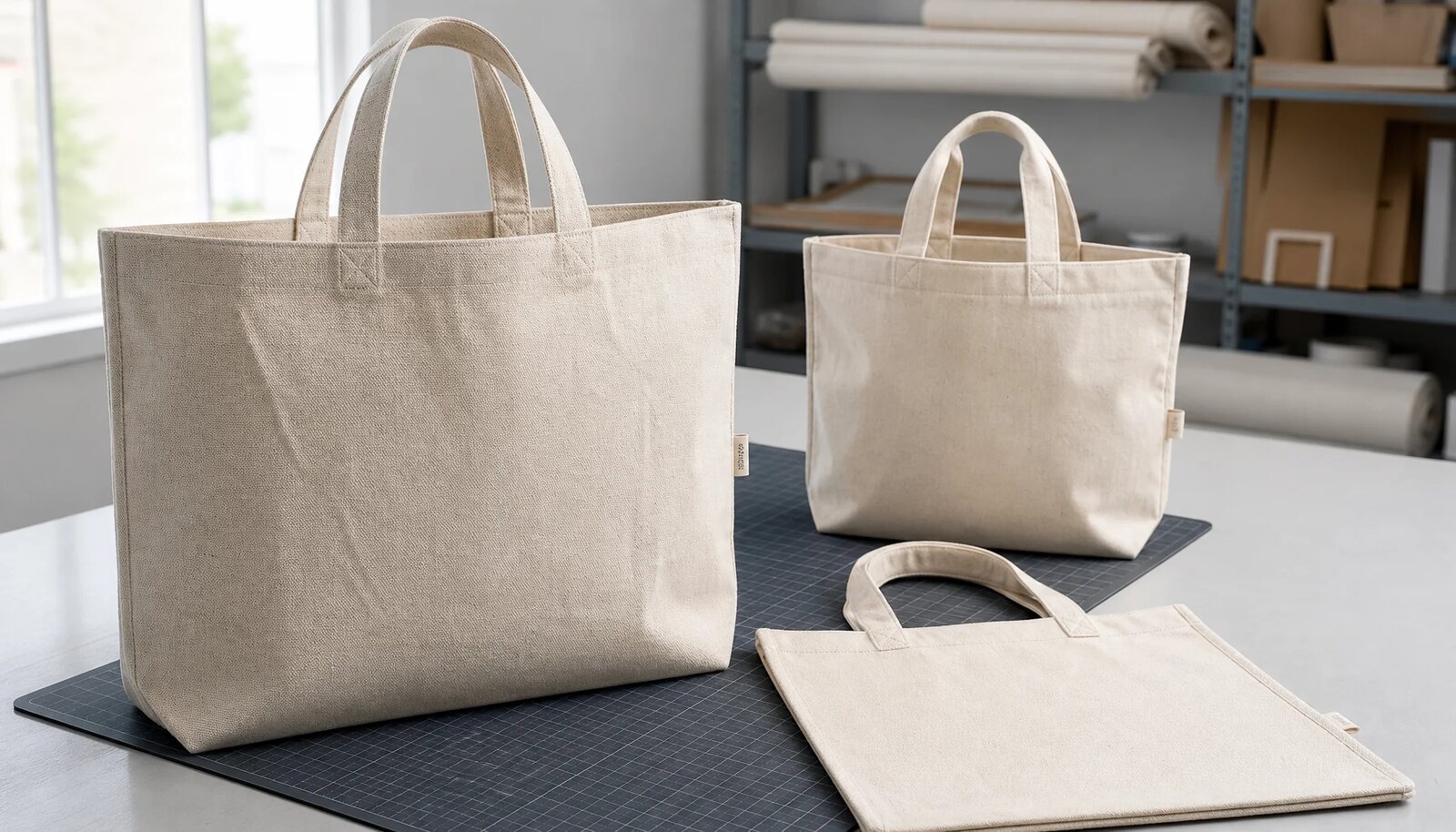
Start With the Event Load
For B2B event procurement, "organic cotton tote" is not a specification. It is a category. A tote for a badge, agenda, and folded map has a very different job from a tote carrying a water bottle, catalogue, boxed sponsor sample, hoodie, notebook, and charger pouch. Before asking suppliers for unit pricing, define the actual load, the distribution method, and the expected life of the bag. Those details decide whether the project needs a light flat tote, a midweight conference carrier, or a heavier gift-style bag with reinforced handles and a cleaner finish.
The right target is not automatically the heaviest bag the budget can tolerate. It is the lightest practical fabric weight and construction that still protects the attendee experience, the sponsor presentation, and the event schedule. Heavy totes cost more to cut, sew, pack, store, and ship. Very light totes can save money but may look transparent, wrinkle fast, twist around contents, or make detailed artwork appear soft. A good RFQ makes those tradeoffs visible before procurement compares prices.
Think about the bag before it reaches the attendee too. Totes placed on seats need to lie neatly. Bags pre-packed by a kitting partner need a consistent opening width and reliable seams. Bags shipped to several venues need carton marks that receiving teams can reconcile quickly. The tote is a branded product, but it is also part of the event operation. Treating it that way prevents late surprises.
- Estimate contents weight and list the largest or sharpest items, including bottles, catalogues, boxes, apparel, notebooks, and electronics-adjacent accessories.
- Decide whether the tote is a one-day carrier, reusable attendee bag, sponsor kit container, retail-style merch item, or premium gift intended to be kept.
- State whether bags will be handed out empty, laid flat on seats, pre-kitted, shipped to hotels, routed to several venues, or held for late registration.
- Set a minimum handle expectation whenever the tote carries bottles, books, boxed samples, or paper-heavy inserts.
Use Oz and GSM Correctly
Fabric weight is usually quoted in ounces per square yard for North American tote programs and in GSM, grams per square meter, in many factory and textile contexts. For buying conversations, the rough conversion is enough to compare offers: 5 oz is about 170 GSM, 6 oz about 200 GSM, 8 oz about 270 GSM, 10 oz about 340 GSM, and 12 oz about 400 GSM. These numbers are approximate, but they help buyers identify quotes that are not really equivalent.
The important procurement phrase is finished fabric weight. A supplier may describe a tote as 8 oz because that is the mill's nominal fabric weight, a stock blank catalog description, a pre-finish value, or a shorthand used by the sales team. Another supplier may measure after finishing, shrinking, or cutting. Both quotes may say "8 oz," yet the bags can feel different in the hand and behave differently under print. Ask for the weight in both oz and GSM, then ask exactly what stage of material it represents.
Fabric weight also should not stand in for quality. Yarn, weave density, finishing, shrinkage, cutting accuracy, and sewing all affect performance. A tight 8 oz cloth may print cleaner than a loose 10 oz cloth. A heavier fabric with weak handle joins can fail sooner than a midweight tote with proper reinforcement. Use weight to narrow the field, then approve the actual fabric, construction, and decoration through samples.
- Use 5 oz to 6 oz, about 170 to 200 GSM, for light handouts, paper-only inserts, and low freight targets.
- Use 8 oz, about 270 GSM, as the practical starting point for most conference, trade show, and sponsor-kit programs.
- Use 10 oz to 12 oz, about 340 to 400 GSM, for heavier contents, VIP gifts, retail-style presentation, or longer reuse expectations.
- Require suppliers to state whether the weight is finished goods, mill specification, stock blank description, stock fabric data, or pre-finish fabric weight.
Match Weight to Event Format
A fabric weight guide becomes useful when it is tied to the event format. Registration-only programs usually need a clean branded carrier for paper, badges, and a few small items. In that case, a 5 oz to 6 oz organic cotton tote may be enough if the print is simple and the buyer accepts a lighter hand. For a general conference bag, 8 oz is often the better starting point because it improves opacity, print stability, and perceived durability without moving into premium-gift cost.
Sponsor kits and product drops need more caution. Boxed samples push against corners. Bottles create concentrated stress. Thick catalogues pull on handles and distort weak seams. An 8 oz to 10 oz tote with a gusset and reinforced handle join is often more appropriate than a flat lightweight tote. If the kit includes sharp-edged boxes, ask how the bottom seam is built and whether the gusset gives the contents enough room to sit naturally.
VIP events and press gifts are less forgiving. Attendees may judge the bag against retail merchandise rather than a giveaway item. A 10 oz to 12 oz organic cotton tote can provide more structure, cleaner folding, and a more substantial feel. Still, the buyer should check carton weight, storage space, receiving constraints, and freight before approving a premium weight. A beautiful tote that arrives late or overwhelms storage is not a procurement win.
- Registration tote: 5 oz to 6 oz, flat construction, one print placement, simple hem, bulk or counted-bundle packing.
- General conference tote: 8 oz, reinforced handles, one or two print placements, carton marks tied to event receiving.
- Sponsor kit tote: 8 oz to 10 oz, gusset recommended, stronger handle reinforcement, tested with representative contents.
- VIP tote: 10 oz to 12 oz, tighter weave, stricter shade and print tolerance, presentation folding or individual packing when needed.
Specify Construction Details
Fabric weight is only one part of tote performance. Construction determines how that fabric carries the event load. A complete specification should include finished body width and height, gusset depth, top hem depth, side seam type, bottom seam type, handle width, handle drop, handle attachment length, and reinforcement method. Without those details, three suppliers can quote three different bags while using the same general description.
Handle drop is a frequent quote gap. A short handle may work for hand carry at a registration desk, but many attendees expect shoulder carry once the bag is full. A shoulder-friendly handle drop is often around 10 in to 12 in, although the best dimension depends on the bag body and audience. Handle width matters as well. Narrow handles reduce material use but can feel uncomfortable with catalogues or bottles. Wider self-fabric handles usually improve comfort and perceived value.
Gussets should be decided early. A flat tote is economical, stacks neatly, and works well for paper. A bottom or side gusset increases usable volume and helps boxed items sit better, but it changes fabric consumption, sewing time, folding, carton size, and sometimes print placement. If the buyer adds a gusset after quotes are collected, the pricing comparison has to be rebuilt.
- Request handle width, handle drop, attachment length, stitch type, and reinforcement photos in the quote package.
- Use box-X stitching, bar tacks, double stitching, or an approved equivalent for heavier event loads.
- Specify gusset depth for bottles, boxed samples, apparel bundles, or multi-item sponsor kits.
- Include finished dimension tolerances for body size, gusset, handle drop, and handle width in the purchase order.
Plan Artwork Around Cotton
Screen printing is the common decoration method for wholesale event totes because it is repeatable, economical, and effective for bold logos. The fabric still matters. Open weaves, lint, and natural slubs can soften fine edges. Heavy ink coverage can feel stiff or show cracking if curing is poor. Lightweight fabric can shift during printing and may allow show-through from darker contents. A tote is not a smooth paper sheet, so artwork needs to be judged on the fabric that will actually be used.
Natural organic cotton is not a coated white substrate. Unbleached fabric may include seed flecks, slubs, and shade variation from lot to lot. That texture can be part of the appeal, but it changes how white ink, light colors, fine lines, and small sponsor marks appear. For detailed artwork, the safest approval tool is a strike-off printed on the selected fabric weight and shade. A digital mockup can confirm layout; it cannot confirm ink behavior, curing, edge sharpness, or cotton tone.
Other branding methods may be appropriate when tested and priced correctly. Embroidery can feel premium on heavier totes, but it can pucker lightweight fabric and extend production time. Heat transfer can reproduce fine detail, yet it changes the hand feel and must be tested for adhesion. Woven labels or side labels can make the bag feel more finished, but they add sewing operations and placement tolerance. Put each decoration option into the RFQ as a separate priced line when the decision is still open.
- Use screen print for bold one-color or two-color logos, event marks, and large sponsor branding.
- Require a strike-off for fine type, sponsor grids, white ink, heavy coverage, tight color standards, or multi-color registration.
- Define print placement by measurements from bag edges, seams, or top hem, not by a visual mockup alone.
- Ask for setup fees, screen charges, color-match costs, print area limits, curing requirements, and reprint rules.
Choose the Sourcing Route
Stock blanks, local decoration, trading-company sourcing, and factory-direct cut-and-sew production solve different problems. Stock organic cotton blanks are useful when the event date is close, the quantity is modest, and the buyer can accept fixed size, shade, handle drop, and GSM. Local or domestic decoration can reduce schedule risk for simple logos because the blanks are already available and print approval can happen quickly.
Factory-direct custom production gives more control over fabric weight, bag size, gusset, handles, labels, packing, and repeat consistency. It also needs a longer calendar for fabric booking, sampling, print strike-off, bulk cutting, sewing, inspection, and freight. This route usually makes more sense for larger quantities, repeat annual programs, or events where the tote must match a detailed brand and logistics specification.
Many pricing problems come from comparing different sourcing routes as if they were identical. One supplier may price a stock 6 oz blank with a one-color local print. Another may price a custom 8 oz organic cotton tote with reinforced handles, labels, organic documentation, and counted bundles. A third may exclude freight, palletization, and special carton marks. Before negotiating unit cost, normalize the assumptions.
- Use stock blanks when speed and lower quantity matter more than custom construction.
- Use factory-direct production when fabric weight, gusset, labels, handle construction, packing, or repeat consistency are important.
- Use an intermediary when they add clear value in communication, inspection, documentation, consolidation, or destination logistics.
- Compare suppliers only after each has priced the same fabric, construction, artwork, packing, documentation, delivery terms, and timeline.
Build a Priceable RFQ
A strong RFQ should read like a working commercial specification. Include quantity, price breaks, fabric weight in oz and GSM, finished dimensions, gusset, handle details, fabric color, artwork, decoration method, print placements, label requirements, packing method, destination, incoterm, required arrival date, and event date. The more complete the RFQ, the fewer assumptions suppliers need to make and the easier it is for procurement to compare bids.
Ask for price breaks at quantities that could realistically be ordered. A quote at 2,000 pieces may sit near a production threshold, while 3,000 or 5,000 pieces may improve fabric use, printing efficiency, or freight economics. Extra units can be useful for staff, late registrations, sponsor replacements, and damage allowance. Still, event inventory has storage and budget cost, so the buyer should evaluate overage intentionally.
The quote should identify inclusions and exclusions clearly. Base tote cost, print setup, screens, color matching, sample fees, woven labels, special packing, carton marks, documentation, testing, freight, duties, and destination charges should not appear as surprises after the purchase order is approved. The aim is not to demand a full open cost sheet from every supplier. The aim is to prevent late add-ons that change the real landed cost.
- Attach production-ready artwork and list file format, number of print colors, placements, print dimensions, and print side.
- Ask for unit pricing at the target quantity and the next useful breaks, such as 1,000, 3,000, 5,000, or 10,000 pcs when relevant.
- Require suppliers to state assumptions, including standard carton, standard handle, no special documentation, or stock fabric use.
- Include delivery address, required arrival date, event date, warehouse hours, appointment rules, routing instructions, and carton mark requirements in the first RFQ.
Use Samples as Gates
Samples should answer defined approval questions. A fabric swatch confirms weight, shade, hand feel, opacity, and weave. A proto sample confirms size, gusset, handle drop, and sewing construction. A print strike-off confirms artwork behavior on the selected fabric. A pre-production sample confirms the final combination of fabric, dimensions, handles, print, labels, and packing before bulk production begins. Each sample should have a purpose and a decision attached to it.
For event planners, the pre-production sample deserves hands-on testing. Measure it flat. Fill it with the expected contents or close substitutes. Check whether the handle length works for hand carry and shoulder carry. Fold it the way it will be packed. Review the print after handling. If a kitting center will load the bags, test the opening width and gusset with the actual kit format. If bags will be laid on chairs or tables, check fold marks and presentation quality.
Approval records matter when the schedule is tight. Keep the approved sample, approval date, supplier name, fabric weight, finished dimensions, print reference, shade notes, and allowed tolerances. If natural cotton shade may vary within a documented range, record that. If print position may shift within a small tolerance, record that too. Written approval turns final inspection into a comparison against agreed criteria instead of a debate about taste.
- Approve a fabric swatch before locking shade-sensitive artwork or claim language.
- Approve a print strike-off before bulk printing for detailed sponsor marks, white ink, heavy coverage, or strict brand colors.
- Approve one physical pre-production sample before mass cutting, sewing, or printing begins.
- Retain an approved sample for final inspection, repeat orders, and dispute resolution.
Set QC Rules Early
Quality control becomes practical when acceptable variation is defined before production. Organic cotton has natural texture and shade variation, but that does not excuse dirty goods, weak stitching, distorted dimensions, poor curing, incorrect artwork, or wrong carton marks. The purchase order should include measurable tolerances for body size, gusset, handle drop, handle width, finished fabric weight, print position, print color, carton quantity, and packing method.
Use defect categories to reduce subjective inspection arguments. Critical defects should include broken handles, open seams, wrong artwork, missing print, severe stains, mildew odor, wet cartons, unsafe contamination, or incorrect destination marks. Major defects may include visible print misregistration, loose seams, serious shade mismatch, incorrect label placement, repeated dimension drift outside tolerance, or packing that disrupts receiving. Minor defects may include small loose threads or light natural slub variation within the approved range.
Inspection should sample across cartons and production positions. Do not rely only on the top sample or the cleanest carton. Check sewing inside and outside the bag, apply reasonable hand pressure to the handles, inspect backtacking, review the top hem, and compare print curing and color under consistent light. If totes will be packed with apparel or paper, check odor and ink transfer because those issues can affect the full kit, not only the bag.
- Set written tolerances for dimensions, finished GSM or oz, handle drop, print position, shade variation, and carton count.
- Define critical, major, and minor defects before inspection begins.
- Pull samples from multiple cartons and carton positions, including middle and bottom layers when possible.
- Record inspection findings with photos, measurements, carton numbers, defect category, and comparison to the retained approved sample.
Verify Organic Claims
Organic cotton sourcing requires careful language. A supplier may have an organic certificate for a facility, yarn, fabric, chain-of-custody process, or selected material input. Those are not automatically the same as order-level documentation for the finished tote. Procurement should ask what documentation can be provided for the specific order before artwork, hangtags, product pages, or sustainability copy are approved.
The buyer should distinguish between product claims and marketing claims. A phrase printed on the tote, carton, event website, sponsor deck, or attendee material may need support. If documentation only supports the cotton input, do not imply that every finishing, dyeing, printing, sewing, or packing process is certified unless the supplier can document that scope. Narrower wording is often easier to support and safer for procurement review.
Documentation should be handled early because it can affect supplier selection, price, and lead time. Stock blanks may have limited paperwork depending on the distributor and lot. Custom production can be planned around stronger documentation, but only if the buyer asks before fabric is booked. Treat claim support as part of the specification. It belongs beside fabric weight, dimensions, artwork, packing, and delivery date.
- Ask what certificate, transaction document, fabric record, or chain-of-custody support is available for the specific order.
- Confirm whether documentation covers cotton fiber, yarn, fabric, finished bag production, dyeing, printing, or only selected steps.
- Approve claim wording before printing tags, labels, bags, cartons, sponsor material, or event copy.
- Keep documentation, quote assumptions, sample approvals, and final inspection records together for procurement review.
Specification comparison for buyers
| Procurement decision | Typical specification to request | Best event fit | Quote or QC risk to control |
|---|---|---|---|
| Light registration handout | 5 oz to 6 oz organic cotton, about 170 to 200 GSM, flat body, simple top hem, one-color screen print | Programs, maps, badges, light brochures, low freight targets, one-day distribution | Can look translucent, wrinkle quickly, and show ink bleed; approve opacity, hand feel, and print edge quality on a physical sample |
| General conference tote | 8 oz organic cotton, about 270 GSM, reinforced handles, 10 in to 12 in handle drop when shoulder carry is expected | Most conferences, trade shows, sponsor bags, and attendee kits with mixed paper and light goods | Suppliers may quote nominal mill weight instead of finished weight; require finished GSM or finished oz tolerance and keep an approval sample |
| Sponsor kit or product-drop tote | 8 oz to 10 oz organic cotton, about 270 to 340 GSM, gusset if boxed items are included, stronger handle join | Bottles, boxed samples, catalogues, apparel, chargers, notebooks, or multi-item kitting | Flat totes can distort around boxes; specify gusset depth, bottom seam type, handle reinforcement, and load expectation |
| Premium or VIP gift tote | 10 oz to 12 oz organic cotton, about 340 to 400 GSM, tighter weave, cleaner folding, stricter shade and print control | Press kits, executive events, retail-style merch, gift shops, and higher perceived-value programs | Higher fabric and freight cost; carton gross weight, folding method, and presentation packing must be priced before approval |
| Fast fixed-date program | Stock organic cotton blanks plus local or domestic decoration, with stock lot confirmed before selling the spec internally | 500 to 1,500 pcs, simple branding, urgent event dates, or programs with limited sampling time | Blank dimensions, shade, handle drop, and GSM are usually fixed; inspect current stock because catalog data may not reflect the available lot |
| Repeat annual program | Factory-direct custom cut-and-sew production with approved fabric, labels, decoration, packing, and retained master sample | 3,000 pcs and up, repeat artwork, custom sizing, multi-venue shipping, stable procurement calendar | Needs time for fabric booking, sampling, strike-off, production, inspection, and freight; late approvals compress QC |
| Documented organic claim | Supplier route with certificate scope, order-level documentation where applicable, and approved claim wording | Corporate procurement, sponsor requirements, ESG review, retail partners, or regulated claim review | A facility certificate is not always proof for the finished item; confirm which material, process, and order the documentation covers |
| Bold logo print | Screen print on 8 oz to 10 oz organic cotton with approved strike-off on the actual fabric | Large brand marks, one or two colors, predictable event branding, sponsor logos with clear shapes | Open weave, lint, or excessive ink deposit can blur edges; test ink coverage, curing, and crocking on production fabric |
| Detailed sponsor artwork | Tighter 8 oz to 10 oz fabric, simplified fine lines, minimum readable text size, physical print strike-off | Sponsor grids, small type, QR-adjacent graphics, multi-color alignment, strict brand review | Natural cotton shade and texture reduce sharpness; define minimum text size, registration tolerance, and print placement tolerance |
Buyer checklist before sampling
- Define the event load in measurable terms: estimated contents weight, largest item size, sharp corners, bottles, boxed samples, paper volume, and whether attendees will shoulder-carry the tote.
- Choose a target finished fabric weight in both oz and GSM, and ask whether the supplier's value is nominal mill weight, pre-finish weight, finished-goods measurement, or stock blank catalog data.
- Specify finished bag width, height, gusset depth, top hem, side seam, bottom seam, handle width, handle drop, handle attachment length, and reinforcement method.
- State color clearly: natural unbleached, bleached white, dyed fabric, or custom shade; include acceptable shade variation for natural organic cotton before print approval.
- Send production artwork with file format, number of colors, Pantone or color target, print size, placement, orientation, print side, and acceptable position tolerance.
- Ask every supplier to quote the same packing method: loose bulk, counted bundles, individual polybag, paper band, tissue, inner carton, master carton, carton quantity, gross weight, palletization, and carton marks.
- Require a sample plan that identifies swatch, proto, print strike-off, pre-production sample, top sample, and retained approval sample, with approval gates and working days for each.
- Request a tolerance sheet for finished dimensions, fabric weight, handle drop, handle width, stitch density, print position, print color, carton quantity, and visible defect classification.
- Confirm organic claim support before artwork is finalized, including certificate scope, transaction or material documentation where available, and safe wording for product, packaging, and event material.
- Set commercial terms before the purchase order: MOQ, price breaks, sample charges, setup charges, incoterm, delivery date, overrun or underrun allowance, payment terms, change-order rules, and cancellation exposure.
Factory quote questions to send
- What finished fabric weight are you quoting in GSM and oz per square yard, and what tolerance do you apply to finished goods?
- Is the quoted weight based on mill specification, pre-finish fabric, finished fabric, cut panels, or stock blank records?
- What is the fabric construction: weave type, yarn count if available, natural or dyed shade, finishing treatment, shrinkage expectation, and whether the cotton is combed, carded, or unspecified?
- Is this order made from stock blanks, stock organic cotton fabric, or custom cut-and-sew production, and how does that affect MOQ, lead time, and available sizes?
- What are the exact finished dimensions: body width, height, gusset depth, usable opening width, handle drop, handle width, handle attachment length, seam allowance, and top hem depth?
- What handle reinforcement is included as standard: box-X stitching, bar tack, double stitching, or another construction, and can you provide photos from current production?
- What print method is included, how many colors and placements are priced, what maximum print area is allowed, and what setup, screen, color-match, or artwork charges apply?
- Can you provide a strike-off on the actual organic cotton fabric for all sponsor logos, fine text, heavy ink coverage, and strict brand colors before bulk printing?
- What sample sequence do you recommend, how many working days does each sample require, and which approvals must be completed before fabric cutting and bulk printing begin?
- What tolerances apply to dimensions, finished GSM, handle drop, handle width, stitch density, print placement, print color, fabric shade, and carton quantity?
Quality-control points to confirm
- Confirm finished fabric GSM or oz against the approved tolerance band, and record whether the measurement comes from finished goods, cut panels, lab data, or supplier fabric documentation.
- Compare fabric hand feel, opacity, weave consistency, shade range, odor, lint level, slubs, seed flecks, and surface contamination against the retained approved sample.
- Measure finished bag width, height, gusset, handle drop, handle width, top hem, and usable opening on samples pulled from multiple cartons, not only top-of-carton goods.
- Inspect side seams, bottom seams, top hem, handle joins, stitch density, loose threads, skipped stitches, backtacking, seam puckering, raw-edge control, and seam allowance consistency.
- Check handle stress points for the approved reinforcement, especially for totes intended to carry bottles, books, catalogues, electronics-adjacent swag, or boxed samples.
- Review print placement, registration, edge sharpness, ink coverage, curing, cracking, crocking, smearing, pinholes, bleed into the weave, and distortion after folding.
- Compare print color and cotton shade to the approved strike-off or pre-production sample under consistent light, allowing only the documented tolerance for natural cotton variation.
- Confirm labels, hangtags, care or claim language, sponsor marks, woven side labels, and country-of-origin markings are present, correctly positioned, legible, and not trapped in seams.
- Verify packing quantity per bundle and carton, carton marks, event codes, destination labels, polybag or bulk-pack method, carton condition, and packing list accuracy before shipment release.
- Classify and reject critical defects such as broken handles, open seams, missing prints, wrong artwork, severe stains, mildew odor, wet cartons, incorrect destination marks, or unsafe contamination.