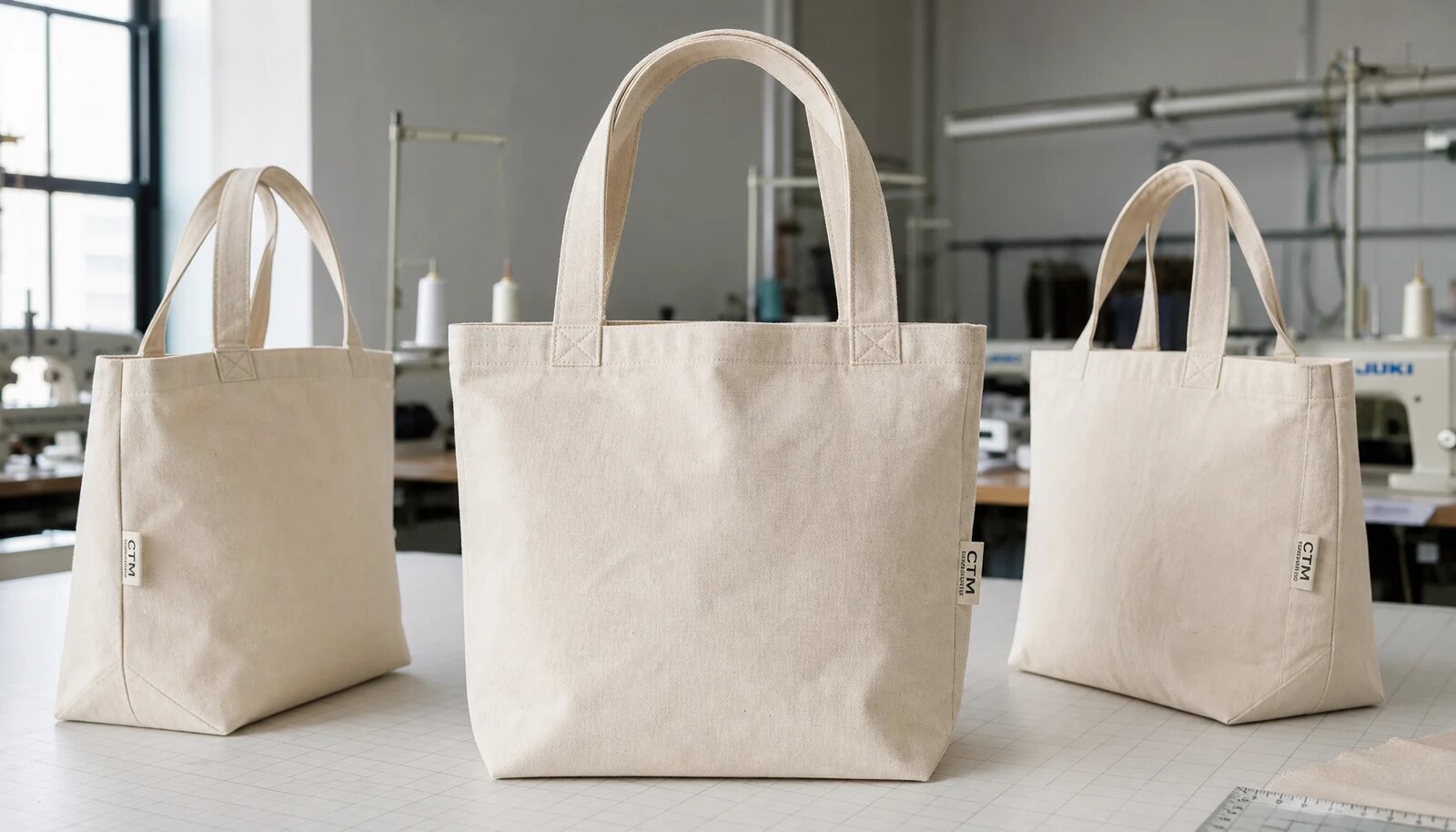
Start With the Event Job
Wholesale organic cotton totes for event planners should be sourced around the work the bag must do. A tote used for badge pickup and a schedule card can be lighter and simpler than one packed with a bottle, notebook, sponsor samples, and a boxed device. The sourcing brief should describe the event use case before asking for price, because fabric weight, handle reinforcement, packing method, and inspection risk all change with the load.
Procurement should list the planned contents, approximate total weight, and the heaviest single item. Rigid corners are important because they press into bottom seams and side panels. Bottles add swing weight. Catalogs and books add flat weight that can stretch handles. A tote can look acceptable in a product photo and still be wrong for fast venue packing if the gusset is too shallow or the handle drop is awkward for attendees.
The presentation level also belongs in the brief. A staff giveaway may need bulk flat packing and basic count control. A sponsor kit may need cleaner folding, tighter print placement, destination carton marks, and lower visible-stain tolerance. A retail tote may need barcode labels, hangtags, individual packing, and stricter carton condition. Bulk pricing becomes easier to compare when essential performance is separated from optional presentation upgrades.
- State the event type, attendee count, handout method, and whether the tote is utility, sponsor, retail, VIP, or staff use.
- List planned contents with estimated total weight and the heaviest single item.
- Flag bottles, rigid boxes, books, electronics, and samples that may stress seams or distort the bag.
- Tell the supplier who will pack the tote: factory, kitting partner, warehouse, venue staff, or attendee.
- Ask the supplier to challenge any spec that is too light for the stated load before quoting.
Make the Pricing Plan Comparable
A wholesale organic cotton totes for event planners bulk pricing plan is not just a lower unit price at higher volume. It is a comparison model that keeps the specification constant while showing quantity tiers, setup charges, packing assumptions, freight basis, and landed-cost risks. Without that structure, procurement may compare quotes based on different GSM, different handle construction, different organic documentation, and different delivery terms.
Ask each supplier to quote practical breaks such as 500, 1,000, 3,000, 5,000, and 10,000 pieces, or use tiers that match forecasted attendance and sponsor commitments. A sharp price drop may show where fabric booking, screen setup, cutting efficiency, or carton utilization improves. A flat curve may mean the supplier is using stock fabric or has already absorbed setup. Both answers are useful only if the tote specification stays unchanged across the tiers.
Separate one-time and recurring costs. Screen charges, strike-offs, printed samples, label setup, carton changes, and special packing can make a low unit price misleading. For a one-time event, these charges belong in total event cost. For an annual program, they may be amortized over reorders if screens, cutting patterns, labels, and approved samples can be reused. The quote should show bag cost, decoration cost, packing cost, carton cost, sample cost, inspection assumption, and trade term.
- Use one pricing grid with the same fabric, size, print, packing, and incoterm at every tier.
- Request separate lines for bag, print, setup, sample, label, packing, inspection, and freight assumptions.
- Ask whether screens, dies, patterns, labels, and approved samples can be reused for reorders.
- Confirm MOQ changes for split artwork, split color, split carton marks, or split destinations.
- Approve against landed cost and event risk, not factory unit price alone.
Verify Organic Evidence
Organic cotton claims need more precision than a simple yes or no. A supplier may have access to organic cotton, may hold certified fabric, may sell blanks made with organic fiber, or may be certified to make finished-product claims. Those are not the same procurement position. The RFQ should state whether organic documentation is mandatory, preferred, or only part of the desired material story.
Common documents serve different purposes. A GOTS scope certificate shows that a company is certified for listed activities and product categories under the Global Organic Textile Standard, but it does not by itself prove that a specific order is certified. An OCS scope certificate does the same general role for the Organic Content Standard. A transaction certificate is order-specific evidence that certified material moved through a certified chain for a defined shipment or transaction. Supplier invoices, mill letters, and fabric certificates may help trace material, but they are not always enough to support a public certified-product claim.
Finished-product claim limits matter. If the buyer wants to say certified organic cotton tote, made with organic cotton, or GOTS certified product, the supplier must confirm which language the documents support. Some orders can support an organic fiber content statement but not a finished-product certification claim. Some blanks may be made from organic cotton but decorated later by a non-certified facility, which can affect the claim. Procurement should approve marketing copy only after matching it to the actual evidence for the order.
- Ask for current GOTS or OCS scope certificates for the relevant mill, factory, or supplier, not unrelated company documents.
- Request a transaction certificate when the order must support certified material movement through the chain of custody.
- Confirm whether printing, dyeing, washing, labeling, or repacking affects the finished-product claim.
- Keep approved public wording aligned with the evidence: fiber content, fabric claim, chain of custody, or certified finished product.
- If certification is preferred but not mandatory, say so clearly so suppliers can quote both documented and lower-control options.
Specify Fabric and Handles
GSM is a major cost driver, but it is not a complete strength standard. As a practical buying range, 140 to 160 gsm can work for light literature, badges, maps, and short-use handouts. Around 160 to 200 gsm is often a safer starting point for notebooks, bottles, boxed samples, and reusable attendee kits. Heavier fabric may suit retail merchandise or premium gifts, but construction still matters; a high-GSM body with weak handle stitching is not a strong event tote.
Use finished measurements instead of vague catalog language. Include width, height, gusset depth, handle drop, handle width, seam allowance if relevant, and whether measurements are taken flat. Set tolerances before production. Buyers commonly negotiate tolerances such as plus or minus 5 to 10 mm for finished dimensions and handle drop, and a defined GSM tolerance such as plus or minus 5 percent, but the right number depends on the factory process and the kit fit requirement.
Handles should be specified as a separate component. A self-fabric handle, folded cotton handle, and cotton webbing handle behave differently in strength, comfort, print appearance, and cost. State whether the attachment is X-stitch, box stitch, bartack, folded hem capture, or another construction. For loaded kits, require a fill-load test using the planned contents plus an agreed safety margin. Record load, duration, and pass criteria so inspection can repeat the test.
- Use 140 to 160 gsm mainly for light handouts and flat literature.
- Use 160 to 200 gsm for sponsor kits, notebooks, bottles, and higher reuse expectations.
- Specify natural undyed, bleached, dyed, washed, calendered, preshrunk, or unwashed fabric.
- Lock handle drop, handle width, handle material, stitch type, and attachment reinforcement.
- Set written tolerances for dimensions, GSM, handle drop, print placement, and visible defects.
- Test the actual kit load before approving bulk production.
Choose the Right Buying Route
The buying route changes both price and control. A direct cut-sew-print factory can be strong for stable orders above 1,000 pieces where the buyer wants control over GSM, dimensions, seams, print, labels, cartons, and documentation. A trading company or sourcing agent can be helpful when the event program includes several products, several factories, or heavy coordination. A domestic decorator using imported blanks can be better when the event date is close, sponsor artwork is late, or the order quantity is too small for efficient custom production.
Do not compare a custom sewn quote with a stock blank quote as if they are the same product. A custom factory quote may include specific fabric, construction, organic evidence, carton marks, and made-to-order packing. A domestic blank quote may cost more per piece but reduce proofing time, transit risk, and replacement friction. The right choice depends on volume, lead time, compliance needs, customization, and the cost of missing the event date.
For recurring events, repeatability can outweigh the lowest first-order quote. A contract factory can keep the cutting pattern, handle spec, print placement, fold, carton count, and documentation workflow stable. For one-off events with uncertain attendance, stock blanks may protect cash flow and schedule. Ask each supplier what is custom, what is stock, what may be substituted, and what changes on a reorder six months later.
- Ask whether cutting, sewing, printing, inspection, and packing are in-house or subcontracted.
- Request the production factory name and location even when buying through an intermediary.
- Compare custom factory, stock blank, local print, and distributor routes on separate landed-cost models.
- Ask which parts of the spec are repeatable and which depend on available stock.
- Confirm who pays for sorting, rework, replacement, or credit if inspection fails.
Control Artwork Early
Event totes are visible brand surfaces, so decoration decisions should be locked early. Screen printing is often practical for bulk event totes with simple logos, sponsor marks, and limited-color artwork. It is efficient at volume and can work well on organic cotton texture when artwork is designed for the base fabric. Water-based ink can give a softer hand, while other systems may be chosen for opacity, durability, or color strength. The RFQ should name the print method and ask what ink and curing process are included when performance matters.
Other decoration methods have their place. Heat transfer can support gradients, photographic artwork, and complex sponsor graphics, but it should be checked for folding, rubbing, edge lift, and handfeel. Embroidery can work for premium small marks, although dense stitching may distort lighter cotton. Digital print can suit shorter runs or complex color if the supplier has the right fabric preparation and curing process. The method should match quantity, artwork complexity, base color, fold method, and attendee use.
Placement must be measurable. A mockup that looks centered is not a production control. Specify print size, printable area, side of bag, distance from top hem or bottom edge, and horizontal alignment from centerline or side seam. Keep artwork away from heavy seams, gusset folds, and handle attachment areas unless the supplier confirms clean production there. Freeze sponsor hierarchy and logo spacing before screens or transfers are made.
- Provide vector artwork where possible, with Pantone references or approved physical color standards.
- State print method, ink type if required, print size, number of colors, side of bag, and placement dimensions.
- Request a strike-off or printed pre-production sample on final production fabric.
- Check folded printed bags for ink transfer, cracking, tackiness, scuffing, and crease damage.
- Keep fine text, QR codes, and thin lines away from coarse fabric, seams, and gusset folds.
- Set a deadline after which sponsor artwork changes require cost and schedule reapproval.
Write an RFQ That Exposes Risk
A strong RFQ gives suppliers fewer places to guess. Asking for a price on organic cotton totes without construction, print, packing, QC, and delivery basis invites assumptions. One supplier may quote 140 gsm natural cotton with one-side print and bulk packing. Another may quote 180 gsm, reinforced handles, two-side print, individual packing, and delivered pricing. The cheaper number may simply be a thinner offer.
The RFQ should read like a compact product specification. Include finished width, height, gusset depth, body GSM, handle construction, fabric finish, organic documentation requirement, print method, artwork colors, label or tag requirement, sample expectation, packing method, carton quantity, inspection requirement, incoterm, and delivery destination. If the receiving date is fixed, include it in the first request and ask the supplier to confirm whether the schedule is realistic before pricing.
Quote questions should reveal operational risk. Ask when lead time starts: PO date, deposit, artwork approval, sample approval, fabric booking, or material arrival. Ask whether third-party inspection is allowed and at what stage. Ask how shortages, overages, rework, and replacement shipments are handled. Ask for carton dimensions and gross weight before freight is finalized. A quote without these details is incomplete until the assumptions are visible.
- Include final destination, required delivery date, and kitting start date in the RFQ.
- Require quantity breaks using the same exact spec at each tier.
- Ask what is excluded, including duty, local delivery, inspection, storage, bank fees, and sample freight.
- Request carton dimensions, pieces per carton, gross weight, net weight, and packing method.
- Ask whether shortages or overages are allowed and how they will be invoiced.
- Require written approval before any fabric, blank, print method, or packing substitution.
Use AQL-Based Inspection
A pre-production sample is the buyer's strongest control point before bulk production. It should use final fabric, final dimensions, final handle construction, final print, final label, final fold, and representative packing. A development sample made with substitute fabric can support early discussion, but it should not release production. Once approved, mark the sample as the golden sample, date it, and require the factory to keep a matching reference at the line.
For larger orders, use a formal final random inspection or a documented internal equivalent before shipment release. Many soft-goods buyers reference ANSI/ASQ Z1.4 or ISO 2859-1 sampling plans with an agreed inspection level and AQL limits. The exact AQL should be negotiated by risk, but the purchase order should name the standard, sample size approach, defect classes, and pass or fail rule. Inspection should occur after enough cartons are packed to verify real packing quality, not only loose pieces from the sewing line.
Defect classification prevents disputes. Critical defects are safety, legal, or brand-stopping issues such as wrong organic claim labels, mold odor, sharp contamination, wrong logo, or bags that fail the agreed load test. Major defects affect function or saleability, such as open seams, broken handle bartacks, severe stains on the front panel, wrong dimensions outside tolerance, poor curing, or short counts. Minor defects are small workmanship issues that do not affect use, such as a limited loose thread, slight slub within the approved cotton character, or a tiny mark outside the main visible area.
- Approve a final pre-production sample before bulk cutting, sewing, printing, or packing.
- Name the sampling standard, inspection level, AQL limits, defect classes, and shipment-release rule.
- Inspect production fabric, finished pieces, printed logos, labels, folds, carton marks, and packed counts.
- Run a documented fill-load test using expected contents plus an agreed safety margin.
- Classify defects as critical, major, or minor before inspection begins.
- Define whether failed goods will be repaired, replaced, credited, sorted, or reworked before shipment.
Plan Packing and Schedule
Packing affects freight cost, warehouse handling, registration speed, and attendee presentation. Flat bulk packing is often best for standard event handouts because staff can count quickly and open fewer packages. Individual polybags can protect against dust and support retail presentation, but they add cost, handling time, and waste. Belly bands, tissue, hangtags, or folded presentation packs may suit VIP kits, but they can create crease risk and slow packing unless the fold is approved.
Cartons should be specified before the purchase order. Ask for pieces per carton, carton dimensions, gross weight, net weight, and carton strength. Cotton totes are soft goods, so freight may be driven by volume as much as actual weight. A lower unit cost can lose value if cartons are underfilled, oversized, or weak. For multi-venue events, carton marks should show PO number, item name, color, artwork version, quantity, carton sequence, destination, and event routing code.
Build the schedule backward from the kitting start date or venue receiving date, not the event opening day. Work through local delivery, customs clearance, freight transit, export handling, inspection, packing, printing, sewing, cutting, fabric booking, sample approval, artwork approval, and PO release. Lead time may start at deposit, final artwork, signed sample, or fabric arrival, so the purchase order should name the milestone. Keep an air-freight contingency visible when the event date cannot move.
- Choose flat bulk packing for fast handout and simple count control.
- Use individual packing only when dust protection, retail presentation, or kitting control justifies it.
- Approve the fold line and confirm it does not damage or crease the printed logo.
- Require carton marks that match the PO, packing list, destination, and receiving plan.
- Confirm factory ready date, inspection date, freight departure, customs release, and final delivery date.
- Reserve time for sample revisions, lab dips, documentation checks, and late sponsor artwork decisions.
Specification comparison for buyers
| Quantity tier | Setup and sample charges | Estimated unit cost basis | Packing basis | Freight basis |
|---|---|---|---|---|
| 500 pcs | Highest setup impact; screen, strike-off, sample, and label setup may dominate the order | Often stock fabric or stock blank pricing; custom fabric may be inefficient | Bulk flat pack, 50-100 pcs per carton unless presentation packing is required | Usually courier, LTL, air, or domestic delivery depending on route |
| 1,000 pcs | Setup begins to spread, but sample freight and proofing still matter | Practical entry point for many custom sewn totes if fabric is available | Bulk flat pack; carton dimensions and gross weight should be quoted before PO | Air or ocean depending on event date; DDP, FOB, CIF, or ex-works must be separated |
| 3,000 pcs | Setup has lower per-piece impact; reusable screens and approved patterns can help reorders | Better cutting and print efficiency; stronger basis for comparing factories | Bulk cartons by destination, kit type, or registration desk if needed | Ocean may be viable if approvals are early; air contingency should be priced |
| 5,000 pcs | Setup usually minor versus unit and freight cost; supplier may offer sharper fabric booking | Custom GSM, handle spec, labels, and carton marks become more economical | Factory-packed allocation plan recommended for multi-venue events | FOB plus forwarder quote often gives procurement clearer landed-cost control |
| 10,000 pcs | Setup is negligible if artwork is stable; annual-program pricing may be negotiable | Best tier for repeatable spec, fabric booking, and production-line planning | Carton strength, count accuracy, and pallet or container loading plan become important | Ocean freight typically drives cost planning unless schedule requires air split |
| Reorder tier | Minimal setup if same spec, screens, labels, and carton plan are retained | Should be quoted separately because fabric price and freight can move | Repeat approved fold, carton count, carton mark format, and inspection checklist | Quote current freight separately from bag price |
Buyer checklist before sampling
- Define the event use case: registration handout, sponsor kit, retail merchandise, VIP gift, staff tote, press kit, campus program, or multi-city activation.
- List expected contents with approximate total weight, the heaviest single item, and any rigid corners, bottles, catalogs, electronics, or boxed samples that stress seams.
- Lock finished dimensions, gusset depth, handle drop, handle width, body GSM, handle GSM if different, weave, and whether the tote must stand, fold flat, or fit a specific kit.
- State the organic cotton claim required: certified organic fiber, certified fabric, chain-of-custody evidence, finished-product certification, or natural cotton appearance only.
- Ask which evidence can be supplied for this order: GOTS scope certificate, OCS scope certificate, transaction certificate, invoice traceability, fabric mill certificate, or finished-product label approval.
- Specify fabric color and finish, including natural undyed, bleached, dyed, washed, calendered, preshrunk, or unwashed greige-look fabric where relevant.
- Choose print method, print area, number of colors, Pantone or physical color standard, ink type if required, and placement measured from seams, hem, or centerline.
- Ask for MOQ by bag size, GSM, fabric color, print version, label version, packing method, carton mark, split shipment, and reorder quantity.
- Request a pre-production sample made with final fabric, final print, final label or tag, final handle construction, final stitch type, and final packing fold.
- Define QC tolerances for GSM, finished dimensions, handle drop, stitch density, seam strength, print position, print color, stain limits, odor, loose threads, and carton condition.
Factory quote questions to send
- What exact body fabric GSM, weave, yarn type, finish, and expected shrinkage are included in this quote?
- Are the handles the same fabric and GSM as the body, or a separate tape, webbing, or folded cotton construction?
- Is the cotton certified organic for this exact order, and can you provide a current GOTS or OCS scope certificate for the relevant supplier?
- Can you provide a transaction certificate for this order, or only general supplier certification documents?
- Does the available documentation support a fiber claim, fabric claim, chain-of-custody claim, or finished-product claim?
- Is the quoted fabric natural undyed, bleached, dyed, washed, calendered, preshrunk, or otherwise finished?
- What are the finished body dimensions, gusset depth, handle drop, handle width, and size tolerances included in the quote?
- Which seams are reinforced, what stitch type is used, and how many stitches per inch or centimeter are standard?
- How are handle attachment points constructed: X-stitch, box stitch, bartack, folded hem capture, or another method?
- Which print method is included, how many colors are covered, what is the maximum print area, and what setup charges apply?
Quality-control points to confirm
- Fabric GSM matches the approved specification within the written tolerance, checked from production fabric rather than only from a showroom sample.
- Body fabric, handles, gussets, and pocket panels if any match the approved shade range, with no obvious shade breaks across panels or mixed lots in the same carton.
- No visible holes, oil marks, dirt, mildew odor, severe slubs, broken yarns, needle damage, or weaving defects on attendee-facing surfaces.
- Finished width, height, gusset depth, handle drop, and handle width stay within written tolerance and fit the planned inserts, boxes, or sponsor kit.
- Side seams, bottom seams, top hems, and handle attachment points are straight, secure, and consistent with the approved construction sample.
- Load-bearing seams show no skipped stitches, open seams, loose thread clusters, broken bartacks, seam grin, or puckering that weakens the bag.
- Handle attachment survives a fill-load test using expected event contents plus an agreed safety margin, with no tearing, seam opening, or distortion beyond the agreed limit.
- Print placement matches the approved proof, measured from the seam, hem, bottom edge, or bag centerline rather than judged by eye only.
- Print color is checked against an approved Pantone reference, drawdown, or physical standard, allowing for the natural cotton base color where relevant.
- Print curing is complete, with no tackiness, cracking, peeling, ink transfer, heavy bleeding, unacceptable odor, or distortion near seams and fold lines.