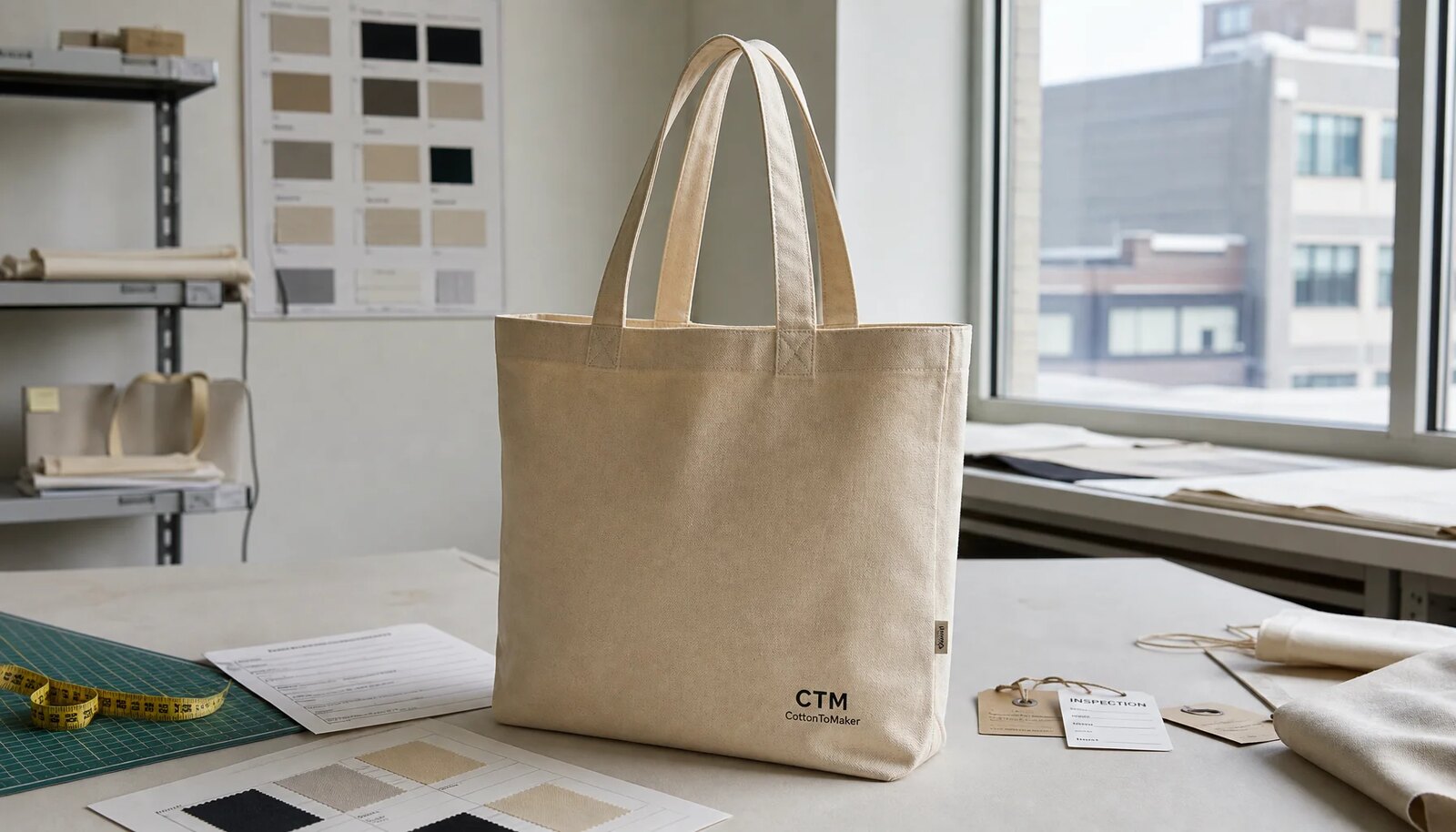
Define the craft fair load first
A craft fair tote is not only a promotional bag. It may carry cards at one booth, then candles, jars, ceramics, books, textiles, or boxed sets from several more. The load is uneven, the shopper may carry it by one handle, and the bag may be folded, stacked, opened, and refilled many times during an event. Those actions stress the handle base, side seam, bottom seam, gusset corners, and printed area.
Start the RFQ with the use case before asking for price. A tote for paper inserts and lightweight apparel can use a different construction than a resale bag expected to hold dense goods. Appearance also matters: a bag may technically survive a load test but still sag badly, twist, show contents through the fabric, or feel too thin for a maker brand.
Write the load profile in practical terms. Name the heaviest likely item, the normal item mix, the target working load, and whether the bag is hand-carry or shoulder-carry. This helps suppliers quote the intended product instead of a generic cotton tote that only looks similar in a photo.
- Use real merchandise examples instead of vague phrases such as durable or heavy duty.
- Set a working load band: 5 kg for light event use, 8 kg for mixed retail, or 10-12 kg for premium heavier-use totes.
- Separate giveaway totes from resale totes because handle comfort, fabric opacity, and defect tolerance are different.
- Confirm whether the tote must fold flat for vendor storage or stand with a gusset for boxed products.
- Ask the supplier to recommend construction for the load, then quote that exact construction.
Specify organic cotton with evidence
Organic cotton is a sourcing claim, not a full bag specification. Two bags can both be described as organic cotton while differing in GSM, weave, yarn character, shade, shrinkage, slub level, sewing stability, and print performance. Procurement teams should treat the organic claim and the physical fabric spec as two related but separate requirements.
For light giveaways, 180-200 gsm organic cotton canvas can be enough when the load is mostly paper or apparel. For many craft fair retail programs, 220-240 gsm is a practical middle range. For premium resale totes or dense items such as jars, books, bottles, and ceramics, 260-280 gsm is usually safer, provided the handle and seam construction are also upgraded.
Ask exactly what documentation is available. Examples may include a supplier scope certificate, transaction certificate where applicable, fabric lot record, purchase invoice, mill declaration, or material declaration. The key question is scope: does the documentation cover only fabric, or also handles, labels, processing, and the finished tote? If retail copy says organic cotton tote, the wording should match the evidence the supplier can provide.
Natural undyed cotton may show seed flecks, small slubs, and lot-to-lot shade movement. That can be part of the look, but it still needs approval limits. Dyed organic cotton adds shade and crocking risk, so repeat orders should use retained shade standards and lot records.
- Quote fabric as a GSM range, such as 180-200, 220-240, or 260-280 gsm.
- Confirm weave type, such as canvas, plain weave, or twill.
- Set GSM tolerance as an agreed percentage or supplier-confirmed range.
- Approve natural shade, flecks, and slub level against a physical swatch or signed sample.
- Confirm whether the organic claim applies to fabric only or to the finished packed tote.
Lock dimensions and tolerances
Cotton totes are sewn goods, so small measurement variation is normal. Fabric relaxation, cutting layers, seam allowance, pressing, and manual sewing all affect finished size. The answer is not to ignore tolerances; it is to make them realistic, measurable, and agreed before the price is fixed.
Many simple tote programs use about plus or minus 1.0 cm for finished width and height. Gusset depth, handle drop, handle width, and print placement may be held closer, often around plus or minus 0.5 cm to 1.0 cm when the factory confirms it can achieve that. Tighter tolerances can raise labor time and reject rates, so buyers should decide whether the added control is commercially necessary.
Measurement method matters. Width can be checked at the top opening, mid-body, or bottom. Gusset depth can be measured flat or opened. Handle drop should be measured from the top edge of the bag to the highest inner curve of the handle. A simple measurement diagram prevents disputes at final inspection.
Pattern decisions also affect cost and performance. Flat totes pack neatly and cost less. Bottom or side gussets improve capacity for boxed goods but require better cutting and sewing control. Any change to size, gusset, fabric GSM, handle type, or fold method can change fabric consumption, carton cube, and landed cost.
- Specify finished width, height, gusset depth, handle width, handle drop, seam allowance, and logo placement in centimeters.
- Attach a measurement diagram showing exact check points.
- Define whether the tote is flat, bottom-gusseted, side-gusseted, or boxed-bottom.
- State edge finish, such as folded seam, overlock, bound edge, or French seam.
- Recheck carton dimensions if GSM, gusset depth, or fold method changes.
Engineer handles and seams
Most tote failures start in predictable places: handle bases, side seams, bottom seams, and gusset corners. Heavier fabric does not fix short handle overlap, weak stitching, poor thread tension, or reinforcement that misses the stress area. For wholesale organic cotton totes for craft fairs, handle construction should be specified as carefully as fabric weight.
Handle width and drop affect both strength and perceived quality. Narrow handles can dig into the hand when the bag carries jars, books, or ceramics. Short handles may suit hand carry, while outdoor markets and crowded aisles may require shoulder carry. Loaded sample approval is more useful than relying on a number alone.
The RFQ should define handle material, width, drop, attachment overlap, reinforcement pattern, thread type, stitch density, and color. Box-X stitching, bar-tacks, or another approved reinforcement pattern should be consistent across both handles. If a supplier changes from cotton webbing to self-fabric handles, or from reinforced stitching to simple straight stitching, the durability result changes even if the bag looks similar.
Inspect seams before and after functional testing. Loose tension, skipped stitches, raw edges, needle damage, or inconsistent stitch density may only become visible after the bag has been filled and lifted repeatedly.
- Require box-X stitching, bar-tack stitching, or an approved equivalent at handle bases.
- Define attachment overlap and reinforcement dimensions.
- Measure left and right handle symmetry to prevent twisting under load.
- Check skipped stitches, broken threads, loose backtacks, and needle holes around stress points.
- Use uneven test items because craft fair purchases rarely load like a single weight plate.
Match decoration to cotton canvas
Decoration should be approved on the same fabric that will be used in bulk production. Organic cotton canvas has texture and absorbency, so fine lines, reverse type, dense ink blocks, and small text behave differently than they do in a digital mockup. One-color or two-color screen printing is often practical for craft fair totes, but only when ink deposit and curing are controlled.
Ask the supplier to confirm minimum line thickness, smallest readable text size, registration tolerance, placement tolerance, and curing process. Large solid ink areas can feel stiff, crack on folds, or transfer during stacking if not cured properly. Multi-color prints add registration risk and setup cost.
Print placement must be reviewed with the fold and packing plan. If the fold line crosses the logo, run a crease test. If totes are stacked print-to-print, check for blocking, gloss marks, or transfer. For premium programs, woven labels, side labels, embroidery, or stitched marks may be better than a large print, but they still need placement, fraying, and claim-wording checks.
- Request a strike-off or printed sample on approved fabric, GSM, and shade.
- Set placement tolerance from top edge, side seam, bottom seam, or handle base.
- Define unacceptable defects: pinholes, smudges, opacity loss, cracking, odor, transfer, and registration drift.
- Avoid large ink blocks on planned fold lines unless fold-rub testing passes.
- Check labels carefully if they mention organic cotton, care, origin, or sustainability claims.
Use a clear durability test record
A durability testing checklist is useful only when it creates repeatable pass-or-fail evidence. Avoid loose wording such as strong handle or good print. The checklist should state sample quantity, test weight, item distribution, hold time, lift cycles, inspection points, print rub method, fold method, and acceptance criteria.
For small to mid-size production lots, a practical approach is to function-test a defined number of random finished totes, such as 3 to 5 pieces for pilot orders and 8 to 13 pieces for larger bulk lots, unless the buyer's internal standard requires more. The sample count should be agreed before production because destructive or semi-destructive tests may not be saleable afterward.
Load testing should reflect the approved use case. Fill the tote with a similar item mix, not only a neat metal weight. Hold or hang the loaded tote for the agreed time, then perform repeated lift-and-lower cycles. Even 20-50 cycles can reveal weak handle attachment, seam slippage, fabric tearing, or permanent distortion. After testing, inspect handle bases, side seams, bottom seam, gusset corners, and handle drop change.
Print testing should mirror packing and event handling. Use dry rub, fold rub, and light scratch checks on production pieces. If the fabric or handles are dyed, add a dry crocking check so color does not transfer to light goods, labels, or clothing.
- Record format: sample ID, carton number, weight, item mix, hold time, cycle count, tester, result, defects, photos, and disposition.
- Pass load hold only if there is no handle pull-out, seam opening, fabric tearing, or severe permanent distortion.
- Pass repeated lift only if reinforcement stitches and seams remain secure after the agreed cycle count.
- Pass print rub only if there is no unacceptable transfer, smearing, flaking, or visible surface breakdown.
- Retest reworked goods before shipment release if any functional sample fails.
Compare suppliers on one spec
Supplier route changes risk. A direct factory with organic cotton cut-and-sew capability can offer stronger control over fabric booking, sampling, sewing, inspection, and repeat orders. A trading company can be useful for programs with several styles, labels, trims, cartons, or destinations. A stock blank converter may be fastest for urgent events, but the buyer usually has less control over GSM, handle drop, shade, gusset, and documentation.
Ask who owns every production step. Cutting, sewing, printing, pressing, labeling, packing, inspection, and carton preparation may happen in different places. Subcontracting is not automatically a problem; hidden subcontracting is. If a print defect or load failure appears, the buyer needs to know who can rework the goods and who is responsible for delay.
Compare every supplier with the same RFQ sheet, artwork file, packing instruction, and inspection standard. Otherwise, a lower price may simply mean thinner fabric, smaller finished dimensions, shorter handles, weaker stitching, omitted setup charges, or looser carton packing.
Traceability matters for reorders. Ask how the supplier links fabric lots to production batches and how it retains shade standards, approved samples, and inspection records.
- Request production site address and process ownership for each step.
- Confirm experience with cotton canvas totes, not only nonwoven or thin promotional bags.
- Require disclosure of subcontracted printing, labeling, packing, or inspection.
- Use one RFQ sheet so quote differences are visible.
- Ask whether approved GSM, shade, handle drop, and print placement can be held on reorders.
Structure MOQ and quote lines
MOQ is rarely one fixed number. It changes with fabric availability, dyeing, cutting efficiency, custom size, print setup, color count, label minimums, packing labor, and carton planning. A natural cotton tote with one-color print usually has more flexible MOQ than a dyed canvas tote with custom webbing, woven labels, multiple artworks, and retail packing.
Request separated quote lines. Ask for base bag unit price, fabric or dyeing upcharge, print setup, print unit charge, label cost, sample cost, packing cost, carton cost if special, testing charge, and documentation charge if applicable. This shows whether cost is driven by GSM, bag size, artwork, label application, or packing.
Quote the quantity bands that match the buying plan while keeping all other specs unchanged. If you request 500, 1,000, 3,000, and 5,000 pieces but change GSM or print method between bands, the price breaks are not comparable. If one base tote will carry several craft fair brand artworks, ask whether the base bag MOQ can be shared and whether each artwork requires separate screens or setup.
Landed cost needs carton data. Heavier canvas may fit fewer pieces per carton and increase freight cube. Request carton dimensions, net weight, gross weight, pieces per carton, fold method, and palletization details before choosing the lowest ex-factory price.
- Ask what changes raise MOQ, unit price, or lead time.
- Separate one-time setup charges from repeat-order unit prices.
- Clarify mixed-artwork rules and screen charges.
- Confirm overrun or underrun tolerance and billing method.
- Compare carton cube and gross weight as part of landed cost.
Approve samples as production standards
A sample should become the production standard, not just a rough design reference. The approved sample should confirm fabric hand-feel, GSM, shade, dimensions, gusset depth, handle drop, stitching, reinforcement, print method, print placement, label, fold, and packing concept.
A showroom sample is useful for discussion, but it should not release bulk production unless it matches the intended specification. A pre-production sample should use the planned fabric, thread, handle, reinforcement, size, decoration, label, and packing fold. For printed totes, approve a strike-off on actual cotton fabric because ink color, opacity, and edge clarity change on textured material.
Once approved, sign and label the sample. Keep one with the buyer or buying office and require the factory to keep one identical sample at the production site. Record approval date, version number, artwork file name, measurement table, tolerances, print color reference, and accepted natural cotton variation.
If revisions occur, control version history. Mark old samples as rejected or superseded and confirm the final version in writing before cutting or printing starts.
- Mark the approved sample with date, version, supplier name, artwork file, and buyer signature.
- Attach measurement points and tolerances to the sample record.
- Photograph handle reinforcement, gusset, seam finish, print placement, label, and fold method.
- Do not approve bulk production from a digital mockup when durability or shade matters.
- Use the signed sample during inline and final inspection.
Set QC acceptance before shipment
Quality control works best when the factory sees the standard before production begins. Inspection should cover material, organic claim documents, workmanship, measurement, print, functional load performance, labeling, packing, and carton condition. Buyers may use a formal AQL plan or a simplified sampling plan, but defect classification must be clear.
A common inspection reference is ANSI/ASQ Z1.4 with general inspection level II for visual workmanship and special inspection levels for measurements or functional tests. The buyer should choose the plan that matches order value, risk, and internal policy. If AQL is used, define acceptable limits for critical, major, and minor defects in the PO or inspection instruction.
Critical defects may include mold, unsafe contamination, severe odor, wrong organic claim, wrong artwork, mixed SKU, or failure under the approved load test. Major defects may include loose handles, broken seams, out-of-tolerance dimensions, visible stains, print cracking, heavy ink transfer, wrong carton count, or missing labels. Minor defects may include small loose threads or slight shade movement within the approved range.
Carton selection should be random across the lot, not only from easy-to-access cartons. Measurements and functional tests should be recorded with sample IDs, carton numbers, photos, and results. If goods fail, define the action: rework, replacement, retest, shipment hold, partial shipment, or commercial settlement.
- Classify critical, major, and minor defects before production.
- Define visual sample size, measurement sample size, and functional test quantity.
- Inspect random cartons across fabric rolls, sewing lines, print batches, and packing shifts where possible.
- Record test results, defect photos, carton numbers, and corrective actions.
- Release shipment only after failed functional tests are corrected and retested.
Specification comparison for buyers
| Buying decision | Best-fit option | Use when | Key checks before PO |
|---|---|---|---|
| Light craft fair giveaway | 180-200 gsm organic cotton canvas, flat tote, reinforced self-fabric handles | The tote carries brochures, cards, lightweight apparel, small accessories, or event inserts | Confirm opacity, seam finish, handle overlap, print show-through, and whether the organic document covers the fabric used |
| Balanced booth retail tote | 220-240 gsm organic cotton canvas, flat or bottom-gusseted tote, box-X or bar-tack handles | Shoppers carry mixed goods such as candles, paper goods, boxed soaps, small jars, folded textiles, or stationery | Run an 8 kg load check, inspect gusset corners, confirm handle drop, and test print rub after folding |
| Premium resale tote | 260-280 gsm organic cotton canvas, gusseted construction, 25-30 mm webbing or reinforced self-fabric handles | The tote is sold as merchandise or used for books, ceramics, bottles, glass jars, boxed sets, or repeated reuse | Check carton cube, sewing consistency, handle comfort, fabric lot shade, higher freight volume, and 10-12 kg functional testing |
| Direct factory route | Factory controls fabric sourcing, cutting, sewing, inspection, and preferably printing | You need custom dimensions, repeatable construction, organic traceability records, and stable reorders | Verify production site, fabric lot records, approved sample retention, in-house versus subcontracted processes, and QC responsibility |
| Trading company route | Trading company manages named factories and consolidated shipments | You are buying several bag styles, labels, trims, destinations, or packing formats under one program | Require factory disclosure, process ownership, corrective-action path, organic document chain, and inspection release authority |
| Stock blank plus local decoration | Available organic cotton blank decorated after purchase | You need a fast event order, small pilot run, or minimal customization | Durability-test the actual blank, confirm claim documentation, check handle drop and GSM, and do not assume future stock lots will match |
Buyer checklist before sampling
- Define the craft fair load profile by real items: books, jars, candles, ceramics, bottled products, boxed sets, apparel, prints, or mixed purchases.
- Select a working load target such as 5 kg for light use, 8 kg for mixed booth retail, or 10-12 kg for premium heavier-use totes.
- Specify finished width, height, gusset depth, handle width, handle drop, seam allowance, print area, fold method, inner pack, and master carton quantity in centimeters.
- Set fabric requirements by GSM range, weave, color basis, shrinkage expectation, shade tolerance, and acceptable natural flecks or slubs.
- Clarify organic documentation scope: yarn, fabric, handles, processing, finished bag, transaction certificate, scope certificate, or supplier declaration where applicable.
- Require handle construction details including material, attachment overlap, box-X or bar-tack reinforcement, stitch density, thread type, and left-right symmetry.
- Approve decoration on the actual fabric and GSM, including print size, colors, placement tolerance, curing method, minimum line thickness, rub resistance, and fold-line risk.
- Request a pre-production sample made with the intended fabric, handles, thread, print, label, fold, and packing method, not only an available showroom sample.
- Keep one signed buyer approval sample and require the factory to retain one identical production reference sample.
- Set QC instructions before cutting: sampling method, AQL if used, defect classifications, measurement sample size, functional test quantity, carton selection, and pass/fail action.
Factory quote questions to send
- What exact fabric GSM range, weave, shrinkage expectation, shade basis, and GSM tolerance are included in this quote?
- Which organic documents can you provide, and do they cover yarn, fabric, handles, processing, finished product, or only purchased material?
- Can you provide document examples such as a valid scope certificate, transaction certificate where applicable, fabric lot record, purchase invoice, or material declaration before bulk shipment?
- What finished-size tolerance can you hold for width, height, gusset depth, handle drop, handle width, and print placement?
- Who performs fabric sourcing, cutting, sewing, printing, finishing, packing, and final inspection, and which steps are subcontracted?
- What handle reinforcement will be used, what is the attachment overlap, and what stitch density or bar-tack standard can you hold?
- Which print method and ink system will you use, what curing process is required, and what setup cost applies per color or screen?
- What minimum line thickness, smallest readable text size, registration tolerance, and placement tolerance do you recommend for this cotton texture?
- Can you quote 500, 1,000, 3,000, and 5,000 pieces using the same size, GSM, handle, print, label, and packing specification?
- What costs are separate from the unit price: sampling, strike-off, screen setup, label application, special packing, cartons, inspection, testing, or documentation?
Quality-control points to confirm
- Fabric weight should match the approved GSM range and agreed tolerance, with representative checks across production rolls and no holes, oil marks, stains, weak weave zones, mildew odor, or unexpected shade bands.
- Organic claim checks should compare supplier documents against the PO claim wording, material lot records, approved labels, and any hangtag or retail copy used by the buyer.
- Finished measurements should follow the approved measurement diagram for width, height, gusset depth, handle width, handle drop, print placement, fold size, and carton quantity.
- Seams should be straight and secure, with no skipped stitches, broken threads, raw edges, seam slippage, loose backtacks, needle damage, or twisting that changes bag shape when loaded.
- Handle attachment should be checked at every stress point, including box-X or bar-tack position, overlap length, stitch density, thread tension, reinforcement size, and left-right symmetry.
- Load testing should use the buyer-approved weight, item distribution, hold time, and lift cycles; passing samples show no handle pull-out, seam opening, fabric tearing, or severe permanent distortion.
- Print quality should be checked for registration, opacity, edge clarity, pinholes, smearing, ink buildup, cracking, odor, adhesion, dry rub transfer, fold rub damage, and light scratch resistance.
- Dyed cotton or dyed handles should be checked for shade consistency and dry crocking risk, especially if the tote may contact light-colored goods or apparel.
- Labels, care marks, organic claim wording, hangtags, country-of-origin marks, barcodes, and SKU labels should match approved artwork and destination requirements supplied by the buyer.
- Packing should match the PO for fold method, inner quantity, master carton count, carton dimensions, gross weight, carton marks, SKU separation, moisture protection, and print-transfer prevention.