Why Coffee Roasters Need a Precise Tote RFQ
A coffee roaster tote looks simple until it sits next to roasted coffee on a café shelf. Then every construction choice becomes visible. The fabric either feels substantial or flimsy. The print is either clean or slightly off. The handles either sit comfortably on the shoulder or make the bag feel like a throwaway promotion. If the tote is sold as merchandise, packed into a holiday bundle, used for subscription pickup, or sent to wholesale café accounts, it carries the same brand expectations as the coffee itself.
That is why a loose request such as “organic cotton tote with logo” creates trouble. One supplier may quote a thin plain-weave bag with short handles and a heat transfer. Another may quote 10 oz canvas, shoulder-length handles, bartacks, screen print, woven label, inner bundles, and export cartons. Both prices may appear reasonable, but procurement is not comparing the same product. The difference often shows up later in sample revisions, extra setup charges, unexpected carton volume, or quality disputes.
A stronger RFQ fixes the bag before the price conversation starts. It defines the use case, load, finished size, fabric weight, finish, handle construction, branding method, samples, inspection criteria, packing, delivery terms, and documentation. Suppliers can still offer alternatives, but those alternatives should be labeled as options. The base quote stays comparable.
For coffee roasters, this discipline matters because many tote orders are tied to a date: a retail launch, holiday campaign, trade show, new café opening, loyalty program, or subscription refresh. A vague spec can cost two or three sample rounds. A precise RFQ gives the supplier fewer excuses, gives the buyer cleaner pricing, and gives QC a clear standard at final inspection.
- State whether the bag is merchandise, promotion, subscription packaging, event use, or wholesale account support.
- Describe the expected load in real coffee terms, such as two to four 250 g bags or several 12 oz or 1 lb retail bags.
- Require suppliers to list quote assumptions, exclusions, and alternative specs separately.
- Treat the approved pre-production sample as the benchmark for bulk production and inspection.
Start With the Physical Spec: Size, Fabric, Gusset, and Handles
Begin with finished measurements. Not catalog names. Not “standard shopper.” A factory can price and make “38 x 42 cm flat tote with 26 cm handle drop” far more accurately than “large organic tote.” For a coffee roaster RFQ, include width, height, gusset depth, handle width, and handle drop. If the bag needs to hold retail coffee bags upright, a gusset is usually worth evaluating. If the bag is mainly for a lightweight event giveaway, flat construction may reduce cost and carton volume.
Fabric weight should be written in a way suppliers cannot reinterpret. Organic cotton canvas around 8 oz to 10 oz is a practical starting point for many roaster programs. It has more structure than very light promotional cotton, remains printable, and can still be folded for shipping and storage. In metric terms, buyers often see 8 oz quoted around 270 GSM and 10 oz around 340 GSM. Treat those numbers as reference points, not universal conversions. Ask each supplier to state the actual GSM, fabric construction, and acceptable tolerance for bulk production.
Handles deserve more attention than they usually get. They are the first part customers test and the first part likely to fail under load. Specify self-fabric folded handles, cotton webbing, or another handle material. Then state width, length, drop, stitching, and reinforcement. A 24-28 cm drop is commonly used for shoulder carry, but the right number depends on bag height, market preference, and whether the tote is intended for hand carry or daily reuse.
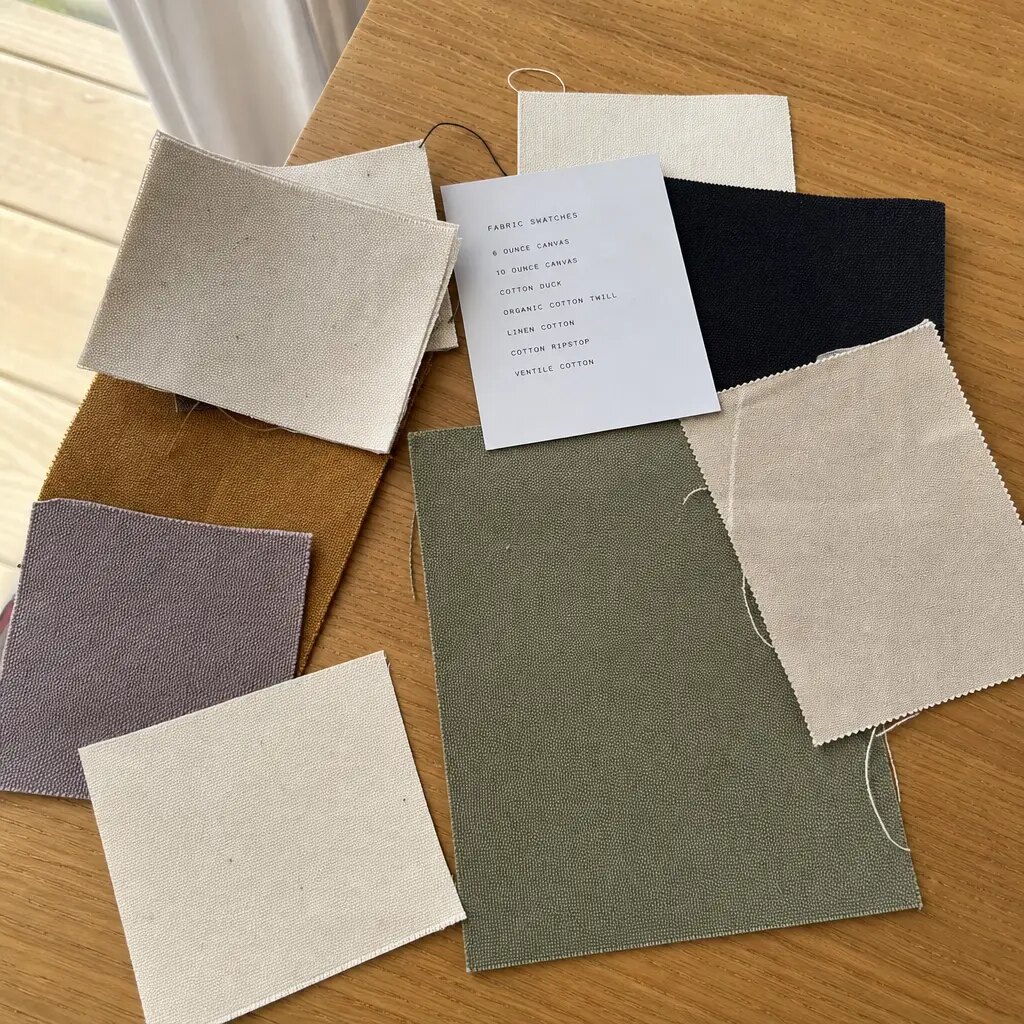
Finish changes the bag’s appearance and sometimes its production behavior. Natural organic cotton may show seed flecks, mild slubs, and shade variation. That can look authentic and on-brand for coffee, but only if everyone agrees what is acceptable. Bleached, dyed, washed, enzyme-washed, or pre-shrunk options can create a more controlled look, yet they may add cost, shrinkage variables, sample approvals, and color-control requirements. Put the finish in the RFQ, then approve it against a physical swatch.
- Specify finished width, height, gusset depth, handle width, and handle drop.
- Ask for fabric weight in oz and GSM, plus weave and finishing route.
- Choose gusseted construction when the tote must carry coffee bags neatly and repeatedly.
- Require bartack, box stitch, or reinforced handle attachment for bags expected to carry weight.
- Define acceptable natural shade variation before bulk fabric is cut.
Organic Cotton Documentation and Claim Control
Organic cotton is not only a fabric choice. It is also a claim that may need support. If the tote will be described as organic on a website, hangtag, invoice, retailer form, line sheet, or sustainability page, procurement should ask for documentation before the order is awarded. Waiting until the packaging artwork is ready can put the buyer in a difficult position: the product may be manufacturable, but the claim may not be supportable in the exact way marketing wants to use it.
Separate material evidence from finished-product claims. A supplier may be able to source organic cotton fabric but may not be able to provide a specific certification logo, transaction certificate, retailer compliance form, or approved claim statement for the finished tote. The RFQ should ask what is included, what is available on request, what costs extra, what takes additional time, and what cannot be provided for this order.
This is especially important for coffee roasters selling through specialty retail, grocery, corporate gifting, ecommerce marketplaces, or distributors. Those channels may require material declarations, country-of-origin marking, barcode data, restricted wording, or particular document formats. Attach those requirements at the RFQ stage. The supplier can then price labels, hangtags, carton marks, and administrative work accurately.
A practical RFQ sentence is: “Please state exactly what organic cotton documentation is included with this quote, what can be provided at extra cost, what lead time is required, and whether the documents support our intended claim wording.” It is a simple sentence, but it prevents broad promises and keeps the claim pathway visible.
- Ask whether documentation covers fiber, fabric, supplier scope, finished product, or claim labeling.
- Attach retailer or internal compliance requirements before sampling starts.
- Confirm whether certification logos or claim wording are allowed before printing hangtags.
- Keep documentation charges and timing visible in the quote.
- Avoid vague marketing copy until the paperwork path is confirmed.
RFQ Template Fields to Send Every Supplier
A good RFQ reads like a production brief, not a casual sourcing email. It should be detailed enough for each supplier to quote the same tote and organized enough for procurement to compare responses line by line. For wholesale organic cotton totes for coffee roasters, the core fields are purpose, quantity tiers, finished dimensions, fabric, handles, branding, labels, documentation, samples, QC, packing, shipment terms, and target delivery date.
Open with the commercial use. Tell the supplier whether the tote is for resale, gift-with-purchase, café pickup, event distribution, subscription packing, or wholesale account support. Mention the expected load in practical terms: two to four 250 g bags, several 12 oz or 1 lb bags, a tumbler, small brewing accessories, or general daily carry. This helps the supplier understand whether the bag can be light and promotional or needs stronger construction.
Next, list the technical specification. Include finished size, gusset, fabric weight, weave, color, finish, handle material, handle drop, handle width, reinforcement, and tolerances. If you are open to options, ask suppliers to provide them as separate lines: base spec, cost-down option, premium option, and any stock-size alternative. Do not let alternatives replace the base quote, or comparison becomes messy.
Branding instructions should be measurable. Send vector artwork where possible. State print method preference, number of colors, print size, ink reference, print position, and whether branding appears on one side, two sides, gusset, label, or hangtag. For woven labels, care labels, paper bands, barcode stickers, and retail hangtags, include dimensions, artwork status, attachment method, and data requirements. Every added component affects MOQ, setup, labor, QC, and packing.
Finish with the quote format. Request unit prices at the same tiers, such as 1,000, 2,500, and 5,000 pieces. Ask suppliers to separate sample charges, screens, plates, woven-label setup, special packing, tests, documents, and freight terms. Require carton dimensions, pieces per carton, gross weight, net weight, estimated CBM, payment terms, lead time after approval, and quote validity. A useful quote is not just cheap; it predicts the real landed cost.
- Product brief: purpose, channel, expected load, launch date, and target order quantity.
- Technical spec: size, gusset, fabric, finish, handle, reinforcement, tolerances, and sample requirements.
- Branding spec: artwork, print method, colors, placement, labels, hangtags, and barcode needs.
- Commercial quote: unit price, setup charges, sample cost, packing cost, testing, documents, and freight terms.
- Supplier response: assumptions, exclusions, lead time milestones, MOQ rules, and quote validity.
Logo Methods for Roaster Merchandise
Many coffee roaster logos are ideal for one-color screen print. Wordmarks, roast badges, simple icons, and line-art illustrations usually reproduce well on cotton canvas when the artwork is clean and the ink is properly cured. The RFQ should state print size, color reference, placement, number of print locations, and whether the supplier is quoting the print on actual bulk fabric. A beautiful digital proof is useful, but it is not the same as ink on textured cotton.
Ask about curing and handling. Under-cured ink can smear, crack, stick in folded stacks, or transfer to the reverse side of the bag. If the artwork has heavy coverage, fine lines, or a large solid area, request the supplier’s feedback before sampling. The issue may not be the logo itself; it may be the fabric texture, ink system, print area, or folding schedule after printing.
Transfers and digital prints have a place, especially for gradients, small detail, photo-style artwork, or multi-color campaigns. Still, they should be selected for a reason, not because the mockup looks sharper on a screen. Cotton canvas has texture and movement. A transfer can look clean at first and behave differently after folding, rubbing, carrying, or spot cleaning. Ask for a strike-off and durability comments on the actual fabric.
Woven labels give roaster merchandise a different feel. A small side-seam label can make the tote look more retail-ready without turning the entire front panel into advertising. It also works when the same tote body is used across seasons and the variable branding lives on a hangtag or paper band. If you choose labels, define size, fold type, color count, location, orientation, and whether the label is sewn into the seam during construction or attached after sewing.
For roasters with several cafés, sub-brands, or seasonal drops, ask how artwork versions change MOQ and setup. One tote body with four logos may sound efficient, but it can require four print setups, four inspection lots, and careful carton segregation. Sometimes the simpler route is one standard printed tote plus variable retail tags. Sometimes separate artwork SKUs are worth it. The RFQ should make those cost and handling differences visible.
- Use screen print for bold, repeatable logos and simple roaster artwork.
- Use transfers only when artwork detail justifies the method and durability is checked.
- Request a print strike-off on the actual bulk fabric before PPS approval.
- Set print placement tolerance from top edge, side seam, or centerline.
- Quote woven labels separately, including setup, MOQ, fold, colors, and sewing position.
MOQ, Price Tiers, and Landed-Cost Comparison
MOQ is not only a number to negotiate down. It is often tied to fabric availability, cutting efficiency, print setup, label production, packing labor, and factory scheduling. A supplier may offer a low MOQ for stock natural canvas in a standard size with one-color print and bulk packing. The same supplier may need a higher MOQ for custom dyeing, multiple artwork versions, woven labels, individual packing, or special carton allocation.
Ask every supplier to quote the same tiers. For many roaster tote programs, 1,000, 2,500, and 5,000 pieces are useful comparison points, though your actual tiers should match the sell-through plan. Confirm whether MOQ applies to the total order or separately to fabric color, tote size, artwork, label, and packing configuration. This detail matters. A 3,000-piece order is not simple if each of three café logos has its own 1,000-piece minimum and separate setup cost.
Read the unit price together with all secondary charges. Screens, plates, print strike-offs, sample revisions, woven-label setup, hangtag printing, barcode stickers, special folding, testing, documentation, and cartons can all change the true cost. A lower unit price can disappear once these line items are added. Ask suppliers to show the base unit cost and the extra costs separately so the buyer can calculate a realistic factory total.
Then bring logistics into the comparison. Heavier canvas can look better, but it also increases gross weight and may increase carton volume. Gussets, individual packaging, and retail folding can do the same. Ask for pieces per carton, carton dimensions, gross weight, net weight, and estimated CBM before awarding the order. The best value is the tote that meets the brand and usage requirement at the best landed cost, not automatically the heaviest fabric or the lowest ex-works price.
For a first run, simplicity often wins. A natural organic cotton canvas tote with one-color screen print and bulk carton packing may be the cleanest launch order. Once demand is proven, the next order can add heavier fabric, woven labels, individual retail presentation, more artwork versions, or channel-specific packing.
- Ask whether MOQ is by total order, fabric color, artwork, size, label, or packing style.
- Compare the same quantity tiers from every supplier.
- Separate unit price from sample, setup, documentation, testing, packing, and freight costs.
- Calculate carton volume and weight before assuming the heavier tote is the better value.
- Use the first order to prove demand before adding unnecessary SKU complexity.
Sampling Sequence and Approval Discipline
Sampling is the point where the RFQ becomes real. A digital mockup can show approximate logo scale, but it cannot confirm fabric opacity, shoulder comfort, stitch tension, gusset shape, print behavior, odor, or folding presentation. Coffee roasters should test the sample with the actual products customers will carry: 250 g retail bags, 12 oz or 1 lb bags, tumblers, small brew tools, gift inserts, or subscription items.
A practical sequence is material swatch, reference sample if needed, print strike-off, and pre-production sample. The material swatch confirms shade, weight, weave, and finish. The print strike-off confirms ink color, coverage, edge sharpness, and compatibility with the fabric. The pre-production sample should bring everything together: final bulk fabric, dimensions, handle construction, branding, labels, folding, and packing method.
Approval should be written, measured, and version-controlled. Record finished width, height, gusset, handle drop, handle width, fabric weight, print size, print placement, label location, fold method, and any accepted deviations. Photograph the approved sample from the front, back, inside seams, handle attachments, label area, and folded state. If the supplier sends a revised sample, update the version and confirm whether the price or lead time changes.
Avoid approvals that only say “looks good.” They are too easy to misread. A stronger approval note might say: “Approved for bulk production: natural 10 oz organic cotton canvas, 38 x 42 x 10 cm finished size, 26 cm handle drop, black one-color screen print centered 11 cm below top edge, woven side label at right seam, bulk pack 100 pcs per carton.” That sentence gives production, QC, and receiving teams a shared standard.
Keep one signed or clearly documented pre-production sample as the inspection benchmark. If the supplier cannot physically hold a matching sample, make sure both teams have the same photos, measurements, artwork files, color references, packing instructions, and approval date. When there is a dispute later, the approved sample record is much more useful than a chain of informal messages.
- Test samples with the real coffee products the tote must carry.
- Approve fabric, construction, artwork, label placement, folding, and packing together.
- Use the print strike-off to confirm ink before bulk printing.
- Keep one signed or clearly documented PPS as the inspection standard.
- Reconfirm cost and timing after any sample change that affects material, print, labels, or packing.
QC Criteria: Tolerances, Defects, and Inspection Checks
Quality control belongs in the RFQ and purchase order, not only in the final inspection report. The supplier needs to know what the buyer considers sellable, repairable, minor, or rejectable. For organic cotton totes, inspection should cover finished dimensions, fabric weight, appearance, stitching, handle reinforcement, print placement, print quality, label placement, cleanliness, odor, count accuracy, and carton condition.
Set realistic tolerances before production. Cotton tote dimensions can vary because fabric relaxes, cutting layers shift, seams consume fabric, and finishing may change shape slightly. Many tote programs use about +/- 0.5 cm to +/- 1 cm for key measurements, depending on bag size, fabric weight, construction, and finish. The supplier should confirm what is achievable. Handle drop needs its own tolerance because a small change can affect shoulder comfort.
Defect classification keeps inspection practical. Major defects can include broken handles, missing reinforcement, wrong fabric, wrong artwork, severe stains, holes, open seams, incorrect labels, strong odor, wrong carton count, or mixed SKUs. Minor defects may include a trim-able loose thread, slight fold wrinkle, mild natural cotton speckling, or small shade variation that was already accepted in the approved sample. This distinction prevents over-rejecting normal natural-fabric character while still protecting the brand from serious failures.
Print inspection should be measured, not judged by eye alone. Check logo position against the agreed distance from the top edge, side seam, bottom seam, or centerline. Inspect ink coverage, edge sharpness, curing, registration for multi-color prints, pinholes, smudges, cracking, ghosting, and reverse-side transfer. If bags are folded soon after printing, confirm the ink is cured before packing. A stack of printed totes can be ruined by ink that looked dry but was not fully set.
Odor is worth a separate line item for coffee brands. Customers associate the brand with aroma, freshness, and sensory quality. Bags that smell musty, smoky, damp, chemical, or mildewed can damage that impression even if the sewing is acceptable. Include odor and cleanliness checks in final inspection, especially when goods have been stored, shipped in humid conditions, or packed tightly for long periods.
- Measure samples from multiple cartons, not only the top pieces.
- Classify broken handles, holes, wrong artwork, severe stains, and wrong counts as major defects.
- Use the approved PPS as the visual, measurement, and packing benchmark.
- Check print placement with a ruler and defined tolerance.
- Include odor, cleanliness, and carton accuracy in final inspection.
Packing, Carton Marks, and Warehouse Receiving
Packing can quietly add cost after the goods arrive. A coffee roaster may need totes for cafés, an ecommerce warehouse, subscription packing, event staff, corporate gifting, or wholesale partners. If cartons are mixed, poorly marked, overfilled, underfilled, or missing inner counts, the receiving team has to open, count, sort, and repack. That labor belongs in the real cost of the order, even if it never appears on the supplier’s unit price.
Define the packing method in the RFQ. Options include bulk packing, inner bundles, individual polybags, paper bands, hangtags, barcode stickers, or retail-ready folding. Bulk packing is usually efficient, but ecommerce and retail channels may require individual protection or barcode labels. If the brand wants to reduce plastic, ask about paper bands or bundle packing. Then check whether that method still protects the bags from moisture, dirt, heavy creasing, and carton abrasion during transit.
Ask for carton details before awarding the order: pieces per carton, carton dimensions, gross weight, net weight, and estimated CBM. Fabric weight, gusset depth, folding style, and individual packaging can change volume significantly. Overpacked cartons can create deep wrinkles or distorted shapes. Underfilled cartons waste freight space. For palletized receiving, check whether carton dimensions and weights fit the buyer’s warehouse and carrier rules.
Carton marks should be treated as a specification, not an afterthought. Include buyer name, PO number, style number, color, artwork version, quantity, carton number, gross weight, net weight, and country-of-origin marking if required. If your receiving system needs barcode carton labels, destination codes, café allocation codes, SKU stickers, or mixed-carton warnings, send the exact format with the RFQ or PO.
Avoid mixed cartons unless your warehouse has approved the method. If mixed cartons are necessary, require a clear inner breakdown, carton label, and packing list format. For multi-location roasters, it may be better to pre-allocate cartons by café, region, or event. The supplier may charge extra for this work, but it can save receiving labor and reduce distribution errors.
- Define bulk pack, inner bundle, paper band, polybag, hangtag, or retail-ready packing.
- Avoid mixed cartons unless the warehouse has approved the sorting method.
- Require carton marks with PO, style, artwork version, quantity, and carton sequence.
- Ask for carton dimensions, weight, pieces per carton, and estimated CBM before award.
- Confirm folding method when presentation, wrinkles, or retail display matter.
Lead Time, Risk Points, and PO Handoff
Lead time should be broken into milestones. A supplier may quote 30-45 days after approval, but “approval” can mean different things: deposit received, artwork confirmed, fabric booked, strike-off approved, PPS approved, documents completed, or carton marks finalized. For coffee roasters working toward a holiday box, retail launch, trade show, café opening, or subscription campaign, the start date matters as much as the ship date.
Typical stages include fabric sourcing, material approval, sample making, print strike-off, pre-production sample approval, bulk cutting, sewing, printing, trimming, QC, packing, and export handover. Custom dyed fabric, woven labels, retail hangtags, barcode setup, testing, claim documentation, or special carton allocation can add time. Peak production periods can also affect sewing and printing capacity. Ask for a milestone calendar, not only one promised delivery date.
Buyer-side delays are common and preventable. A factory may make a sample quickly, but it cannot protect a production slot while marketing, sustainability, operations, and retail teams send conflicting comments. Assign one approver. Freeze artwork early. Confirm claim wording before hangtags are printed. Send carton marks with the PO. If a change affects fabric, dimensions, print size, label position, or packing, ask for the revised price and schedule before approving it.
The final purchase order should mirror the RFQ and sample approval. Include the approved spec version, quantity by artwork, unit price, setup charges, sample reference, tolerances, QC criteria, packing instructions, carton marks, shipment terms, documentation requirements, and delivery deadline. A clean PO gives the supplier a production checklist. It also gives procurement a fair basis for inspection, receiving, and dispute resolution.
One final point: keep alternatives out of the PO unless they are explicitly approved. If the RFQ allowed an 8 oz cost-down option and a 10 oz base option, the PO must state which one was selected. The same rule applies to handle drop, print location, label type, packing, and documentation. Ambiguity at handoff is where many small sourcing problems become expensive production problems.
- Ask when lead time starts and which approvals must be complete.
- Request milestones for fabric, samples, PPS, production, inspection, packing, and handover.
- Identify long-lead items such as custom fabric, dyeing, woven labels, hangtags, testing, and documents.
- Assign one buyer-side approver for sample comments and final signoff.
- Make the PO match the approved RFQ, PPS, tolerances, packing, and documentation requirements.
Specification comparison for buyers
| Spec decision | Recommended option | When it fits | Buyer risk to check |
|---|---|---|---|
| Fabric route | Organic cotton canvas around 8 oz to 10 oz, or 270-340 GSM equivalent stated in the RFQ | Retail-ready roaster merchandise, customer loyalty bags, subscription pickup bags, and premium promotional programs | Oz and GSM are not identical across suppliers; require actual bulk fabric weight tolerance and sample confirmation |
| Construction route | Flat tote for simple promos; gusseted tote with reinforced handles for coffee retail use | Coffee bean purchases, café merchandise walls, holiday gift bundles, and wholesale account support | Catalog terms such as medium or heavy duty can hide weak seams, shallow gussets, and short handle drops |
| Finished size route | Write width, height, gusset, handle width, and handle drop in cm or inches | Any quote comparison where suppliers must price the same physical bag | Finished size can vary after sewing and finishing; set tolerances before issuing the PO |
| Supplier route | Factory or managed supplier that controls fabric, sewing, printing, sampling, packing, and export documentation | Programs where repeatability, brand color, carton accuracy, and delivery timing matter | Unclear subcontracting can create responsibility gaps when print, sewing, or packing defects appear |
| MOQ strategy | Request 1,000, 2,500, and 5,000 pcs per artwork/color when possible | Launch orders, seasonal coffee events, café chains, ecommerce bundles, and distributor replenishment | MOQ may apply by fabric color, artwork, label, size, or packing style rather than total order only |
| Print method | One-color screen print for most roaster logos; woven label for subtle branding; transfer only when artwork detail requires it | Bold logos, café names, roast icons, loyalty merchandise, and repeat reorder SKUs | Complex artwork can add screens, registration risk, curing risk, setup charges, and longer approval time |
| Handle spec | Self-fabric folded handles or cotton webbing, commonly 2.5-3.5 cm wide with 24-28 cm shoulder drop and bartack or box-stitch reinforcement | Bags expected to carry multiple 250 g, 340 g, 454 g, or 1 lb coffee bags plus small accessories | Short handles reduce reuse; weak attachment is a high-severity defect because it causes field failure |
| Documentation route | State whether you need organic cotton certificates, transaction references, supplier declarations, scope certificates, test reports, or approved claim wording | Brands with sustainability pages, retailer compliance requests, corporate gifting buyers, or internal ESG records | Marketing the tote as organic without matching documents can create compliance, retailer, and customer-trust problems |
| Sample approval route | Approve material swatch, print strike-off, and pre-production sample before bulk cutting | Orders with fixed logo position, natural fabric shade expectations, custom labels, or launch deadlines | Skipping PPS can lock in wrong fabric hand feel, handle drop, artwork scale, label placement, or folding method |
Buyer checklist before sampling
- Define the tote role before quoting: resale merchandise, gift-with-purchase, subscription pickup bag, event giveaway, café retail carrier, or wholesale account support.
- Provide finished dimensions in cm or inches: width, height, gusset depth, handle width, and handle drop. Do not rely on size words such as medium, large, shopper, or book bag.
- State fabric weight in oz and GSM where possible. For reference, 8 oz cotton is often around 270 GSM and 10 oz is often around 340 GSM, but ask each supplier to confirm their actual fabric basis.
- Specify weave and finish: canvas, plain weave, twill, natural, bleached, dyed, washed, enzyme washed, or pre-shrunk. Define the acceptable shade range against the approved sample.
- Confirm expected load, such as two to four 250 g coffee bags, several 12 oz or 1 lb bags, a tumbler, brew accessories, or general daily carry.
- Specify handle material, width, drop length, attachment method, and reinforcement. Request close-up approval photos of bartacks, box stitches, or reinforced seams.
- Provide vector artwork when possible and list Pantone, CMYK, or ink references. State whether the logo is one-color, two-color, full-color, woven-label-only, or combined branding.
- Give exact print placement: distance from top edge, side seam, or bottom seam; maximum print area; and whether the logo may cross seams, gussets, or folded areas.
- Tell suppliers whether you require organic cotton documentation, test reports, supplier declarations, barcode stickers, retail hangtags, branded labels, care labels, or customer-specific carton marks.
- Set measurable acceptance criteria for finished size, handle drop, stitching, loose threads, print placement, ink coverage, stains, holes, odor, shade variation, and carton count.
Factory quote questions to send
- What exact organic cotton fabric weight, weave, yarn count or construction reference, finishing method, and color are included in your quote?
- Do you quote fabric by oz, GSM, or both? What tolerance do you allow for bulk fabric weight versus the approved sample?
- Is the quoted fabric in stock, reserved for this order, or custom produced? If custom, what is the material lead time and minimum fabric quantity?
- Can you quote the same tote at 8 oz, 10 oz, and one heavier option so we can compare hand feel, unit cost, carton volume, and freight impact?
- What finished size tolerance do you recommend for width, height, gusset, and handle drop, and how will you control shrinkage, cutting variation, and sewing take-up?
- What handle construction is included: self-fabric folded handle, cotton webbing, bartack, box stitch, cross stitch, or another reinforcement method?
- What load test or internal strength check do you perform for handle attachment, side seams, bottom seams, and gusset seams?
- Which logo method is included in the price: screen print, transfer, digital print, embroidery, woven label, printed label, or a combination?
- How many screens, plates, print colors, woven-label setups, sample revisions, and artwork adjustments are included, and what is charged separately?
- Can you provide a print strike-off on the actual bulk fabric before pre-production sample approval?
Quality-control points to confirm
- Finished size tolerance: define width, height, and gusset tolerance before production. Many cotton tote programs use about +/- 0.5 cm to +/- 1 cm depending on size, fabric weight, and finishing, but the supplier should confirm what is realistic.
- Handle drop tolerance: measure from the top opening to the highest carry point. A 1 cm change can affect shoulder comfort, especially on compact totes.
- Fabric weight consistency: bulk fabric should match the approved sample closely enough that hand feel, opacity, and drape do not change unexpectedly. Ask whether the supplier verifies GSM by cutting and weighing sample swatches.
- Fabric appearance: reject obvious stains, oil marks, weaving faults, holes, severe slubs, unacceptable yellowing, panel shade jumps, or fabric contamination unless natural variation has been pre-approved.
- Stitch density and seam security: side seams, bottom seams, top hem, and handles should not show skipped stitches, unraveling, loose tension, broken thread, or untrimmed thread clusters.
- Handle reinforcement: bartack, box stitch, or reinforced seam should be consistent on both handles and should be checked under realistic load, not only visually.
- Print placement: logo should remain centered and within the agreed measurement tolerance from top edge, side seam, or bottom seam. Common tolerances are often around +/- 0.5 cm to +/- 1 cm, depending on artwork and print setup.
- Print quality: check ink coverage, curing, edge sharpness, registration for multi-color artwork, cracking, smudging, pinholes, ghosting, and unwanted ink marks on the reverse side.
- Label position: woven side labels, care labels, hangtags, belly bands, or barcode stickers should match the approved location, orientation, attachment method, and SKU data.
- Odor and cleanliness: bags should not arrive with strong chemical, mildew, smoke, damp storage, or musty odors. This matters for coffee brands because aroma is part of the customer experience.