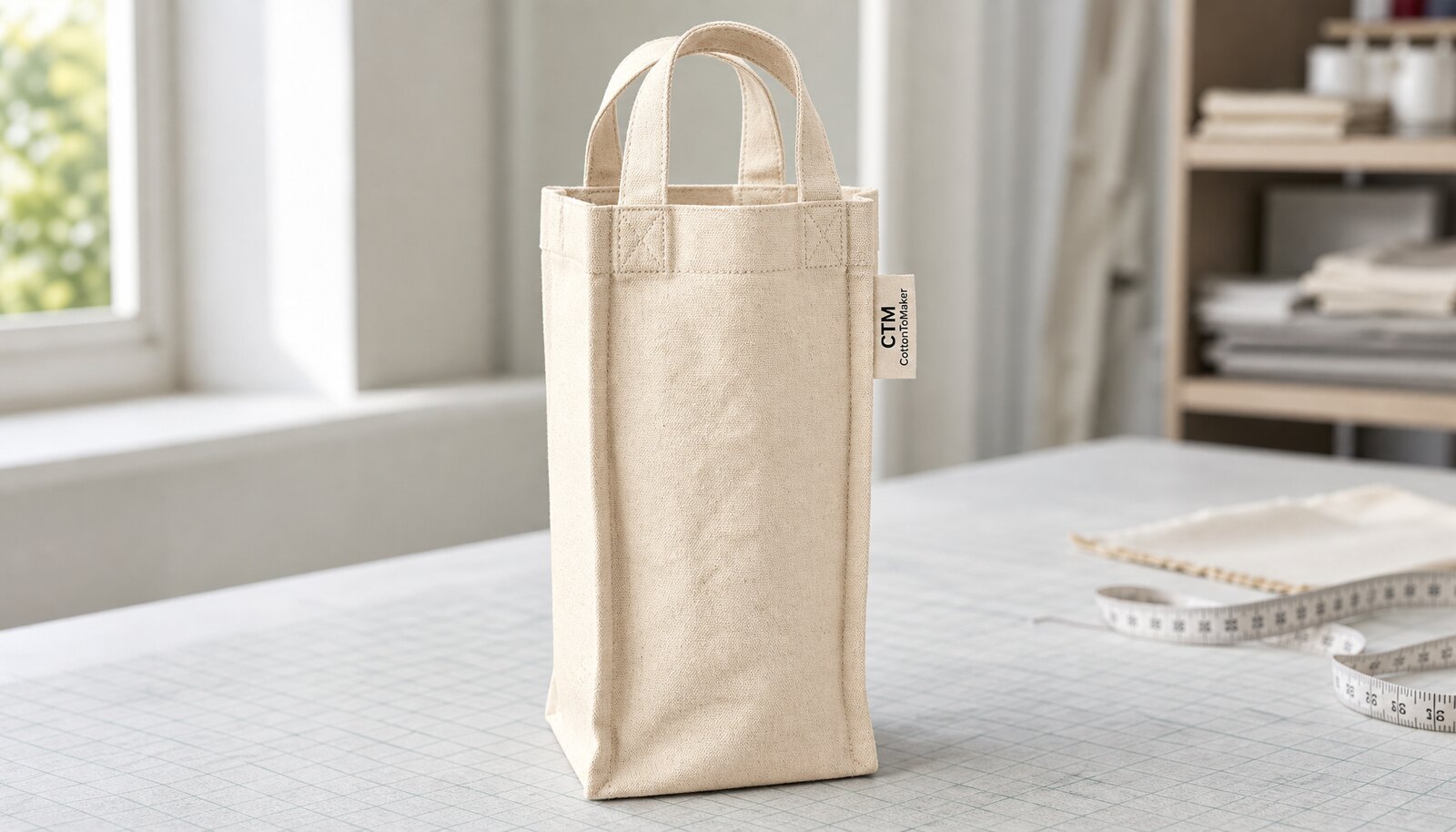
Start With the Use Case, Not the Tote
Boutique wineries do not buy organic cotton totes for the same reason a grocery chain does. A tasting room bag may need to carry one bottle, a brochure, and a receipt. A gift-shop bag may need to hold two bottles, tissue, or a premium club insert. That use case drives the fabric weight, handle length, and seam reinforcement far more than the logo artwork does. If the buyer starts with a price request and leaves the use case vague, every supplier will quote a different bag and the comparison becomes useless.
Before you send an RFQ, lock the business role of the tote. Is it a retail product, a free carry bag, or a premium packaging item that supports bottle sales? That answer determines whether a lighter 5 to 6 oz body is acceptable or whether the program should start at 8 oz or 10 oz. It also decides whether a simple screen print is enough or whether the bag needs a sewn label and cleaner finishing. Three decisions need to be fixed early: bottle count, carry distance, and shelf presentation.
- One bottle, two bottles, or mixed inserts should be stated explicitly.
- Tasting-room giveaway and retail merchandise should not be quoted as the same product.
- If the tote is sold, the finish quality needs to match the shelf price.
Choose a Spec That Supports the Negotiation
Fabric weight is the first commercial choice that affects MOQ. A 5 to 6 oz organic cotton tote is usually easier to source and cheaper to sew, but it is better suited to flat giveaways than to wine bottles. An 8 oz body is the common middle ground for boutique winery programs because it balances handfeel, print surface, and cost. A 10 oz body feels more premium and carries weight better, but it raises material consumption and sewing time. If your buyer team only says thick or heavy, the factory will fill in the blanks and you will compare quotes that are not built on the same cloth.
State the spec in measurable terms. Use oz or gsm, and also define whether the fabric is plain weave, canvas, natural undyed, or bleached. If the tote must look premium, consider a cleaner weave and a tighter stitch density rather than jumping straight to a heavier weight. Decoration also changes the production path. A one-color screen print is the simplest setup. A woven label or sewn patch adds labor but can support a more retail-looking bag. Embroidery can look sharp on heavier cloth, but it is a poor fit for thin fabric because it distorts the panel.
- 5 to 6 oz: best for flat event packs and low-cost distribution.
- 8 oz: best for the standard boutique winery retail tote.
- 10 oz: best for premium gift packs or heavier bottle carry.
- One-color screen print keeps setup simple and reduces quote friction.
What Really Drives MOQ and Price
MOQ is not a random number. It usually comes from a factory trying to cover fabric booking, cutting efficiency, print setup, label sourcing, and packing labor. Custom size increases fabric waste. Custom fabric color can force a mill minimum. Extra print colors add screen charges or more press time. A sewn pocket, divider, or reinforcement patch can slow the line enough to lift the minimum order. The real problem is that many quotes hide these drivers inside one unit price, so buyers cannot see why one supplier offers 300 pieces and another only quotes 1,000.
Treat MOQ as a stack of smaller requirements rather than one big number. Ask the supplier to separate body MOQ, print MOQ, label MOQ, and packing MOQ. That makes negotiation practical. You may be able to keep the same body and reduce the logo complexity, or keep the same logo and accept stock natural fabric instead of custom-dyed fabric. Once you know which layer is forcing the floor, you can decide whether to pay more per unit, simplify the spec, or move the order to a different sourcing route.
- Custom size usually affects cutting yield before it affects sewing cost.
- Print color count often changes the setup more than the art concept itself.
- Extra finishing steps can turn a small run into an uneconomic run fast.
Compare Supplier Routes Before You Negotiate
A direct factory, a trading company, a local decorator, and a stock wholesaler are not interchangeable supplier routes. A direct factory is the best fit when you want repeatability, lower unit cost after approval, and control over the construction details. A trading company helps when you need one point of contact for mixed products, but you must watch whether the quote is carrying hidden margin or whether the final factory stays stable between reorders. A local decorator is useful for urgent runs and very small tests, but the product usually costs more and the documentation is thinner.
The stock wholesaler route is the fastest path to a first market test. It works when the buyer wants to validate sell-through before committing to a custom program. The tradeoff is obvious: less control over fabric weight, fewer size options, and a weaker brand fit. For boutique wineries, that can still be a smart first step if the core question is whether the tote sells at the tasting room. Once the order model is proven, move the repeat program closer to the factory so you can negotiate MOQ against a stable spec instead of against a reseller's inventory.
- Use a direct factory when the tote is a repeatable SKU.
- Use a trading company when the sourcing basket is broader than one bag type.
- Use a local decorator when speed matters more than exact spec control.
- Use a stock wholesaler when you need a market test before investing in tooling.
Negotiate MOQ Without Paying for Hidden Risk
The cleanest negotiation is the one that reduces the factory's risk in a visible way. Keep the body size standard, keep the logo to one color, and accept natural fabric if the market does not require a custom shade. In return, ask for a lower MOQ or a better price break at the first reorder level. If the bag must start small, accept a slightly higher unit price rather than forcing the factory to cut against poor yield. That keeps the quote honest and avoids the classic problem where a low opening price turns into a quality dispute later.
A practical buyer can also negotiate by separating the first run from the repeat run. State the launch quantity, the forecast reorder quantity, and the time window for the second PO. That gives the factory a reason to hold fabric or plan the sewing line around future work. If your winery needs both single-bottle and two-bottle versions, ask whether the body can stay constant while the insert, divider, or print changes. Reducing variables usually helps the MOQ more than pushing harder on price alone.
- Standardize the bag body first and use artwork to differentiate the line.
- Offer a forecast if you want the factory to lower the entry quantity.
- Accept a higher first-run price if it protects the production setup.
- Keep one spec fixed across variants wherever possible.
Approve Samples for Function, Not Just Appearance
A sample is not approved because the logo looks good in a photo. It is approved when the bag actually works. Measure the body size, gusset depth, handle drop, and seam placement. Insert a filled bottle and remove it several times. The tote should not twist, gape open, pinch the neck, or collapse under its own weight. For a two-bottle version, the base must stay flat and the handles must not cut into the hand. If a sample passes visually but fails in use, the production run will repeat the same flaw at scale.
Keep one physical golden sample and use it as the baseline for production. Also keep one retained sample from the first bulk lot. Write the acceptable tolerance into the purchase order so the factory knows which differences are cosmetic and which ones are rejectable. Natural cotton can show minor shade variation, but the print placement, stitch line, and handle symmetry should stay controlled. If the sample is intended for a bottle program, the bottle fit matters as much as the print quality.
- Use a physical sample, not only a photo approval.
- Confirm the filled-bottle fit and the carry feel in hand.
- Write tolerances for dimensions, print placement, and stitch appearance.
- Retain a golden sample for any reorder dispute.
Set Packing and Carton Rules Early
Packing affects both customer experience and shipping cost. Flat folding is the most efficient way to move tote bags, but if the winery sells the tote as a retail item, you may want a cleaner fold, a recyclable belly band, or a simple side label. That adds labor, but it also improves shelf presentation. Decide whether the totes should ship loose in bulk, wrapped in inner packs, or packed in a specific retail count. If the buyer waits until after the quote to define this, the carton count and labor cost will change and the order will no longer match the original offer.
Carton dimensions matter more than most first-time buyers expect. A bag that looks cheap on paper can become expensive once the cartons are too large or too lightly filled. Oversized cartons waste freight space. Overpacked cartons crush handles and make receiving more difficult. Ask the supplier to quote pieces per carton, carton dimensions, and gross weight before you approve the PO. If the warehouse receives pallets, give the supplier the stack limit and pallet height so the shipment arrives in a form your team can actually receive and store.
- Flat pack is cheaper; retail-ready fold costs more but sells better.
- Define whether inner packs are needed before the order is confirmed.
- Ask for carton dimensions and gross weight, not just piece count.
- Match the carton plan to your warehouse or retail receiving process.
Build the Schedule Around the Slowest Part
Lead time is usually driven by the slowest input, not by sewing. For organic cotton totes, that slowest input is often fabric booking, label approval, or print setup. A realistic schedule breaks the job into sample, pre-production sample, bulk cutting, printing, sewing, final inspection, and packing. If the factory already has approved stock fabric, the order can move faster. If the order depends on mill-dyed fabric or a special label run, the timeline becomes less flexible and the buyer has to plan earlier.
Wine retail has its own calendar. Harvest season, holiday gifting, club shipment dates, and tasting-room promotions compress ordering windows. A supplier can look fast on paper and still miss the real deadline if the art is changed late or the purchase order is incomplete. Build a reorder plan around the merchandising calendar instead of around a generic production calendar. Once the tote becomes a recurring SKU, lock the approved spec and the approved carton pattern so you are not re-solving the same problem every season.
- Do not let lead time start with a vague order date; define the approval trigger.
- Reserve extra time if the job needs custom labels or organic fabric booking.
- Plan around tasting-room and holiday retail peaks.
- Use the approved spec as the reorder baseline.
Compare Quotes as Landed Cost, Not Factory Price
The lowest factory price is often not the lowest landed cost. A real comparison needs the same fabric weight, the same print method, the same packing, and the same incoterm. If one supplier includes sample credit, inner wrapping, or carton labeling while another leaves those items out, the quote with the lower unit number is incomplete. Buyers should compare the full cost stack, including setup fees, packing, freight, duty, and internal handling at destination. That is the only way to tell whether a quote is genuinely cheaper or just less transparent.
For a boutique winery program, the real decision is not just unit cost. It is the total landed cost per sellable tote and the amount of operational risk in the offer. A slightly higher quote from a factory that can hold size, stitch quality, and repeatability may be the better business choice. A lower quote that shifts risk into the carton plan or the print finish can cost more after receiving, repacking, or replacement. Use the quote to test the supplier's control, not only their willingness to discount.
- Compare like-for-like spec, not quote fragments.
- Include setup, packing, freight, and duty in the landed view.
- Treat missing line items as risk, not savings.
- A stable supplier can be worth more than a lower opening price.
Avoid the Mistakes That Inflate MOQ
The obvious mistake is changing the art after sample approval. The quieter mistakes are more expensive. Buyers often leave handle length open, fail to state whether the cotton must be organic certified or just organic cotton, or send a reference photo without a measurement sheet. Every ambiguity becomes factory risk, and factory risk is priced back through MOQ or unit price. A vague RFQ can make two suppliers look competitive when they are actually quoting two different products.
The best practice is to send one complete RFQ package. It should include the finished size, fabric weight, artwork file, color count, packing plan, destination term, and approval path. If the supplier knows exactly what is expected, the quote is easier to compare and the first run is easier to repeat. Once the order is approved, keep the spec sheet, golden sample, and carton reference together so the next reorder can move faster and with less negotiation friction.
- Do not leave handle length or bag size open.
- State the organic documentation requirement up front.
- Send measurements, not just a reference photo.
- Keep the approved spec together with the golden sample for reorders.
Specification comparison for buyers
| Spec decision | Recommended option | When it fits | Buyer risk to check |
|---|---|---|---|
| Direct factory sourcing | Use a factory with its own cutting, sewing, and printing line | Best for repeat programs, custom size control, and lower unit cost after sample approval | Verify the factory is not subcontracting critical steps without telling you |
| Trading company sourcing | Use a trader with access to multiple bag factories | Useful when you need one contact for mixed bag programs or wider product sourcing | Check margin opacity, factory identity, and whether specs stay stable between quotes |
| Local decorator or print shop | Buy blank totes and add logo locally | Good for urgent events, test runs, and very small first orders | Expect higher unit cost, limited organic paperwork, and weaker control over fabric weight |
| Stock wholesaler with logo add-on | Choose a stock tote and apply a simple brand mark | Works when speed matters more than exact dimensions or premium presentation | Confirm the stock body is acceptable for bottle weight and that the print area is large enough |
| Fabric weight around 5 to 6 oz | Use lighter organic cotton for low-cost giveaway bags | Fits flat event packs and light retail inserts | May feel thin, wrinkle easily, and sag with one or two wine bottles |
| Fabric weight around 8 oz | Use a balanced midweight body with standard reinforcement | Good for most boutique winery retail totes and tasting-room sales | Check handle stitching and base structure so the bag does not collapse under a bottle load |
| Fabric weight around 10 oz | Use heavier cloth for premium retail or two-bottle carrying | Best for higher perceived value and stronger structure | Higher fabric cost and sewing time can push MOQ or unit price up |
| Single-color screen print | Choose one solid logo color on a clean flat print area | Best for simpler branding and lower setup cost | Fine lines, gradients, and small text can fail or fill in on cotton texture |
| Sewn woven label or patch | Use a sewn brand label for a premium finish | Fits retail bags where the tote itself is part of the product line | Check label MOQ, placement consistency, and whether extra labor changes the price break |
Buyer checklist before sampling
- Define the tote use case: one bottle, two bottles, tasting-room purchase, gift pack, or event giveaway
- Lock the finished size, gusset depth, handle length, and handle drop before requesting quotes
- State the target fabric weight in oz or gsm and whether you need organic certification paperwork
- Choose the decoration method in advance: screen print, woven label, sewn patch, or embroidery
- Confirm whether the first order can use stock natural fabric or must use a custom woven or dyed body
- Send the artwork in the correct format and state the number of colors and print locations
- Write down the expected sample approval path: photo sample, physical sample, golden sample, and pre-production sample
- Specify packing: flat pack, folded, inner wrap, carton count, and whether retail presentation matters
- Set the destination term and give the supplier the port, warehouse, or door address for freight planning
- Ask for a price break by quantity so you can see what changes at the next reorder level
Factory quote questions to send
- What is the MOQ by fabric weight, print method, color, and finished size?
- Which specification changes cause the MOQ to rise: size, fabric color, handle length, label, or print count?
- Is the quote based on stock fabric or newly sourced organic cotton fabric?
- What are the sample fee, screen fee, label fee, and are any of them credited on order?
- What tolerance do you hold for body dimensions, handle length, and print placement?
- How are the totes packed per carton, and what are the carton dimensions and gross weight?
- What are the lead times for sample, pre-production sample, and bulk production?
- What documents can you provide for organic cotton claim, country of origin, and inspection status?
Quality-control points to confirm
- Verify fabric weight, handfeel, and weave density against the approved sample or agreed GSM
- Measure body width, height, and gusset after finishing and confirm they stay within the written tolerance
- Check handle length, handle symmetry, and bar-tack or cross-stitch reinforcement at every stress point
- Pull test the handles with a filled bottle load to confirm the seam does not open or distort
- Inspect print clarity, color match, registration, and placement on the front panel and side label
- Reject bags with broken stitches, needle holes, oil marks, odor, or visible fabric contamination
- Confirm carton count, fold method, and packaging material match the purchase order
- Inspect one carton from the top, middle, and bottom of the lot so sample bias does not hide a packing issue