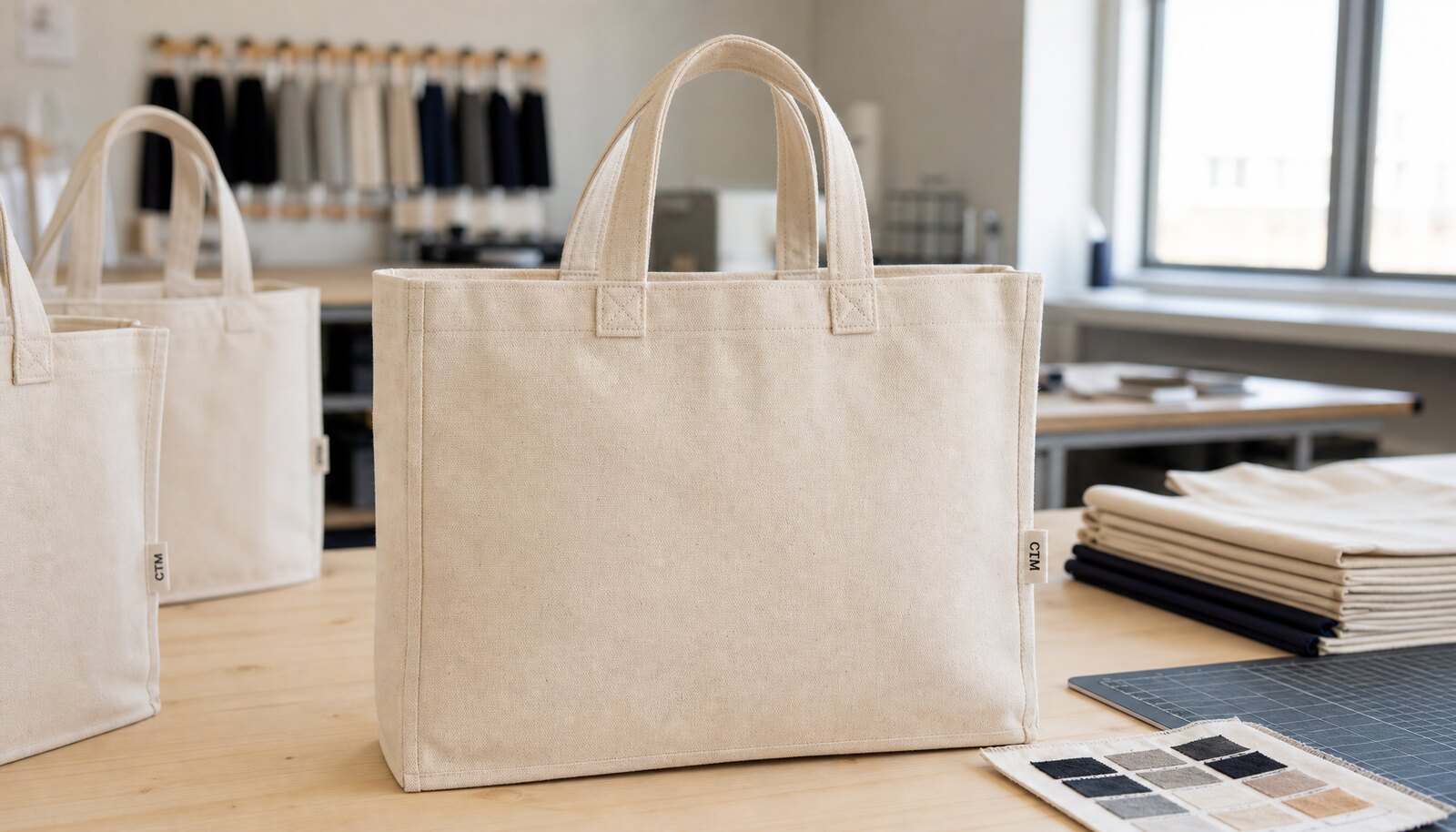
Why winery totes need a tighter spec than a normal promo bag
A tote for a boutique winery is doing three jobs at once. It may be retail merchandise, a gift carrier, and a practical way to move bottles, tasting notes, or membership materials. That mix changes the procurement logic. A bag that looks acceptable in a flat mockup can still feel too flimsy on a shelf, crease badly in transit, or fail the first time a customer loads it with wine and a brochure stack. The buying brief has to treat the tote as a commercial product, not a throw-in promo item.
The first mistake is asking for quotes before the use case is locked. One supplier will price a light retail tote, another will assume a bottle carrier, and a third will quote a premium canvas with added finishing. The numbers are not comparable until the buyer defines the load, the presentation standard, and the sales channel. For winery programs, the most important question is not 'How much per bag?' It is 'What exactly must this bag hold, how should it feel in hand, and what must survive the first season of use?'
If the tote is sold in the tasting room, shelf value matters as much as strength. If it is included with a bottle purchase, the load requirement comes first. If it is a membership or event item, packout and delivery speed may matter more than heavy fabrication. A good buying checklist starts by assigning the tote to the right job, because that decision sets every other spec.
- Define the tote as retail merch, gift packaging, bottle carry, or event giveaway before requesting pricing.
- Write down the actual contents it must hold, not just a brand concept.
- Decide whether the tote must feel premium in hand, carry weight reliably, or both.
Start with the load, then size the tote
The cleanest way to spec a winery tote is to start with what goes inside it. A single bottle with a card insert does not need the same dimensions as a two-bottle set with a divider or a tasting kit with brochures and glassware. Once the contents are known, the bag size, gusset depth, and handle drop become straightforward commercial decisions instead of guesswork. If the tote is meant to be carried on the shoulder, handle length matters more than almost anything else because a short handle can make an otherwise beautiful bag annoying to use.
This is also where the buyer should think through balance and stability. A tote with a narrow base can tip when a bottle is placed inside. A bag with too little gusset depth can bulge awkwardly or distort the logo area. If the program is designed around gift sets or retail resale, test the proposed dimensions with actual contents before you release the RFQ. That test does not need to be formal; it just needs to prove that the tote opens well, closes neatly, and sits flat enough to look intentional in a tasting room display.
For winery work, the most useful spec language is practical. State the number of bottles, the size of the insert, whether the bag should fit over a shoulder, and whether the handhold should allow an insulated sleeve or outer coat. If the buyer can define that much up front, the supplier can size the pattern correctly and the quote will be much easier to compare.
- Test the tote with the real bottle count or a weighted equivalent before final approval.
- Specify shoulder carry or hand carry, because handle drop changes usability.
- Use gusset depth to control stability and retail presentation, not just capacity.
Fabric, weave, and finishing choices that change the feel
Organic cotton tote bags usually start with canvas, but there is still a real range of feel and performance inside that category. A lighter 200-220 gsm canvas can work well for tasting notes, impulse retail, or a clean brand gift. Move toward 240-300 gsm when the tote has to hold bottles or when the winery wants a more substantial, premium hand feel. Heavier is not automatically better. Too much cloth can make the bag stiff, inflate freight, and reduce the elegance of the finished product. The right answer depends on the actual load and the brand position.
Finishing matters just as much as raw weight. A natural unfinished bag will look relaxed and earthy, but it can vary more by lot and show more fiber fleck. A washed or softened finish can feel better on shelf, but it may slightly change size and shrinkage behavior. If the buyer needs a very clean retail look, ask for how the fabric is sourced, finished, and pressed before sewing. Also decide whether the order is based on finished GSM or source-fabric GSM, because that detail affects price comparisons more than many buyers expect.
For procurement, the important point is consistency. A winery merch program often needs repeat orders across seasons. If the factory cannot hold the same fabric hand, shade, and shrink behavior on reorders, the bag can drift from one batch to the next. That is not just a quality issue; it is a brand consistency issue.
- Set the GSM range against the tote's real load and shelf position.
- Ask whether GSM is measured before or after finishing.
- Request shrinkage and finish details if the tote needs a consistent retail look across reorders.
Construction details that determine whether the tote actually lasts
The best tote fabric will still disappoint if the sewing is weak. Stitch quality, reinforcement, and seam layout are what keep a tote from looking cheap after the first dozen uses. For most winery programs, self-fabric handles with box-X or bar-tack reinforcement are a sensible default because they distribute load well and keep the design clean. A decorative handle can look attractive in the sample room and still fail under repeated bottle weight. The buyer should inspect the attachment method, not just the visible strap width.
Body dimensions also matter beyond the printed artwork area. A tote with poor seam allowance can skew after sewing, which changes both the look and the usable interior volume. Ask the supplier to state seam allowance, stitch density, reinforcement points, and whether the top edge is hemmed or bound. These details are not trivia. They determine how the tote sits, whether the opening stays square, and whether the brand mark lands where the buyer expected.
A useful habit is to compare the approved sample against a simple dimension sheet. The buyer does not need a lab-grade setup for every order, but it should be clear what counts as in spec. If the tote is being sold rather than given away, that level of discipline protects the program from slow quality drift.
- Ask for seam allowance, stitch density, and reinforcement style in the quote.
- Use box-X stitching or bar tacks at load points as the default expectation.
- Check symmetry and squareness, not only width and height.
Decoration choices that protect the brand after repeated use
Most boutique winery tote programs do not need complicated decoration. In many cases, the strongest choice is a clean one- or two-color screen print with a restrained logo size. Screen print usually keeps the hand feel soft, works well on organic cotton, and gives the buyer a clear setup cost to compare between suppliers. If the artwork includes small type, thin rules, or delicate details, the buyer should ask for a proof on the actual fabric before bulk sewing. Cotton weave and print mesh both affect legibility.
Embroidery can work well for a smaller premium mark, but it is not the default answer for a large tote graphic. It can add stiffness, raise the unit cost, and distort fine lines. Woven labels, side-seam labels, or a subtle chest-size mark can be better for wineries that want a more understated product. Heat transfer or digital methods can solve certain artwork issues, but they need a clear durability standard. The buyer should not compare decoration methods only by first glance; the long-term wear profile matters too.
Artwork control is where many tote quotes break down. If the buyer sends a loose logo file and an informal color request, each supplier will interpret the print differently. Send vector art, define placement from the seam or hem, call out Pantone references if they matter, and approve a pre-production print strike before the full run starts. That keeps the factory from improvising under schedule pressure.
- Use screen print for most simple winery logos and short brand text.
- Reserve embroidery or woven labels for smaller premium marks.
- Define placement and artwork size from a physical point of reference, not from a verbal description.
How to verify organic claims without slowing the buy
Not every organic cotton tote order needs the same level of documentation, but the buyer needs to know which claim is being made. There is a difference between saying the bag is made from organic cotton and making a certified organic claim on packaging or in sales materials. If the winery needs certified chain-of-custody documentation, the supplier should be able to show certificate holder details, scope, validity dates, and the product line covered by the quote. If that paperwork does not match the company name on the invoice, the risk is obvious.
This is also a place where buyers should stay precise. A fabric declaration, a certificate PDF, and an order confirmation are not interchangeable. The question is whether the certification status aligns with the exact factory, trade route, and final product. If the supplier is sourcing through a trading company or subcontracted sewing line, ask how the chain is maintained. Do not assume that a claim on the sample automatically transfers to the bulk order.
The goal is not paperwork for its own sake. It is to avoid a compliance mismatch after the bags are already in production. The easiest time to verify the claim is before the PO is placed, while the buyer still has leverage and options.
- Separate a general organic cotton claim from a certified organic claim.
- Check certificate holder name, scope, dates, and product line against the quote.
- Ask how the supplier keeps certification alignment across fabric sourcing, sewing, and packing.
Read the quote like a procurement document
A useful tote quote should read like a procurement sheet, not a sales note. The buyer needs to see the fabric weight, bag dimensions, decoration method, setup charges, packing format, lead time, and shipping term. Without those fields, the unit price is not comparable. One supplier may hide print setup inside the piece price; another may price the bag blank and add decoration separately. If the buyer compares those numbers directly, the cheapest quote can be the most expensive order once the hidden charges appear.
Shipping term matters for the same reason. EXW, FOB, and DDP can all be correct in context, but they are not the same commercial basis. If the team wants a factory-level comparison, normalize every bid to one term before ranking suppliers. Then ask for the secondary costs separately: screens, sampling, labels, freight, duty, and any extra carton charge. The supplier that can break those items out clearly is often easier to work with later because the production and documentation process is already more disciplined.
If you want a quote that is actually usable, send one controlled RFQ package. Include a spec sheet, artwork file, target quantity, carton instruction, and delivery window. The more variables you freeze, the more truthful the quote becomes.
- Normalize all bids to the same shipping term before comparison.
- Require separate lines for blank bag cost, print setup, sampling, packing, and freight.
- Reject any quote that does not name the exact fabric weight and bag dimensions.
Sample approval and QC thresholds that actually catch defects
A photo is not a sample approval. For a winery tote, the buyer needs a physical pre-production sample that confirms fabric hand, stitch quality, print placement, handle feel, and overall structure. Once that sample is approved, keep a signed reference on file so the bulk run can be checked against something real. This is the simplest way to avoid arguments later about whether a slightly different print shade or a narrower gusset was acceptable.
The QC standard should be written in measurable terms. A common buyer target is body and gusset dimensions within +/-3% or +/-0.5 cm of the approved sample, handle length matched within the same tolerance, and no visible skipped stitches or loose threads. If the tote is meant to carry bottles, set a load test that reflects the real use case. A 5 kg static hold for 60 seconds is a reasonable buyer-side screen for lighter retail bags, while bottle programs may need a stronger practical test using the actual bottle set. The exact threshold is up to the buyer, but it should be written before production starts.
Do not skip finish checks. A tote can pass sewing inspection and still fail because of shrinkage, poor rub resistance, dirty packing, or a carton that crushes the shape in transit. Good QC should cover the bag, the print, the carton, and the final receiving condition.
- Approve a physical sample and keep one signed reference sample on file.
- Set tolerances for dimensions, handle length, print position, and carton count.
- Add tests for load, shrinkage, rub resistance, and packing integrity before shipment release.
Packing, palletizing, and inbound receiving
Packing is part of the product experience, not a separate logistics footnote. Organic cotton bags can pick up dust, crease in transit, or pick up odor if they are packed badly. For wholesale programs, flat bulk packing is usually the most efficient option because it reduces carton volume and makes receiving easier. If the tote has to go straight to retail shelves, then individual polybags, insert cards, and hangtags may be appropriate, but they should be treated as paid line items, not implied extras.
Carton specs deserve the same discipline as the bag itself. Ask for carton count, carton dimensions, gross weight, outer marks, and pallet pattern if the order is shipping in bulk. A carton that is too heavy will slow warehouse receiving and increase damage risk. A carton that is too loose can crush the tote shape. If the winery distributes to several tasting rooms or wholesale accounts, clear SKU labels and lot codes will save time and reduce mis-picks.
Receiving should also include a quick damage check. A simple buyer-side drop test on the carton, inspection of carton corners, and verification of carton count can catch a surprising number of packaging problems before the bags are distributed. If the supplier cannot pack cleanly, the reorder cost will usually rise somewhere else.
- Use bulk flat packing unless shelf-ready presentation is explicitly required.
- Specify carton count, carton weight, and outer marking format in the PO.
- Ask for pallet labels and lot codes when the tote will ship through multiple receiving points.
A sourcing workflow that keeps repeat orders easy
The best wholesale tote program is the one you can reorder without rebuilding it from scratch. That means the buyer should keep one version-controlled spec sheet, one approved sample, one artwork file, and one packaging instruction set. When the winery updates a label or revises the bag size, that change should be recorded as a new revision number instead of being handled through email memory. It is a small discipline, but it avoids the common problem of a second-order bag that is almost right but not quite the same as the first.
For recurring seasonal programs, the buyer should also plan around the calendar instead of reacting to it. Review the spec before harvest season, holiday gifting, or member shipment windows, because those are the periods when delays become expensive. Ask the supplier what can slip, by how much, and which steps need buyer sign-off. That question makes lead time real. If the factory cannot tell you where the risk sits, they probably do not have the process under control yet.
A simple procurement rhythm works well: define the use case, freeze the spec, approve the sample, compare landed cost, and inspect against a signed reference. That is enough to keep the order disciplined without overcomplicating a small bag program. For boutique wineries, the right tote is the one that looks intentional on the shelf, carries properly in use, and reorders without drama.
- Store the approved spec, artwork, and sample under a revision number.
- Review reorders early enough to avoid seasonal bottlenecks.
- Treat the tote as a repeatable product line, not a one-off purchase.
Specification comparison for buyers
| Spec decision | Best default for boutique wineries | Alternative when the use case changes | Pass/fail threshold | Procurement watchout |
|---|---|---|---|---|
| Fabric weight | 200-220 gsm organic cotton canvas | 240-300 gsm when the tote must carry bottles or heavy gift sets | Pass if GSM is within +/-5% of spec and shrinkage stays under 5% after wash or steam | Do not compare quotes if one supplier prices light cloth and another quotes a heavy canvas |
| Bag structure | Open-top tote with a 10-12 cm gusset | Flat tote only for brochures, tasting notes, or very light retail use | Pass if the base sits flat, gusset panels are symmetrical, and the bag does not twist under load | A flat bag can look cheaper in a quote but lose usable volume and retail value |
| Handle construction | Self-fabric handles with box-X or bar-tack reinforcement | Webbing handles only if you want a different aesthetic or a higher grip feel | Pass if the handle width is at least 2.5 cm and a 5 kg static load holds for 60 seconds with no seam pull | Single-needle attachment can pass a visual inspection and still fail in real retail use |
| Decoration method | 1-2 color water-based screen print for most winery logos | Embroidery or woven label for smaller premium marks | Pass if print position is within 5 mm of the approved layout and there is no visible cracking after flexing | Thin type, gradients, and fine line art need proofing before bulk sewing starts |
| Organic proof | Current certificate set with matching scope, company name, and SKU reference if you need certified organic claims | Basic fiber declaration only if you are not making a formal certification claim on pack | Pass if the paperwork matches the seller, factory, and product line on the quote | A generic certificate PDF is not enough if the factory name, scope, or dates do not match |
| Packing format | Flat bulk packed with carton count, size label, and SKU code | Individual polybag, insert card, or hangtag only when the tote must arrive shelf-ready | Pass if carton count matches the PO and the product arrives clean, dry, and unwrinkled | Retail-ready packing is not free; it changes labor, carton size, and damage risk |
| Landed-cost basis | Compare on the same shipping term, ideally EXW, FOB, or DDP as a single basis | Use DDP only when your team needs a delivered cost with fewer internal assumptions | Pass if freight, duty, inland delivery, and setup fees are separated and visible | A low unit price can hide freight, labels, rework, or setup charges |
Buyer checklist before sampling
- Define the tote's use case first: retail sale, tasting-room gift, membership pack, bottle carrier, or event merch.
- Write the exact contents it must hold, including the bottle count, insert card size, or bundled gift items.
- Set the finished bag size, gusset depth, and handle length before asking for pricing.
- State whether your quoted GSM is finished fabric weight or pre-finish fabric weight.
- Choose the fabric color path early: natural, bleached, dyed, or a specific recycled-dyed look if the program allows it.
- Specify the decoration method, max number of print colors, print size, and exact print placement.
- Provide vector artwork and confirm whether you need Pantone matching or a close visual match.
- Ask for a physical pre-production sample and a signed golden sample before bulk approval.
- Confirm whether the supplier can provide organic certification documents that match the exact factory and product line.
- Request separate pricing for sample fees, setup fees, screens, embroidery digitizing, cartons, and retail packing.
Factory quote questions to send
- What exact fabric composition, weave, and GSM are included in the quoted price, and is the GSM finished or pre-finish?
- Can you quote the same tote at two fabric weights so we can compare a retail bag against a bottle-carry version?
- What is the exact bag size, gusset depth, handle length, and seam allowance included in the quote?
- Which reinforcement method is included at the handle attachment points, and can you show a drawing or sample photo?
- Is the price for a blank tote or a printed tote, and what is included in the print setup charge?
- How many print colors are included, what is the setup fee per color, and do you charge for screens or plates separately?
- Can you confirm the MOQ by size, color, print version, and packing style?
- What organic certification documents can you provide, and do the certificate holder name and scope match the quoted product?
- What tests have you already run on the bag, including stitch strength, handle load, shrinkage, and colorfastness?
- What carton pack count, carton size, and gross carton weight are included in the packing quote?
Quality-control points to confirm
- Measure finished body width, height, and gusset against the approved sample and allow a tolerance of +/-3% or +/-0.5 cm, whichever is greater.
- Check handle length, handle drop, and handle symmetry against the approved sample before packing.
- Verify stitch density on body seams and handle attachment points; a common buyer target is 7-9 stitches per inch on main seams and tighter reinforcement at stress points.
- Inspect reinforcement at all load points for box-X stitching, bar tacks, or equivalent coverage with no skipped stitches.
- Run a static load test using the real intended contents or an agreed equivalent; the tote should hold for 60 seconds with no seam pull, handle tearing, or visible distortion beyond the agreed limit.
- For bottle-carry programs, test with the actual bottle weight plus insert or sleeve and confirm the bag can be lifted repeatedly without strap failure.
- Check print placement, color consistency, edge sharpness, and opacity under normal daylight; if you use lab testing, set a visual match target or a Delta E limit before production.
- Flex the printed area several times by hand and inspect for cracking, flaking, or adhesive lift if a transfer method is used.
- Measure shrinkage after the relevant finish or wash process; set a buyer target of under 5% unless the spec calls for something tighter.
- Perform a colorfastness check with a white cloth rub test; if the tote will be sold as premium merch, ask for a minimum grade of 4/5 or no visible transfer under the agreed method.