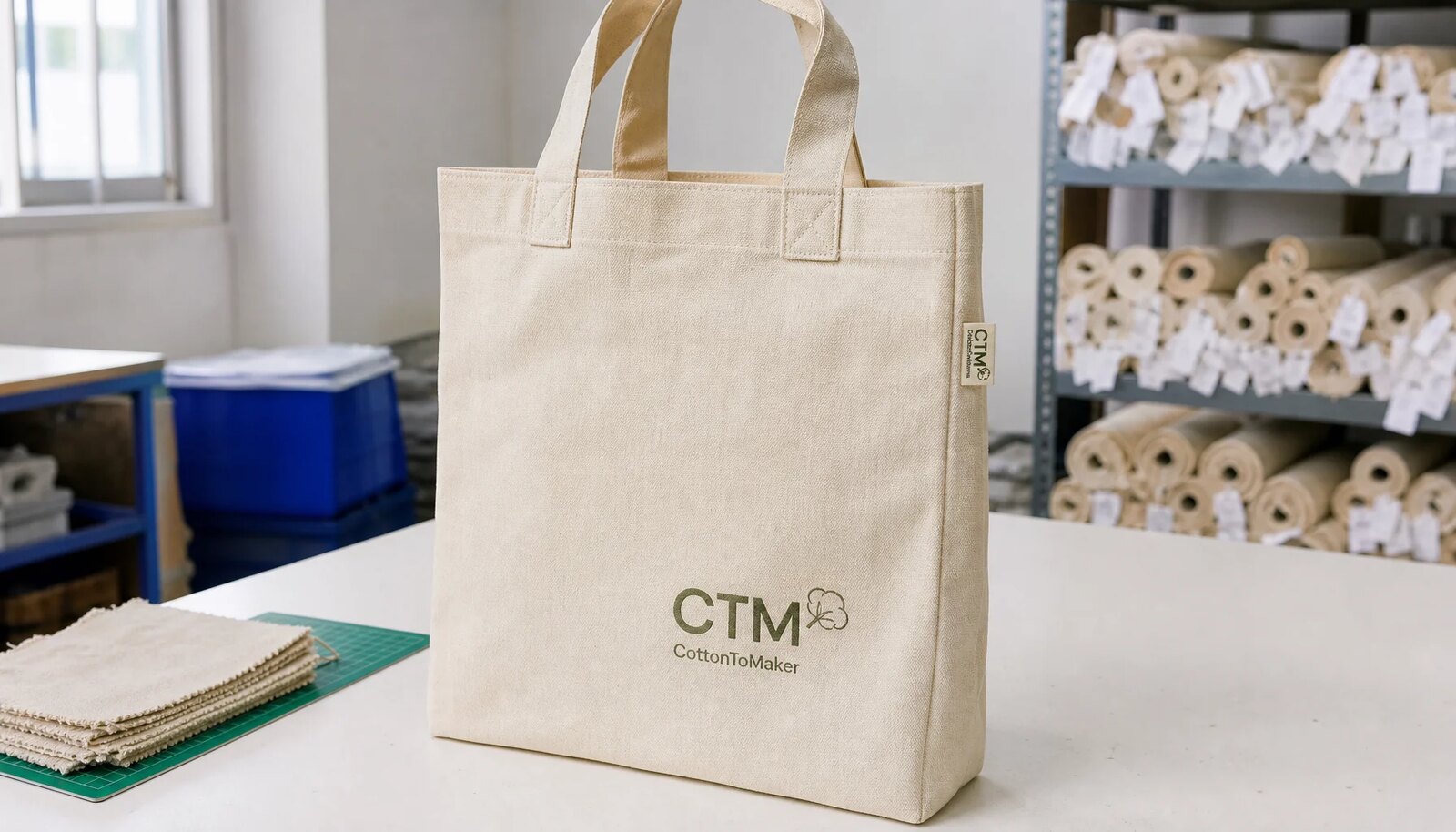
Begin With the Event Use Case
A tote that looks fine on a quote sheet can fail in a very ordinary way: the sponsor folder does not fit, the print sits too close to the handle, cartons are not marked for the right ballroom, or a pale logo disappears against natural cotton. Event totes are handled quickly, often by temporary staff, under fixed deadlines. Procurement needs the proof to answer production questions, not just aesthetic ones.
Before requesting pricing, define how the bag will be used. A registration tote for badges and brochures has different requirements from a VIP welcome kit, hotel room drop, retail merchandise item, or sponsor sampling bag. The expected contents affect fabric weight, gusset depth, handle comfort, carton weight, and whether individual packing is worth the added labor.
The proofing file should become the working control document. It should show the approved artwork version, final print size, placement measurements, fabric choice, construction notes, organic claim wording, packing method, carton marks, and delivery requirements. A digital mockup can start the conversation, but it cannot prove fabric opacity, print cure, seam strength, or how the tote arrives at the venue.
- List the actual items the tote must carry before choosing size or GSM.
- Decide whether the tote is a light giveaway, working conference bag, premium sponsor kit, or resale item.
- Treat the proof as a production approval, not only a marketing layout.
- Keep one approved physical sample or signed photo set for inspection reference.
- Review receiving needs early if goods ship direct to a hotel, warehouse, booth builder, or venue.
Specify the Tote Body First
Artwork should not be finalized until the tote body is fixed. Finished width, height, gusset, handle length, handle drop, fabric weight, reinforcement, and print panel all affect whether the design can be produced cleanly. If the RFQ only says organic cotton tote with logo, suppliers may price different products while appearing comparable.
Fabric weight should be stated in gsm or oz/yd2. A 5 oz tote, often around 140-170 gsm depending on the source, can work for flyers, badges, and light handouts. A 6 oz range, often around 180-220 gsm, is a practical default for many conference bags because it improves opacity and hand feel without making freight heavy. An 8 oz tote, often around 270 gsm, and heavier canvas styles suit premium kits, product samples, and repeated reuse, but they can be overbuilt for simple literature drops.
Finished size matters more than product name. One supplier's conference tote may be flat and narrow; another may include a 10 cm gusset and a larger print field. Ask whether dimensions are finished after sewing. If contents include folders, catalogs, drinkware, apparel, or boxes, test those items in the sample. A gusset adds capacity but changes folding, carton cube, and print-panel behavior.
Handle drop is easy to overlook. Hand-carry bags can use shorter handles, while shoulder totes often need about 25-30 cm of drop depending on audience and fill weight. Reinforcement also matters: bar-tacks, cross-stitching, folded top hems, and cotton webbing handles should be described, not assumed.
- State finished width, height, gusset depth, handle length, and handle drop.
- Quote fabric weight in gsm or oz/yd2, not only as light, medium, or heavy.
- Match GSM to event contents and brand positioning, not just unit price.
- Confirm handle construction and reinforcement method.
- Use practical sewn tolerances such as +/- 1 cm unless the supplier confirms a tighter standard.
Compare Supplier Routes Cleanly
The best supplier route depends on the amount of control the program needs. Direct factory sourcing is usually strongest for custom size, fabric weight, labels, handle construction, repeat production, and packing control. It suits annual events, sponsor kits, and programs where the same specification may be reordered.
A sourcing agent or trading company can be useful when the event includes several product categories. The risk is that a commercial quote may compress important details from the actual factory. Ask for the build sheet behind the price: GSM, dimensions, tolerances, print method, sample standard, carton count, inspection rule, and documentation for organic claims.
Domestic decorators and blank-stock wholesalers can be the right answer when the deadline is tight. The tradeoff is reduced control over shade, sewing, imprint area, and lot consistency. If you approve a decorated blank, tie approval to the exact model number and, where possible, the same inventory lot. Natural cotton shade can shift between lots even when the product code stays the same.
When comparing prices, make every supplier quote against the same fields. A lower unit price may exclude sample freight, screen charges, claim documents, carton labeling, inspection, or special packing. The buying decision should compare landed, proofed, event-ready totes, not only blank product cost.
- Use direct factories for custom construction and stronger production visibility.
- Use agents for multi-item programs, but request the actual factory spec.
- Use domestic decoration when speed matters and stock construction is acceptable.
- Use blank-stock routes only when substitution rules and imprint limits are clear.
- Compare landed cost and included services, not headline unit price alone.
Build an RFQ That Removes Guesswork
A procurement-ready RFQ should describe the product, decoration, proofing, packing, documentation, and delivery requirement separately. This prevents a supplier from burying construction assumptions inside a logo quote. Include finished size, GSM, cotton color, gusset, handles, reinforcement, print side, print size, print color count, artwork status, sample requirement, packing method, carton marks, ship-to address, delivery date, and order quantity.
Ask suppliers to separate product cost, print cost, setup charges, sample cost, label cost, packing cost, inspection cost, and freight terms. Screen charges, transfer setup, woven labels, hangtags, inserts, barcode labels, individual bags, split packing, and sample freight can change the real price. Separating line items also makes it easier to reduce cost without weakening the whole specification.
Event quantities often move. Registration counts change, sponsors request extras, or a venue plan shifts. Ask for price breaks at two or three realistic quantities and identify which changes trigger a new MOQ. Dyed fabric, nonstandard handles, custom labels, multi-color printing, and individual packing often move both price and lead time.
The RFQ should name the required proof before bulk begins. A digital layout is not a strike-off. A sewn blank is not a decorated pre-production sample. A packed sample is another step again. Naming the proof level early lets the supplier price it properly and prevents late approval gaps.
- Separate tote construction specs from decoration specs.
- Request line-item pricing for setup, samples, labels, packing, inspection, and freight.
- Ask for price breaks and lead-time impact at likely quantities.
- State whether exact quantity is required or whether overrun and underrun are allowed.
- Name the sample type required before bulk approval.
Proof Artwork on Cotton
Cotton is textured, flexible, and absorbent. Artwork that looks sharp on a screen can lose clarity on fabric, especially thin lines, small reversed text, low-contrast colors, and tight sponsor marks. Before sampling, ask the printer to flag minimum line thickness, small type risks, gradients, halftones, and registration limits at the final print size.
For screen print, inspect ink color, opacity, registration, edge sharpness, and cure on the chosen cotton. Simple one-color logos are often the most controlled option. Multi-color screen prints need a registration tolerance because even a small shift can be visible where colors touch. Light ink on natural cotton may need an underbase or additional print pass; the strike-off should prove it.
For DTF or heat transfer, approve more than the image. Check edge visibility, hand feel, stiffness, adhesion, folding marks, and whether the transfer suits the fabric weight. Transfers can be useful for gradients, many colors, and short runs, but a sample on a different fabric does not answer the real production question.
Placement must be measured, not described as centered. State print width and height, then measure from fixed points such as the top hem, side seam, bottom seam, gusset fold, or handle attachment. For many event totes, +/- 5 mm to +/- 10 mm is workable, but brand marks with tight visual alignment may need a confirmed tighter tolerance.
- Send vector artwork with fonts outlined and linked images embedded.
- State final print size in millimeters or inches.
- Provide Pantone, brand, CMYK, or swatch references and define acceptable color variance.
- Use a strike-off for opacity, fine detail, sponsor marks, and color-critical artwork.
- Measure placement from sewn references and include tolerance in the PO.
- Avoid approving only a flat mockup when print contrast or location is important.
Use the Right Sample Ladder
Different samples answer different questions. A digital mockup helps stakeholders agree on layout. A fabric swatch shows cotton color, weave, hand feel, and approximate opacity. A print strike-off shows how ink or transfer behaves on the selected fabric. A sewn pre-production sample proves the full tote build. A packed sample shows how units arrive for counting, staging, or fulfillment.
For most event programs, the strongest approval is a decorated pre-production sample made with the same fabric weight, tote color, thread, handle construction, print process, label, folding, and packing method planned for bulk. If the schedule does not allow that, document the weaker approval path. For example, a sewn blank plus a separate strike-off may be acceptable for a rush order, but it should not be treated as equal to a final decorated sample.
Review samples physically. Lay the bag flat, measure it, check handle drop, fill it with expected contents, carry it, fold it, and unfold it. Look for print cracking, transfer lifting, ink rub, excessive stiffness, low contrast, crooked handles, weak bar-tacks, and seams that pull open. Venue lighting and real contents often reveal issues that an office mockup misses.
When marketing, sponsors, and operations all comment, procurement should consolidate feedback into one approval note. Attach the final artwork version, mark photos, list accepted deviations, and send one clean correction list or approval. Mixed comments create production ambiguity.
- Use digital mockups for layout only.
- Use swatches for shade, weave, hand feel, and opacity.
- Use strike-offs for print color, detail, cure, adhesion, and hand feel.
- Use sewn pre-production samples for complete construction approval.
- Use packed samples for folding, labels, inserts, barcodes, and carton presentation.
- Record approved changes in one written note with version-controlled artwork.
Control Organic Claims
Organic cotton claims need evidence and careful wording. The tote may use organic cotton fabric, but the claim on a label, hangtag, sponsor page, carton, or event website must match the documents available. Procurement should settle claim language before artwork is approved, especially if certification names, logos, or sustainability statements are involved.
Ask what documentation the supplier can provide and what it covers. Useful documents may include a GOTS scope certificate for a certified facility, an OCS certificate, transaction certificates for certified material movement, material declarations, or chain-of-custody information. Each document has limits. A facility certificate alone may not prove that a specific shipment is certified. A transaction certificate may support a specific material flow but still needs the right claim wording.
Separate internal sourcing language from public language. A purchase order may say organic cotton material for internal tracking, while a printed claim needs more precise wording. If the tote is not fully certified as a finished product, avoid wording that implies more than the supplier can support. Certification marks or logos should only be used when the approval process and scope allow it.
Labels and hangtags also affect production. Woven side labels may require separate MOQ and sewing time. Printed labels may have placement limits. Hangtags and inserts add packing labor and carton planning. Proof every claim-bearing component separately, including spelling, capitalization, certification references, country-of-origin language where applicable, and label placement.
- Ask which document supports the specific tote order, not just the supplier generally.
- Review GOTS, OCS, transaction certificates, or material declarations for scope and limits.
- Decide where the claim appears: tote, label, hangtag, insert, carton, website, or internal PO.
- Route public claim language through the responsible compliance or brand team.
- Do not add certification names or symbols unless the documentation and approval process support that use.
Set Practical QC Rules
Quality control should be agreed before cutting, printing, and sewing begin. A useful inspection plan defines critical, major, and minor defects. Critical defects make the bag unusable or commercially unacceptable. Major defects affect appearance, function, or brand presentation. Minor defects are small issues that do not affect normal use within agreed limits.
Dimension rules need to respect sewn cotton production. Fabric can move during cutting, sewing, pressing, and packing. Many buyers use around +/- 1 cm for finished tote measurements and +/- 5 mm to +/- 10 mm for print placement on simple designs. If the brand requires tighter control, prove the factory can hold it during sampling.
Defect examples should be concrete. Critical defects include wrong artwork, missing handle, open seam, wrong fabric weight, wrong bag color, incorrect claim label, major stain, unusable print, or an event-critical quantity shortage. Major defects include visibly off-center logos, weak bar-tacks, poor ink cure, transfer lifting, inconsistent handle drop, wrong label position, wrong packing, or fabric shade outside the approved range. Minor defects may include short thread tails, light fold marks, or small natural slubs away from the artwork.
Inspection timing matters. First-article photos can catch mistakes after the first production units. In-line inspection can stop repeated defects before cartons are sealed. Final inspection is useful for high-volume orders, sponsor-sensitive branding, and direct-to-venue shipments. The purchase order should say what happens if defects are found: rework, replacement, repacking, discount, rejection, or expedited freight.
- Measure finished size, handle length, handle drop, and gusset against the approved sample.
- Check print size and placement with a ruler from fixed seams or hems.
- Inspect stitch density, skipped stitches, open seams, bar-tacks, handle alignment, and loose threads.
- Check opacity, edge sharpness, cure, rub resistance, registration, and transfer adhesion.
- Reject wrong artwork, major stains, open seams, missing handles, wrong claim labels, and unusable prints.
- Agree who pays for rework, replacement, repacking, or expedited freight when defects create delay.
Make Packing Work at the Destination
Packing is part of the tote specification because it affects labor at receiving. Bulk flat packing is often best for large registration orders. It reduces unit handling, keeps counting simple, and lets event staff stage product quickly. Even bulk packing needs rules: goods should be clean, dry, consistently folded or stacked, and packed in carton quantities that warehouse teams can lift and count.
Individual bags, hangtags, inserts, barcodes, sponsor kit assembly, and multi-SKU sorting may be necessary for VIP rooms, retail resale, hotel drops, or fulfillment centers. These choices add labor, material, carton cube, and lead time. They can also add wrinkle or moisture risk if cotton is sealed too tightly or too soon. A packed sample is the easiest way to approve presentation before thousands of units are boxed.
Carton marks should be written into the PO. Event orders often need PO number, event name, SKU, item description, quantity per carton, carton sequence, destination, and warehouse-required labels. If goods are split by sponsor, location, session, registration tier, or date, the carton label should let receiving route stock without opening every box.
For direct-to-venue delivery, carton clarity can be as important as print quality. The receiving dock may be handling signage, badges, furniture, AV cases, sponsor freight, and catering supplies at the same time. Clear marks reduce scrambling during setup.
- Choose bulk flat packing for fast registration-table distribution.
- Use individual packing only when presentation, policy, retail handling, or fulfillment requires it.
- Confirm inner pack count, master carton quantity, carton dimensions, gross weight, net weight, and total carton count.
- Add PO number, event name, SKU, quantity, carton sequence, and destination to carton marks.
- Use a packed sample for inserts, hangtags, barcodes, special folding, or split packing.
- Avoid overpacked cartons that crush handles, distort prints, slow counting, or exceed handling limits.
Build the Calendar Backward
Event procurement has a fixed failure point: the event date. Start with the required in-hand date and work backward through venue delivery, receiving, possible customs clearance, freight, final inspection, packing, printing, sewing, cutting, fabric preparation, sampling, artwork correction, quote approval, and purchase order release. A supplier lead time is only useful if it includes buyer approvals.
Sampling needs real time. A digital proof may be fast, but a strike-off or sewn pre-production sample can take several working days after complete artwork and specs are received. Sample shipping adds more time. Bulk production depends on fabric availability, quantity, print complexity, labels, packing, and factory capacity.
Keep room for one correction cycle and a buffer between goods-ready date and event setup. That buffer protects against sample changes, inspection findings, customs questions, local delivery issues, and warehouse counting. It also gives the team time to stage totes, insert materials, and resolve shortages.
If the calendar is already tight, simplify the tote. Use a standard size, available fabric, fewer print colors, no custom label, and bulk packing. A simpler tote delivered correctly is better than a complex tote arriving after setup.
- Work backward from the in-hand date, not forward from the PO date.
- Request dated milestones for artwork approval, sample dispatch, bulk start, inspection, packing, goods-ready date, and shipment.
- Reserve time for one artwork or sample correction cycle.
- Add lead time for custom labels, dyed fabric, complex printing, split cartons, or individual packing.
- Keep a receiving buffer before event setup.
- Simplify construction and decoration when full custom proofing no longer fits the deadline.
Specification comparison for buyers
| Procurement route | When it fits | Proofs to request | Risk to control |
|---|---|---|---|
| Direct factory | Custom size, fabric weight, handles, labels, packing, or repeat annual programs where the tote must match a fixed build. | Fabric swatch, print strike-off, sewn pre-production sample, packed sample when carton presentation matters. | Substitution after approval: fabric GSM, natural shade, thread, handle tape, ink system, label, folding, or carton plan. |
| Sourcing agent or trading company | Programs with several coordinated items such as totes, pouches, lanyards, apparel, inserts, and split shipments. | Underlying factory spec sheet, production-line sample photos, decorated sample, carton mark plan. | The quote may hide key details; require GSM, finished size, tolerances, print method, inspection standard, and claim documents in writing. |
| Domestic decorator using blanks | Short lead times where the blank tote is acceptable and only logo decoration changes. | Decorated sample from the exact blank model and, where possible, the same stock lot. | Blank lots can vary in shade, size, handle drop, sewing quality, and imprint area. |
| Blank-stock wholesaler | Rush giveaways, smaller batches, registration bags, or simple one-color marks with standard construction. | Inventory confirmation, model spec sheet, imprint-area proof, decorated sample if timing allows. | Substitutions and stock movement; confirm model number, fabric weight, color, print limits, inventory hold, and replacement rules. |
| Hybrid: imported blanks plus local decoration | Moderate deadlines where the buyer wants more print control but cannot wait for full custom production. | Blank sample, local print strike-off, final decorated sample, packing confirmation. | Responsibility can split between blank supplier and decorator; define who owns shade issues, print failures, shortages, and rework. |
| Material | organic cotton canvas, batch documentation where available, undyed or low-impact dyed fabric, and shrinkage control | Before price comparison | Different cloth weights, backing, or certification claims make quotes hard to compare |
| Construction | seam allowance, handle reinforcement, label attachment, fabric pre-shrink note, and batch shade control | Before sampling | Weak stress points create returns and failed inspections |
| Decoration | water-based print, embroidery, woven organic label, or low-impact transfer checked against certification claims | Before artwork approval | The wrong method can crack, bleed, pucker, or fail on the chosen fabric |
Buyer checklist before sampling
- Define finished tote width, height, gusset depth, handle length, and handle drop; include metric and imperial units if global teams will review the proof.
- Choose fabric weight by event contents: about 140-170 gsm for light handouts, about 180-220 gsm for standard conference kits, and about 270 gsm or heavier for premium or repeated-use programs.
- State whether dimensions are finished measurements after sewing, not cutting dimensions before assembly.
- Specify the organic cotton claim before artwork approval, including whether it appears on the tote, label, hangtag, carton, event page, sponsor copy, or internal procurement records only.
- Request relevant documentation such as GOTS scope certificate, OCS certificate, transaction certificate, material declaration, or supplier chain-of-custody explanation, and confirm what each document actually covers.
- Send vector artwork in AI, EPS, SVG, or production PDF format with fonts outlined, linked images embedded, and final print size stated.
- Provide Pantone, brand, CMYK, or physical swatch references and state whether a commercial close match is acceptable on natural cotton.
- Approve a strike-off or decorated pre-production sample on the same fabric weight, tote color, print method, and sewn construction planned for bulk.
- Measure print placement from fixed sewn references such as top hem, side seam, bottom seam, gusset fold, or handle attachment.
- Set written tolerances for finished dimensions, print placement, print size, fabric shade, color variance, stitch defects, stains, label position, carton quantity, and packing format.
Factory quote questions to send
- What exact fabric weight in gsm or oz/yd2, weave, yarn description, fabric color, shrinkage allowance, and finished measurement tolerance are included?
- Are dimensions quoted as finished size after sewing, and what tolerance do you hold for width, height, gusset, handle length, and handle drop?
- What organic cotton documentation can you provide, what supply-chain stage does it cover, and what public claim wording can it support?
- Is the price based on one-side or two-side printing, what print size is included, how many colors are included, and what setup charges apply?
- Which print method are you quoting, and what are the limits for fine lines, small reversed text, gradients, halftones, and registration on this fabric?
- Will you provide a digital mockup, fabric swatch, print strike-off, sewn pre-production sample, packed sample, or a combination of these before bulk approval?
- Will the approved sample use the same production fabric, thread, handle construction, print process, label, folding, and packing method as bulk goods?
- What changes trigger new MOQ or added lead time: tote size, GSM, dyed fabric, handle length, gusset, label style, print color count, individual packing, or carton marking?
- What inspection method, defect classification, size tolerance, placement tolerance, color tolerance, and sampling level do you use during production?
- How do you check bar-tacks, handle attachment, seam openings, loose threads, stains, ink cure, transfer adhesion, and print rub before packing?
Quality-control points to confirm
- Measure finished width, height, gusset depth, handle length, and handle drop against the approved sample and written spec sheet.
- Use agreed tolerances such as +/- 1 cm for many sewn dimensions and +/- 1.5-2 cm for larger dimensions when appropriate, or record the buyer's stricter standard in the PO.
- Compare fabric hand, opacity, weave, shade, and stated GSM against the approved sample and supplier documentation.
- Inspect print placement from fixed sewn references such as top hem, side seam, bottom seam, gusset fold, and handle attachment points.
- Use a written print placement tolerance, commonly +/- 5 mm to +/- 10 mm for simple tote prints unless the artwork requires tighter control and the supplier confirms capability.
- Verify print size, color, opacity, edge sharpness, registration, ink cure, transfer adhesion, rub behavior, and legibility of fine lines or reversed text.
- Check that the print area is free from heavy slubs, wrinkles, stains, needle marks, oil spots, and seam distortion that visibly affect the artwork.
- Inspect stitch density, seam straightness, bar-tack reinforcement, handle alignment, loose threads, skipped stitches, and whether side seams open under a light manual pull.
- Classify wrong artwork, missing handle, open seam, wrong fabric, wrong claim label, major stain, unusable print, or incorrect event-critical quantity as reject conditions.
- Classify visibly off-center logos, weak stitching, wrong packing, wrong label position, heavy fabric shade mismatch, or poor print cure as major defects requiring rework or rejection.