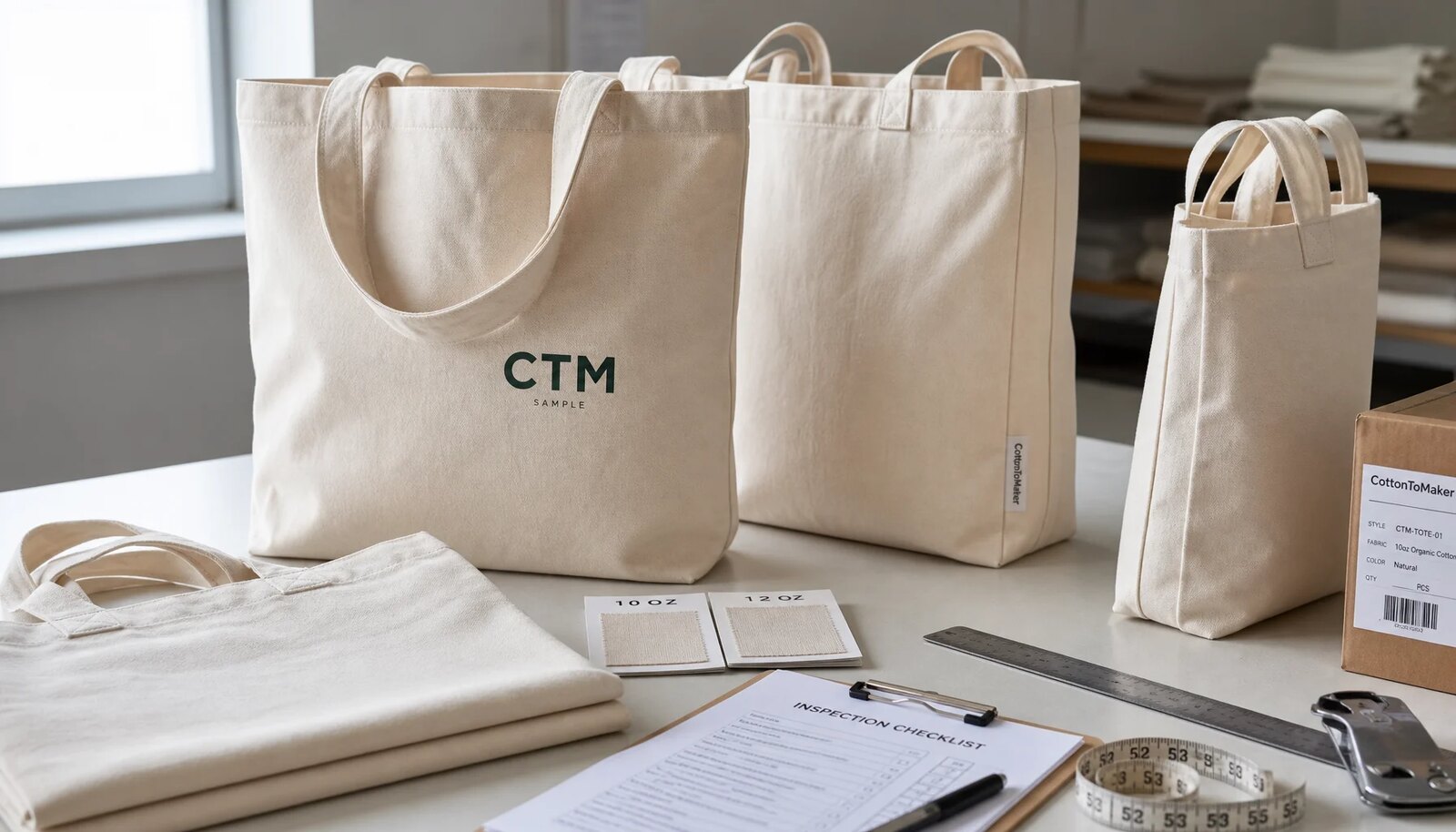
Why Craft Fair Tote MOQ Is Not One Number
Wholesale organic cotton totes for craft fairs look simple on a product page. In a factory quote, they are rarely simple. The MOQ may be driven by the organic cotton fabric lot, the chosen fabric color, the cutting size, the handle construction, the print setup, the sewn label, the carton mark, or a shipment split. If the RFQ only says “organic cotton tote, logo print, low MOQ,” the supplier has to fill in too many blanks. That usually leads to a safer but higher price, vague assumptions, or extra charges that appear after artwork and packing are confirmed.
Craft fair demand is often uneven. A small spring market may need 300 bags. A holiday event may need 800. A regional artist program may need 2,000 pieces split across several designs. The better negotiation is not just asking the factory to “go lower.” It is showing which parts of the program can stay fixed and which parts need flexibility. When the base tote is standardized, the supplier can consider a combined fabric run, lower per-design print quantities, or staged shipments with less operational risk.
For procurement teams, the order should be treated as a small program rather than a one-line merchandise item. Share confirmed demand, forecast demand, artwork count, event dates, packing needs, and organic cotton documentation requirements at the start. Organic cotton adds another layer because material availability and paperwork may affect both MOQ and lead time. Buyers who separate the real MOQ drivers get cleaner answers and fewer surprises.
- Ask which MOQ drives the quote: fabric, color, cutting size, print setup, label, packing, or delivery split.
- Group multiple craft fair designs under one base tote when fabric, size, handles, seams, and packing can stay identical.
- Do not compare suppliers until quote assumptions match, including organic cotton documentation and one-time charges.
- Treat per-artwork MOQ separately from total base-tote MOQ when several event graphics are involved.
- State whether repeat orders are likely and whether leftover blanks can be held, reprinted, or carried into the next event season.
Start With the Base Tote, Not the Price
MOQ negotiation becomes much cleaner once the base tote is defined. For craft fair use, a practical shopper size is often around 38 x 42 cm. Add an 8-10 cm gusset if the tote must hold candles, jars, folded apparel, books, or small ceramics. Handle length commonly falls around 60-70 cm, creating a shoulder-carry drop of about 25-30 cm depending on the top hem and attachment point. These measurements are not mandatory, but they give all suppliers the same target.
Construction deserves as much attention as fabric weight. Two totes can both be called 10 oz organic cotton canvas and still feel very different in use. A folded top hem, lockstitch seams, reinforced handle attachment, and consistent stitch density make a reusable event bag feel more reliable. Handle reinforcement should be named: box stitch, cross stitch, bar tack, or another approved method. If the tote will be sold as merchandise, not handed out as booth packaging, raise the visual standard for stitch lines, loose threads, print placement, and panel shape.
Be clear about finished dimensions. Buyers, inspectors, and end users judge the finished bag, not the cutting panel. Cutting dimensions may change with shrinkage, seam allowance, hem construction, and fabric handling. If the factory only receives a rough drawing and no tolerance, it may quote a promotional-grade bag that is close enough for a giveaway but weak for retail craft fair merchandise.
- Specify finished width, finished height, gusset depth, handle length, handle drop, top hem width, seam allowance, thread color, and reinforcement method.
- Use one approved base tote for multiple craft fair programs if only artwork or carton labeling changes.
- State whether the tote is for retail resale, gift-with-purchase, booth packaging, or giveaway because finish expectations differ.
- Use centimeters or inches consistently, and confirm whether tolerances apply before or after washing if washability is claimed.
- Attach a simple technical drawing or annotated sample photo for print position, handle drop, label placement, and gusset details.
Fabric Weight, GSM, and Organic Cotton Claims
Fabric weight is the first major cost driver and one of the easiest places for quotes to drift apart. Suppliers may describe tote fabric as 8 oz, 10 oz, or 12 oz, while mills or buyers may also use GSM. In day-to-day sourcing, the conversion is not exact because weave, finishing, moisture, and measurement method affect the result. As a working reference, 8 oz cotton canvas is often around 230-250 GSM, 10 oz around 280-300 GSM, and 12 oz around 330-360 GSM. The purchase order should state the target and the allowed tolerance, not rely on broad language such as “heavy cotton.”
For craft fair totes, very light 5 oz or 6 oz cotton may work for simple giveaways, but it often lacks the handfeel expected for reusable merchandise. A 10 oz organic cotton canvas is a balanced option for many buyers because it feels substantial while still packing efficiently. A 12 oz version is better when the tote will be sold as a retail item or used to carry books, pottery, bottles, jars, or several handmade goods. Heavier fabric also raises material cost, carton weight, and sometimes sewing time, so the comparison should be landed cost per approved bag, not unit price alone.
Organic cotton appearance needs a written standard. Natural unbleached cotton may show seed specks and shade variation. Some brands like that look; some retail channels do not. Dark specks in a blank area may be fine, while the same specks under a pale print may be rejected. Dyed organic fabric can push MOQ higher because dye lot control, shade approval, and documentation become more complex. Before using fabric weight as the main comparison, ask whether the fabric is stock, repeat-booked, or custom made.
- Use 8 oz organic cotton for lighter event bags when price and carton efficiency matter more than premium handfeel.
- Use 10 oz organic cotton canvas for most craft fair merchandise totes that need a stronger, retail-ready feel.
- Use 12 oz organic cotton canvas when the tote is sold, reused heavily, or expected to carry denser goods.
- Write both oz/yd² and GSM in the RFQ, and add a fabric weight tolerance such as ±5% if commercially acceptable.
- Clarify natural, greige, bleached, or dyed fabric because color and finishing can change MOQ, shade variation, lead time, and documentation.
- Ask for estimated finished bag weight for each fabric option so freight, carton weight, and warehouse handling can be compared.
Build the MOQ Strategy Around Standardization
A factory may not want 200 pieces each across six different tote constructions. The same factory may be open to a larger combined program if all versions use the same blank. That difference is practical, not personal. Different sizes require cutting changes. Different fabric colors need lot separation. Different handles slow the sewing line. Different packing SKUs add sorting work. The buyer’s job is to identify the cheapest form of flexibility. In many craft fair programs, artwork variation is easier to manage than changes in fabric, size, or construction.
A useful structure is to request one total MOQ for the base tote and a lower minimum for each artwork when the blank stays identical. For example, ask for one natural 10 oz organic cotton tote in a standard size, then request one-color screen print pricing at different artwork split quantities. The factory can then evaluate fabric booking and sewing as one program while treating printing as the variable. It also prevents a common misunderstanding: a 1,000-piece order may sound simple, but ten designs at 100 pieces each are ten small print runs.
Forecasts help, but only when they are presented honestly. A supplier may consider better pricing if repeat demand is credible, but procurement should not ask for 3,000-piece pricing when only 300 pieces are approved. A clearer approach is to request tiered pricing and explain the event calendar. The first purchase order can cover the confirmed quantity, while the quote can show repeat-order pricing if the same blank, print method, and packing format continue. That keeps leverage without creating a false volume promise.
- Standardize fabric weight, color, bag size, handle, stitching, label position, and packing before negotiating lower per-design MOQ.
- Ask for total base-tote MOQ and per-artwork MOQ separately when multiple craft fair graphics are needed.
- Avoid custom dyed fabric for small orders unless the retail margin and event schedule can absorb the higher fabric MOQ.
- Use the same print location and print size across designs where possible to reduce setup complexity and inspection variation.
- Ask whether blank totes can be produced first and printed later, but confirm storage cost, shade-lot risk, dust control, and handling damage.
- Separate confirmed PO quantity from forecast quantity and request repeat-order price breaks instead of implying unapproved volume.
Print Choices That Can Raise or Lower MOQ
Most wholesale organic cotton totes for craft fairs use screen printing because it works well for simple logos, event names, sponsor marks, and one to three solid colors. Water-based ink is common on cotton canvas because it usually gives a softer handfeel than heavier print systems. Still, cotton canvas has texture. Pale inks, fine lines, and large filled areas can look different on 8 oz, 10 oz, and 12 oz fabrics. Approve print appearance on the actual fabric weight, not only on a digital proof.
Digital printing can be useful when the order has many low-quantity artworks, gradients, or detailed illustrations. It may reduce pressure from screen setup, but it is not automatically cheaper or safer. Unit cost can be higher, handfeel can differ, color repeatability may be less exact for brand colors, and durability expectations must be agreed. Heat transfer may support full-color graphics, but edge feel, heat marks, long-term adhesion, and alignment on thick cotton canvas should be checked before approval.
Print method changes MOQ because every artwork version creates work in the print room. One color on 1,000 pieces is usually straightforward. Ten designs at 100 pieces each mean ten screens or ten digital setup checks, more approvals, and more changeover time. If the program includes multiple artist graphics, ask for a clear option matrix: screen print for repeat designs, digital print for low-volume art, and separate charges for each setup. That makes the MOQ discussion factual.
- Use water-based screen print for solid logos, repeat event designs, limited color counts, and softer handfeel requirements.
- Use digital print for short runs, many artwork versions, gradients, or detailed art where exact Pantone control is not the top priority.
- Review heat transfer only after checking handfeel, edge durability, heat shadow, alignment, and whether it fits the organic cotton product story.
- Specify print size, placement, color count, ink coverage, and minimum line thickness before asking for a unit price.
- Ask for print placement tolerance, commonly around ±0.5-1 cm depending on artwork and factory capability.
- Require dry rub and light damp rub checks if printed areas may contact apparel, tissue, or light-colored merchandise.
What a Comparable Factory Quote Must Include
A useful factory quote shows more than a unit price. It should state fabric weight and tolerance, finished dimensions, construction, print method, artwork assumptions, label and hangtag details, packing format, MOQ structure, sample cost, lead time, Incoterm, payment term, organic cotton documentation, quote validity, and one-time charges. Without that detail, two prices that look different may not be comparable at all.
Quote tiers should use the same specification. For craft fair programs, practical tiers may be 300, 500, 1,000, and 3,000 pieces. If the supplier changes fabric source, packing, or print method between tiers, the quote should say so directly. Also ask for the cost of splitting by artwork or event date. A low unit price can become expensive once separate screens, carton labels, small-batch inspection, and event sorting are added.
Incoterm and packing details affect landed cost. EXW, FOB, CIF, and DDP quotes include different responsibilities. Small tote orders can be especially sensitive to freight, documentation, and handling fees. Ask for carton dimensions, pieces per carton, gross weight, and net weight early enough to compare freight. For some buyers, receiving labor and event sorting cost more than a small difference in factory unit price, so packing belongs in the commercial quote from the start.
- Request an itemized quote with unit price, one-time charges, sample charges, document fees, packing costs, and inspection support clearly separated.
- Ask for price tiers using identical assumptions so the buyer can compare quantity effects instead of specification changes.
- Confirm whether screen charges, strike-offs, Pantone matching attempts, barcodes, carton marks, hangtags, and organic cotton documents are included.
- State Incoterm clearly and request estimated carton dimensions, carton weight, and pieces per carton for freight planning.
- Ask what changes if the order is split by artwork, event, destination, PO, or shipment date.
- Compare landed cost per approved usable bag, not only the lowest quoted ex-factory unit price.
Sample Approval Before Bulk Production
The pre-production sample is the production reference. It is not a courtesy photo and it is not a formality. For organic cotton totes, the sample should use the approved bulk fabric weight, handle material, thread color, seam construction, reinforcement method, print ink, label, and packing format wherever feasible. If a supplier sends a substitute-fabric construction sample, mark it as construction-only. Do not approve it as the bulk standard. A separate print strike-off on the actual fabric may be needed before the print is released.
Sample review should be hands-on. Measure finished width, height, gusset, handle length, handle drop, print position, label position, and top hem. Load the tote with realistic craft fair contents such as books, candles, jars, folded garments, or small ceramics. Watch whether the handle attachment distorts or the seams open. Rub the print with a dry white cloth and a lightly damp white cloth if the printed surface may touch light merchandise, tissue, or apparel. Check natural cotton specks in the print area, not only on blank panels.
Approval comments should be measurable. “Looks good” does not protect the order. A stronger approval note says to move the print 1 cm higher, increase handle drop to 28 cm, adjust green closer to the approved Pantone target, trim loose threads, reduce visible slubs in print panels, or confirm 10 oz fabric within tolerance. Keep one approved sample with the factory and one with the buyer or inspection team. Attach photos and approval notes to the PO or QC file.
- Approve actual bulk materials before cutting whenever possible; use substitute samples only for limited construction review.
- Keep written approval comments with dimensions, print location, color notes, accepted natural cotton character, and corrections required before bulk.
- Use ruler photos for print position, handle drop, label placement, carton packing, and any sample deviation.
- Confirm whether sample remakes, strike-offs, sample courier, and approval delays affect lead time or cost.
- Do not approve mass production until fabric weight, construction, print method, and organic cotton document path are confirmed.
- State whether any accepted sample deviation is allowed in bulk or accepted only for that sample stage.
QC Standards for Organic Cotton Tote Bags
Quality control should separate natural cotton character from real defects. Small seed specks or mild shade variation may be acceptable on natural unbleached organic cotton if the buyer approved that look. Oil marks, mildew odor, water stains, dirty handling marks, holes, broken yarns, insect contamination, severe slubs in print areas, and machine damage should not be excused as “organic character.” Write this distinction before inspection so the supplier, buyer, and inspector use the same standard.
The main functional risks are handle failure, seam opening, dimension drift, and print defects. A craft fair tote may be carried around a venue with several purchases inside, so handle reinforcement and stitch quality matter. Inspection should include dimension checks, visual defect sorting, stitch review, print placement measurement, rub checks, carton assortment checks, and a simple load or hang check based on expected use. The test can be simple, but the weight, duration, and pass condition should be agreed before production.
Defect severity needs to be defined. Wrong artwork, wrong fabric weight outside tolerance, weak handle attachment, open seam, mildew odor, and mixed cartons are usually major or critical issues. A tiny natural speck away from the print area may be minor or acceptable. Without severity rules, inspection reports become subjective. Buyers using third-party inspection should still provide a tote-specific checklist because a generic textile checklist may miss craft fair use risks.
- Set finished dimension tolerance, commonly ±1 cm for simple totes unless retail channel requirements are tighter.
- Set print placement tolerance, color approval method, rub-check expectation, and acceptable print defects before final inspection.
- Inspect handle reinforcement for stitch pattern, skipped stitches, loose tension, broken thread, needle damage, and weak backtack.
- Check seams for open stitching, seam slippage, puckering, uneven hems, exposed raw edges, loose thread nests, and panel distortion.
- Classify critical, major, and minor defects so inspectors do not reject normal cotton specks or pass serious workmanship issues.
- Require inspection photos of measurements, print defects, fabric defects, handle stitching, carton marks, packing method, and carton condition.
Packing, Cartons, and Event Distribution
Packing choices affect freight cost, receiving labor, cleanliness, retail readiness, and sustainability messaging. Flat bulk packing in export cartons is usually efficient for wholesale craft fair programs. Individual polybags can keep bags clean and support barcode scanning, but they add material cost, plastic use, unpacking labor, and possible conflict with an eco-focused product story. Depending on the channel, paper bands, grouped bundles, carton liners, or inner bags may be a better fit.
Carton quantity should balance cube efficiency with handling weight and product condition. Heavy 12 oz totes packed too tightly can create cartons that are hard to lift. They can also crease print panels or deform handles. Many buyers prefer carton gross weight below about 15-18 kg, but the exact limit should follow the buyer’s warehouse rules and destination handling practice. Ask the supplier for estimated pieces per carton, carton dimensions, gross weight, net weight, and carton marks before the purchase order is finalized.
Packing can also change MOQ when each artwork or destination needs separate sorting. Ten craft fair designs packed in separate cartons create more work than one bulk SKU. If the buyer needs event-ready cartons with event names, PO numbers, barcodes, or destination labels, that work should be quoted and inspected. If a domestic warehouse will repack by event, compare factory sorting cost with local receiving and repacking cost. The cheapest carton plan at origin may not be the cheapest operating plan.
- Use flat export carton packing when goods ship to a distributor, brand warehouse, or event organizer for later allocation.
- Use individual packing only when resale cleanliness, barcode scanning, retail display, or channel rules require it.
- Specify carton quantity, carton dimensions, gross weight limit, inner liner, moisture protection, SKU separation, and carton mark format.
- Keep printed panels flat and protected from blocking, abrasion, heavy compression, and dirt during packing.
- Confirm whether pallets, master carton labels, corner protection, desiccants, or destination labels are included in the quote.
- Inspect carton marks against PO, artwork version, SKU, quantity, event name, and destination before shipment release.
Lead Time for Date-Critical Fairs
Craft fair orders are date-sensitive. A tote delivered after the fair may have little commercial value. Lead time should be broken into artwork review, sample making, sample courier, sample approval, fabric booking, cutting, sewing, printing, curing, finishing, final inspection, export packing, document release, handover, transit, customs clearance, and warehouse receiving. Buyers often focus on mass production days and forget that artwork revisions, strike-off approval, organic documentation review, and inspection scheduling also take calendar time.
A strong RFQ states the requested ex-factory date, latest acceptable ship date, warehouse arrival date, and event date. If several fairs are involved, identify the earliest event and any later replenishment windows. The supplier can then recommend one production batch, a split shipment, or staged printing of blanks. Rush orders should stay simple: standard natural fabric, common size, limited artwork count, normal packing, and clear documentation requirements. Custom dyed fabric and complex multi-color prints are risky choices when the deadline is tight.
MOQ and lead time are connected. A supplier may accept a low MOQ but schedule it later because larger orders take priority. Ask whether the quoted lead time is based on current capacity, expected capacity, or a general estimate. Milestones should be updated after artwork delay, payment delay, fabric booking, sample remake, or sample approval. If the date is firm, the PO should include the latest acceptable handover date and the agreed process if delays occur.
- Do not count sampling time as mass production lead time unless the supplier explicitly includes it.
- Reserve calendar time for artwork corrections, screen making, strike-off review, print curing, final inspection, and warehouse receiving.
- Ask whether organic fabric booking or documentation adds lead time compared with conventional cotton totes.
- Schedule inspection before final payment or shipment release, not after cartons are already loaded.
- Use split delivery only when it reduces the risk of missing the earliest fair more than it increases cost and handling complexity.
- Update the milestone schedule after sample approval, artwork approval, deposit receipt, fabric booking, and production start.
Specification comparison for buyers
| Sourcing decision | B2B recommendation | Typical acceptable range | Quote or QC risk to control |
|---|---|---|---|
| Fabric weight | Specify organic cotton canvas in both oz/yd² and GSM, with test method and tolerance. | 8 oz about 230-250 GSM for light event use; 10 oz about 280-300 GSM for most craft fair totes; 12 oz about 330-360 GSM for heavier retail use. | Oz and GSM are not exact equivalents across weaves and finishing. Require the quoted fabric reference, tolerance, and a bulk fabric weight check before cutting. |
| Finished size | Use one standard base size across designs wherever possible. | Common shopper size 38 x 42 cm; gusset 8-10 cm if bulky goods are expected; handle length 60-70 cm with handle drop about 25-30 cm. | Small size changes affect fabric consumption, cutting yield, carton cube, and MOQ tier. State finished dimensions, not only cutting dimensions. |
| Construction | Define seam type, top hem, reinforcement, stitch density, and thread color. | Folded top hem 2-3 cm; lockstitch seams; box stitch, cross stitch, or bar tack at handle points; approx. 8-10 stitches per inch where suitable. | A low quote may use simple handle stitching, narrow hems, or loose stitch density. Require approval photos and inspection points for stress areas. |
| Print method | Match print method to artwork count, order volume, color target, and handfeel requirement. | Water-based screen print for 1-3 solid colors; digital print for many low-volume artworks or gradients; heat transfer only after handfeel and edge review. | Per-artwork setup charges can erase the benefit of a low MOQ. Confirm screen charges, strike-offs, curing time, rub result, and acceptable color deviation. |
| MOQ structure | Negotiate by base tote, fabric lot, color, artwork, label, packing SKU, and delivery date. | Example: one base tote total MOQ plus lower per-design MOQ if only front artwork changes. | A supplier may agree to a low total number but add hidden costs for repeated screens, carton sorting, labels, or separate inspection lots. |
| Organic cotton claim | Define claim wording and required documentation before sampling. | Internal fabric declaration may be enough for some B2B uses; retail claims may need supplier scope documents, material lot records, or transaction documents. | Do not assume every factory can issue documents tied to the buyer PO or shipment. Confirm issuing party, timing, document name, and cost. |
| Sample approval | Approve a physical pre-production sample using actual bulk materials whenever feasible. | Sample should match fabric weight, thread, handle, print ink, label, and packing plan; strike-off may be separate for print color. | Substitute fabric samples cannot confirm shrinkage, opacity, print absorption, handle strength, or final retail appearance. |
| Inspection tolerances | Set measurable tolerances in the PO and inspection checklist. | Finished dimensions commonly ±1 cm; print placement often ±0.5-1 cm; fabric weight tolerance commonly agreed as ±5% unless a tighter standard applies. | If no tolerance is written, inspection becomes subjective. Define major defects, minor defects, and acceptable natural cotton characteristics. |
| Packing | Plan carton packing by SKU, handling weight, cleanliness, and event distribution. | Flat pack 50-100 pcs per carton depending on weight; keep carton gross weight commonly under 15-18 kg when warehouse rules allow. | Overpacked cartons can crease print panels, deform handles, create dirt marks, and increase receiving labor. Require carton dimensions and marks in the quote. |
Buyer checklist before sampling
- Define the use case first: resale tote, booth packaging, gift-with-purchase, vendor kit, sponsor merchandise, artist collaboration, or event giveaway.
- Lock the base tote specification before negotiating MOQ: fabric weight, weave, finished size, gusset, handle length, handle drop, top hem, seam type, reinforcement, and thread color.
- State fabric weight in oz/yd² and GSM with an agreed tolerance, and ask whether the quoted fabric is stock, repeat production, or made to order.
- Separate MOQ by raw organic cotton fabric, natural or dyed fabric lot, bag size, artwork version, print setup, label type, packing SKU, delivery date, and inspection lot.
- Provide print-ready artwork details: artwork size, placement from top and side edges, color count, Pantone or target reference, ink coverage, line thickness, and required print method if fixed.
- Request comparable price tiers such as 300, 500, 1,000, and 3,000 pieces using identical assumptions for fabric, print, label, packing, Incoterm, and documentation.
- Ask for one-time charges separately from unit price, including screens, strike-offs, sample making, sample courier, digital file preparation, organic documents, labels, barcodes, and special carton marks.
- Require a physical pre-production sample or, at minimum, a construction sample plus print strike-off on actual fabric before mass cutting or full print production.
- Write sample approval comments with measurable instructions: dimension corrections, print movement, color adjustment, accepted natural specks, loose-thread limits, and any deviations allowed in bulk.
- Set QC tolerances for dimensions, handle placement, stitch quality, print position, print defects, fabric cleanliness, carton assortment, carton weight, and carton marks.
Factory quote questions to send
- What is your MOQ separately for the organic cotton fabric lot, finished tote size, natural versus dyed fabric, printed artwork, sewn label, hangtag, packing SKU, and shipment split?
- Can you quote 8 oz, 10 oz, and 12 oz organic cotton canvas options with approximate GSM, fabric construction, expected finished bag weight, and allowed fabric weight tolerance?
- Is the quoted fabric greige, natural unbleached, bleached, dyed, or washed, and what shade variation is normal between lots?
- Is the fabric in stock, reserved, repeat-booked, or newly produced from a mill, and how does that affect MOQ, lead time, cancellation terms, and documentation?
- What finished dimensions and handle drop do you recommend for craft fair merchandise such as books, candles, jars, folded apparel, and small ceramics?
- What seam construction, top hem width, reinforcement method, thread type, and stitch density are included in the quote?
- Which print method do you recommend for our artwork size, color count, line detail, ink coverage, and handfeel requirement?
- Are screen charges, digital file preparation, strike-off samples, Pantone matching attempts, sample remakes, and print setup fees included or charged separately?
- What print placement tolerance, color tolerance, rub test expectation, curing time, and blocking-prevention process do you use for cotton canvas totes?
- Will the pre-production sample use the same bulk fabric, handle material, thread, stitch construction, ink system, label, and packing as mass production?
Quality-control points to confirm
- Finished width, height, gusset depth, handle length, and handle drop measured against the approved sample and PO; common simple-tote tolerance is ±1 cm unless the buyer sets a tighter retail tolerance.
- Fabric weight verified from bulk fabric or cut panels using an agreed method, not only from the supplier’s pre-order swatch; common commercial tolerance should be written, often around ±5% when acceptable.
- Handle placement and symmetry checked so the tote hangs evenly; left and right handle ends should align consistently and not twist after flat packing.
- Handle attachment reinforced by the specified box stitch, cross stitch, or bar tack, with no skipped stitches, loose tension, broken thread, needle cuts, or weak backtack at stress points.
- Top hem, side seam, bottom seam, and gusset seam checked for seam allowance, open seam, seam slippage, puckering, uneven folded edges, exposed raw edges, and excessive thread tails.
- Stitch density checked against the approved standard, especially around handles and top hem, because loose stitch density can pass a quick visual check but fail under load.
- Print position measured from agreed reference points with tolerance stated in the inspection checklist; inspect for tilt, wrong scale, wrong artwork version, and inconsistent placement between cartons.
- Print surface checked for cracking, bleeding, pinholes, poor coverage, blocked cartons, ink transfer, visible scum marks, and unacceptable color variation against the approved sample or strike-off.
- Dry rub and light damp rub checks performed on printed areas when bags may contact light clothing, tissue paper, apparel, or retail merchandise.
- Natural cotton appearance controlled with written limits: small seed specks may be acceptable, but oil marks, mildew odor, water stains, dirty hand marks, severe slubs in print areas, broken yarns, holes, and insect contamination should not pass.