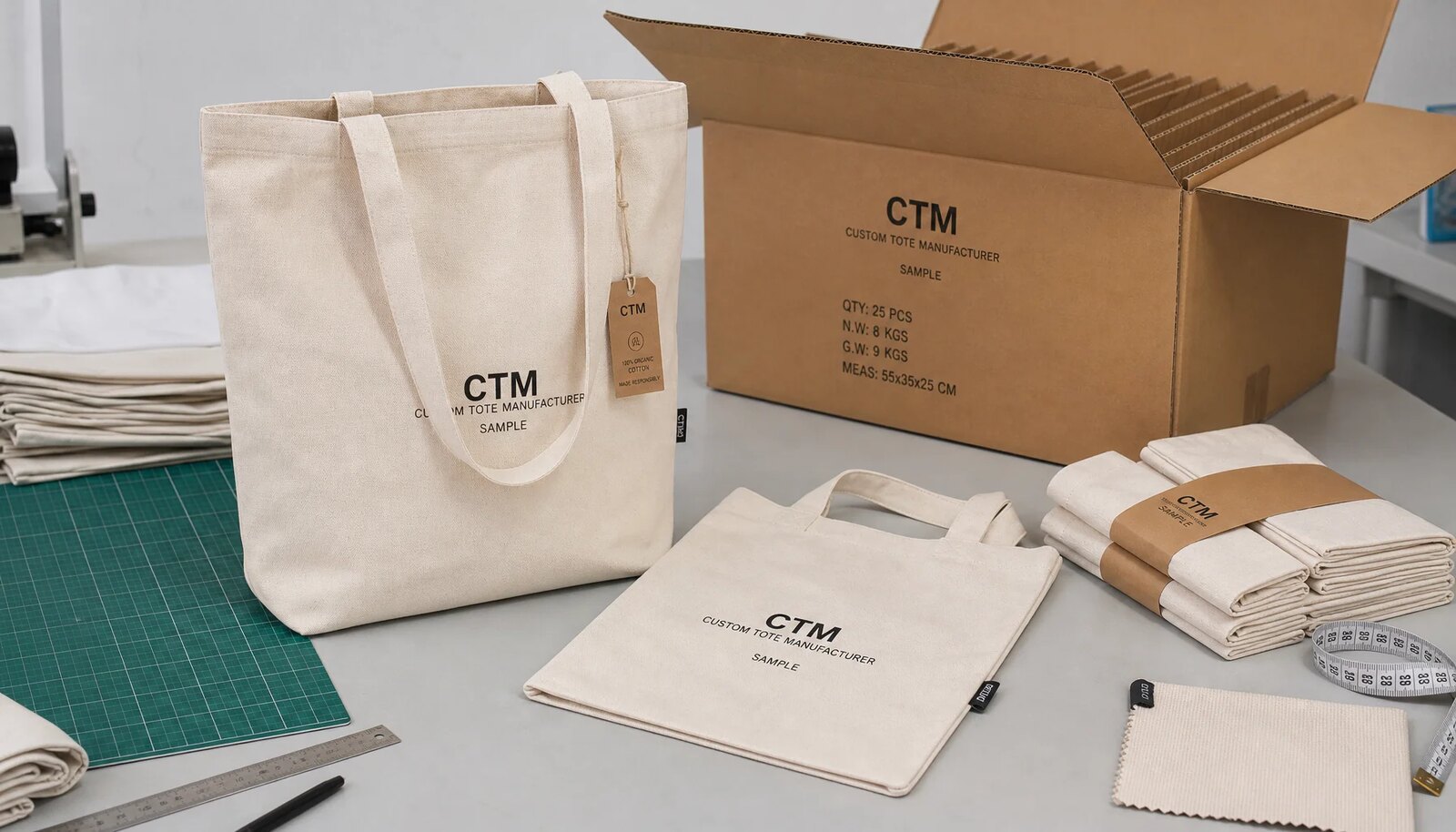
Plan The Carton Before You Chase The Lowest Unit Price
For a craft fair program, the tote is not only a bag. It is also a retail item, a booth supply, a warehouse pick unit, and a shipping cube that has to survive handling before anyone sees the logo. A flat sample can look acceptable in a photo and still create problems when bulk cartons arrive with crushed corners, hard fold lines through the print, mixed artwork versions, or counts that do not match the packing list.
That is why procurement teams should connect the bag specification and carton packing plan at the RFQ stage. Fabric GSM, finished size, gusset depth, handle length, print area, fold direction, inner bundle count, carton dimensions, and gross weight all affect price. If those details are left open, each supplier may quote a different assumption. The cheapest quote may simply be using lighter fabric, less handle reinforcement, fewer packing steps, or a carton count your warehouse cannot work with.
Start by describing the actual use. Will the tote be sold as craft fair merchandise, given to visitors, packed into vendor kits, or replenished to several booths during a market season? Will it carry prints and brochures, or heavier items such as ceramics, jars, books, candles, and packaged food? These answers help the factory recommend a realistic construction and pack count. They also help your team avoid repacking at destination, which is slow, messy, and difficult to cost accurately after the PO is placed.
- For many 10 oz printed canvas totes, evaluate 50 pcs per export carton first, then confirm with a packed-carton test.
- For 6-8 oz light totes, 100 pcs per carton may work, but only after checking carton bulging, print creasing, and gross weight.
- For multi-booth distribution, specify inner bundles of 10 or 25 pcs so staff can count quickly without opening every tote.
- For resale or distributor cartons, mark PO, SKU, print version, fabric color, quantity, carton number, net weight, gross weight, and external carton size.
- For printed totes, approve the fold method so the main artwork is not crushed on the sharpest fold or rubbed during transit.
Match Fabric Weight To Real Carry Use
Organic cotton tote quotations can look similar while the bags are very different. A 170 GSM sheeting tote, a 240 GSM light canvas tote, a 300 GSM canvas tote, and a 340 GSM heavy canvas tote may all be described as cotton totes. They will not have the same body, opacity, sewing behavior, print surface, carton cube, or hand feel. Buyers should compare the fabric construction and measurement method, not just the product name.
For craft fair resale, 280-300 GSM organic cotton canvas is a practical starting point. It usually has enough structure to sit well on a vendor table, gives screen print artwork a cleaner surface than very light sheeting, and remains manageable in carton packing. For sponsor giveaways or attendee bags, 170-240 GSM may be acceptable when contents are brochures, lightweight samples, or small packaged items. For heavier craft fair purchases, a 320-340 GSM canvas with reinforced handles may be the better spec, even though it increases unit cost and carton volume.
Ask the supplier to state whether the fabric is natural, bleached, dyed, washed, or unwashed. Natural organic cotton may show seed flecks, slubs, and shade variation. Some brands want that look. Others need a cleaner visual standard for retail presentation. Do not approve shade or texture from screen images alone; physical swatches reveal stiffness, odor, uneven tone, and surface defects that photos often soften.
- 170-200 GSM: economical for event distribution, low carrying weight, higher transparency, and more visible wrinkling.
- 220-240 GSM: better hand feel for promotional totes while still supporting higher carton counts.
- 280-300 GSM: balanced craft fair retail weight with good body, print surface, and manageable freight impact.
- 320-340 GSM: premium or heavier-load option with stronger appearance, higher cost, larger carton cube, and lower pack efficiency.
- Set the GSM tolerance, commonly +/-5%, and confirm whether the supplier measures greige fabric, finished fabric, or the finished bag panel.
Write Construction Details Like A Buying Specification
A logo file and a front-view mockup are not a tote bag specification. Craft fair bags are handled in uneven ways: shoppers fill them with dense small items, booth staff move stacks quickly, and cartons may be opened and closed repeatedly during event setup. Failures often begin at the handle attachment, side seam, top hem, or bottom gusset. Those points need written controls.
Common open tote sizes include 35 x 40 cm, 38 x 42 cm, and 40 x 35 x 10 cm with a bottom gusset. Shoulder handles are often about 55-65 cm in total length, while shorter hand-carry handles may be about 35-45 cm. The important number for user comfort is the finished handle drop, not just the cut handle length. Top hem depth, fold allowance, and stitching position can all reduce the usable opening.
For reusable craft fair merchandise, cotton webbing handles are usually a better choice than narrow self-fabric strips. Webbing width, hand feel, shrinkage, and color should be agreed before sampling. The stitch pattern also matters. Box-x stitching, reinforced cross stitch, or a defined bartack gives the factory and inspector something visible and measurable. If a supplier quotes a simpler attachment, request close photos, stitch density, thread type if relevant, and a simple load test result before accepting the cost saving.
- State finished size tolerance, such as +/-1 cm on width and height after sewing, pressing, and resting.
- State gusset tolerance separately, such as +/-0.5 cm, when shelf fit, carton count, or product loading depends on depth.
- Specify handle width, total handle length, and handle drop instead of relying on loose terms such as shoulder length.
- Require inside and outside photos of handle reinforcement on the pre-production sample.
- Define seam finish expectations, including no open seams, raw edges where finished edges are required, or loose thread nests.
- Approve the folded shape with handle position so packed handles do not twist, crease the print, or deform the top opening.
Control Print Quality Before Bulk Production Moves Too Far
Most wholesale organic cotton totes for craft fairs use screen printing because many designs are logos, sponsor marks, event graphics, or limited-color illustrations. Water-based screen printing is commonly used on cotton canvas and can give a softer hand than a heavy ink deposit, but it still needs a physical strike-off. Natural cotton shade, weave texture, seed flecks, ink absorption, and curing time all change how the artwork looks in bulk.
The print specification should cover artwork size, position, color reference, registration, and minimum line detail. Fine lines below about 0.3 mm can break up on textured canvas, especially on coarser weaves or near seams. Large dark fills need extra attention because they can feel stiff, show pinholes more clearly, and develop fold marks if the panel is packed too soon or folded directly through the artwork.
For multi-color designs, confirm screen count and registration tolerance. For orders with several vendors, sponsor versions, or seasonal graphics, assign version codes before production starts. Those codes should appear on the PO, sample tag, carton mark, packing list, and inspection report. A clean version-control system sounds basic, but it prevents a common receiving problem: correct total quantity, wrong mix by artwork.
- Approve a physical strike-off on the actual fabric quality, not only a digital mockup.
- Use Pantone references where helpful, but treat the approved strike-off as the working production standard.
- Set print placement tolerance from fixed references such as top hem and side seam, not visual centering alone.
- Define registration tolerance for multi-color artwork and rejectable issues such as smears, heavy pinholes, ghosting, and ink transfer.
- Require dry rub and light wet rub checks after curing and before folding into cartons.
- Name every artwork version in the PO, sample tag, carton mark, packing list, and final inspection checklist.
Separate MOQ, Setup Charges, And Packing Costs
MOQ is not just a supplier preference. It can be driven by fabric sourcing, dyeing or washing, cutting yield, screen setup, sewing line changeover, packing materials, and inspection time. A low MOQ may be useful for a new craft fair program, but it often brings a higher unit price, separate setup charges, courier sample costs, or limitations on fabric color, labels, and carton packing.
For a clean comparison, ask suppliers to separate the base bag price from decoration and packing charges. One factory may include paper-banded bundles, barcode labels, hangtags, carton marks, and pre-production samples. Another may quote a plain bag with one simple shipping mark. The second quote can look better until your team adds the missing work or pays for repacking after arrival.
Ask for quantity breaks by fabric weight, print color count, artwork version, and packing method. This is especially important for distributors buying several designs in one season. The bag body may be identical, but the factory may treat each print version as a separate setup. If MOQs apply per SKU or per artwork, get that in writing before the buyer consolidates demand across events.
- Base bag cost is affected by GSM, fabric width, cutting yield, gusset construction, handle length, seam complexity, and sewing minutes.
- Print cost is affected by color count, print area, screen setup, ink type, curing time, and rejected printed panels.
- Packing cost is affected by paper bands, individual packaging, hangtags, barcodes, inner cartons, carton labels, and special fold methods.
- Freight cost is affected by carton cube, gross weight, pallet configuration, and whether cartons bulge or stack poorly.
- Sample cost should identify swatch, blank sample, strike-off, pre-production sample, courier, and remake rules.
- Mixed artwork or color orders should state whether MOQs apply per total order, per SKU, or per print version.
Build The Carton Packing Plan Before The Packing Table
A carton packing plan should be part of the approved production file, not a last-minute factory decision. It needs to define fold method, print protection, inner bundle quantity, pieces per carton, carton dimensions, carton marks, partial-carton rules, and whether mixed SKUs are allowed. If these choices are made only after sewing is complete, the packing team will usually choose speed over product presentation and downstream count accuracy.
For 10 oz organic cotton canvas totes with a front print, 50 pieces per carton is a sensible starting point. The factory should test the proposed carton using real production samples or early bulk pieces. Review the external dimensions, gross weight, carton shape after sealing, fold marks, and whether printed panels rub against each other. If the carton bulges, the logo develops a hard crease, or edges crush easily, reduce the pack count, change the fold, or add protective paper between bundles.
For lighter 6-8 oz totes, 100 pieces per carton may be workable. Still, there is no automatic rule. Large light cartons may bill by volume, while smaller overpacked cartons may damage the goods. The best carton plan balances warehouse handling, freight cube, count accuracy, booth replenishment, and the condition of the tote when a customer finally sees it.
- State whether totes are folded once, folded twice, flat-packed, rolled, or bundled by another approved method.
- Use paper bands or labeled inner bundles of 10 or 25 pcs to reduce count errors without defaulting to individual polybags.
- Ask for external carton dimensions because freight forwarders calculate volume from outside measurements.
- Set a maximum gross weight that fits your warehouse, distributor, or event handling policy; do not leave it to supplier judgment.
- Mark partial cartons clearly and prohibit mixed SKUs unless the buyer has approved a written mixed-carton rule.
- Request first-carton approval before the factory repeats the packing method across the full order.
Approve Samples In A Sequence That Catches Risk Early
One finished sample cannot carry all approvals for an order that includes organic cotton fabric, custom printing, reinforced construction, and a defined carton plan. Sampling should isolate risk step by step: material, print, construction, and packing. This prevents a familiar late-stage problem: the bag is sewn correctly, but the fabric shade is wrong; the print is sharp, but the fold cuts through the logo; the handles look good, but the carton will not close without pressure.
A useful approval path starts with a fabric swatch in the target GSM and finish. If hand feel or structure matters, request a blank sample. Next, approve a print strike-off using production ink on the actual fabric quality. Then review the pre-production sample with final dimensions, handles, stitching, labels, and the planned fold. For larger orders or fixed event deadlines, add first packed-carton approval before mass packing continues.
Put sample comments in writing. Avoid vague approvals such as ok or proceed when there are multiple elements in play. Record what is approved, what must change, and whether the approval applies to fabric, print, construction, packing, or all of them. Keep an approved gold sample with both buyer and factory so final inspection has a physical standard.
- Fabric swatch approval should cover shade, GSM, slub level, odor, hand feel, and surface cleanliness.
- Print strike-off approval should cover color, line clarity, ink coverage, hand feel, curing, and rub behavior.
- Pre-production sample approval should cover finished size, handle drop, stitch reinforcement, seam quality, and label placement.
- Packed-carton approval should cover fold direction, bundle count, carton size, gross weight, shipping mark, and print protection.
- Do not release bulk cutting until fabric and artwork are frozen, especially when several print versions are involved.
- Keep sample approval dates in the production schedule so lead time starts from the correct milestone.
Give Inspectors Criteria They Can Enforce
Quality control works best when the standard is measurable. Words such as premium, strong, or good workmanship are not enough for inspection. Define what must be measured, what is acceptable natural variation, and what becomes a defect. Organic cotton can include minor flecks or slubs, so the QC standard should separate normal material character from oil marks, mildew odor, dirty handling, holes, broken yarns, and heavy shade mixing.
For craft fair totes, inspection should focus on the visible front panel, print placement, handle attachment, seams, count accuracy, and carton condition. The front panel drives retail value, and the handles carry the load. If the order uses a formal AQL plan, the defect list still has to be specific. If the order is smaller and inspected internally, a structured checklist is still better than an informal visual review.
The approved gold sample should be present during final inspection. Inspectors should compare bulk goods against the sample for shade, fabric hand, logo size, logo position, stitch type, handle length, and fold method. They should also open random cartons. Outside carton marks can be correct while the inner bundle count, artwork version, or fold direction is wrong.
- Measure finished width, height, gusset, handle length, and handle drop across multiple cartons, not only top pieces.
- Reject open seams, skipped stitches, loose handle reinforcement, broken thread, visible thread nests, and raw edges where finishing is specified.
- Check print placement from fixed measurement points and compare color against the strike-off under consistent lighting.
- Perform agreed dry rub and light wet rub checks before goods are tightly packed or sealed for shipment.
- Open random cartons to verify count, bundle size, folding direction, SKU, artwork version, and carton mark accuracy.
- Record defects with photos and carton numbers so the factory can sort, repair, or replace affected goods.
Verify Organic Claims Before The PO Is Released
Do not assume that a tote described as organic cotton will satisfy every retailer, marketplace, or brand compliance requirement. The needed support may be a supplier declaration, certificate details, transaction documentation, chain-of-custody records, or a combination of these. The requirement depends on the claim being made, the market where the goods will be sold, and whether the claim appears on hangtags, listings, invoices, carton labels, or point-of-sale materials.
The safer approach is to confirm claim support before order placement. If the supplier can only support a general material statement, avoid stronger wording that implies certification or chain-of-custody coverage the order does not have. If certificate numbers or transaction certificates are required, request them early and confirm that they apply to the specific fabric lot and order quantity.
Also review compliance details that are not strictly about organic cotton. Dyes, inks, packaging materials, metal trims if any, labeling, and restricted substance expectations can affect destination acceptance. If your buyer requires testing, document review, special hangtags, or additional labeling, treat those as quote lines and schedule items rather than assumptions inside the base unit price.
- Ask what document supports the organic cotton claim and whether it applies to the quoted fabric and order.
- Align claim wording across quote, invoice, hangtag, product listing, carton mark, and packing list.
- Confirm whether bleaching, dyeing, washing, recycled blends, or non-cotton trims change the claim language.
- Request certificate details before PO release if retailer compliance requires them.
- Keep claim wording conservative unless supporting documents clearly allow stronger language.
- Quote testing, compliance review, hangtags, and certification handling separately so they are not hidden in unit price.
Protect Lead Time With Clear Milestones
Lead time should start from the last required approval, not from the first price discussion. Organic cotton fabric availability, strike-off corrections, screen making, bulk cutting, printing, curing, sewing, trimming, inspection, packing, and export booking can each add time. Buyers often lose days by placing a deposit before artwork, fabric, labels, or carton rules are final, then asking the factory to recover time during production.
Build the schedule around milestones: RFQ clarification, fabric approval, artwork approval, strike-off approval, pre-production sample approval, bulk production, first-carton approval, final inspection, and shipment booking. Each milestone needs an owner and a target date. If the order supports a fixed craft fair season, reverse-plan from the required warehouse receipt date, not the event date. Distributors and booth teams still need time for receiving, allocation, local delivery, and issue resolution.
Do not squeeze print curing and packing time. Folding printed panels too soon can increase transfer, blocking, odor, and fold marking. Also, do not wait until every carton is sealed before checking SKU mix and carton marks if the order has several artwork versions. A short inspection window before final sealing can prevent a much slower receiving dispute later.
- Allow 5-7 working days for strike-off review and correction when physical approval is required.
- Do not start bulk cutting until fabric shade, GSM, and finish are approved in writing.
- Leave curing time before tight folding, especially for large dark prints or heavy ink coverage.
- Book inspection before final shipment and, where possible, before all cartons are sealed if SKU accuracy is high-risk.
- Add buffer for holidays, fabric shortages, courier delays, port congestion, customs documents, and vessel schedule changes.
- For seasonal craft fairs, plan from required warehouse receipt date and include time for sorting, relabeling if needed, and booth allocation.
Specification comparison for buyers
| Spec decision | Recommended option | When it fits | Buyer risk to check |
|---|---|---|---|
| Resale fabric weight | 10 oz organic cotton canvas, usually about 280-300 GSM | Craft fair merchandise, maker market retail bags, and reusable totes expected to carry purchases | Confirm whether GSM is measured before or after washing/finishing; set tolerance such as +/-5% unless a tighter standard is agreed |
| Giveaway fabric weight | 6-8 oz organic cotton sheeting or light canvas, usually about 170-240 GSM | Sponsor bags, attendee gift bags, low-load event distribution, or budget programs | Below about 200 GSM may show contents, wrinkles, seam puckering, and uneven ink coverage more clearly |
| Premium/load fabric weight | 11-12 oz organic cotton canvas, usually about 320-340 GSM | Totes for books, ceramics, jars, candles, or higher retail price points | Higher GSM increases unit cost, carton cube, gross weight, sewing difficulty, and risk of hard fold lines |
| Finished size tolerance | State finished size after sewing, for example +/-1 cm on width/height and +/-0.5 cm on gusset | Useful for warehouse slotting, retail display, and consistent print placement | Pattern size is not enough; final dimensions change after hemming, pressing, and fabric relaxation |
| Handle construction | Cotton webbing handles with box-x, cross stitch, or reinforced bartack at each attachment point | Reusable craft fair bags expected to carry uneven, dense products | Top-hem-only stitching can loosen under repeated lift cycles; request pull/load test method in writing |
| Print method | Water-based screen print for 1-3 solid colors on natural cotton canvas | Most logos, maker market artwork, sponsor marks, and simple wholesale designs | Require physical strike-off, placement tolerance, curing check, and dry/wet rub review before bulk packing |
| Carton pack count | 50 pcs/carton for many 10 oz printed totes; 100 pcs/carton only for lighter totes after packed-carton test | Keeps cartons easier to count, move, and replenish at booths or distributor warehouses | Overpacking can create logo creases, print abrasion, carton bulging, crushed edges, and unsafe manual handling weight |
| Inner bundling | Paper-banded bundles of 10 or 25 pcs, or clearly labeled inner packs | Multi-booth allocation, distributor pick/pack, and fast event replenishment | Unbundled cartons create count disputes; individual polybags add cost, cube, labor, and disposal burden |
| Organic claim support | Supplier declaration, scope certificate details, transaction certificate where applicable, and matching invoice/hangtag wording | Brands or retailers making organic cotton claims on listings, packaging, or POS materials | Do not assume claim eligibility from fabric description alone; verify documents before PO release |
Buyer checklist before sampling
- Issue the RFQ with finished bag size, gusset type, target GSM/oz, fabric color, handle length, handle width, seam type, stitch reinforcement, print method, and intended carrying load.
- Separate use cases in the purchase order: resale totes, sponsor giveaways, vendor kits, and distributor replenishment often need different labels, bundle counts, and carton marks.
- Ask suppliers to quote carton data with pieces per carton, external carton dimensions, net weight, gross weight, carton board grade if available, and estimated CBM per 1,000 pieces.
- State dimension tolerances before sampling, such as +/-1 cm for finished width/height, +/-0.5 cm for gusset, and agreed print placement tolerance from fixed reference points.
- Require fabric GSM tolerance, commonly +/-5%, and specify whether the reference is greige fabric, finished fabric, or finished bag panel after pressing.
- Approve a physical fabric swatch under daylight or a controlled light source because natural organic cotton shade, seed flecks, and slub level can vary by lot.
- Define print acceptance criteria: Pantone target or approved strike-off, maximum placement deviation, registration tolerance for multi-color prints, dry rub result, light wet rub result, and unacceptable pinholes.
- Require handle attachment photos and a simple load test result on the pre-production sample if the tote is intended to carry ceramics, books, jars, candles, or packaged food.
- Ask for a first packed carton photo or video showing fold method, bundle count, carton mark, carton closing, and whether printed panels touch each other.
- Confirm whether printed panels are folded face-in, face-out, separated by tissue, or flat-packed; do not let the factory choose after production.
Factory quote questions to send
- Which organic cotton fabric options can you quote in 170-240 GSM, 280-300 GSM, and 320-340 GSM, and are they natural, bleached, dyed, washed, or unwashed?
- Is the quoted GSM measured on greige fabric, finished fabric, or finished bag panels, and what GSM tolerance do you guarantee in bulk?
- What organic cotton documentation can you provide for this order, and does it support the exact claim wording planned for hangtags, web listings, or invoices?
- What is the MOQ by fabric weight, bag size, fabric color, handle color, print color count, and artwork version?
- What finished size tolerance, gusset tolerance, and handle length tolerance are included in your standard production control?
- What handle material, handle width, handle length, stitch pattern, and reinforcement are included in the quoted unit price?
- Can you quote box-x stitch, reinforced bartack, or cross stitch separately if not included in the base price?
- Which print method is included, what ink type is used, how is curing controlled, and what rub or wash checks can you perform before packing?
- What are the screen setup charges, Pantone matching charges, strike-off charges, and remake rules if the strike-off is outside the approved tolerance?
- How many pieces are packed per carton, what are the external carton dimensions, what are net and gross weights, and what is the estimated CBM per carton?
Quality-control points to confirm
- Fabric GSM should be verified against the approved swatch or specification, with a written tolerance such as +/-5% unless the buyer has set a narrower range.
- Finished tote dimensions should be measured after sewing, pressing, and resting, not from the paper pattern or cut panel alone.
- Size checks should cover width, height, gusset depth, handle length, and handle drop across multiple cartons rather than only top pieces.
- Handle attachment should be inspected for stitch pattern, stitch density, loose threads, skipped stitches, uneven placement, and secure reinforcement at all four attachment points.
- For reusable craft fair resale totes, handle load checks should reflect realistic contents; the buyer and supplier should agree on test weight, hold time, and repeated lift cycles before production.
- Print color should be compared against the approved physical strike-off or Pantone target under consistent light, with special attention to natural cotton shade variation.
- Print placement should be measured from fixed bag edges or seam reference points; artwork drift should not be judged visually only.
- Ink curing should pass dry rub and light wet rub checks before tight folding to reduce transfer, smearing, and blocking inside cartons.
- Natural organic cotton texture may include minor flecks or slubs, but oil marks, mildew odor, dirty handling, holes, broken yarns, and heavy shade mixing should be rejectable defects.
- Stitching should have no open seams, raw exposed edges where finished edges are required, thread nests on the visible front panel, or handle ends protruding beyond the approved finish.