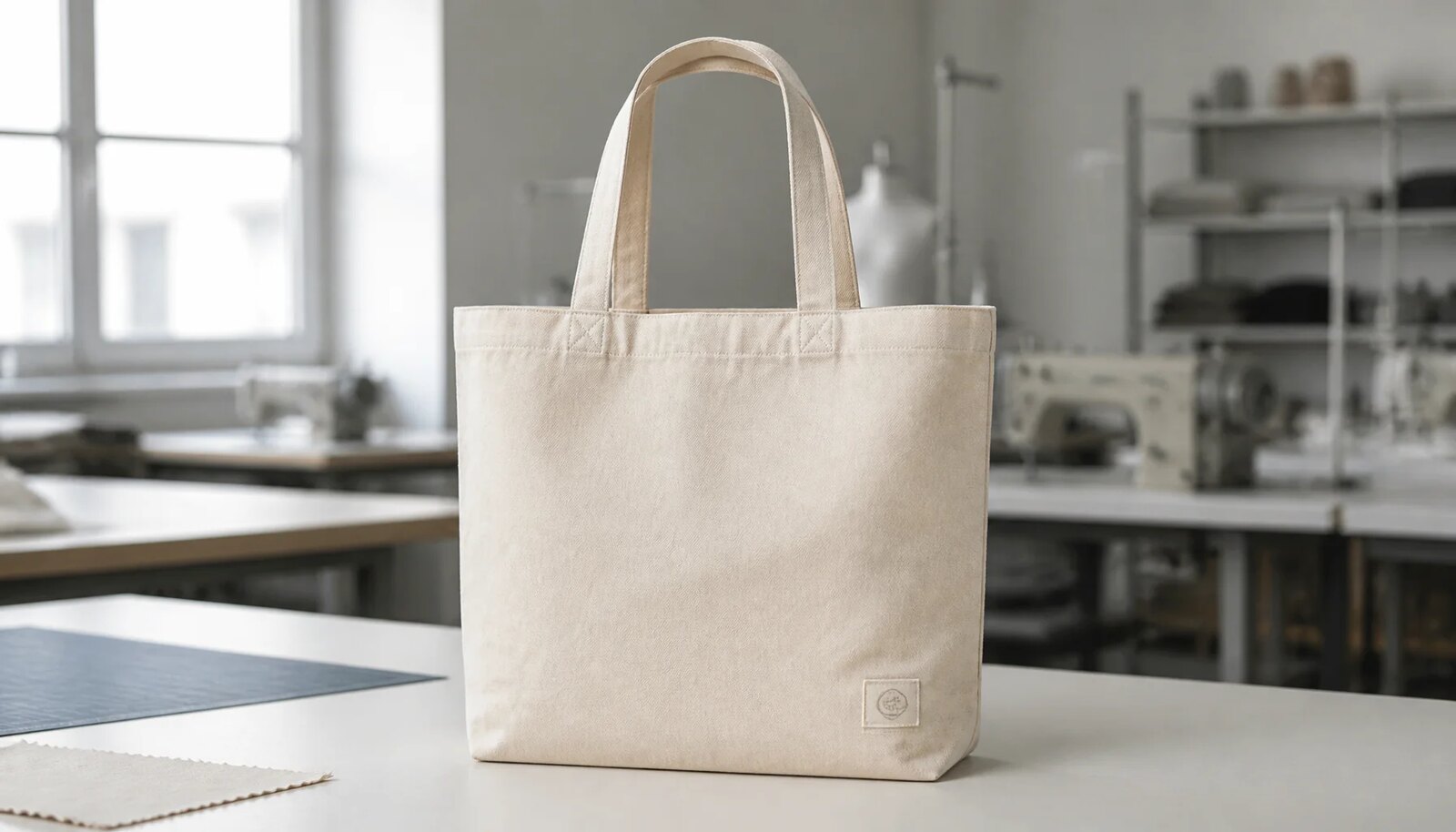
Why a tote RFQ needs more than a product name
Wholesale organic cotton totes look straightforward until suppliers start quoting them. One supplier may assume a 140 GSM flat bag, bulk packed, with a one-color print. Another may quote a 180 GSM bottom-gusset tote with reinforced handles, a woven label, and individual wrapping. Both may call the product an organic cotton tote. For procurement, they are different products, different cost structures, and different quality risks.
Corporate gifting raises the bar because the tote is part of the presentation. It may carry an employee onboarding kit, a client welcome pack, a conference bundle, a university program gift, or internal campaign materials. The recipient notices fabric feel, handle comfort, logo placement, odor, creasing, and stitching before anyone thinks about unit price. A cheaper bag can become expensive if cartons arrive late, prints transfer, handles fail, or the brand team rejects the look.
A strong RFQ does not need to be long for its own sake. It needs to tell suppliers exactly what they are pricing and tell internal stakeholders what has been approved. The same document should support quote comparison, sample review, purchase order writing, inspection, and receiving. That is the point of this wholesale organic cotton totes for corporate gifting RFQ template guide: fewer assumptions, cleaner quotes, and fewer surprises after production starts.
- Define the use case before asking for price: event giveaway, onboarding kit, client gift, retail-style bundle, or internal campaign.
- Quote the finished tote, not only the material: dimensions, gusset, handles, decoration, packing, and QC expectations.
- Ask every supplier to use the same spec sheet, quantity breaks, incoterm, packaging assumption, and documentation level.
- Treat print placement, odor control, folding, carton marks, and inspection access as buying requirements, not side notes.
Start with contents, load, and distribution
The cleanest tote specification begins with what the bag must carry. A bag for a notebook, badge, pen, and brochure does not need the same construction as one carrying drinkware, apparel, catalogs, boxed samples, or small electronics accessories. Suppliers can recommend better fabric and handle choices when they know the expected contents and target carry weight. Without that context, they may quote a bag that looks fine on a screen but feels weak or awkward once loaded.
Distribution matters just as much as the contents. Bulk-packed totes going to a 3PL for kitting need consistent carton counts, tidy folding, and manageable carton weights. Totes sent to a corporate office may need clear receiving marks and stronger dust protection. Totes that must fit into a gift box need a repeatable folded size. Event giveaways need fast unpacking and predictable counts. Those decisions affect labor, packaging, carton density, lead time, and presentation risk.
Use practical language. Instead of saying the tote should feel premium, specify the construction behind that feeling: for example, 160-180 GSM organic cotton canvas, self-fabric handles with X-box reinforcement, a small lower-corner print, and flat folding that does not crush the logo. Instead of saying durable, state the expected load and ask the supplier to confirm the handle reinforcement and load-check method. The more measurable the requirement, the less room there is for guesswork.
- List expected contents or provide a realistic target carry weight for the supplier to check against the construction.
- State whether the tote will be hand-carried, shoulder-carried, mailed, packed inside a kit, or distributed loose at an event.
- Choose flat tote, bottom gusset, or side gusset based on contents, standing shape, folding size, and presentation.
- Tell suppliers whether the finished tote must fit a gift box, mailer, shelf carton, 3PL workflow, or event registration table.
Specify organic cotton fabric clearly
Organic cotton should be described in a way that matches the buyer's documentation requirement. Some corporate programs only need a supplier declaration and fabric certificate for the order file. Others need stronger records for ESG, brand, customer, or compliance review. The RFQ should state what document is required, which party must provide it, and whether the document must connect to the fabric lot used in production. A broad claim that the tote is organic cotton may not be enough later.
GSM is useful, but GSM alone does not define the fabric. Ask for GSM, weave, yarn or construction description if available, color, finish, shrinkage tolerance, and GSM tolerance. Natural organic cotton may include seed flecks, small specks, slubs, and mild shade variation. That may suit a natural brand look, but it should be approved before bulk production. Bleached, dyed, washed, or custom-colored fabric can give a cleaner target, though it may increase MOQ, cost, and lead time.
For many corporate gifting programs, 140-180 GSM is a practical working range. A 140 GSM tote can fit light event packs, documents, apparel, brochures, or budget-sensitive campaigns. Around 160 GSM often balances hand feel, cost, and usability. A 180 GSM tote or heavier canvas can feel more substantial, but heavier is not always better. It can increase carton weight, create deeper fold creases, change sewing behavior, and affect freight cost.
- Request GSM, weave, color, finish, shrinkage tolerance, and GSM tolerance, such as a defined range or percentage.
- State whether natural cotton flecks, shade variation, slubs, or small specks are acceptable or should be treated as defects.
- Ask which organic cotton document will be provided and whether it applies to fiber, yarn, fabric, finished goods, facility scope, or transaction scope.
- Require fabric lot identification when traceability matters to procurement, brand, customer, or ESG records.
- Confirm whether replenishment orders can use the same fabric construction or only an approved equivalent.
Lock construction before chasing price
Tote construction drives both cost and user satisfaction. The RFQ should name finished width and height, gusset type and depth, handle width, handle drop, seam type, reinforcement, label placement, and any pocket, zipper, snap, lining, tag, or insert. Finished dimensions should be measured after sewing and any washing, steaming, pressing, or folding process. Cut size and finished size are not the same.
For many corporate programs, a finished size around 35-40 cm wide by 38-42 cm high is common. That range can carry notebooks, folded apparel, brochures, drinkware, or small boxed gifts. Still, the correct dimensions depend on the actual contents. A flat tote works well for low-profile materials. A bottom gusset, often around 8-12 cm for giftable totes, improves capacity and presentation when contents are bulky or boxed.
Handles deserve their own line in the RFQ because handle problems are highly visible. Self-fabric handles are common and look clean when made from the same cotton as the bag. A practical width is often 2.5-3.5 cm, with handle drop chosen for hand carry or shoulder carry. Reinforcement may use X-box stitching, cross-stitching, bar-tacks, or another approved method. Ask the supplier to describe it, not just promise that the handles are strong.
- State finished dimensions and tolerances for width, height, gusset depth, handle width, and handle drop.
- Require the supplier to describe seam type, stitch density, seam allowance, and handle reinforcement method.
- Set a target load or use case so the factory can confirm whether the chosen construction is appropriate.
- Confirm the printable area after gusseting and sewing, especially for large artwork or lower-corner placement.
- Ask whether washing, steaming, pressing, or folding may change final dimensions, texture, shade, or appearance.
Choose branding that fits the gift
Decoration should start with the artwork and the cotton surface. For clean one- or two-color corporate logos, screen printing is often the simplest and most quote-friendly route. It is easy to define by color count, screen count, print size, and placement. It works best with strong lines and enough spacing. Very fine text, tight registration, gradients, tiny legal marks, and large solid ink blocks can be risky on textured cotton.
For understated corporate gifting, a large front logo is not always the best answer. A woven side label, sewn patch, small lower-corner print, internal label, or tone-on-tone mark can feel more considered. Embroidery can work for certain programs, but stitch count, backing, fabric weight, and distortion need review. Heat transfer or digital methods can reproduce more complex artwork, but buyers should check hand feel, edges, adhesion, wash behavior, and long-term appearance on the chosen fabric.
Placement needs numbers. Terms like front center, bottom right, or small logo create too much room for interpretation. The RFQ should state logo width and height, distance from the top edge, distance from the side seam or centerline, and acceptable tolerance. A placement tolerance such as +/-5 mm may be workable for many standard totes, but the supplier should confirm what they can hold. Approve a strike-off, sew-out, or label proof at real scale before bulk production.
- Use screen print for simple one- or two-color artwork and predictable repeat orders.
- Use woven labels, patches, or small lower-corner prints when the tote should feel less promotional.
- Require a strike-off, sew-out, or label proof for any brand-sensitive order.
- Define logo dimensions and placement from fixed reference points with a written tolerance.
- Ask suppliers to flag fine text, registration risk, ink coverage, Pantone limitations, or fabric texture issues before sampling.
Use MOQ to find the cost drivers
MOQ is rarely one number. It moves with fabric availability, size, color, decoration method, label type, packing method, and production planning. A supplier may accept a lower MOQ for a standard flat tote made from stock organic cotton fabric with a one-color print. The same supplier may require a higher MOQ for custom-dyed fabric, unusual dimensions, zippers, pockets, multiple labels, several logo versions, or individual presentation packing.
A useful RFQ asks suppliers to show which decision is creating the MOQ. Request the MOQ for stock fabric versus new sourcing, standard size versus custom size, screen print versus embroidery, and bulk pack versus individual wrap. This gives procurement practical levers if the first quote misses the budget or quantity target. It also prevents the team from locking in a highly customized tote before the gifting program is proven.
Price breaks should be requested in the same format from every supplier. Ask for the same specification at quantities such as 500, 1,000, 3,000, and 5,000 pieces, or whatever volumes match the program. Require the same incoterm, packing, documentation, and artwork assumptions for each line. If the supplier changes the spec to reach a lower price, the quote should say so clearly.
- Ask for MOQ by fabric, size, decoration method, label type, packing method, and colorway.
- Request volume breaks using the same specification and commercial terms across all suppliers.
- Clarify whether multiple logo versions, department names, regional labels, or carton marks can be combined in one run.
- Use stock fabric, standard dimensions, and simple decoration for pilots, regional rollouts, and first-time programs.
- Expect custom dye, custom weave, zippers, internal pockets, special labels, and retail-style packing to increase MOQ and lead time.
Build the RFQ as a quote template
A good RFQ template is strict enough to prevent vague answers and simple enough for suppliers to complete without confusion. Start with the program summary: use case, recipient, contents, target quantity, destination, delivery deadline, fixed event date, and approval owner. Then use a quote table where the supplier must complete product specification, commercial terms, documentation, sample timing, and QC approach. Blank fields should trigger follow-up before the quote is treated as comparable.
Separate product details from commercial terms. Product details include fabric, size, gusset, handles, seams, reinforcement, decoration, labels, packing, and QC. Commercial terms include MOQ, price breaks, unit price, setup fees, sample cost, courier cost, payment terms, incoterm, quote validity, lead time, and exclusions. This makes internal review cleaner because a higher price can be tied to stronger construction, better packing, more complete documentation, or a different service level.
Add approval checkpoints to the same RFQ. Corporate gifting often needs artwork proof, fabric swatch, print strike-off, full pre-production sample, production photos, pre-shipment inspection, and final packing photos. Each step takes time, and some carry cost. A quote that says 30 days production may still need artwork review, sample making, sample courier, revisions, inspection booking, export handling, and receiving buffer.
- Program fields: recipient, use case, expected contents, target quantity, destination, event date, delivery deadline, and approval contact.
- Product fields: finished size, gusset, fabric GSM, weave, color, handle dimensions, seams, reinforcement, decoration, labels, and packing.
- Commercial fields: MOQ, price breaks, unit price, setup fees, sample cost, courier cost, payment terms, incoterm, quote validity, and exclusions.
- Approval fields: artwork proof, fabric swatch, strike-off, sew-out, pre-production sample, production photos, inspection date, and final approval owner.
- Documentation fields: organic cotton records, lot identification, packing list, carton marks, inspection report, and any required compliance documents.
Compare quotes beyond the unit price
The lowest unit price is not always the lowest delivered cost. A quote can be cheaper because it assumes lighter fabric, narrower handles, no reinforcement, looser packing, no documentation support, or a decoration method that does not suit the artwork. It can also look cheaper because setup fees, sample courier, screen charges, labels, hangtags, carton marks, inspection support, inland transport, or export charges are excluded.
Start by checking whether every supplier quoted the same physical product. A 140 GSM flat tote and a 180 GSM bottom-gusset tote are not line-by-line alternatives. A bulk-packed tote and an individually wrapped tote are not the same packing cost. An EXW quote and an FOB quote treat inland transport and export handling differently. Normalize those points before comparing savings.
Quote comparison can also guide negotiation. If the preferred supplier is slightly higher, ask which cost drivers can be adjusted without weakening the gifting objective. A smaller print, standard handle width, stock fabric color, simpler hangtag, higher carton quantity, or bulk packing may reduce cost. The healthier conversation is to adjust the specification openly, rather than pressure the factory to absorb cost and risk quiet quality reductions.
- Normalize GSM, finished size, gusset, handle construction, decoration, packing, carton count, documentation, and incoterm.
- Separate unit price from setup fees, sample charges, courier, labels, hangtags, carton marks, inspection support, and freight assumptions.
- Ask suppliers to state exclusions and change fees in writing before purchase order approval.
- Check quote validity dates when cotton cost, exchange rates, or freight rates are moving.
- Compare landed cost, calendar risk, documentation readiness, and quality controls, not only ex-factory price.
Make sample approval production-intent
Sample approval is where a tote project becomes controlled or starts drifting. A photo-friendly sample is not enough for a corporate gifting order. The sample should prove production-intent fabric, decoration, handle construction, dimensions, folding, label placement, and packing approach. When possible, review the physical sample, load it with representative contents, check handle comfort, inspect the print in normal light, and confirm that the tote folds or sits the way the program requires.
Procurement should distinguish between a reference sample, custom sample, and pre-production sample. A reference sample shows general workmanship but may not match the final fabric or artwork. A custom sample may show the buyer's logo and approximate specification while still using available materials. A pre-production sample should use the intended fabric construction, intended decoration method, correct label position, approved reinforcement, and planned folding method.
Keep one approved sample as the inspection standard, and make sure the supplier keeps the same reference. Record accepted deviations, including fabric shade range, natural cotton flecks, logo size, placement tolerance, stitch method, folding style, and packaging. Without that record, disputes become subjective. With it, inspection can focus on whether production matches what was signed off.
- Do not approve a brand-sensitive bulk order from a PDF mockup alone.
- Load the sample with realistic contents to check handle comfort, seam behavior, and bag proportions.
- Measure finished width, height, gusset depth, handle drop, handle width, and logo placement on the physical sample.
- Check print opacity, cracking, bleeding, edge clarity, stiffness, and rub-off under normal handling.
- Retain an approved sample or detailed approval file for pre-shipment inspection and dispute resolution.
Write QC, packing, and timing into the PO
Quality control belongs in the purchase order, not in a late email after production. For organic cotton totes, the main inspection points are fabric condition, dimensions, stitching, handle strength, decoration, labeling, packing, carton marks, and count accuracy. The PO should define what will be checked and what counts as a defect. That helps the factory brief production teams and gives the inspector a consistent basis for pass, fail, or rework decisions.
Defect categories reduce argument. Critical defects may include wrong artwork, wrong material, severe stains, open seams, failed handle reinforcement, missing required labels, strong odor, moisture damage, or carton marks that prevent receiving. Major defects may include visible print misalignment, shade variation outside the approved standard, skipped stitches, broken labels, unacceptable creasing, or poor carton condition. Minor defects may include small trim threads or tiny cosmetic marks that do not affect presentation or function.
Packing and delivery controls protect both the product and the calendar. State the folding method, finished folded size if relevant, inner packing, pieces per carton, estimated carton dimensions, gross weight limit, carton marks, and whether individual wrapping, paper bands, hangtags, or inserts are included. Build the schedule from artwork approval to warehouse receipt, not only production start to factory finish. Include sample courier time, inspection booking, export handling, transit, customs clearance if applicable, and receiving buffer. For event-linked gifting, that buffer is part of the specification.
- Use a sampling plan or AQL expectation for larger orders and define who pays for reinspection if goods fail.
- Require production photos before final packing when timelines are tight or the order is highly visible.
- Confirm carton marks include PO number, style, quantity, carton number, destination, and warehouse codes if needed.
- Set a carton gross weight limit that the receiving team can handle efficiently and safely.
- Separate production lead time, inspection time, transit time, customs time, and warehouse receiving time in the schedule.
Specification comparison for buyers
| Spec decision | Recommended option | When it fits | Buyer risk to check |
|---|---|---|---|
| Fabric weight | 140-180 GSM organic cotton plain weave or canvas, with stated tolerance such as +/-5% after conditioning | Most conference kits, employee onboarding packs, client gifts, and retail-adjacent gift bundles | A quote saying only cotton canvas may hide major differences in weight, weave, shrinkage, and hand feel |
| Fabric documentation | Lot-level organic cotton fabric documentation, with certificate type and scope named in the quote | Programs where procurement, ESG, brand, or customer teams need records in the order file | A certificate may cover fiber, yarn, fabric, facility, or transaction scope; confirm what the document actually proves |
| Finished size | Quote finished dimensions after sewing, pressing, washing if applicable, and folding; common tote size ranges are about 35-40 cm wide by 38-42 cm high | Standard corporate gifts carrying notebooks, apparel, brochures, drinkware, or small boxed items | Cut size and finished size are not the same; shrinkage and seam allowance can reduce usable capacity |
| Gusset choice | Flat tote for documents and apparel; 8-12 cm bottom gusset when the gift has boxed or bulky contents | Flat bags suit low-profile event packs; bottom gussets improve capacity and presentation for kitted gifts | Unspecified gusset construction can change price, folding size, logo position, carton density, and stability when filled |
| Handle construction | Self-fabric handles, commonly 2.5-3.5 cm wide, with X-box stitching or bar-tack reinforcement at stress points | Totes expected to carry notebooks, bottles, catalogs, apparel, or mixed gift contents | Weak handle attachment is a high-visibility failure; require stitch type, reinforcement, and a load-check method |
| Logo method | 1-2 color screen print for simple logos; woven label, sewn patch, or small lower-corner print for understated gifting | Corporate branding that should feel controlled rather than like a disposable giveaway | Fine type, tight registration, and large ink blocks can fail on cotton texture; approve a strike-off on actual fabric |
| Logo tolerance | Specify size and placement from fixed reference points, with placement tolerance such as +/-5 mm for standard totes when practical | Programs with strict brand presentation, multi-location events, or photo-sensitive launches | Terms like centered or small logo are subjective and can produce visible variance across cartons |
| MOQ route | Use stock organic cotton fabric, standard dimensions, and simple decoration to reduce MOQ pressure | Pilot programs, regional rollouts, first-time corporate gifting orders, or budget-controlled campaigns | Custom dyeing, nonstandard fabric, zippers, pockets, complex labels, and individual presentation packing usually raise MOQ |
| Packing method | Flat pack in clean export cartons; individual wrap, paper band, hangtag, or insert only when the fulfillment flow needs it | Bulk kitting, 3PL receiving, event distribution, or direct delivery to corporate offices | Overtight packing can cause creasing, print transfer, odor, moisture issues, and inconsistent receiving counts |
Buyer checklist before sampling
- Define the gifting use case, recipient profile, expected contents, target carry weight, event date, receiving location, and whether the tote is part of a kitted gift or the gift itself.
- Specify finished tote dimensions in centimeters or inches, including width, height, gusset type and depth, handle width, handle drop, seam allowance expectation, and whether measurements are taken after washing or pressing.
- State fabric GSM, weave, color, finish, acceptable GSM tolerance, shrinkage tolerance, and whether natural cotton flecks or shade variation are acceptable for the brand standard.
- Identify the organic cotton documentation required for the order file, such as fabric certificate, scope certificate, transaction certificate where applicable, supplier declaration, or lot traceability record.
- Provide vector artwork, Pantone or brand color references, exact logo dimensions, print area, placement from top edge and side seam or centerline, number of colors, and any minimum clear-space rules.
- Ask suppliers to recommend the decoration method, but require them to name setup fees, color limitations, artwork risks, placement tolerance, and whether a strike-off, sew-out, or label proof is included.
- Request MOQ and price breaks by quantity using the same spec, same packing, same incoterm, and the same documentation level so quotes can be compared line by line.
- Specify packing style, folding method, pieces per inner pack if any, pieces per carton, target carton dimensions, gross weight limit, carton marks, and whether individual polybags, paper bands, hangtags, or inserts are required.
- Require a pre-production sample using production-intent fabric, decoration, label placement, handle reinforcement, folding method, and packing approach before bulk approval.
- Ask the quote to separate unit price, screen or setup fees, sample cost, sample courier, packaging cost, documentation cost if any, inspection support, freight terms, payment terms, quote validity, and change fees after approval.
Factory quote questions to send
- What exact fabric are you quoting: GSM, weave, yarn or construction description if available, color, finish, shrinkage allowance, and GSM tolerance?
- Is the fabric certified organic cotton, and which document can you provide for this order: supplier declaration, fabric certificate, scope certificate, transaction certificate where applicable, or lot-level record?
- Will production use stock fabric or newly sourced fabric, and can the same fabric construction be reserved or repeated for replenishment orders?
- What finished width, height, gusset depth, handle width, handle drop, seam allowance, stitch density, and handle reinforcement are included in the quoted unit price?
- What is the recommended maximum carry weight for this construction, and what in-house load check or seam-strength check can you perform before packing?
- Which branding method is included, how many colors are included, what is the setup cost per screen or artwork, and what artwork format do you require?
- What placement tolerance can you hold for the logo, label, or patch, and from which reference points will your team measure it during QC?
- Will you provide a digital proof, fabric swatch, print strike-off, sew-out, or full pre-production sample, and how many calendar days and courier days should we allow?
- What is your MOQ by fabric, size, decoration method, label type, packing method, and colorway, and where do price breaks occur at 500, 1,000, 3,000, 5,000, or other relevant quantities?
- Are multiple logo versions, department names, regional labels, or carton marks allowed in one production run, or does each version need to meet a separate MOQ?
Quality-control points to confirm
- Fabric GSM should be checked against the approved specification using an agreed tolerance, commonly written as a percentage or GSM range, and compared with the approved sample hand feel.
- Fabric should be from the approved lot or documented replacement lot, clean, dry, odor-free, and free from visible stains, oil marks, holes, excessive slubs, heavy skewing, and shade variation outside the approved standard.
- Finished dimensions should match the purchase order after sewing, pressing, washing if used, and folding, with written tolerances for width, height, gusset depth, handle width, and handle drop.
- Seams should be straight and secure with consistent stitch density, proper seam allowance, back-tacking where needed, and no open seams, skipped stitches, puckering, broken threads, or loose thread clusters.
- Handle attachment points should use the approved X-box, cross-stitch, or bar-tack reinforcement and pass the agreed load check without seam opening, fabric tearing, or visible distortion.
- Logo or label placement should be measured from fixed reference points such as top edge, side seam, gusset edge, or centerline, using the tolerance agreed before production.
- Print should match approved artwork and color reference as closely as the fabric allows, with acceptable opacity and no significant bleeding, cracking, ghosting, misregistration, pinholes, smudging, or rub-off under normal handling.
- Embroidery, woven labels, patches, hangtags, care labels, and insert cards should match approved spelling, size, color, placement, language, and attachment method.
- Packing should prevent moisture exposure, dust, print transfer, deep creasing, and count mix-ups, while keeping carton quantity and gross weight consistent across the shipment.
- Cartons should be clean, dry, undamaged, securely sealed, and marked with style number, PO number, quantity, carton count, destination, country of origin where required, and warehouse-required barcodes or codes.