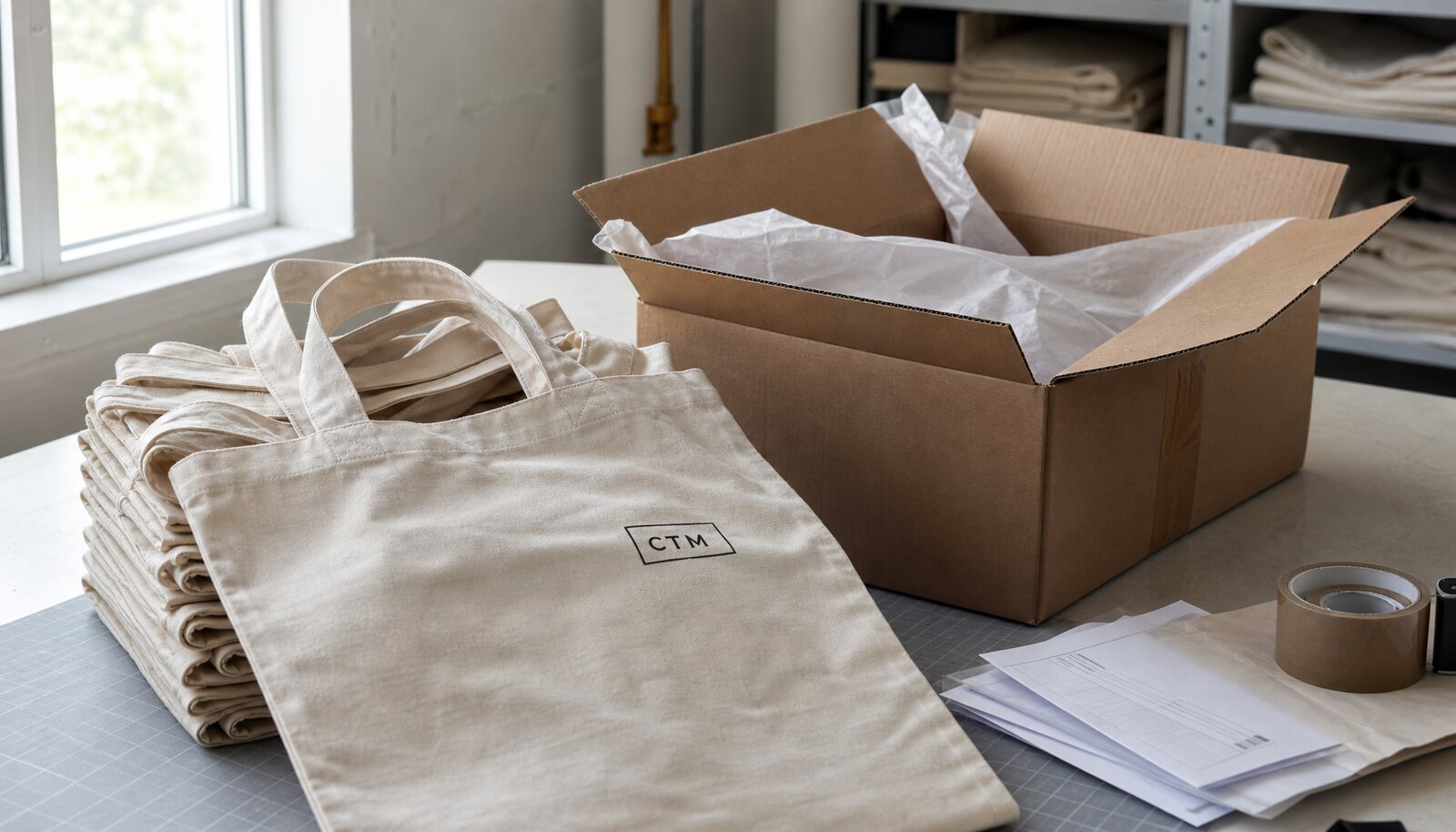
Why carton planning matters more than the tote spec sheet
For corporate gifting, the bag spec is only half the job. The order can look approved on paper and still fail in transit if the cartons are overfilled, underfilled, or built around the wrong folding method. Organic cotton totes are light individually, but once you add print, labels, and consistent folding, the carton math changes fast. That affects freight quotes, warehouse receiving, pallet utilization, and even the condition of the bags when they reach the recipient.
A buyer who treats carton planning as an afterthought usually sees the same problems: cartons that burst at the seam, repacks at the warehouse, inconsistent counts by carton, and a final landed cost that no longer matches the original quote. The practical goal is simple. Lock the tote dimensions, fabric weight, decoration method, and carton configuration together before the factory starts cutting fabric, because those four decisions determine the real shipping cost more than the bag artwork does.
- Treat carton size as part of the product spec, not a logistics note added later.
- Use one approved folding standard across all units so carton counts stay stable.
- Make the supplier quote against the same pack count you expect to receive.
Pick the tote spec that packs efficiently and still feels premium
For wholesale organic cotton totes used in gifting, the safest starting point is usually 140-180 GSM cotton. Below that range, the bag may feel too soft, show the contents, and crease heavily in the carton. Above that range, the bag becomes more expensive to ship and can take up more space after folding. If the bag is intended for a premium executive gift, 180 GSM or a similar heavy cloth can make sense. If it is a high-volume event handout, 140-160 GSM often gives a better balance of cost, print quality, and carton density.
Size choice matters just as much as fabric weight. A standard 38 x 42 cm tote with a moderate gusset is easier to pack, easier to quote, and easier to reorder than a custom oversized shape. Handles should be long enough for shoulder carry but not so long that they tangle during folding. For corporate gifting, the most efficient tote is usually the one that allows a repeatable fold, a clean front print field, and a carton count that lands on a practical number like 25 or 50 per inner pack.
- 140-160 GSM: better for large giveaways and lower freight density.
- 160-180 GSM: better for gift programs where hand feel and durability matter.
- Simple tote geometry reduces packing variation and lowers receiving errors.
Use the right decoration method for the carton plan you want
Print method changes both the unit cost and the way the bags pack. A simple one-color screen print is still the most economical option for many corporate gifting programs because the setup is stable and the ink layer is predictable. Water-based printing can be a good fit when the buyer wants a softer hand feel and lower visual buildup, but it still needs prepress discipline and a fabric surface that can support clean detail. If the artwork is intricate, a woven label or sewn-on patch can be more reliable than forcing small text through a low-cost print process.
The decision should be driven by how the tote travels in the carton. Heavy ink coverage can make folded bags stick together or create visible set marks. A large multicolor print may look good in sample form but introduce yield loss in mass production if registration drifts. For quote comparison, separate decoration cost from packing cost. A supplier who gives a low print price but then changes the fold size to protect the print may end up creating more carton waste and freight cost than a slightly higher-print quote with stable packing.
- One-color screen print is usually the cleanest choice for repeat corporate orders.
- Water-based print helps hand feel, but cure control must be verified on the final fabric.
- If the art is detailed, compare sewn labels or patches against print before approving the route.
Understand MOQ logic before you ask for carton quotes
MOQ is rarely one number. With organic cotton totes, the factory may have separate constraints for fabric weaving or greige stock, cutting, printing, labels, and carton packing. A buyer who only asks for a bag MOQ can miss the real constraint, which is often the decoration setup or the packing configuration. A low piece count with a custom carton layout can cost more per unit than a slightly larger order packed in a standard export carton pattern.
The practical way to negotiate MOQ is to split the order variables. Ask what changes if you keep the tote size standard, use a single print color, and accept a standard inner pack count. Then ask what happens if you need individual polybags, retail-ready inserts, or multiple ship-to destinations. In many factories, the best leverage is not a lower bag MOQ; it is a cleaner spec that reduces the number of production steps and keeps the carton format unchanged across reorders.
- Separate MOQ for fabric, print, labeling, and carton configuration.
- Standard tote size and one-color print usually lower the real production threshold.
- Custom packing logic can add labor even when bag quantity looks acceptable.
Compare sourcing routes by carton control, not just unit price
The cheapest quote is often not the best route if the cartons are part of the downstream plan. A direct factory with export experience usually gives the most control over inner pack counts, carton dimensions, and pallet loading. A trading company may be useful when the buyer needs speed across multiple categories, but packing details can become less transparent and more variable. For corporate gifting, where the order may be split across offices, dealers, or event venues, that variability becomes a real cost.
The key comparison is not whether the supplier says they can pack the order. It is whether they can prove the packing logic with a carton spec sheet, a signed pre-production sample, and a packing list that matches the final production lot. If a supplier cannot tell you gross weight, cartons per pallet, and whether the bag is packed flat or gusseted, then the quote is incomplete. The decision should favor suppliers who can show the shipping outcome, not only the bag photo.
- Direct factory: better carton visibility and stronger control over reorder consistency.
- Trading route: useful for mixed products, but packing accountability can be weaker.
- Always compare supplier routes using the same carton assumptions.
What the sample needs to prove before production starts
A sample for this kind of order should do more than show the logo placement. It needs to prove the real fabric weight, the stitch behavior, the folding method, and the carton fit. A correct pre-production sample should be made with the final textile, the actual print process, the final handle length, and the same label or side mark that will ship. If the sample is built from a different cloth or printed with a different ink system, it is a reference only, not an approval basis.
Sample review should focus on failure points that show up in bulk packing. Check whether the bag folds to the agreed size without forcing the seams, whether the print cracks when folded, and whether the handles sit flat inside the carton. Measure the sample against a ruler, not visual memory. If the tote has to be slightly adjusted for carton efficiency, make that decision now. Small dimensional changes are cheap before cutting and expensive after dozens of cartons are packed.
- Approve only a sample made from the final fabric and print method.
- Measure bag dimensions, fold size, and handle drop against the spec.
- Reject samples that pack differently from the proposed production method.
Set QC thresholds that protect receiving and freight
For organic cotton tote programs, QC should start with measurable thresholds. Fabric GSM should fall within the agreed range, and the weave should not vary enough to change the hand feel across cartons. Stitching at the handle base and side seams must be even, with no skipped stitches in the stress areas. Print should be checked on actual production fabric for registration, opacity, and cure, because a print that looks clean on a lab swatch can fail on finished cloth that has more texture or movement.
Carton-level QC matters just as much. Every master carton should match the approved count, and the gross weight should stay within the shipping plan. If the order is split into mixed packs, carton marks need to be readable and consistent so warehouse teams can identify the destination quickly. The buyer should ask for a final inspection report that ties the bag spec, carton count, and packing format together. That report is what makes reorder decisions faster and protects the buyer when claims arise later.
- Use a defined GSM tolerance rather than accepting vague fabric claims.
- Inspect handle stress points, seam alignment, and print cure on finished bags.
- Verify carton count and gross weight before shipment release.
Build the packing plan around the destination, not the factory habit
Packing choices should follow the destination. If the bags will move through a distribution center, flat-packed units with consistent inner packs are usually easiest to receive and count. If the bags will be handed out at an event, a smaller inner pack with a clean presentation may matter more than maximum carton density. If the program includes kitting with notebooks, pens, or samples, then the tote carton should be sized around the kit workflow instead of around the tote alone.
The best carton plan is the one that can be repeated. That means defining the fold method, the number of pieces per inner pack, the master carton count, and whether cartons are palletized. Keep the format stable across production runs unless there is a clear reason to change it. Buyers often lose money by revising packing late in the cycle to save a small amount on carton space, only to create repacking labor or receiving delays that cost more than the freight gain.
- Choose packing format based on warehouse intake or event distribution.
- Lock the fold method so the bag fits the carton without over-compression.
- Keep packing stable across reorders unless the supply chain changes.
Use landed-cost thinking instead of only unit-price thinking
The quote should be tested as a landed cost, not a unit price. A slightly lower tote price can become more expensive if the bags ship in larger cartons, require more cubic volume, or need extra labor to repack on arrival. For example, two suppliers can quote the same tote spec, but the one using a tighter carton arrangement may produce fewer cartons, lower freight exposure, and faster warehouse handling. That difference is often bigger than the nominal per-piece savings on the bag itself.
To compare quotes properly, line up the same assumptions: tote dimensions, GSM, print method, inner pack count, master carton count, and whether the supplier is quoting ex-works or with export packing. Ask for carton dimensions and gross weight, then compare volume and pallet fit. If the seller cannot provide those numbers, the quote is not ready for a procurement decision. The most useful quote is the one that tells you what will arrive, in what carton shape, and at what weight.
- Compare quotes on unit price plus freight volume, not unit price alone.
- Use carton dimensions and gross weight to estimate receiving and shipping cost.
- Treat packing labor as part of landed cost when kitting or repacking is required.
Schedule risk comes from late changes, not from the sewing line
Lead time for wholesale organic cotton totes is usually driven by three events: fabric readiness, print approval, and packing finalization. The sewing line is rarely the only bottleneck. If the buyer changes artwork after the strike-off, revises the fold size after the sample, or adds a new carton mark after production starts, the schedule can slip even when the factory is otherwise ready. That is why a clean approval path matters more than squeezing the shortest possible stated lead time from the supplier.
A realistic schedule should include the time for sample approval, material booking, bulk production, packing, and final QA before shipment. Ask the supplier which step has the longest variance, because that is where the real risk sits. If the order is tied to a corporate event date, build in a buffer for freight booking and customs checks. The buyer who protects the schedule early usually gets better carton consistency because the factory has time to pack to spec rather than rush the closing stage.
- Most delays come from approval changes, not basic sewing capacity.
- Build buffer time for freight booking, inspection, and export docs.
- Freeze artwork and packing details before the bulk order starts.
Specification comparison for buyers
| Spec decision | Recommended option | When it fits | Buyer risk to check |
|---|---|---|---|
| Fabric weight | 140-180 GSM organic cotton for branded giveaway totes | Most corporate gifting programs that need a clean hand feel and stable print surface | Too light can show contents and wrinkle in carton; too heavy raises freight cost and may slow drying after printing |
| Bag size | 38 x 42 cm or similar standard tote format with moderate gusset | Office gift sets, event handouts, and retail-ready corporate mailers | Oversized bags waste carton space; undersized bags create a poor decoration area and lower perceived value |
| Print method | 1-2 color screen print or water-based print for simple logos | High-volume, repeat programs with stable artwork and low decoration risk | Fine lines, gradients, and small reverse text can fail if prepress is weak or the fabric is too textured |
| Supplier route | Direct factory with export packing experience | When carton count, inner packing, and freight efficiency matter | A trading layer can hide real carton specs, slow sample approvals, or change packing without notice |
| MOQ approach | Separate MOQ for fabric, print, and carton configuration | When the same tote is used across multiple campaigns or ship-to locations | A low bag MOQ can still create a high carton or print setup cost if packaging details are changed late |
| Packing format | Flat-packed, folded to a fixed size, with bulk master cartons | For ocean freight, warehouse fulfillment, or kitting after arrival | Loose folding causes carton overfill, crease damage, and inconsistent carton weights |
| Inner pack count | 10, 25, or 50 pcs per inner polybag or paper band | Programs that need faster counting at distribution centers | Too many variants in inner packs make receiving slower and raise pick errors |
| Carton strength | 5-ply or export-grade corrugated with clear gross weight limit | Long transit routes, humid climates, or stacked pallet loads | Weak cartons crush under compression, especially if the bag body is dense or accessories are included |
| Compliance evidence | Signed pre-production sample and carton spec sheet | When the buyer needs a repeatable purchase record for future reorders | If carton dimensions and net/gross weight are not locked, every reorder becomes a new freight quote |
Buyer checklist before sampling
- Confirm the final tote size, fabric GSM, gusset depth, and print placement before asking for freight dimensions.
- Lock the carton pack count and inner pack method so the factory can calculate carton size and gross weight accurately.
- Request pre-production samples with the exact fabric, ink, label, stitching, and folding method that will ship.
- Ask for carton dimensions, carton gross weight, and cartons per pallet if the order will move by ocean or warehouse inbound freight.
- Require a packing list that states units per carton, carton marks, and any kitting or assortment logic.
- Compare quotes only after the same packing assumptions, because carton configuration changes freight and labor materially.
Factory quote questions to send
- What exact tote dimensions, GSM, and seam construction are included in the quoted unit price?
- How many pieces per inner pack and per master carton are you quoting, and what are the resulting carton dimensions and gross weight?
- Is the print price based on one side, two sides, or multiple placements, and what is the setup charge if artwork changes?
- What sample will you send for approval, and will that sample reflect the final fabric, print method, label, and folding method?
- What is the production lead time after sample approval, and what steps in the schedule are most likely to move if artwork or packing changes?
- Can you provide a carton spec sheet, packing list format, and palletization option for freight comparison?
Quality-control points to confirm
- Fabric GSM within the agreed range, with no obvious thin spots, slubs that affect print, or inconsistent weave density across the lot.
- Stitching strength at handles and side seams, with clean bartacks and no skipped stitches in high-stress points.
- Print registration, opacity, and cure quality checked on the final fabric color, not only on a blank test piece.
- Bag dimensions after finishing, including handle drop and gusset, measured against the approved sample tolerance.
- Fold method and carton fill verified so the carton closes without bulging and the bags recover without permanent creasing.
- Carton count, carton marks, and gross weight matched to the approved packing list before shipment release.