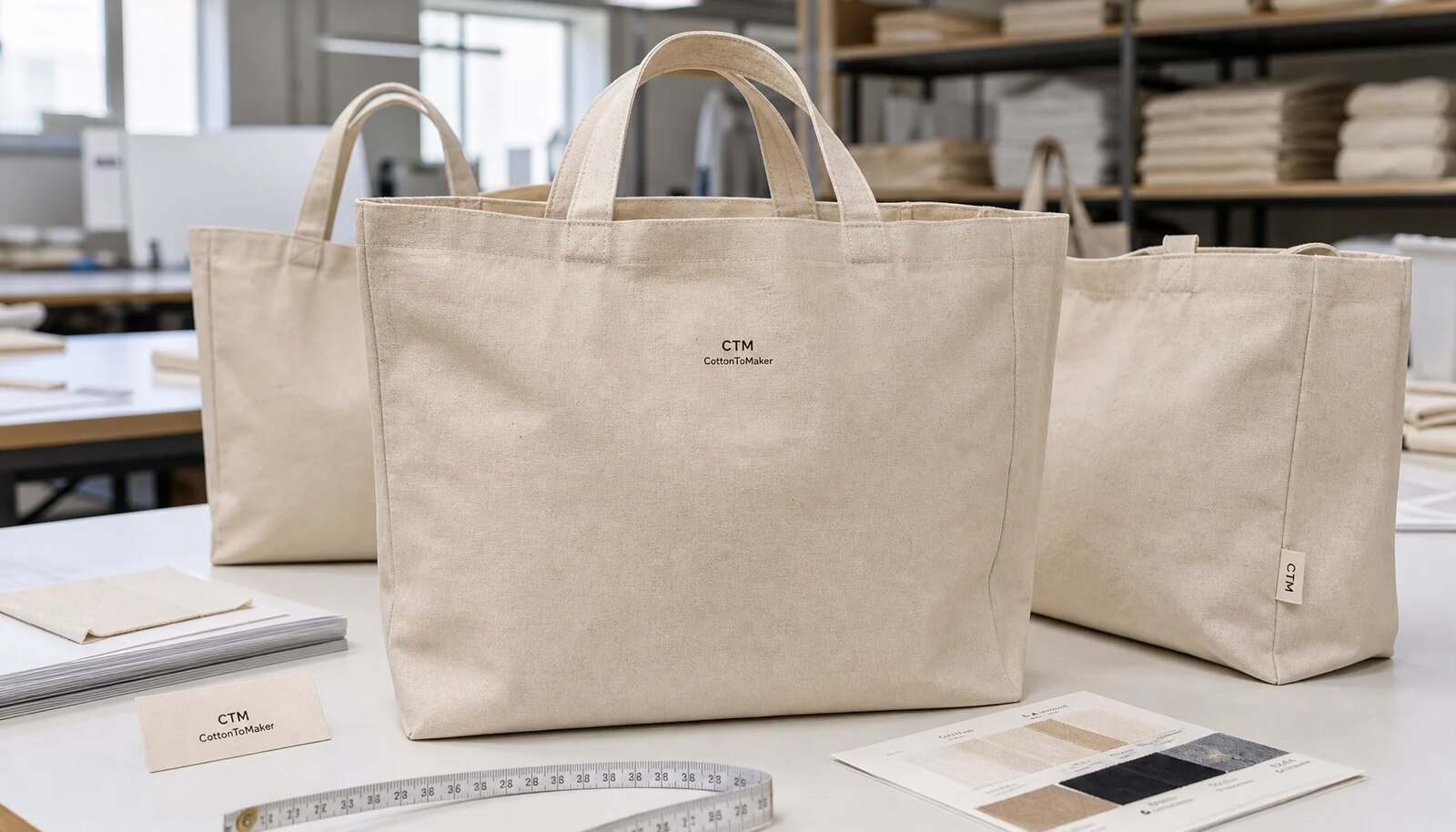
Why tote sourcing fails when the quote looks complete
A tote quote can look tidy and still leave too much open. “Organic cotton tote, natural, logo print” sounds straightforward, but it does not lock fabric GSM, weave, finished size, handle drop, seam style, reinforcement, logo area, ink type, carton quantity, organic documentation, or inspection tolerance. If those choices are not in the RFQ, someone will still make them later. Usually that happens during production, when the buyer has the least control over cost-saving substitutions.
For eco apparel brands, the same bag may play very different roles. It might be sold as branded merchandise, given away with purchase, used instead of disposable packaging, inserted into subscription boxes, handed out at events, or supplied to a wholesale distributor. A 140 GSM natural cotton tote may be fine for a lightweight apparel insert. A retail tote expected to carry books, shoes, or multiple garments needs a denser handfeel, stronger handle stitching, and cleaner finishing standards.
A stronger buying checklist turns soft language into measurable requirements. Instead of asking for “good quality,” ask for target GSM and tolerance, weave, finished dimensions, handle drop, reinforcement method, logo size, print placement, print color count, carton quantity, carton marks, and inspection method. Then the supplier can quote the actual bag, not a loose interpretation of one.
- A low quote may hide lighter GSM fabric, simplified handle stitching, smaller logo coverage, loose bulk packing, excluded carton labeling, or limited documentation.
- The correct tote spec depends on whether the bag is sold, gifted, packed with apparel, shipped through a 3PL, or used as event stock.
- Eco apparel buyers should confirm organic claim scope before using sustainability language on product pages, hangtags, wholesale line sheets, or retailer portals.
- A quote is not complete until it states what is included, what is excluded, and which production variables change the price.
Start with use case, GSM, weave, and finish before the logo
Fabric is the first commercial decision because it drives handfeel, print clarity, durability, carton weight, and freight cost. For many wholesale organic cotton tote programs, 140–180 GSM is the working range. Around 140–160 GSM can suit apparel inserts, simple event bags, and reusable packaging where weight and cost matter. Around 160–180 GSM usually gives a more substantial retail feel for boutique, lifestyle, bookstore, and eco apparel channels. Above 180 GSM can make sense for premium merchandise, but only if the added unit cost and shipping weight support the tote’s selling price or campaign value.
Do not buy by GSM alone. Plain weave is common for economical everyday totes. Twill or canvas construction can feel denser and more structured. Yarn count, thread density, finishing, and shrinkage all affect the final result. Two fabrics with the same GSM can feel noticeably different if one is loosely woven and another is compact. Ask for a swatch, approve a pre-production sample, and write the target GSM plus tolerance into the PO. A common tolerance is ±5%, unless the mill has a different documented standard.
Finish also matters. Unbleached natural organic cotton is popular with eco apparel brands because it supports a natural look and avoids some color-matching complexity. Still, natural cotton can show shade variation and small seed flecks. If the tote must match a seasonal color, exact off-white, or deep black, expect lab dips or strike-offs, shade tolerance, and crocking or colorfastness checks. Dyed fabric may also bring higher MOQ and longer lead time because it is less likely to be available as stock material.
- Use 140–160 GSM for lightweight apparel inserts, simple promotions, and programs where low weight and cost control are priorities.
- Use 160–180 GSM for general wholesale resale, boutique packaging, and bags expected to carry multiple garments.
- Use 180 GSM and above when the tote is positioned as premium merchandise or must carry heavier daily-use loads.
- Confirm weave type, finish, color state, shrinkage expectation, and whether the material is stock fabric or produced specifically for the order.
- Write the GSM tolerance, shade tolerance, and approved fabric swatch reference into the PO.
Define tote construction like a product specification, not a sketch
A tote looks simple until the first bulk cartons arrive with handles that feel short, a gusset that will not hold the intended package, or seams that pull at the corners. Define finished width, finished height, gusset depth, handle width, handle length, handle drop, top hem width, seam allowance, and reinforcement method. Finished dimensions matter more than cut dimensions because hemming, pressing, folding, and shrinkage can change the usable space. If the bag must hold folded garments, shoeboxes, catalogs, or retail kits, test those items in the approved sample.
Handles deserve extra attention. They are functional, visible, and often the first point of failure. Self-fabric handles keep a consistent cotton look. Cotton webbing can feel more structured, depending on the weight and weave, but it changes both style and cost. Reinforcement may be a box stitch, cross stitch, bartack, or agreed combination. The approved sample should show the real reinforcement method. A front-view mockup proves artwork placement; it does not prove handle strength.
Seams and finishing should be practical, not vague. A basic tote may use simple internal seams. A more premium tote may need cleaner inside finishing or reinforced bottom corners. Stitch density can be specified when it matters; many cotton tote constructions use a visible range such as 8–10 stitches per inch, though the right value depends on fabric and thread. The aim is consistency. Decide in advance how to treat internal thread ends, minor natural fabric marks, uneven hems, skipped stitches, and measurement variation.
- Measure finished width, height, gusset, handle drop, handle width, top hem, and seam allowance on the pre-production sample.
- Specify whether handles are self-fabric, cotton webbing, or another material, and whether handle shade must match the bag body.
- Require reinforced handle attachment for totes expected to carry more than one lightweight garment.
- Inspect the inside of the tote; skipped stitches, open seams, and poor trimming often appear inside first.
- Confirm whether the bag must fold flat, hang on a retail hook, fit a warehouse bin, or ship in a fixed carton size.
Choose branding by artwork, durability, handfeel, and repeat cost
For many eco apparel brands, one-color screen printing on natural organic cotton is the cleanest balance of cost, clarity, and repeatability. Two-color screen printing can also work well when artwork separation is clean and registration tolerance is realistic. Water-based screen printing is often requested for a softer handfeel, but it still needs correct curing and opacity control. A print can feel soft and still be too faded. It can sound eco-aligned and still be poorly cured. Approve the physical print, not only the ink description.
Let the artwork choose the method. Fine lines, small type, gradients, distressed textures, large solid panels, and oversized placements all create different risks. A full-front print may look strong in a digital mockup, but it can raise ink cost, stiffen the panel, crack on tight folds, or offset when stacked too soon. Placement should be measured from the top hem and side seam, with an agreed tolerance such as ±3–5 mm when appropriate.
Embroidery, woven labels, and hangtags can make the tote feel more premium, but they are not automatically the better option. Embroidery works best for small logos and durable texture; it can pucker lightweight cotton and is priced by stitch count. Woven side labels are useful when a brand wants subtle, repeatable identity without a large print area. Hangtags can carry barcode, care, material, and sustainability information, but they introduce version-control and attachment checks. Choose the method that matches the tote’s price tier, artwork complexity, and reorder plan.
- Use one-color screen print for first orders, clean logos, and cost-sensitive wholesale programs.
- Use two-color screen print only after checking registration tolerance, art separation, and added setup cost.
- Use embroidery for small premium marks, not large complex artwork on lightweight fabric.
- Use woven labels when the brand wants consistent identity with minimal surface printing.
- Ask for itemized pricing for base bag, setup, per-color print charge, second-side print, label, hangtag, barcode sticker, and repeat orders.
Use MOQ logic instead of chasing the lowest headline minimum
MOQ is not just a sales number. It reflects how the supplier buys fabric, cuts panels, sets up screens, schedules sewing, and packs cartons. A supplier may advertise a low minimum, but that number may apply only to stock natural fabric, one size, one print color, one artwork file, and bulk packing. Add dyed fabric, multiple logo versions, individual paper bands, woven labels, hangtags, or carton-specific SKU labels, and the real production minimum can change quickly.
For a first wholesale organic cotton tote order, reducing variables often works best. One fabric, one natural color, one size, one print position, and one packing format usually mean clearer pricing and shorter lead time. If the brand needs separate artwork for different collections, markets, or retail partners, ask whether MOQ is calculated per artwork, per fabric color, per size, or across the full order. “2,000 pieces” can mean 2,000 total units, or 2,000 units per version. That difference changes the budget.
Unit price is only useful when it is weighed against inventory risk. A lower price at a much higher MOQ may not help if the tote supports a seasonal campaign or packaging format that may change. Very small batches can also be expensive because screens, sampling, documentation, and packing setup are spread over fewer units. The practical target is the smallest order that still gives the right fabric, consistent print, acceptable packing, and a sensible reorder path.
- Ask whether MOQ is by total quantity, size, fabric color, artwork version, print color count, label version, or packing format.
- Confirm whether split shipments, mixed artwork, or multiple carton marks are allowed and whether they add cost.
- Ask whether repeat orders can use existing screens, labels, artwork files, or carton marks to reduce future charges.
- Check whether low MOQ pricing excludes sample cost, special packing, carton marks, inspection support, or organic documentation.
- Avoid changing fabric, size, and artwork all at once on a small first run unless the higher unit cost is acceptable.
Verify organic cotton terminology before making claims
Organic cotton sourcing needs precise language. A supplier may say “organic cotton” because the cotton input is organic. That does not automatically mean the finished tote is certified organic, and it does not mean every marketing claim is safe to use. Standards such as GOTS or OCS have defined scopes, certified entities, transaction documents, and chain-of-custody rules. The useful question is not only whether organic cotton was used. It is what the documents prove for this exact order.
Ask for documentation tied to the PO, SKU, and quantity shipped. Depending on the supply chain, evidence may include a supplier scope certificate, transaction certificate, fabric invoice, input declaration, or other order-specific record. If a retailer requires finished-product certification, confirm this before quotation. It may affect the factory, material source, labeling, documentation cost, and lead time. If the supplier can document organic fabric input but not finished-product certification, adjust claim language before artwork is approved.
This matters for eco apparel brands because wholesale accounts may request substantiation. It also prevents avoidable rework. A hangtag that says “GOTS certified bag” can create a problem if only the yarn supplier is certified or no transaction document covers the finished bags. Clear terminology protects the brand, the supplier, and the retail partner.
- Ask exactly what the documents cover: fiber, yarn, fabric, process, transaction, or finished tote.
- Match claim language to documentation; do not use broad finished-product certification claims unless the scope supports them.
- Confirm whether certification logos can be used on the tote, hangtag, product page, or carton label before artwork approval.
- Keep organic documentation connected to the PO, quantity, SKU, and artwork version shipped.
- Build documentation review into the lead time instead of treating it as a post-shipment request.
Compare supplier routes with evidence, not assumptions
A direct tote factory, trading company, sourcing agent, and full-service supplier can all quote wholesale organic cotton totes. None is automatically right or wrong. The best route depends on the buyer’s risk profile, order size, documentation needs, and operating style. A direct factory may give clearer visibility into fabric, cutting, sewing, printing, and packing. A trading company may help consolidate multiple accessories or bag categories. A sourcing agent may be useful for vendor discovery and local follow-up. The mistake is assuming each route offers the same control because the first sample looks similar.
Evidence should carry more weight than sales language. Ask for swatches, close-up stitching photos, print tests, packing examples, and sample inspection notes. These do not replace a physical sample or third-party inspection, but they show whether the supplier understands tote production beyond the basic quote. A supplier that can discuss GSM tolerance, handle reinforcement, print curing, carton compression, and organic documentation scope will be easier to manage than one that only repeats the lowest price.
Printing accountability is especially important. Some tote factories print in-house; others outsource screen printing, embroidery, or labels. Outsourcing is not automatically a problem, but responsibility must be clear. If the print is off-center or ink offsets inside the carton, the buyer should not be trapped between a sewing factory and a print subcontractor. The quote should say who controls print approval, who inspects the printed panels, and how defects are handled.
- Ask who owns fabric sourcing, cutting, sewing, printing, finishing, inspection, packing, and export documentation.
- Request photos of recent similar tote production, but do not treat photos as proof of your order’s quality.
- Confirm whether printing is in-house or outsourced and who is responsible for print defects.
- Check whether the supplier can provide organic documentation that matches your intended marketing language.
- Choose the route that gives the clearest accountability for sample approval, production changes, QC, and claims.
Approve a pre-production sample that represents the bulk order
A showroom sample is good for direction. It should not be the final approval for a branded wholesale order unless it matches the production plan. The pre-production sample should use the final fabric quality, final GSM target, final color or natural shade, final print file, final ink method, final handle construction, final label or hangtag, and proposed packing fold. If anything differs, ask the supplier to list the difference in writing. Then decide whether another sample is needed before bulk cutting starts.
Sample review should be measurable. Record finished width, height, gusset, handle drop, handle width, print size, print placement from top and side seams, label position, seam appearance, and packing fold. Take photos under neutral light and save them with the PO, artwork file name, approval date, and spec version. Verbal approval is weak evidence when bulk production varies from someone’s memory of the sample.
Use the sample like the customer or warehouse will use it. Put the intended garments or retail items inside. Carry it with a realistic load. Fold it as it will be packed. Check whether the print crosses a fold line, whether embroidery puckers, whether the handle twists, and whether the top hem looks level. Sampling is not a delay tactic. It catches predictable problems while they are still inexpensive to fix.
- Approve one physical pre-production sample for branded retail, launch-date, distributor, or retailer-compliance orders.
- Measure width, height, gusset, handle drop, handle width, logo size, and logo position; do not rely only on a mockup.
- Compare fabric handfeel, opacity, and shade against the chosen swatch or previous approved order.
- Fold the sample in the intended packing format to check print cracking, handle distortion, and crease lines.
- Document approval with date, PO number, SKU, artwork file name, and permitted tolerances.
Set QC tolerances before production, not after defects appear
Quality control works best when the standard is written before production starts. For wholesale organic cotton totes, inspect fabric, dimensions, stitching, handles, print, trim, packing, and carton marks. The supplier should know which issues are critical, major, and minor. Wrong artwork, an incorrect certification label, open seams, broken handles, severe stains, or unreadable barcodes are not the same as small internal thread ends.
AQL inspection can be useful when order size, value, or retailer requirements justify it. Many softgoods inspections use general inspection level II with AQL targets such as 2.5 for major defects and 4.0 for minor defects, but the buyer should choose the level that fits the risk and agreement. Smaller orders may use a simpler random sampling plan. Either way, the method, sample size, and defect definitions should be agreed before goods are packed and shipped.
Practical tests should match the tote’s intended use. A handle load check may specify a static load such as 5–10 kg for 30–60 seconds on sampled pieces, with no tearing, seam opening, or handle detachment. Print checks can include dry rub, light wet rub if relevant, folding, and offset checks after stacking. Dimension checks should happen after finishing, not just after cutting. Carton checks should verify count, SKU, artwork version, and clean, dry condition.
- Set tolerances for finished size, handle drop, print placement, GSM, shade, and carton count before bulk production.
- Classify defects: critical issues such as wrong artwork or false label claim; major issues such as open seams, stains, or detached handles; minor issues such as small removable thread ends.
- Request in-line photos of fabric, cutting, handle stitching, and print placement on larger or time-sensitive orders.
- Use final inspection photos or reports to verify random packed cartons, carton marks, bundle counts, and comparison with the approved sample.
- Define the claim process in advance, including evidence needed, response time, rework options, replacement policy, credit method, and short-shipment handling.
Packing, carton configuration, and receiving rules affect landed cost
Packing is often treated as a final detail, but it affects freight, damage risk, warehouse labor, and receiving accuracy. Loose bulk packing may be acceptable for internal use. Wholesale and 3PL workflows usually need counted bundles, clear carton marks, and consistent carton quantities. If the receiving team has to recount mixed cartons or separate artwork versions by hand, the buyer has moved factory savings into warehouse labor.
The RFQ should define pieces per bundle, bundles per carton, carton dimensions, gross weight, carton marks, SKU labels, barcode needs, and whether mixed cartons are allowed. If the brand avoids individual plastic packaging, define the alternative. Options may include paper bands, counted inner bundles, tissue interleaving for printed panels, or clean bulk bundles inside a lined carton. “Eco packing” is too vague; suppliers may interpret it as no individual polybag, recycled carton, paper banding, or simply bulk packing.
Carton sizing should protect the tote without crushing it. Overfilled cartons can crease printed panels, distort handles, and increase carton failure risk. Underfilled cartons waste freight volume. If the shipment is palletized, confirm pallet height, stacking limit, carton strength, and label orientation. If it ships by courier or LCL, moisture protection and carton durability matter because cartons may be handled many times before reaching the buyer.
- Specify pieces per inner bundle, bundle method, bundles per carton, and total pieces per carton.
- Confirm carton dimensions, gross weight, carton material, shipping marks, SKU labels, and barcode placement if applicable.
- Avoid over-compression that can crease printed panels or distort handle placement.
- If plastic-free packing is required, define the exact alternative instead of simply writing “eco packing.”
- Ask for carton photos before shipment showing marks, label placement, bundle format, and random count verification.
Specification comparison for buyers
| Spec decision | Recommended option | When it fits | Buyer risk to check |
|---|---|---|---|
| Fabric weight | 140–180 GSM organic cotton plain weave or twill for most wholesale programs; agree a GSM tolerance such as ±5% or the supplier’s documented mill tolerance | Apparel inserts, lifestyle retail, bookstore merchandise, event sales, subscription packaging, and reusable customer packaging | Too light can look transparent and weak; too heavy raises unit cost, carton weight, freight volume, and sometimes import duty value without improving sell-through |
| Fabric finish | Unbleached natural cotton for most eco-positioned programs; dyed, bleached, or reactive-dyed fabric only when brand color control requires it | Brands that want a natural look, simpler processing, and a consistent sustainability message | Natural shade can vary by cotton lot; dyed colors need lab dip or strike-off approval, shade tolerance, crocking/colorfastness checks, higher MOQ, and added lead time |
| Weave choice | Plain weave for economical everyday totes; twill or canvas construction for a denser handfeel and more premium appearance | Plain weave suits inserts and promotional use; twill/canvas suits resale and higher perceived value programs | GSM alone is insufficient because yarn count, thread density, finishing, and shrinkage affect handfeel, print clarity, strength, and final dimensions |
| Finished size | Define width, height, gusset, handle length, and handle drop after finishing; common tolerance is ±1 cm for small totes or ±2%–3% by dimension when agreed | Any B2B program where bags must fit folded apparel, boxes, hangers, 3PL shelves, or retail displays | Cut size is not finished size. Washing, pressing, hemming, and seam allowance can change the usable internal space |
| Handle construction | Self-fabric or cotton webbing handles with box stitch, cross stitch, bartack, or agreed reinforcement; specify handle width and drop | Wholesale totes expected to carry folded garments, books, sample kits, shoes, or retail purchases | Weak handle attachment is one of the most visible field failures; front-view mockups do not prove handle strength |
| Print method | 1–2 color screen print or water-based screen print for simple logos; woven label or small embroidery for premium subtle branding | Eco apparel brands with clean logos, limited-color artwork, repeat seasonal buying, and moderate unit targets | Fine lines, gradients, oversized ink areas, and poor curing can cause blurry edges, stiffness, cracking, offset, or wash/rub failure |
| MOQ route | Standard MOQ based on one fabric, one size, one colorway, one print setup, and one packing format | First wholesale buy, replenishment programs, and brands protecting cash flow while testing demand | Low MOQ may hide setup fees, restricted fabric choices, no split artwork, simplified packing, or higher repeat pricing |
| Supplier type | Factory or supplier with clear factory access, sample control, printing accountability, and documented QC checkpoints | Volume orders, launch-date orders, or programs where repeatability matters more than the lowest headline quote | Trading layers may slow approvals, obscure the production site, and weaken accountability when defects involve outsourced printing |
| Organic evidence | Request order-specific documentation such as OCS/GOTS transaction documents where applicable, input records, scope certificates, or supplier declarations matched to the claim | Brands making organic cotton claims on product pages, hangtags, wholesale line sheets, or retailer compliance portals | Do not claim the finished tote is certified unless certification scope and transaction documents support that exact claim |
Buyer checklist before sampling
- Define the commercial use first: retail resale, free-with-purchase, apparel insert, event giveaway, subscription packaging, wholesale distributor stock, or 3PL kitting. The tote spec should match the channel, not a generic showroom sample.
- Lock the exact fabric spec in writing: organic cotton content, weave type, target GSM, GSM tolerance, finish, natural/dyed/bleached state, shrinkage expectation, color standard if dyed, and whether the quoted fabric is stock or made to order.
- Confirm usable finished dimensions after sewing and finishing: width, height, gusset depth, handle length, handle drop, handle width, seam allowance, top hem width, fold method, and whether the bag must fit folded garments, shoeboxes, catalogs, or retail kits.
- Define construction details: side seam type, bottom seam, stitch type, stitch density target such as 8–10 stitches per inch when relevant, thread color, reinforcement method, and whether loose internal threads are acceptable or must be trimmed.
- Approve artwork rules before pricing: print method, number of colors, Pantone or color reference, print placement measured from top/side seams, maximum print area, second-side print, inside print, label, hangtag, barcode, or embroidery requirements.
- Set the MOQ by real production variable: fabric color, bag size, artwork version, print color count, label type, hangtag version, and packing format. Do not accept a total MOQ until split-order handling is confirmed.
- Request itemized pricing: base bag, fabric surcharge, print setup, per-color print charge, repeat-screen policy, label or tag cost, sample cost, packing cost, carton marking, inspection cost if any, freight terms, and rush or split-shipment surcharges.
- Ask for organic cotton documentation appropriate to the order and clarify allowable claim language. Keep the supplier documents tied to the PO, SKU, artwork version, and quantity shipped.
- Approve one pre-production sample made from final materials before bulk cutting starts. Record approved dimensions, print placement, fabric handfeel, shade, handle construction, stitching, label position, and packing fold.
- Set measurable QC rules before production: size tolerance, handle-drop tolerance, print-position tolerance, GSM tolerance, stain limits, seam and handle strength expectations, thread trimming rules, bundle counts, carton counts, carton marks, and AQL or inspection method.
Factory quote questions to send
- What exact fabric are you quoting: organic cotton content, GSM, weave, yarn construction if available, finish, color state, and stock versus made-to-order fabric? What GSM tolerance applies in bulk?
- What documentation can you provide for the organic cotton input, and what is the scope: fiber, yarn, fabric, transaction certificate, process certification, or finished product certification?
- Is the quoted price based on one bag size, one natural fabric color, one side print, one print position, one artwork file, bulk packing, and standard export cartons? Which changes trigger repricing?
- What are the surcharges for added print colors, second-side print, larger print area, inside print, woven label, embroidery, hangtag, barcode sticker, paper band, or individual plastic-free sleeve?
- What is the MOQ by fabric type, fabric color, bag size, artwork version, print method, label version, and packing format? Can MOQ be split, and if so, what is the minimum per split?
- Are samples made from the same fabric quality, same print process, same ink, same sewing line standard, and same handle reinforcement intended for bulk production? If not, list the differences.
- What production tolerances do you use for finished width/height/gusset, handle drop, print placement, print color, fabric shade, and GSM? Can we write these into the PO?
- What stitch type, stitch density, seam allowance, top hem width, and handle reinforcement are included? Can you provide close-up photos of handle attachment, inside seams, and bottom corners?
- What practical load check do you perform for handles? State the load weight, duration, number of samples, and pass/fail criteria, or confirm if no load test is standard.
- What packing configuration is included: pieces per inner bundle, bundles per carton, carton dimensions, gross weight, carton marks, SKU labels, barcode placement, and palletization if needed?
Quality-control points to confirm
- Fabric weight should be checked against the quoted GSM using an agreed tolerance, commonly ±5% unless the mill standard differs. A visibly lighter, looser, or more transparent fabric than the approved sample should be stopped before bulk sewing or packing continues.
- Organic cotton claim support should be verified against the PO, SKU, and shipped quantity. Documentation should match the buyer’s intended claim language and should not be treated as a finished-product certification if it only covers fiber, yarn, or fabric input.
- Fabric appearance should be reviewed for oil stains, dirt, weaving holes, broken yarns, excessive slubs, shade bands, foreign fibers, and mildew odor. Natural cotton may have small seed flecks, but visible contamination is not acceptable for retail merchandise.
- Finished bag dimensions should be measured after sewing, finishing, and folding, not only at cutting. A typical B2B tolerance may be ±1 cm on width/height or ±2%–3% by dimension, but the PO should state the agreed rule.
- Handle drop and handle width should be measured because small changes affect carry comfort and display. A practical tolerance such as ±1 cm for handle drop should be agreed when the tote must fit shoulder carry or retail fixtures.
- Seam stitching should be straight, even, and secure at stress points. Skipped stitches, open seams, unraveling corners, loose bartacks, broken threads, needle damage, and uneven hems should be classified as major defects when function or appearance is affected.
- Handle attachment should pass a practical load check matched to the use case. For example, buyers may specify a static load such as 5–10 kg for 30–60 seconds on sampled pieces, with no tearing, seam opening, or handle detachment; the exact requirement should be written into the spec.
- Print registration, opacity, placement, and color should match the approved sample. Common print-position tolerance is often around ±3–5 mm for simple placements, but must be agreed. Ink should not offset, crack when folded, bleed heavily, or create an unapproved stiff panel.
- Print durability should be checked with simple rub and fold tests, and with laundering only if the tote is sold as washable. Water-based ink still needs correct curing; soft handfeel does not automatically mean acceptable fastness.
- Labels, hangtags, and trim should be checked for correct version, position, spelling, logo orientation, barcode readability, and secure attachment. Mixed label versions can create downstream SKU, retailer, and compliance problems.