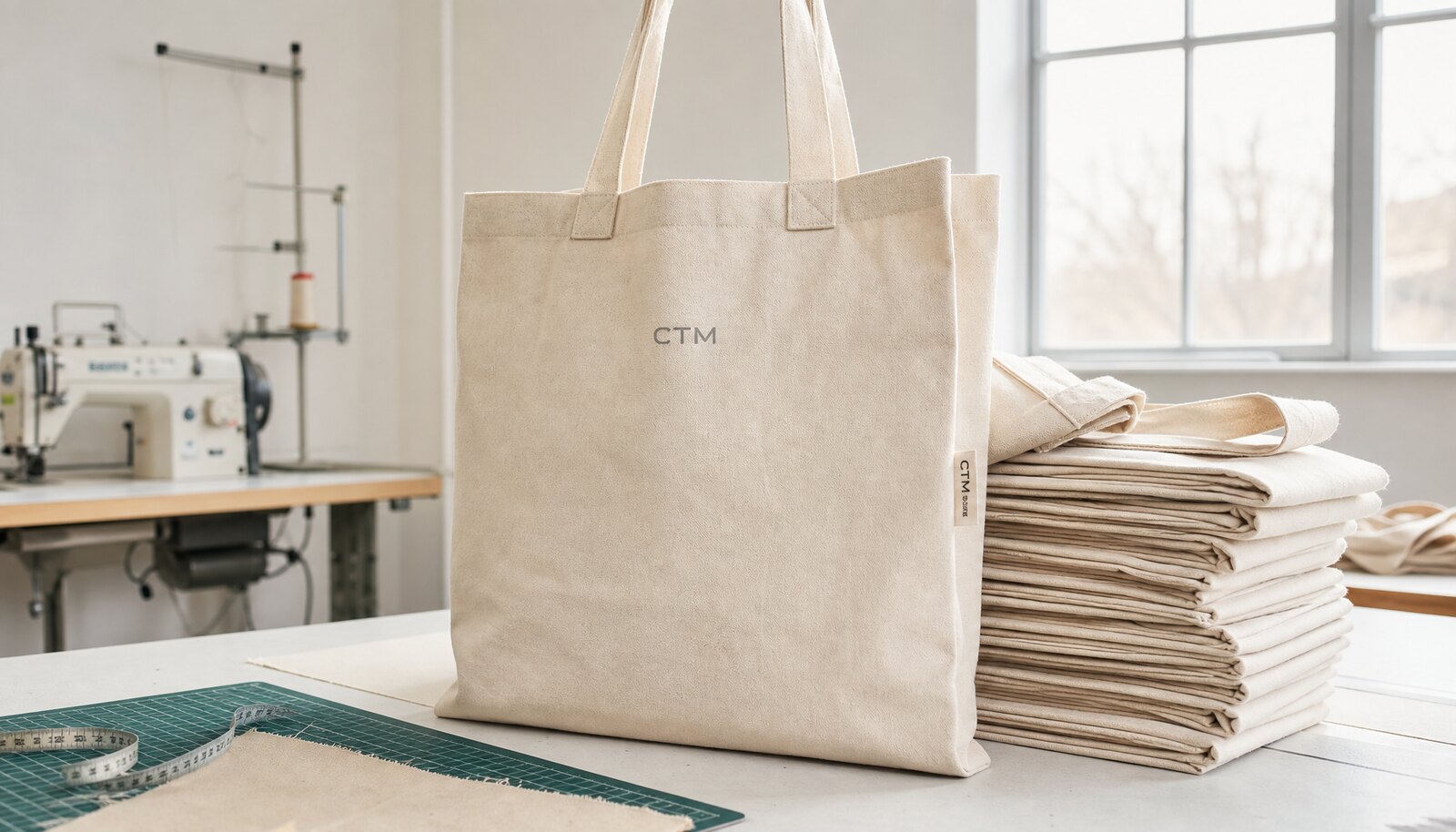
Why winery totes need a different buying spec than generic cotton bags
A tote for a boutique winery is not just a reusable bag with a logo on it. In practice, it serves three jobs at once: it carries product, it acts as packaging during a sale, and it becomes a visible brand item after the customer leaves the tasting room. That means the bag is judged under real load, not just on a flat art board.
For procurement teams, that changes the buying logic. A generic promotional tote may look acceptable in a catalog, but a winery program has higher expectations around bottle weight, handle feel, print durability, and retail presentation. If the tote is too thin, it sags. If the handle stitching is weak, it fails at the first hard lift. If the print cannot survive folding, the premium look disappears quickly.
The strongest buyer approach is to define the tote around usage conditions rather than around a supplier’s stock description. Start with the bottle count, the retail setting, and the expected price point. From there, choose fabric weight, handle build, and print method that match the program instead of paying for features the winery does not need.
This matters even more when the tote will be reused as a carry bag after the initial purchase. Wine customers often fold a tote into a car door pocket, refill it for another visit, or hand it to a friend. Small defects become visible quickly. Procurement teams that write for durability instead of aesthetics usually get better total value and fewer awkward store-floor replacements.
- A boutique winery tote must handle repeated lifting, not just one photo-ready handoff.
- The tote should look presentable when empty and stable when loaded with bottles or inserts.
- The cheapest unit price can become expensive if the bags fail early or look tired in retail use.
Start with the use case: one bottle, two bottles, or a gift set
The first sourcing mistake is buying the fabric before the load is defined. A tote meant for one standard 750 ml bottle and a tasting note card is a very different product from a two-bottle carry tote for gifting or club pickup. Even if the artwork is identical, the fabric, handle reinforcement, and gusset need to change with the load.
For most boutique winery programs, 8 oz to 10 oz organic cotton canvas is a practical starting range, but it should be read as a use-case range, not a universal rule. A single-bottle retail carry bag can work at the lighter end if the handles are reinforced and the bag is not expected to stand upright. A two-bottle gift tote usually performs better at the heavier end because the load is concentrated and the retail feel matters more. If the tote needs to hold a bottle plus brochure, corkscrew box, and small merchandise insert, you may need a slightly wider base rather than just more fabric weight.
The point is not to chase the heaviest canvas. Heavier fabric raises cost, can reduce foldability, and may make the bag feel overly stiff for tasting-room sales. The correct spec is the one that matches the number of bottles, the retail price, and the intended customer experience.
A useful buyer shortcut is to assign each bag a primary task. If the tote is meant to move a bottle from counter to car, durability and handle comfort matter most. If it is meant to sit on a retail shelf as a branded item, shape retention and print finish matter more. If it is a club gift, the bag may justify a more premium material but still needs to be easy to pack, store, and ship in bulk.
- Single-bottle carry: prioritize handle comfort, shape retention, and a clean retail look.
- Two-bottle gift tote: prioritize bottom support, seam strength, and wider handle reinforcement.
- Merch or event giveaway: prioritize cost control and print durability over decorative construction.
How to read fabric weight without getting lost in shorthand
Fabric weight is one of the most common comparison points in tote sourcing, but the number alone can mislead buyers if the basis is not stated. Some suppliers quote ounces, others quote GSM, and some quote weight before finishing while others reference finished cloth. Those are not interchangeable without clarification.
For procurement, the useful question is not simply “What weight is this?” but “What does this weight mean in the finished bag?” A 10 oz canvas with loose weave or weak yarn quality may not outperform a better-made 8 oz cloth. Likewise, a fabric that feels heavy in hand may be overbuilt for a simple tasting-room handout and may inflate landed cost without delivering extra value.
Ask the supplier to state the weight basis, weave type, and whether the figure refers to greige fabric, dyed fabric, or finished fabric after washing and printing. If the bag will be sold as a premium retail item, request a physical sample under normal lighting and compare it with your target bottle load. The hand feel should be substantial, but the cloth should still fold cleanly and not become bulky in carton packing.
Buyers should also ask whether the fabric has been sanforized, prewashed, or otherwise treated for shrink control. A tote that seems accurate at sample stage can change after the first wash or after exposure to moisture in a tasting room. If the supplier cannot explain the finishing state clearly, the quote is not truly comparable to a competing quote that includes shrink control.
- Request weight in GSM or oz, plus the measurement basis.
- Compare fabric weight together with weave tightness and yarn quality.
- Ask how the cloth behaves after printing and folding, not only before production.
Handle design is often the first failure point in bottle-carry totes
In winery use, the handles do more work than the body of the bag. Customers lift at uneven angles, swing the bag while walking, and set it down on counter edges or car seats. A tote can survive many normal uses, then fail at the handle attachment if the stitching is too short or the reinforcement is too narrow.
The better construction for most wholesale organic cotton totes for boutique wineries is a self-fabric handle or webbing-reinforced handle with a comfortable drop and secure top-stitching. For one-bottle use, a handle drop around 20 to 25 cm often feels workable, though the buyer should still test it with a full bottle in hand. For two-bottle programs, slightly wider handle reinforcement and more stitch rows usually matter more than adding decorative trim.
Check the attachment geometry closely. If the handle stitches sit too close to the edge, the stress concentrates in a small area and the panel can distort during loading. Ask the supplier how many stitch rows are used, whether the handles are box-stitched or cross-stitched, and whether the reinforcement extends far enough to distribute pull across the top panel. In the real world, handle failure is often a construction problem, not a fabric problem.
If the tote will be carried by customers in one hand for longer distances, the handle width matters as much as the drop. A narrow handle can cut into the hand even when the bag technically passes strength testing. For winery retail, comfort is part of durability because a bag that is unpleasant to carry is less likely to be reused.
- Check handle drop with the actual bottle weight, not with an empty tote.
- Ask for the stitch pattern at the handle base, not just the material description.
- Look for reinforcement that spreads load across the panel rather than concentrating stress at one point.
Print method, logo size, and retail appearance should be matched to the cotton surface
Logo decoration should support the tote’s use, not fight it. On cotton canvas, a simple one-color screen print is often the most practical option for repeatable wholesale orders because it gives consistent branding, controls cost, and usually works well on natural fabric. Water-based inks can also perform well when the look should stay soft and understated, but the curing process needs to be managed carefully.
Large full-panel graphics can work for some wineries, especially when the tote is sold as merch, but larger ink coverage raises the importance of curing and fold testing. If the ink is undercured or too brittle, the print can crack when the tote is packed, stacked, or refolded by store staff. Embroidery can be attractive for premium programs, but it changes the feel of the bag, adds weight to one area, and can increase the chance of puckering on lighter fabrics.
The best rule is to match the decoration to the retail price and the expected reorder rhythm. Simple programs usually benefit from one-color print with controlled placement. Premium club gifts may justify embroidery or woven labels if the buyer has a higher margin and a longer approval timeline. The important part is to get the supplier to state the exact print area, color count, curing method, and expected performance after repeated folding.
For buyers comparing quotes, decoration should be separated into setup and unit cost. Screen setup, embroidery digitizing, and label attachment can change the total landed price more than the artwork itself. If a quote bundles everything together, ask for the breakdown before approving sample production.
- One-color screen print is usually the easiest to repeat across reorders.
- Large coverage prints need fold and crack testing before bulk approval.
- Embroidery is a premium option, but only if the fabric and layout support it cleanly.
A practical durability testing checklist with thresholds buyers can use
Durability testing should mirror the way a tote will actually fail. For boutique winery use, that usually means handle tear, seam opening, print cracking, shape distortion, odor issues, and cosmetic defects that make the bag unsuitable for retail. A useful checklist should include load, repeat-lift, and drop checks with sample size and pass/fail criteria, even if the tests are simple and done in-house.
A workable buyer-side sampling plan is to test 10 pieces from the pre-production batch or pilot run. Load five bags with the intended bottle weight and five with the maximum expected gift load. Hold the load for 30 minutes to check for stretch, then perform 20 repeated lifts by the handles on at least five bags. After that, drop the loaded bag from about 30 cm onto a flat surface three times and inspect the seams, handle bases, and print face. If any bag shows a seam opening, handle tear, or visible print failure, the lot should not move to bulk without corrective action.
Pass/fail criteria should be simple enough to enforce. Pass means no functional failure, no visible seam opening, no handle distortion that affects carry, and no print cracking that would be obvious to a retail customer. Minor natural cotton slub or small color shade variation can be acceptable if the approved sample already showed it. Reject any bag with holes, loose stitching at the handle base, noticeable odor, oil staining, or a print that transfers when rubbed lightly with dry cloth.
If the winery uses a third-party inspector or internal receiving team, give them the same thresholds. That prevents the common situation where one team approves a cosmetic sample while another team rejects the production lot for obvious defects.
When the tote includes extra features such as a bottom board, pocket, or closure, test those items too. A good-looking pocket that tears off in use is still a defect, and a bottom insert that shifts during loading can make the bag feel unstable even when the seams are intact.
- Sample size: test at least 10 pieces from pilot or pre-production output.
- Static load: hold the intended load for 30 minutes and inspect for stretch or seam creep.
- Repeat-lift: 20 lifts per bag on at least 5 bags, with no handle tear or attachment failure.
- Drop check: 3 drops from roughly 30 cm while loaded, then inspect seams and print.
- Reject if there is any handle tearing, seam opening, print transfer, or obvious contamination.
How to judge samples like a procurement buyer instead of a designer
A sample review should focus on whether the tote can be produced consistently, not only whether it looks attractive in the hand. Start by checking measurements against the spec sheet: body width, body height, gusset depth, handle length, and placement of the logo. Then inspect the sewing from the inside out. A well-made tote should have tidy internal stitching, no loose thread chains, no bunching at corners, and no obvious thread burn or glue residue.
Next, review the bag in the same way a tasting-room associate will use it. Put in a bottle, close the bag if it has a snap or board, and see whether the tote remains balanced. If the bag twists when lifted, the handle placement or seam alignment is off. If the bottom bows too much, the gusset or base support is insufficient. If the logo sits too close to the seam, it can warp once the bag is loaded.
Finally, use the sample to set the boundary between acceptable variation and actual defects. Natural organic cotton will not be perfectly uniform. Small slubs, slight shade variation, and a soft hand feel are normal. By contrast, holes, oil stains, foreign fibers, misaligned prints, and uneven handle lengths are not acceptable in a retail-facing winery program. Defining that line early avoids arguments when the bulk lot arrives.
This is also the right stage to compare the sample against your original usage notes. A bag can pass as a flat sample and still underperform when it is used by store staff, loaded into a club ship box, or stacked in cartons for weeks. Procurement should ask for one sample review under retail conditions, not only a tabletop inspection.
- Measure the finished tote after full construction, not before sewing.
- Inspect inside seams, corners, and handle bases with the same attention as the front panel.
- Use the sample to define what variation is acceptable in natural cotton and what is a reject.
Supplier comparison: direct factory, sourcing partner, and premium decorator
A good procurement decision is not only about product specs. It is also about which type of supplier can actually hold those specs across production. Direct factories usually offer the clearest control over fabric, stitching, and unit cost, especially if they already make cotton bags regularly. That route is strong when the buyer has a detailed spec sheet and can manage sample approval tightly.
A sourcing partner or trading company can be useful when the winery is buying multiple packaging items at once or has limited bandwidth for production follow-up. The advantage is coordination. The downside is that the buyer must be more disciplined about line-item quotes because fabric changes, packing changes, or print changes can be hidden inside a single all-in price. A low quote may not mean the same construction or the same finishing standard.
Premium decorators and specialty merch vendors make sense when the tote is sold as a higher-margin retail item and the brand wants a richer finish such as embroidery, woven labels, or heavier canvas. That route can produce a very polished result, but it also increases the number of variables that can drift, especially on repeat orders. For wineries that need stable replenishment, the simpler build is often easier to hold.
The procurement takeaway is straightforward: choose the route that matches your internal QA capacity. If you can specify and inspect precisely, direct factory sourcing may give the best value. If not, a partner may reduce operational burden, but only if the quote is transparent and the spec is frozen in writing.
When comparing suppliers, ask whether they control fabric purchase, cutting, sewing, decoration, and packing in-house or through subcontractors. More handoffs increase the chance of inconsistency. That does not automatically disqualify a supplier, but it does mean the buyer should inspect their process more closely and request clearer batch records.
- Direct factory: best for control, repeatability, and tote-specific pricing.
- Sourcing partner: best for coordination, but only with strict line-item quote discipline.
- Premium decorator: best for elevated retail presentation, but expect more cost and more process risk.
MOQ, packaging, and lead time: where hidden cost usually appears
MOQ is rarely just a bag-count question. Many suppliers also set minimums by fabric color, print color, or packaging style. A winery may think it is ordering 1,000 totes, but the supplier may actually be pricing around a fabric lot minimum, a screen setup minimum, or a carton configuration minimum. That is why the quote should separate all three.
Packaging is another place where cost can drift. Loose folding in master cartons is usually the most efficient choice for replenishment inventory. Individual polybags may be better for shelf-ready retail, but they add labor, material, and carton volume. If the bags are going directly into a tasting-room stock room, the buyer should not pay for retail packaging that does not improve the selling process.
Lead time is shaped as much by approvals as by sewing. A simple tote can still slip if artwork is revised three times, if the supplier waits for final handle placement confirmation, or if the fabric lot changes after sample approval. Build time into the schedule for pre-production approval and a pilot run. For seasonal winery launches, that buffer is often the difference between hitting the launch date and shipping a close substitute.
When quoting, ask the supplier to state sample lead time, bulk lead time, packing lead time, and the date when the spec is frozen. That helps the buyer see whether the timetable is realistic or just optimistic on paper. It also gives purchasing a cleaner way to explain any schedule risk to marketing or sales teams before a launch date is promised.
If the order is tied to a wine club release or a harvest event, ask what happens if the pilot lot fails. The best answer is not “we will try again.” The best answer is a documented corrective action path: rework, replacement, or revised approval with a new sample reference.
- Ask MOQ by fabric color, print color, and pack style, not just total units.
- Match packing to the sales channel: bulk for replenishment, retail-ready only if shelf presentation matters.
- Reserve time for pre-production approval and a pilot batch before full release.
A procurement-friendly RFQ structure that avoids repetitive back-and-forth
A strong RFQ should make it easy for the supplier to quote the same tote in a consistent way. The goal is not to produce a giant checklist for its own sake. The goal is to prevent the common problem where one supplier quotes one construction and another supplier quotes a different one under the same product name. For winery programs, the RFQ should read like a build sheet.
Keep the request tight but complete: intended use, bottle count, dimensions, fabric weight, handle build, print method, artwork size, packing format, MOQ, sample requirements, and QC expectations. If you already know the retail price target, include it. That helps suppliers propose a spec that fits the program instead of overspending on features that the winery cannot recover at retail.
To make the RFQ easier to compare, ask for a separate line for fabric, sewing, print, packing, and shipping terms. That format reduces the chance of hidden upgrades or unexplained omissions. It also makes revision control easier when you compare a pilot quote to a bulk re-order. Most importantly, it keeps the conversation focused on the actual tote the winery plans to sell, not on a generic product template.
One practical improvement is to attach a one-page spec sheet with photos or line drawings that mark the exact logo placement, handle drop, and base dimensions. That prevents suppliers from interpreting “close enough” differently. Procurement teams often save time later by spending ten extra minutes here at the start.
If the supplier has to clarify basic dimensions after receiving the RFQ, the RFQ is not complete enough. That usually signals a future issue in sample approval as well, because any ambiguity in the quote will surface again in production.
- State use case, bottle count, dimensions, and target retail role in the RFQ.
- Request separate line items for fabric, sewing, printing, packing, and freight terms.
- Tie every quote to a versioned spec sheet so revisions are visible and controlled.
Specification comparison for buyers
| Decision point | Option A | Option B | Option C | Buyer note |
|---|---|---|---|---|
| Fabric weight | 6–7 oz light canvas | 8–10 oz midweight canvas | 10–12 oz heavy canvas | Match to bottle count and retail position; heavier is not automatically better. |
| Handle build | Self-fabric handles with basic top-stitching | Self-fabric or webbing-reinforced handles with box/X stitching | Wide reinforced handles with extended bar-tacks | Handle attachment usually fails before the body fabric does. |
| Decoration | 1-color screen print | Water-based print or 1–2 color print | Embroidery or woven label plus print | Decoration must survive folding, stacking, and shelf handling. |
| MOQ pressure | Low MOQ, but limited customization | Moderate MOQ with stable repeatability | Higher MOQ for custom color or premium finishing | Ask MOQ by bag, fabric color, print color, and pack style. |
| Lead time risk | Stock fabric and simple print | Custom fabric color or added finishing | Multiple approvals or premium decoration | Artwork revision and sample loops often add more time than sewing. |
| QC risk | Higher if spec is vague | Moderate if spec and sample are locked | Lower if process is controlled, but more parts can drift | Compare sample-to-bulk variance, not only the approved sample photo. |
| Best for | Event giveaways and low-cost merch | Most tasting-room retail and bottle carry use cases | Premium club gifts or higher-margin retail | Buy to the channel, not to a catalog description. |
Buyer checklist before sampling
- Define the tote’s job in one sentence: single-bottle retail carry, two-bottle gift tote, tasting-room merch, or event giveaway.
- Specify fabric weight in GSM or oz and state whether the quote is for greige, finished, washed, or dyed fabric.
- State the maximum intended load in plain language, such as one standard bottle plus brochure or two bottles plus insert.
- Lock handle length, handle width, reinforcement method, and stitch pattern before sampling starts.
- Confirm print method, number of colors, print placement, curing approach, and whether the logo must stay legible after folding.
- Require a pre-production sample and a pilot lot before bulk release.
- Ask the supplier to quote packing method, carton quantity, carton dimensions, and gross carton weight.
- Request odor, stain, loose-thread, and contamination checks in the inspection plan, not just visual approval.
- Ask for test records or in-house results for seam strength, handle pull, colorfastness, and print adhesion.
- Tie approval to a versioned spec sheet so the sample, quote, and bulk order all match the same revision.
Factory quote questions to send
- What exact fabric specification are you quoting, including GSM or oz, weave, and whether the cloth is greige, finished, dyed, or prewashed?
- What is the handle construction, handle width, handle drop, and reinforcement method at the attachment points?
- How many stitch rows are used on the handles and side seams, and what reinforcement is used at the stress points?
- Which print method is included, how many colors are covered, and what setup fee applies to the artwork?
- What is the MOQ by bag style, fabric color, print color, and packaging configuration?
- Can you quote the tote with and without a bottom board, inner pocket, or woven label so we can compare cost impact?
- What is the standard packing method, carton quantity, carton dimensions, and gross weight?
- What are your sample lead time, bulk lead time, and the impact if we request a pre-production revision?
- What QC checkpoints do you perform for seam strength, handle pull, odor, stains, size tolerance, and print adhesion?
- What is your reject policy if bulk production drifts from the approved sample on fabric weight, print placement, stitching quality, or pack-out?
Quality-control points to confirm
- Fabric weight should stay within an agreed tolerance, and any substitution to a lighter cloth should require buyer approval before cutting.
- Finished dimensions should be checked against the approved spec, especially body width, gusset depth, handle length, and logo placement.
- Handle stitching should be even, fully secured, and free from skipped stitches, loose tails, thread burn, or tension imbalance.
- Seam allowance should remain consistent across the lot so the tote does not twist or skew when loaded with bottles.
- Print placement should stay within the approved location window, and cured ink should not crack when the tote is folded and unfolded.
- Finished bags should be free from holes, oil marks, strong chemical odor, broken yarns, and visible contamination in customer-facing areas.
- Color variation should be checked against the approved sample under daylight or standardized light, especially for dyed trims or prints.
- Carton counts should match the packing list, with no mixed sizes or unapproved substitutions in master cartons.
- Pilot lots should pass the agreed load, drop, and repeat-lift tests before the bulk run is released.
- Bulk inspection should include random opening checks for odor, staining, loose stitching, and print rub-off, not just carton count verification.