Start the RFQ with the grocery load, not just the tote size
A wholesale organic cotton tote for a natural grocer is not the same product as a light trade show giveaway. The customer may place glass jars, produce, bulk dry goods, refrigerated items, and boxed products in the same bag. If the RFQ only says organic cotton tote, 38 x 42 cm, logo print, suppliers will quote different fabric weights, handle reinforcements, and seam constructions. The cheapest quote may be for a bag that looks fine when flat but performs poorly at the checkout counter.
Define the real carrying job first. A grocery tote that should hold 5 to 8 kg repeatedly usually needs stronger fabric, better handle attachment, and a shape that helps the cashier or customer load items quickly. The RFQ should state finished dimensions, gusset style, handle length, expected carrying weight, retail or giveaway purpose, and whether the bag must stand semi-open on a counter.
- Common grocery size range: 35 to 42 cm wide, 35 to 45 cm high, with 8 to 15 cm gusset.
- Short handles around 35 to 45 cm are hand-carry focused; 55 to 65 cm handles are better for shoulder carry.
- Flat totes cost less, but side or bottom gussets create more useful grocery volume.
- A folded top hem gives a cleaner mouth and better handle anchoring than a raw or thin edge finish.
Choose fabric weight by use case and print result
Organic cotton tote quotes often use ounce weight because many buyers understand 8 oz, 10 oz, and 12 oz canvas. For factory control, GSM is more practical because it can be measured and compared across mills. As a working guide, 8 oz cotton is often around 220 to 240 GSM, 10 oz is around 270 to 300 GSM, and 12 oz is around 320 to 360 GSM, depending on weave and finishing. Do not treat ounce and GSM as exact conversions without a swatch.
Natural grocers normally get better value from 10 oz to 12 oz organic cotton canvas for paid retail totes or loyalty program bags. A lighter 6 oz to 8 oz bag can work for low-cost promotions, but it wrinkles more, feels less substantial, and may not support heavier grocery loads. If the logo has large solid print areas, a heavier and tighter fabric improves coverage and reduces visible yarn gaps.
- Use 6 oz to 8 oz for short-term promotional distribution where low unit cost matters most.
- Use 10 oz for a balanced reusable grocery tote with acceptable structure and print surface.
- Use 12 oz or heavier when the bag is sold at retail or expected to carry dense items repeatedly.
- Specify GSM tolerance, weave type, and whether the fabric is natural, bleached, dyed, or washed.
Organic cotton claims require document control
The word organic creates a documentation obligation. Some suppliers can sew with organic cotton fabric but cannot provide the paperwork needed for a retailer to make a compliant claim. Others can provide certificate copies at company level but not transaction-level evidence for the actual fabric batch. Procurement teams should decide early whether the bag itself will be marketed as organic cotton, made with organic cotton, or simply natural cotton-look.
For a branded natural grocer, the safest RFQ language names the document requirement and the stage when it must be provided. If certificates are required only after shipment, leverage is weak. Build the requirement into sample approval and purchase order terms. Fabric sourcing can affect lead time and MOQ because certified organic cotton fabric may not be available in every GSM, width, or color on short notice.
- Separate organic cotton certification from general factory audits; they prove different things.
- Request traceability for the fabric lot used in your order, not only a general supplier profile.
- If the bag will carry a hangtag claim, align wording with your compliance team before mass production.
- Dyed organic cotton may require additional process documentation, depending on your claim and market.
Construction details decide whether the tote survives store use
Most failures on grocery totes happen at the handle joint, bottom seam, or gusset corner. Fabric may be strong enough, but poor stitch density or weak reinforcement creates early tearing. A self-fabric handle looks natural and matches the tote body, while cotton webbing can give a more structured feel. The quote should state handle material, width, length, stitch type, and reinforcement method.
For natural grocery use, double stitching and a cross stitch or box-X reinforcement at the handle base is usually a better buying decision than saving a small amount with single stitching. Bottom gusset seams should be clean, aligned, and backstitched or secured so the bag does not open under load. Uneven seam allowance is not only cosmetic; it reduces strength and makes inspection disputes harder.
- Recommended stitch density for many cotton totes: roughly 8 to 10 stitches per inch, adjusted to fabric thickness.
- Handle width of 2.5 to 3 cm is more comfortable than narrow promotional handles.
- Boxed bottoms improve loading stability but require better sewing accuracy than simple flat construction.
- Reinforced stress points should be visible and consistent on both handles.
Match print method to artwork and retail handling
Many natural grocery totes use simple one-color or two-color branding, which is well suited to screen printing. Water-based inks support a softer hand feel and a more natural product positioning, but they still require correct mesh selection, ink deposit, curing, and rub control. If the logo contains fine lines, small certification marks, or large solid panels, the factory should review the artwork before confirming price.
Do not approve print only from a digital mockup. A print strike-off on the actual organic cotton fabric shows ink absorption, edge sharpness, color shift, and coverage. Natural and unbleached cotton can change the perceived color of green, brown, black, and cream inks. If strict brand color is required, provide a Pantone reference but allow a realistic tolerance for printing on textile rather than coated paper.
- Screen print is efficient for solid logos and repeat orders with limited colors.
- Heat transfer can handle detail but may look less natural and can crack if poorly selected.
- Embroidery is durable but adds cost, weight, and possible puckering on lighter fabric.
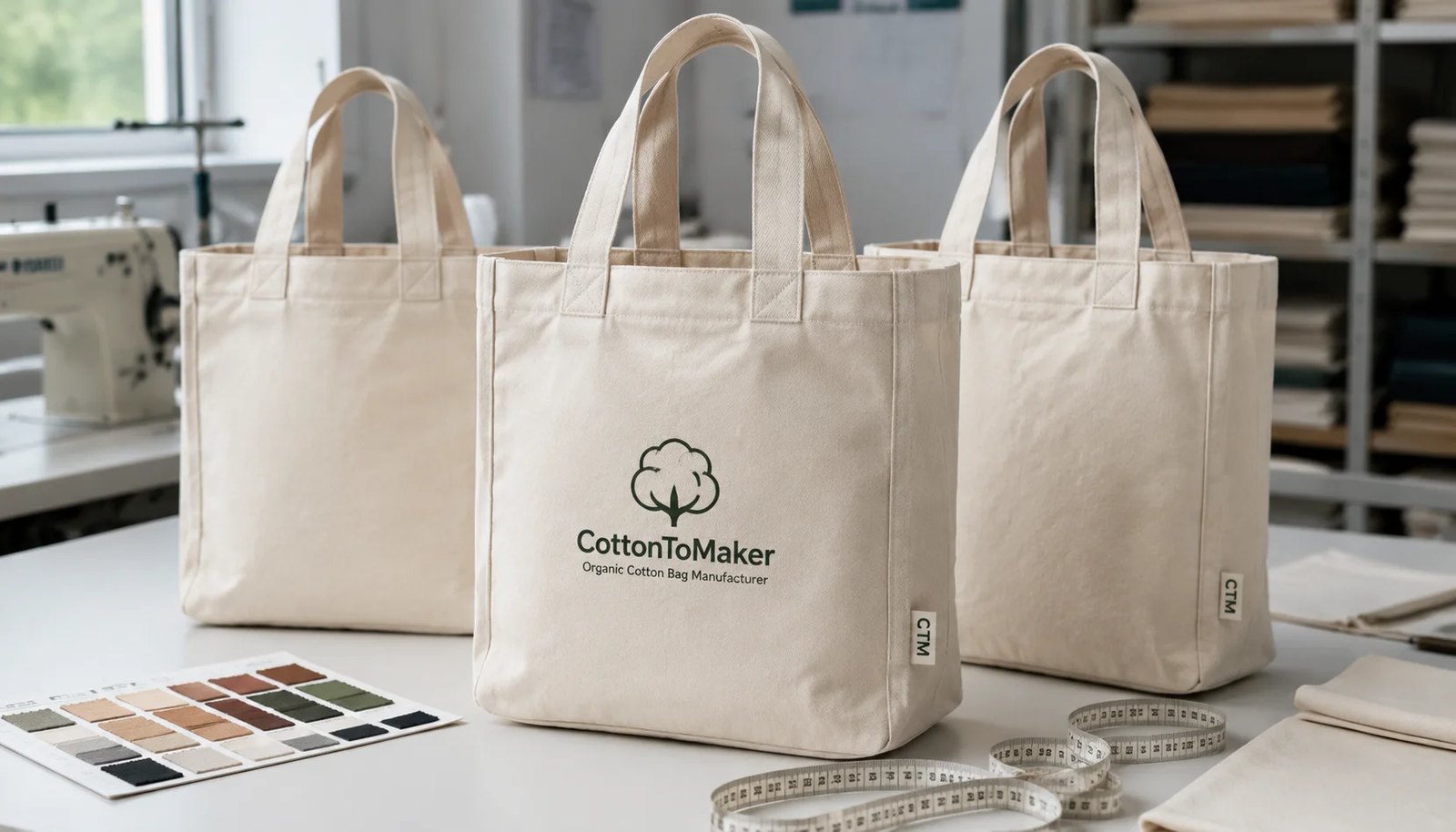
- Woven labels work well for side branding, size information, or CTM-style sample identification.
- Print placement should be measured from fixed seams or edges, with tolerance stated in centimeters.
Understand MOQ logic before comparing unit prices
MOQ is not only a sales rule. It comes from fabric procurement, dyeing minimums, printing setup, cutting efficiency, label production, and carton packing. A supplier may accept a small order if using stock natural cotton fabric and one screen print color, but the same factory may require a much higher MOQ for custom dyed organic cotton, multiple store logos, or special labels.
When comparing quotes, separate the base tote MOQ from design-level MOQ. A distributor ordering the same bag size for ten store banners may think the total quantity is enough, while the factory sees ten separate print setups and ten packing lines. That affects screen charges, sample time, print waste, and carton labeling. A clear breakdown prevents surprise surcharges after artwork approval.
- Lower MOQ is easier with natural color fabric, standard size, and one print position.
- Custom dyed fabric usually increases MOQ and lead time because the mill needs a minimum batch.
- Multiple artwork versions should be quoted with setup cost, per-version MOQ, and overrun policy.
- Private labels, hangtags, and barcode stickers may have their own supplier minimums.
Sample approval should lock materials, sewing, print, and packing
A nice prototype is not enough if bulk production uses different fabric, a different ink, or a faster sewing method. The pre-production sample should represent the actual approved production standard. It should include the same fabric GSM, handle reinforcement, seam construction, print method, label, hangtag if any, folding method, and packing format. If one element is still pending, mark it clearly in the approval notes.
Measure the sample like an inspector would. Record finished width, height, gusset, handle drop, handle width, fabric feel, color, print dimensions, print position, and any odor or shrinkage concern. Keep one approved sample with the buyer and one sealed sample with the factory. For repeat programs, the approved sample becomes the baseline for later shade, stiffness, and workmanship comparison.
- Approve material swatch before cutting if fabric stock is not yet ready.
- Approve print strike-off before full panel printing.
- Approve one complete pre-production sample before bulk sewing.
- Use written approval comments, not only photos in a chat thread.
- Reject samples with unexplained fabric substitution, different handle width, or unapproved print texture.
Set practical inspection thresholds before production starts
Inspection standards must be written before the goods are packed. Otherwise, the buyer, factory, and third-party inspector may classify the same defect differently. For grocery totes, major defects normally include broken stitching at stress points, visible stains, wrong size beyond tolerance, incorrect print placement, heavy print smearing, wrong label, severe fabric holes, and missing carton marks. Minor defects may include small loose threads, slight wrinkle marks, or minor slub variation within the approved natural fabric character.
Organic cotton can have natural specks or slubs, especially in unbleached fabric. That does not mean every mark is acceptable. The approved sample should define the acceptable natural appearance. Oil stains, mildew, dirty hand marks, rust spots, and insect contamination should not be excused as natural cotton variation. A simple defect photo board is useful for both factory QC and final inspection.
- Critical defects: safety hazards, needle pieces, mold contamination, wrong product identity, or illegal claim labeling.
- Major defects: handle failure, open seam, wrong dimensions, visible stain, incorrect artwork, poor print adhesion.
- Minor defects: trim thread, slight shade variation, small non-prominent slub, light crease removable by normal handling.
- Inspection should include random packed cartons, not only loose factory-selected samples.
Packing choices affect sell-through and landed cost
Packing is often treated as an afterthought, but it changes carton count, freight volume, warehouse labor, and retail presentation. Bulk-packed totes are efficient for store distribution, but they may arrive wrinkled if over-compressed. Individually folded bags with paper bands or belly bands improve retail handling but add labor, material, and carton space. Polybags may protect against moisture but may conflict with a natural grocer’s plastic reduction policy.
For import planning, request carton dimensions, units per carton, gross weight, net weight, and packing method with the quote. Large cotton totes can create high volumetric freight even when the unit price is attractive. Moisture control also matters because cotton absorbs humidity during storage and ocean transit. Cartons should be strong enough for stacking, with clear shipping marks and barcode labels if required by the distribution center.
- Bulk pack works for back-room store distribution when minor wrinkles are acceptable.
- Retail-ready folding improves presentation but increases labor and packaging cost.
- Moisture barrier or desiccant may be needed for long ocean transit or humid seasons.
- Carton marks should match purchase order, SKU, color, quantity, and destination requirements.
- Avoid cartons so heavy that warehouse teams rework them before store allocation.
Lead time risk usually sits in fabric and printing, not final sewing
Buyers often focus on sewing capacity, but the real schedule risk for organic cotton totes is usually fabric availability, certification paperwork, dyeing or bleaching, print screen approval, and sample revisions. Sewing a standard tote is relatively fast once panels, labels, and artwork are ready. If the fabric is custom GSM or custom dyed, schedule protection must start before the purchase order is released.
A realistic production timeline should count from approved pre-production sample and confirmed deposit or payment term, not from the first inquiry. Build in time for fabric procurement, lab dips if dyed, strike-offs, sample courier, buyer review, bulk cutting, printing, curing, sewing, trimming, final inspection, packing, and export handover. Natural grocers with seasonal campaigns should also consider port congestion and distribution center booking windows.
- Stock natural fabric with simple print can move faster than dyed or washed fabric.
- Artwork changes after screen preparation create cost and schedule resets.
- Late barcode or hangtag files can hold finished goods in the packing area.
- Final inspection should be scheduled when goods are fully packed, not when sewing is almost done.
- Shipment booking should use actual packed carton data, not an early estimate.
Specification comparison for buyers
| Spec decision | Recommended option | When it fits | Buyer risk to check |
|---|---|---|---|
| Fabric weight for grocery use | 10 oz to 12 oz organic cotton canvas, roughly 270 to 340 GSM depending on weave | Reusable shopping totes expected to carry produce, boxed goods, or 5 to 8 kg typical retail loads | Low-GSM quotes may look cheaper but collapse at checkout, show print-through, and fail handle pull tests |
| Organic claim documentation | Transaction certificate or scope certificate route agreed before production, plus batch traceability from fabric mill | Retailers making organic cotton claims on hangtags, shelf signage, or ecommerce product pages | Supplier may quote organic cotton fabric without valid lot-level paperwork; marketing claims become buyer risk |
| Bag construction | Boxed bottom or side gusset with double-stitched handles and folded top hem | Natural grocers needing a stable bag that stands better during packing | Flat totes are cheaper but less useful for grocery loading and may receive poor store feedback |
| Handle specification | Self-fabric handles, 2.5 to 3 cm width, reinforced cross stitch or box-X bartack | Stores selling the tote as a reusable grocery bag rather than a light promotional giveaway | Narrow handles reduce cost but dig into hands and are more likely to tear at the seam |
| Print method | Water-based screen print for 1 to 3 solid colors; reactive or pigment print for larger panels | Natural grocery branding with simple logos, store names, and earth-tone artwork | Uncontrolled ink curing can cause rubbing, odor, cracking, or poor wash resistance |
| Shrinkage control | Pre-shrunk fabric or shrinkage allowance confirmed on the approved sample | Programs where finished dimensions must match retail shelf labels or planograms | Unwashed organic cotton can shrink after home laundering, creating customer complaints |
| Packing format | Individual folded bag or bulk master carton with moisture barrier depending on sales channel | Bulk distribution to stores, retail-ready stock, or ecommerce fulfillment | Over-compression wrinkles prints; poor carton strength causes dirty bags and crushed edges |
| Inspection level | AQL inspection with defined major and minor defects, plus carton count and moisture check | Importers shipping full cartons to multiple store locations without rechecking every unit | If defect definitions are not written, factories and inspectors will judge stains, loose threads, and print shade differently |
Buyer checklist before sampling
- Define finished bag size, gusset depth, handle length, fabric weight, seam type, and load expectation before requesting price.
- State whether the cotton must be certified organic and what document level is required for your market claim.
- Request fabric GSM tolerance, for example plus or minus 5 percent, not only nominal ounce weight.
- Provide artwork as vector file with Pantone or ink reference and exact placement from bag edges.
- Approve a physical pre-production sample using the same fabric, print ink, stitching, label, and packing method as bulk production.
- Set acceptance criteria for stains, slubs, broken yarns, print registration, handle strength, odor, and carton condition.
- Confirm carton dimensions, units per carton, gross weight, barcode or shipping mark format, and pallet requirements if any.
- Require production photos or inline inspection data before final inspection, especially for new supplier programs.
- Reserve time for fabric procurement, dyeing or bleaching, printing, sewing, final QC, and export packing in the purchase order schedule.
- Compare quotes on the same Incoterm, same documentation scope, same packaging, and same inspection responsibility.
Factory quote questions to send
- What exact organic cotton fabric are you quoting: canvas, twill, plain weave, or drill, and what is the GSM tolerance after finishing?
- Can you provide valid organic cotton documentation for the fabric lot used in production, and at what stage will copies be available?
- Is the quoted size the cut size or finished size, and what finished dimension tolerance do you guarantee?
- What handle reinforcement is included in the base quote: single stitch, double stitch, cross stitch, box-X, or bartack?
- Which print method is included, and what ink test or curing control do you use to reduce rubbing, odor, and cracking?
- What is the MOQ per size, per fabric color, and per print design, and does a repeat order have the same MOQ?
- How many units are packed per export carton, what is the carton grade, and are polybags, paper bands, or moisture bags included?
- What sample types and charges are required before bulk production: material swatch, print strike-off, prototype, or pre-production sample?
- What is the normal lead time from approved sample and deposit, and which process is the current bottleneck?
- What defects do you classify as critical, major, and minor during final inspection?
Quality-control points to confirm
- Finished size tolerance within the approved range, commonly plus or minus 0.5 cm for width and height and plus or minus 0.3 cm for gusset on standard totes.
- Fabric weight verified by GSM cutter or agreed lab method, with tolerance written into the purchase order.
- Handle pull test performed on production samples, with no seam opening, broken thread, or fabric tearing at the approved load.
- Top hem, side seams, bottom seams, and gusset corners checked for skipped stitches, loose threads, puckering, and uneven seam allowance.
- Print position measured from top edge and side edge, not judged by eye only.
- Print surface checked for pinholes, smearing, poor coverage, color deviation, ink migration, odor, and rubbing after dry hand test.
- Organic cotton color checked against approved shade under consistent lighting because natural cotton lots vary.
- Stains, oil marks, mildew spots, dirty folds, and insect contamination treated as major or critical depending on visibility and quantity.
- Needle detection required if the bags will enter strict retail distribution or if the importer has internal safety rules.
- Carton quantity, carton marks, barcode labels, moisture condition, and carton strength verified before shipment release.