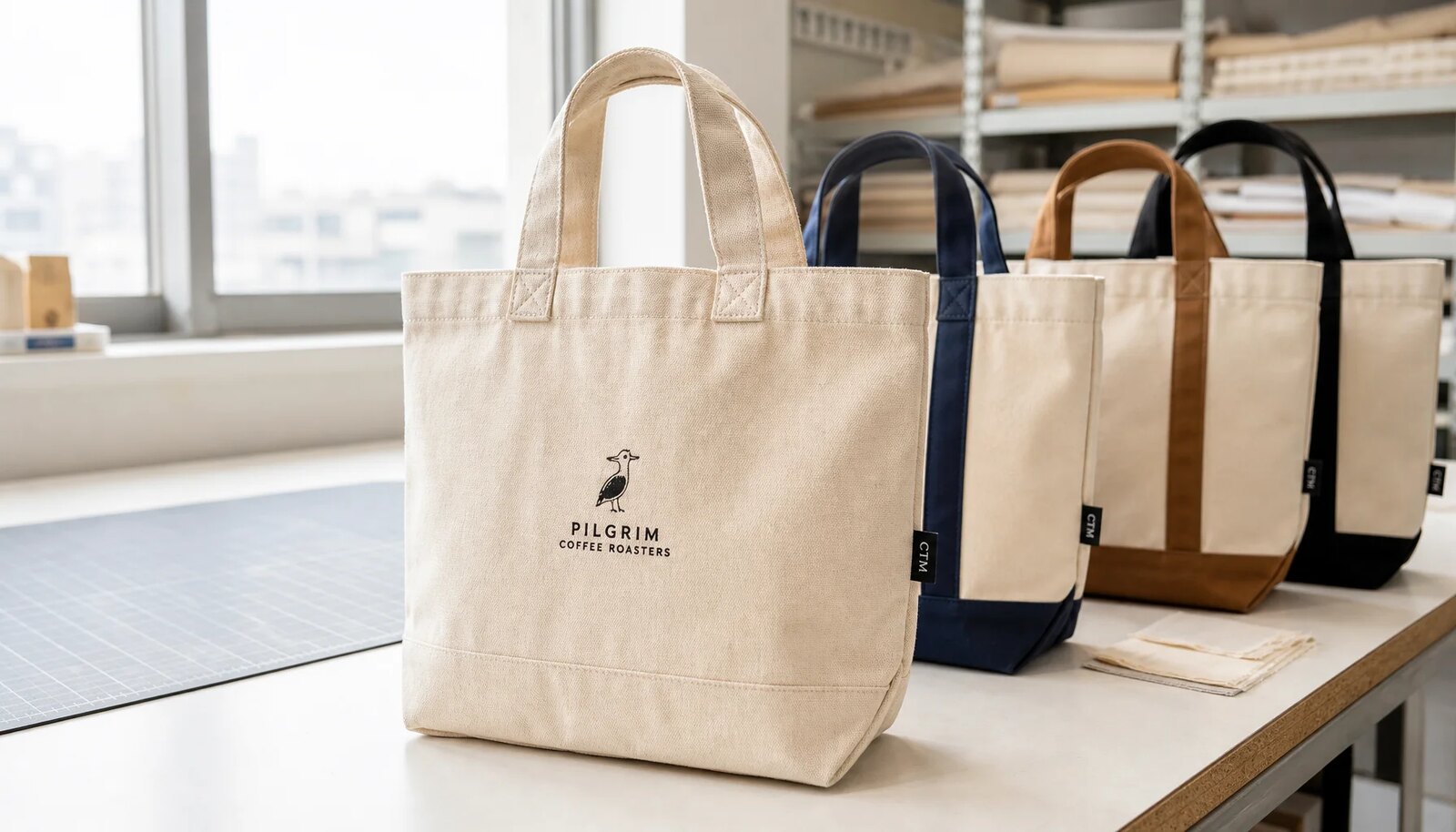
Make Proofing the Control Point
For coffee roasters, an organic cotton tote is usually both packaging and merchandise. It may carry coffee bags, sit beside retail beans, ship inside a subscription box, or sell as a branded reusable item. That means the print proof cannot be treated as a visual nicety. It is the control point that connects artwork, fabric, sewing, packing, and customer-facing brand quality.
Most failed tote orders start with vague approval language. A PDF may look centered, but the finished bag can shift after cutting, sewing, pressing, and folding. Natural cotton texture can make fine type fill in or pale ink look weaker than expected. A useful wholesale organic cotton totes for coffee roasters print proofing checklist should turn those risks into measurable rules before the factory starts bulk production.
- Approve on final fabric, not only on a digital template.
- Measure placement from fixed points: top edge, side seam, center line, or handle seam.
- Keep one signed physical sample as the inspection standard.
Verify the Organic Claim
Organic cotton is not only a fabric choice. For procurement, it is a claim that must be supported through documents. Ask whether the supplier, mill, printer, dyer, or cut-and-sew facility is covered by a current GOTS or OCS scope certificate. The certificate should name the certified organization, certification body, product category, processing steps, and validity period. A generic statement that the cotton is organic is not enough for a purchase file.
If the tote, packaging, invoice, or marketing copy will make a certified organic claim, ask whether transaction certificates are available for the specific order. Requirements vary by certification program and claim type, so buyers should confirm before approving labels or certification marks. Chain-of-custody proof matters most when the bag will carry an organic logo, be sold as certified merchandise, or be included in a sustainability report.
- Request current GOTS or OCS scope certificates before PO approval.
- Confirm whether transaction certificates are required for the order.
- Check labeling rules before using certification logos or organic wording.
Choose Cloth for the Job
Fabric weight drives cost, print behavior, and how the tote feels in hand. A 180-200 gsm organic cotton tote can work for event giveaways, light inserts, and short campaigns. It is usually softer, easier to fold, and less expensive to ship. It can also wrinkle more, show slubs more visibly, and give less structure under a large printed logo.
For retail resale, cafe counter merchandising, or bundles with coffee bags and accessories, 240-280 gsm is usually safer. The fabric feels more substantial and gives the print a steadier surface, but it may increase MOQ, sewing time, and freight weight. Do not specify gsm alone. Confirm weave, shrinkage allowance, finish, handle material, and whether the supplier is quoting finished dimensions or cut fabric dimensions.
- Use lighter cloth for low-cost handouts and inserts.
- Use heavier canvas for retail merch and reusable shopping function.
- Approve fabric swatches before locking color and ink opacity.
Match Print to Artwork
Water-based screen print is the practical default for most coffee roaster logos. It suits bold marks, short slogans, line art, and one- to three-color designs. The buyer should still confirm minimum positive line width, reversed text limits, registration tolerance, and ink opacity on natural cotton. A fine roast note that looks elegant on a bag mockup can disappear into fabric texture when printed at scale.
Transfers or hybrid decoration can help with gradients, small details, or many colors, but they introduce their own proofing questions. Check hand-feel, edge lift, cracking at fold lines, and wash or rub performance. Do not choose a method only because it simplifies setup. Ask the factory why the method fits the artwork and what defect types the inspection team will look for.
- Use screen print for clean logos and repeat production.
- Use transfer methods only when detail or color count justifies them.
- Require fold and rub checks for prints that will crease during packing.
Set Numeric Proof Tolerances
A proofing checklist becomes useful when it includes numbers. For many tote programs, print placement should stay within +/-3 mm for retail-visible logos and +/-5 mm for less demanding promotional orders. Multi-color registration should generally stay within 1 mm unless the artwork is deliberately loose. Finished dimensions often use +/-5 mm for smaller bags and +/-8 mm for larger formats, but the buyer and supplier should agree based on construction.
Line width and color tolerances should also be set before sampling. A common minimum positive line width for screen printing on cotton texture is around 0.5 mm, with reversed text needing more space to stay open. Color can be approved against a Pantone reference, a physical ink drawdown, or an approved sample. If instrument color checking is available, define the acceptable Delta E range; if not, use a signed physical standard under consistent lighting.
- Print placement: define +/-3 mm or +/-5 mm by use case.
- Registration: set a 1 mm target for multi-color artwork.
- Dimensions: agree finished-size tolerance after sewing and pressing.
Build a Comparable RFQ
A good RFQ separates the tote body, organic documentation, decoration, sampling, packing, and freight assumptions. If the supplier gives only one unit price, the buyer cannot tell whether the quote reflects certified material, heavier cloth, better packing, or simply a thinner bag. The RFQ should include finished size, gsm, weave, handle length, print size, print colors, packing count, certification document needs, and inspection expectations.
For coffee roaster programs, version control matters. Buyers often need the same tote body across different roast lines, cafe locations, event dates, or seasonal artwork. Ask for MOQ by artwork, print color count, fabric color, and bag size. Also ask whether the supplier can gang artwork, split carton labels, or hold a repeat price for reorder windows. That detail makes quotes commercially comparable instead of just visually similar.
- Break out setup charges, sample charges, unit price, and packing cost.
- Ask MOQ by artwork, size, fabric color, and print color count.
- Include certification and inspection documents in the quote request.
Approve Samples Like Production
The pre-production sample should be made with final fabric, final sewing construction, final print method, final artwork size, and the intended packing fold. If any element is substituted, mark the sample as limited approval and list what remains open. A photo can help move discussion along, but it cannot show true hand-feel, ink cure, seam pull, or how the tote behaves after folding.
Sample approval should be binary on critical points. The buyer can approve the bag only if the organic documents are acceptable, the fabric matches the swatch, dimensions are within tolerance, print placement is correct, and small details remain legible. If one issue is waived, write down the waiver. Otherwise, that same flaw may appear later in bulk and become difficult to reject.
- Require a physical sample for first orders and artwork changes.
- Seal one approved sample for final inspection reference.
- Record any accepted deviation in writing before bulk starts.
Inspect Beyond the Logo
Print quality is important, but tote failures also come from sewing and finishing. Inspect handle attachment, bartacks, top hem, side seams, gusset alignment, loose threads, oil marks, needle holes, and fraying. For bags carrying coffee products, handle strength and seam consistency are not cosmetic details. A crisp logo on a weak bag is still a failed procurement decision.
Set the inspection plan before production. A common approach is AQL general inspection level II, with critical defects at 0, major defects at 2.5, and minor defects at 4.0, adjusted for order risk. Critical defects can include unsafe contamination, wrong product, or unsupported certification labeling. Major defects can include wrong artwork, severe misplacement, weak stitching, wrong dimensions, or poor ink cure. Minor defects can include small loose threads or slight natural cotton variation outside the print area.
- Check first bulk output before the full run continues.
- Sample from packed cartons, not only from the sewing table.
- Define critical, major, and minor defects before inspection day.
Map the Real Lead Time
Lead time should be shown by factory stage, not as one optimistic number. A straightforward repeat order might need two to three days for artwork proof, several days for screen setup and sample making, one to two weeks for cutting, printing, sewing, and finishing, then additional time for inspection, packing, and freight booking. Custom fabric, certification documents, dyeing, washing, or peak-season print capacity can add meaningful time.
The buyer controls part of the calendar. Late artwork, unclear organic labeling rules, slow sample approval, or missing packing instructions can hold the order even when the factory is ready. Freeze artwork before comparing quotes whenever possible. For launch dates, ask for a schedule with milestones: proof approval, fabric arrival, screen setup, first bulk print, sewing completion, final inspection, packing, ex-factory date, and freight handoff.
- Ask what fabric and trim are already in stock.
- Separate sampling, production, inspection, packing, and freight time.
- Hold freight options open until the proof is approved.
Control Packing and Landed Cost
Packing affects receiving cost and brand presentation. Bulk packing is usually efficient for wholesale and warehouse handling, but carton labels must be precise. Each carton should show PO number, SKU or artwork version, bag size, quantity, carton number, gross weight, and destination details if needed. If the totes are going to a third-party logistics provider, confirm barcode and label requirements before production.
The best quote is the lowest risk-adjusted landed cost, not the lowest unit price. Add sample fees, screen charges, organic documentation costs, packing labor, cartons, inland transport, export paperwork, freight, duties, inspection, and possible rework. A supplier who can prove repeatability, documents, and clean packing may cost more per unit and still be cheaper after receiving, launch timing, and rejection risk are considered.
- Confirm carton marks and pack counts before bulk packing starts.
- Compare landed cost, not only ex-factory unit price.
- Keep inspection and document review tied to final payment terms.
Specification comparison for buyers
| Spec decision | Recommended option | MOQ impact | Cost impact | Proofing risk |
|---|---|---|---|---|
| Organic claim | GOTS or OCS certified material with scope certificate and transaction certificate where applicable | May limit available mills and colors | Higher than conventional cotton, especially at low volume | Incorrect labeling or unsupported organic claim |
| Fabric weight | 180-200 gsm natural organic cotton for light promotions | Usually easier to source at lower MOQ | Lower fabric cost and lighter freight | More show-through, wrinkles, and print texture |
| Fabric weight | 240-280 gsm organic cotton canvas for retail merch | MOQ may rise if fabric is custom woven | Higher fabric cost, slower cutting and sewing | Seam distortion near large prints if handling is poor |
| Print method | 1-3 color water-based screen print | Efficient once screen setup is justified | Setup cost per color, low repeat unit cost | Fine type fill-in, pale ink opacity, placement drift |
| Print method | Transfer or hybrid print for detailed multicolor art | Can work at lower runs, depends on supplier | Higher unit decoration cost | Cracking on folds, plastic hand-feel, edge lift |
| Artwork layout | Large centered logo with clear seam margins | No major MOQ change | Lower proofing and rejection risk | Looks off-center if reference point is vague |
| Handle spec | Self-fabric or reinforced cotton webbing handles | Custom handle length or color can increase MOQ | Adds labor and material cost | Handle stretch or uneven attachment affects perceived quality |
| Packing spec | Bulk packed by artwork and carton count | Usually MOQ neutral | Lowest packing cost | Mis-picks if cartons are mixed or poorly labeled |
| Sample path | Pre-production sample on final fabric and final print method | No MOQ impact, but adds calendar time | Sample fee and courier cost | Approving from PDF misses cloth and sewing behavior |
Buyer checklist before sampling
- Final vector artwork, fonts outlined, one-color backup version, and minimum line-width notes
- Finished tote size, gusset depth, handle length, seam construction, and measurement tolerance
- Fabric weight in gsm, weave type, natural/bleached/washed finish, and shrinkage assumption
- Organic cotton claim supported by current GOTS or OCS scope certificate for the relevant supplier role
- Transaction certificate request where the order requires certified organic chain-of-custody proof
- Labeling plan for organic claims, certification logos, care labels, country of origin, and brand marks
- Print method, ink type, Pantone or LAB target, underbase requirement, and curing standard
- Print size, placement reference point, edge clearances, and allowed shift from approved proof
- Physical pre-production sample on final fabric, with approval owner and revision limit
- MOQ by artwork, bag size, fabric color, print color count, and split-shipment request
Factory quote questions to send
- Which legal entity holds the GOTS or OCS scope certificate, and does the certificate cover the material and process used for this tote?
- Can you provide transaction certificates or chain-of-custody documents if our order requires certified organic claim support?
- Is your price based on finished bag size or cut fabric size, and does it include seam allowance and shrinkage allowance?
- What exact fabric weight, weave, yarn count if available, color, finish, and gsm tolerance are included in the quote?
- Which print method, ink system, curing process, and number of colors are included, and what is the setup charge per artwork?
- What minimum line width and minimum reversed-text height can you hold on this fabric weight?
- What placement tolerance do you hold from the top edge, side seam, center line, and handle reference point after sewing?
- What is the MOQ per design, per bag size, per fabric color, and per print color count, and can the order be split across roast lines?
- Will the pre-production sample use final fabric, final ink, final sewing, and final packing, or is any element substituted?
- What AQL level or sampling plan do you use for finished dimensions, print defects, stitching, and packing accuracy?
Quality-control points to confirm
- Organic claim documents are current, issued to the relevant supplier entity, and cover the claimed fiber and processing scope
- Transaction certificates or chain-of-custody records are collected where certified organic claims will appear on product, packaging, or sales documents
- Fabric weight matches the agreed gsm, typically within +/-5% unless a tighter tolerance is approved
- Finished width and height stay within +/-5 mm for small totes or +/-8 mm for larger totes, with gusset depth within +/-5 mm
- Handle length stays within +/-8 mm, and handle attachment points are even, reinforced, and free of skipped stitches
- Print placement stays within +/-3 mm from the approved reference point for retail-visible logos, or +/-5 mm for standard promotional orders
- Print registration for multi-color artwork stays within 1 mm unless the artwork requires a tighter standard
- Minimum positive line width is confirmed before production, commonly 0.5 mm or wider for reliable screen printing on cotton texture
- Reversed text and small type remain open, legible, and free of ink fill-in after curing
- Color is checked against Pantone or approved physical standard, with acceptable deviation defined before production, such as Delta E <= 3 where instrument checking is available