Start With the Bakery Carry Job
The right wholesale organic cotton tote for an artisan bakery is defined by what customers actually carry. A bag used for two sourdough loaves has different stress points than one holding pastry cartons, coffee packs, jars, and a gift card. Before selecting fabric, define the product mix, expected load, sales channel, and reuse expectation. This prevents two common mistakes: buying a bag that is too light for boxed goods, or overpaying for heavy canvas when the tote is mainly promotional.
Map the tote to the bakery’s use case. A counter giveaway can prioritize clean logo printing and efficient packing. A paid merchandise tote needs better hand feel, straighter sewing, and packaging that presents well when unpacked. A subscription pickup bag may need repeat-use durability and branch-level SKU control. The RFQ should state whether the tote is sold, gifted, used for pickup, or distributed through wholesale partners.
- Bread-only carry: medium canvas, simple flat body, strong top seam, and clean one-color print.
- Pastry carton carry: bottom or side gusset to keep boxes level and reduce tilting.
- Gift bundle carry: heavier canvas, wider handles, reinforced stitching, and controlled folding.
- Merchandise resale: tighter sewing, cleaner print tolerance, hangtag or label option, and retail-ready packing.
- Distributor replenishment: fewer SKU variations to reduce MOQ pressure and carton mix-ups.
Compare Material Options Before Locking Canvas
Organic cotton canvas is the usual choice for bakery totes because it has a natural hand feel, accepts screen printing well, and supports a credible sustainability story when properly documented. Still, not every program needs the same material route. GOTS-certified organic cotton, OCS-certified organic cotton, supplier-declared organic cotton, natural unbleached cotton, dyed organic cotton, and recycled cotton blends can all appear in supplier quotations. They are not interchangeable.
The selection should match the claim the bakery intends to make. If the tote will be sold with certified organic messaging, documentation matters as much as fabric feel. If the goal is simply a natural-looking reusable bag for a seasonal campaign, certified chain-of-custody may be unnecessary. The safest approach is to state the required claim in plain language: certified organic cotton with transaction certificate, OCS organic content claim, supplier-declared organic fiber, or natural cotton appearance only.
- Certified retail claim: use a supplier whose certification scope covers the required product and process.
- Organic content claim: OCS may fit when fiber-content chain-of-custody is the main requirement.
- Fuller processing standard: GOTS may fit when organic fiber plus processing criteria are required.
- Natural look only: unbleached cotton can work, but do not describe it as certified organic.
- Brand color program: dyed organic cotton needs lab dip approval and colorfastness checks.
Specify Organic Documentation Precisely
Broad wording such as “certified organic cotton documentation” creates confusion. A scope certificate confirms that a supplier or facility is certified for certain activities, products, and standards during a defined validity period. It does not by itself prove that a particular purchase order was made from certified organic cotton. A transaction certificate is order-specific chain-of-custody evidence issued for certified goods after the transaction. Buyers who need certified claims should know the difference before approving a quote.
GOTS and OCS also cover different things. GOTS includes organic fiber requirements and processing criteria under its standard. OCS focuses on verifying organic material content and chain-of-custody. A supplier declaration is not the same as third-party certification; it may be enough for internal sourcing records or low-risk promotions, but it should not support a certified claim. Ask the factory what document can be provided, when it is issued, and whether the quoted price includes that documentation path.
- Scope certificate: proves the supplier’s certification status and covered activities, not your specific order alone.
- Transaction certificate: links a certified material transaction to a specific order or shipment.
- GOTS: stronger standard route when processing claims and certified organic textile claims are needed.
- OCS: chain-of-custody route for verified organic content claims.
- Supplier declaration: useful for basic sourcing records but not equivalent to certification.
- Purchase order wording: match the product claim to the exact documentation the supplier can provide.
Choose Fabric Weight by Function
For wholesale organic cotton totes for artisan bakeries, common canvas options often sit between about 8 oz and 14 oz, roughly 220 to 380 GSM depending on yarn, weave, and finishing. Treat these ranges as supplier-dependent rather than universal. An 8 oz to 9 oz tote can be fine for light bread, events, or simple promotions. A 10 oz to 12 oz canvas is often the balanced choice for reusable bakery retail bags because it holds shape better without making freight and sewing costs excessive.
Heavier 13 oz to 14 oz canvas can feel premium, especially for paid merchandise, but it should be justified by the sales price and customer expectation. Heavy fabric increases material cost, needle wear, sewing effort, carton weight, and CBM. It can also crease more visibly if cartons are over-compressed. Ask for both oz and GSM, and confirm whether the measurement is before or after finishing. Keep an approved swatch so bulk goods can be checked against the same reference.
- 8 oz to 9 oz: light promotional use, bread sleeves, events, and lower-cost campaigns.
- 10 oz to 12 oz: practical range for many reusable bakery carry and retail programs.
- 13 oz to 14 oz: premium resale or gift bundle use when hand feel matters more than freight efficiency.
- Unbleached canvas: natural appearance with expected seed specks, shade variation, and slubs.
- Dyed canvas: better brand color control but requires lab dip, MOQ review, and colorfastness testing.
Match Size and Gusset to Bakery Packaging
Bag geometry is often more important than a small change in fabric weight. A flat tote is economical and prints cleanly, but it does not support pastry cartons well. Once a customer adds a tart box, cookie tin, coffee bag, or jar, the bottom corners pull inward and the product can tilt. A bottom gusset improves stability while keeping the front panel simple. A full side gusset adds more capacity for mixed retail purchases and gift bundles.
A general bakery tote may be around 38 x 40 cm, but the correct size depends on the bakery’s actual boxes. Measure the largest common carton and leave room for customer handling. An 8 cm gusset may suit many pastry boxes; 10 to 12 cm adds capacity but changes carton volume and bag silhouette. State finished dimensions after sewing, not cut panel dimensions. Include tolerance, handle position, and artwork safe area so the logo stays visible when the bag is filled.
- Flat tote: lowest cost and easiest print placement for bread, flyers, and light merchandise.
- Bottom gusset: better box stability while preserving a clean front logo panel.
- Full side gusset: stronger capacity choice for gift bundles and larger retail purchases.
- Tall narrow shape: good for baguettes but less useful for square bakery cartons.
- Wider shape: better for boxes but needs fabric and handle reinforcement to reduce sagging.
Engineer Handles for Real Carry Use
Handles are a load-bearing component, not a minor accessory. A tote can use acceptable fabric and still fail because the handle is too narrow, inserted too shallowly, or secured with weak stitching. For many bakery totes, 2.5 to 3.5 cm handle width gives a comfortable grip. A 25 to 30 cm handle drop may allow shoulder carry, depending on bag height and target customer use. For heavier gift bundles, cotton webbing can outperform thin self-fabric handles.
Load claims must be qualified because performance varies by fabric, seam construction, stitch density, handle width, and test method. Instead of accepting a generic “5 kg” or “8 kg” statement, define a practical load test. Load the sample with weight similar to the bakery’s products, lift repeatedly, and inspect the handle base, top seam, and fabric around the stress point. The approved sample should show the exact stitch pattern, usually box stitch with cross reinforcement for reusable programs.
- Handle width: 2.5 cm minimum for many reusable bakery totes; wider for paid merchandise or heavier bundles.
- Handle drop: confirm hand carry, shoulder carry, or both before sampling.
- Stitch pattern: box-cross reinforcement distributes stress better than a single top row.
- Material choice: self-fabric handles look integrated; webbing handles add comfort and strength.
- Inspection focus: skipped stitches, loose threads, puckering, shallow insertion, and seam opening at the handle base.
Select Print Method for Cotton Texture
Natural organic cotton canvas has texture, seed specks, and small slubs, especially when unbleached. That texture supports a warm bakery look, but it affects print detail. Water-based screen printing is usually the most practical option for simple bakery logos, line illustrations, and one to three color artwork. It has a softer hand feel than thick plastisol-style prints and usually aligns better with an organic cotton story.
Fine serif text, QR codes, thin strokes, and dense illustrations need special attention. Coarse canvas can cause small details to fill in, and natural fabric shade can shift perceived ink color. A digital mockup is not enough for a first order. Approve a strike-off on actual production fabric, with Pantone target, acceptable shade range, edge sharpness, and rub resistance. If the tote is sold as washable, add a wash test expectation before printing bulk panels.
- Water-based screen print: good for simple bakery marks, soft hand feel, and moderate cost.
- Pigment print: useful for larger color areas but needs shade approval on actual fabric.
- Heat transfer: handles complex graphics but may feel less natural on organic cotton canvas.
- Embroidery: premium for small marks but can pucker lighter fabric and raise cost.
- Woven side label: useful secondary branding when the front print should remain minimal.
Control MOQ and SKU Complexity
MOQ is driven by more than total order quantity. Factories may set minimums by fabric type, fabric color, size, print artwork, print color count, label, and packing method. A 2,000-piece purchase can be efficient if it is one tote specification. The same quantity can become inefficient when split across several bakery locations, fabric colors, and artwork versions. Each version adds setup time, screen control, packing segregation, and inspection risk.
Common MOQ ranges vary widely by factory, market, certification route, and construction. Treat any supplier’s MOQ as a commercial and production assumption, not an industry rule. If branch-level branding is required, ask whether the same bag body can be used with different one-color prints, side labels, or hangtags. Separate setup charges from unit prices so a low-cost base tote is not distorted by multiple small print runs.
- Lowest complexity: one fabric, one size, one print design, one packing method.
- Moderate complexity: same bag body with branch-specific one-color prints or carton marks.
- High complexity: several dyed colors, multiple sizes, multi-color prints, and retail packing per SKU.
- Cost drivers: screen setup, color change time, cutting segregation, label control, and carton separation.
- Risk controls: SKU matrix, approved artwork list, carton marks, and final inspection by version.
Build Samples That Prove the Spec
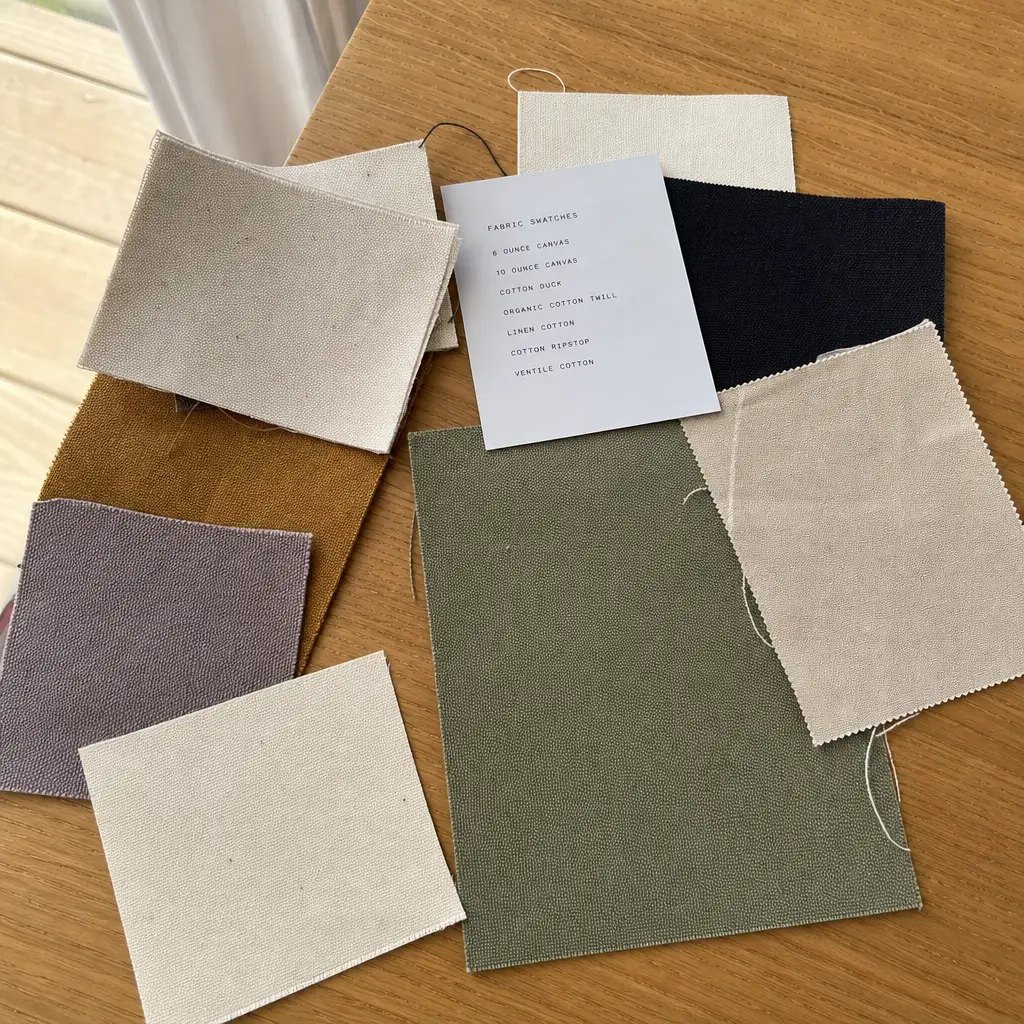
A sample should verify the buying decision, not just look attractive in a courier envelope. Start with fabric swatches if material, shade, or hand feel is still open. Use a blank fit sample to confirm size, gusset, handle drop, and sewing construction. Then approve a print strike-off on the actual fabric. For first orders, a pre-production sample should be signed off before bulk production or at least before bulk printing.
Approval comments need to be measurable. Replace “make it stronger” with “use 3 cm cotton webbing handles and box-cross reinforcement.” Replace “logo is too low” with a distance from top seam or bottom edge. The approved sample becomes the inspection reference for fabric texture, natural specks, shade, seam appearance, print placement, and packing fold. Keep one sealed sample with the buyer and one with the factory so disputes can be judged against the same reference.
- Fabric swatch: confirms GSM, weave, hand feel, natural shade, and seed speck level.
- Blank fit sample: verifies finished size, gusset shape, handle comfort, and sewing details.
- Lab dip: required for dyed organic cotton or strict brand color programs.
- Print strike-off: confirms ink color, line sharpness, coverage, rub behavior, and print placement.
- Pre-production sample: locks the final construction, artwork, label, and packing method before bulk.
Inspect, Pack, and Compare Landed Cost
Final supplier selection should combine product quality and landed cost. Unit price alone misses carton volume, gross weight, packing labor, screen charges, certification cost, courier fees, inspection cost, and Incoterm differences. A 12 oz gusseted tote may be worth the upgrade for bakery boxes, but it can also increase CBM compared with a 10 oz flat tote. Request carton data during quoting so logistics and procurement teams compare realistic totals.
Set quality expectations before deposit. For many softgoods orders, buyers use a random inspection plan based on AQL, with separate treatment for critical, major, and minor defects. Add measurement tolerance, color tolerance, shrinkage testing if washable use is claimed, and print rub or wash tests where relevant. Packing also needs approval: bulk cartons reduce plastic and cost, inner bundles aid warehouse counting, and individual polybags may be justified for resale or fulfillment. Carton marks should identify PO, SKU, quantity, artwork version, and destination.
- Quote comparison: unit price, setup charges, sample fees, certification cost, packing, Incoterm, CBM, and gross weight.
- Inspection plan: AQL level, defect classification, measurement method, color standard, and approved sample reference.
- Print tests: dry rub for normal handling, wet rub for damp exposure, wash test only when washability is claimed.
- Packing choice: bulk carton for counter use, inner bundle for counting, individual polybag for retail or fulfillment.
- Shipment data: pieces per carton, carton dimensions, net weight, gross weight, HS code suggestion, and loading estimate.
Specification comparison for buyers
| Material or supplier option | Best fit for bakery buyers | Main advantages | Procurement risks to verify |
|---|---|---|---|
| GOTS-certified organic cotton tote supplier | Bakery brands that need strong organic and processing claims for retail resale or formal sustainability programs | Covers organic fiber plus processing controls under the supplier’s certified scope when valid documentation is available | Confirm the supplier’s GOTS scope certificate is current and covers the product activity; request transaction certificate availability for the order |
| OCS-certified organic cotton tote supplier | Buyers focused on verifying organic fiber content without needing full processing standard coverage | Useful chain-of-custody option for organic content claims and often more flexible than GOTS for some programs | OCS verifies organic content, not the same processing criteria as GOTS; confirm claim wording and certificate scope |
| Supplier-declared organic cotton tote | Small bakery programs, local promotions, or buyers that need organic positioning but not formal certification claims | Can reduce documentation cost and speed quoting when certification is not required by the sales channel | Do not market as certified organic unless documents support it; request fiber origin declaration and keep claim language conservative |
| Unbleached natural cotton tote, non-certified | Budget-sensitive bakery events where the desired look is natural cotton rather than verified organic sourcing | Lower cost, widely available, rustic appearance with seed specks and natural shade variation | Not suitable for certified organic claims; clearly separate “natural cotton” from “organic cotton” in supplier comparison |
| Dyed organic cotton canvas tote | Bakery chains with strict brand colors, premium merchandise, or seasonal capsule programs | Better visual control for brand palettes and retail presentation than natural cotton | Requires lab dip approval, higher MOQ in many factories, extra lead time, and colorfastness testing |
| Recycled cotton blend tote | Sustainability-led programs where recycled content is more important than organic cotton fiber | Can offer a different environmental story and distinctive texture | Fiber strength, shade consistency, and certification route differ; not a substitute for organic cotton unless specified as such |
Buyer checklist before sampling
- Define the carry job: bread sleeves, pastry cartons, coffee bags, jars, merchandise, or mixed customer purchases.
- Select fabric weight by function; do not upgrade to heavy canvas unless hand feel, resale value, or load testing justifies it.
- Choose the organic documentation level: GOTS, OCS, transaction certificate, supplier declaration, or natural cotton only.
- Ask for the supplier’s valid scope certificate if certified production is required, then confirm whether your order can receive a transaction certificate.
- Specify finished bag size after sewing, gusset depth, handle drop, seam tolerance, and artwork safe area.
- Confirm handle width, handle material, stitch pattern, and practical load test method before approving the pre-production sample.
- Approve print strike-off on the actual fabric, including Pantone target, color tolerance, rub resistance, and wash expectation if relevant.
- Define acceptable natural cotton characteristics such as seed specks, slubs, shade variation, and minor weave irregularities.
- Request MOQ by size, fabric color, print design, and packing method instead of relying on one total order quantity.
- Collect carton dimensions, gross weight, pieces per carton, CBM, Incoterm, and loading estimate before comparing landed cost.
Factory quote questions to send
- What exact fabric weight are you quoting in oz and GSM, and is it measured before or after finishing?
- Is the cotton GOTS certified, OCS certified, supplier-declared organic, or simply natural cotton?
- Can you provide a current scope certificate, and does it cover the facility and product activity used for this order?
- If we require certified chain-of-custody, can a transaction certificate be issued for our purchase order after shipment?
- What MOQ applies per size, fabric color, print design, print color count, label, and packing method?
- Which print method is included, how many colors are priced, and are screens, strike-offs, lab dips, or artwork separations charged separately?
- What finished-size tolerance, handle-strength test, stitch density, seam allowance, and reinforcement method are included?
- Can you quote flat, bottom-gusset, and full-gusset versions using the same artwork so we can compare capacity and freight impact?
- What sample sequence do you recommend: fabric swatch, blank fit sample, lab dip, print strike-off, pre-production sample, or packing sample?
- What AQL level do you use for final inspection, and how do you classify print defects, stains, size variation, and handle failures?
Quality-control points to confirm
- Use a defined inspection plan such as ANSI/ASQ Z1.4 or ISO 2859-1 with AQL agreed in advance; many softgoods buyers use tighter levels for critical defects and separate limits for major and minor defects.
- Classify critical defects as safety or usability failures such as broken handles, open seams, sharp contaminants, mold, severe odor, or wrong artwork that makes goods unsellable.
- Classify major defects as visible stains, wrong fabric weight, incorrect size beyond tolerance, print misregistration, poor ink coverage, loose handle reinforcement, or mixed SKU/carton errors.
- Classify minor defects as small thread tails, slight slubs within the approved reference, minor crease marks, or small shade variation that does not affect saleability.
- Check fabric weight by GSM test or agreed swatch comparison before cutting, and keep a sealed approval swatch for final inspection.
- Measure finished height, width, gusset, handle width, and handle drop; a common tote tolerance is plus or minus 1 cm, but the PO should state the exact rule.
- Set color tolerance for dyed fabric and print, such as approved lab dip or strike-off reference with a practical Delta E target where the buyer requires instrumental control.
- Test shrinkage when washing or steaming exposure is relevant; confirm whether the bag is sold as washable and what shrinkage limit is acceptable after one wash cycle.
- Inspect print rub and wash behavior according to the claim: dry rub for normal use, wet rub if damp handling is likely, and wash test only if washable use is marketed.
- Run a practical load test using the agreed bakery load range; capacity varies by fabric, seam, handle, and construction, so avoid relying on generic kilogram claims.