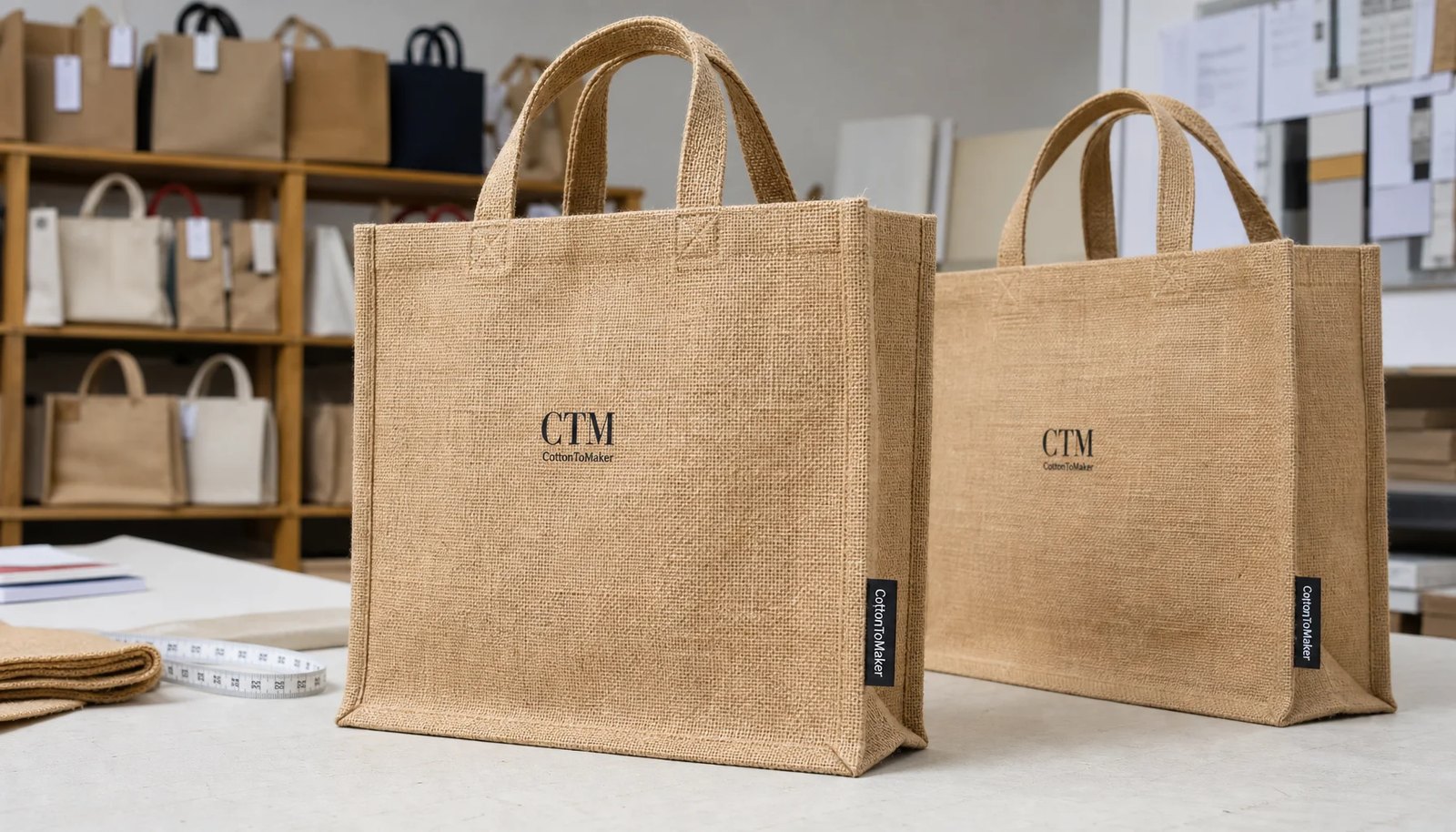
The Proofing Problem Bookstore Buyers Need to Control
Wholesale jute tote bags for university bookstores look simple on a quote sheet, but the production risk is usually in print proofing. Jute has a coarse weave, uneven natural fiber color, and higher ink absorption than cotton canvas. A logo that looks clean in a PDF can lose edge sharpness, shift off center, or look dull once printed on actual burlap. For a bookstore order tied to orientation week, alumni weekend, a campus store relaunch, or a licensed merchandise program, those issues are not cosmetic details; they affect sell-through, brand approval, and receiving deadlines.
The practical goal is to turn a print proof from a polite approval image into a production control document. Your RFQ should make the supplier prove four things before bulk production: the selected jute can carry the graphic, the print method matches the artwork, the sewing process will not disturb placement, and the packing method will protect the finished print. This guide focuses on that buying problem rather than a broad tote bag overview.
- Use a physical proof when the artwork has fine text, a university seal, mascot detail, or tight brand color requirements.
- Treat the proof as a production sample, not a marketing mockup; it should use real fabric, real ink, real handles, and real stitch construction.
- Write approval tolerances into the purchase order before the factory cuts bulk fabric.
Start With the Right Jute Specification
For university bookstore totes, the common working range is 13 oz to 15 oz jute, often described around 370 to 425 GSM depending on weave and lamination. Lighter jute may reduce cost and carton weight, but it can feel limp when carrying textbooks and may not stand well on a retail shelf. Heavier jute gives a stronger hand feel and better merchandising presence, but it increases material cost, shipping volume, and sometimes sewing difficulty at corners and handle joins.
The buyer should not accept fabric weight described only as natural jute, burlap, or standard quality. Jute varies by yarn thickness, weave tightness, lamination, backing, and finishing. Laminated jute can improve body and reduce fiber shedding, but it changes how ink sits on the surface. Unlaminated jute has a more natural touch but can bleed more and may release fibers onto printed areas. If the bookstore wants a cleaner retail finish, a cotton lining or laminated inner face may be worth quoting separately.
- Quote the bag as finished size plus gusset, not only flat panel size.
- Request GSM, oz description, lamination type, and whether the inner side is coated, uncoated, or lined.
- Ask for fabric swatches from current stock before approving artwork size and print method.
- Avoid judging jute quality only from a photo; the weave density and smell need a physical sample.
Match Print Method to Campus Artwork
Screen print is usually the safest commercial method for wholesale jute tote bags when the artwork is one to three solid colors. It gives good opacity, predictable setup cost, and stable repeatability across a bulk order. The limitation is detail. Natural jute does not behave like coated paper. Tiny serif text, thin lines, halftone gradients, and small reversed letters can fill in or look broken because the surface is uneven.
Heat transfer or digital methods may be considered when the artwork has many colors, gradients, or a photographic mascot image. However, these methods can introduce a different hand feel and may not suit buyers who want a natural campus bookstore look. Embroidered patches or woven labels can solve fine-detail problems, but they change the cost structure and create extra sewing steps. The RFQ should force the supplier to recommend a print route based on the artwork file, not quote the cheapest process by default.
- Use screen print for bold logos, bookstore names, department marks, and simple mascot graphics.
- Use a patch or woven label when the seal has fine lines that will not hold on jute.
- Avoid very small QR codes on coarse jute unless the factory proves scan performance on a real printed sample.
- For licensed marks, request a photo and physical proof before brand owner approval is submitted.
Define Artwork Files and Placement Tolerances
The best proofing checklist starts with clean artwork. Send vector files such as AI, EPS, or editable PDF with fonts outlined, Pantone references, exact print size, and a placement diagram. If the buyer only provides a low-resolution JPG pulled from a campus website, the factory may rebuild the logo, and that creates approval risk. A rebuilt logo can pass casual review but fail a licensing review because a shield, mascot outline, or wordmark spacing is slightly wrong.
Placement is also a manufacturing issue. A tote bag panel can move during cutting, printing, sewing, turning, and packing. If the artwork is printed before sewing, the print can be centered more consistently on the panel, but the final visible position depends on seam allowance and gusset forming. If printed after sewing, the bag shape can make screen contact less stable near seams. A written tolerance prevents arguments later.
- State print size as width x height and give placement from top edge and side seam or centerline.
- Use plus or minus 5 mm for standard front logo placement when the artwork is not close to seams.
- Increase tolerance for large prints near gussets or thick seam areas unless the supplier proves tighter control.
- Mark no-print zones around handles, side seams, bottom folds, and gusset edges.
- Approve the final proof at actual size, not scaled to fit an email page.
MOQ Logic for Bookstore Programs
MOQ discussions become messy when a campus buyer wants one tote body with several department logos. A factory may have one MOQ for purchasing jute fabric, another MOQ for cutting a bag size, another for print setup, and another for packing labels. If the quote only says MOQ 1,000 pieces, the buyer still does not know whether that means 1,000 pieces per logo, per color, per size, or per shipment.
A practical structure is to standardize the bag body and vary the print. For example, one natural jute tote size with the same handle, lining, and carton pack can support bookstore, alumni, athletics, and orientation designs. The factory can often produce the blank body in one run and manage print changes by screen and color. This is easier than changing size, handle, and packing for every department.
- Separate blank bag MOQ from printed design MOQ in the RFQ.
- List each artwork version with expected quantity and print color count.
- Ask whether print screens can be reused for repeat orders and how long the supplier stores them.
- Clarify whether color changes create downtime charges or minimum quantity requirements.
- Compare total program cost, not only unit price for the largest logo version.
Cost Drivers Hidden Inside Print Proofing
The unit price of a jute tote is influenced by more than fabric and sewing. Print proofing can add screen charges, sample charges, remake charges, courier fees, color matching time, and approval delays. A supplier quote that looks lower may exclude these items or assume digital approval only. For bookstore procurement, the cleaner quote is usually the one that separates tooling, sample, unit price, packing, and freight assumptions.
Cost also changes with the construction chosen to protect print quality. Printing before sewing can improve panel control, but it requires the factory to manage printed panels through sewing without stains or scratches. Printing after sewing may reduce work-in-process handling, but placement may be less precise on thick seams. A lining adds perceived value and hides lamination, but increases labor and can affect how flat the bag packs into cartons.
- Request unit price at two or three quantity breaks, such as 1,000, 3,000, and 5,000 pieces.
- Ask for separate line items for screen setup, sample cost, sample freight, retail labels, and export cartons.
- Compare carton CBM because bulky totes can make freight cost more important than a small unit price difference.
- Treat remake risk as a cost driver if the supplier will not provide a real pre-production proof.
Pre-Production Sample Approval
A pre-production sample should be built as close to bulk production as possible. It should use the selected jute weight, actual handle material, final stitch reinforcement, final print ink, and the same logo size that will run in production. If the sample is made from a different fabric stock or printed by a sample room method that differs from the bulk line, it is only a design sample. It does not prove production repeatability.
The approval record should be specific. Keep the physical sample, dated photos, measurement notes, Pantone or visual color acceptance notes, and any approved deviations. If the buyer accepts a slightly darker print because natural jute changes the color, write that down. If the logo is approved with a slightly thicker line to prevent filling, update the artwork file and send the revised file back to the supplier as the production master.
- Measure finished size, handle drop, gusset depth, and print position on the sample.
- Rub the printed area lightly after curing to see whether ink lifts or powders.
- Inspect logo edges where the weave crosses fine text or curved mascot lines.
- Fold the sample as it will be packed and check whether the print creases badly.
- Approve only one master sample per artwork version and keep it available for final inspection comparison.
Packing Decisions That Protect the Print
Jute tote packing is often treated as an afterthought, but it can damage the work completed during proofing. Bags compressed too tightly can crease laminated jute and leave pressure marks on the printed area. Cartons that are too heavy can deform bottom corners. If the bags are packed before the ink has fully cured, prints can transfer or stick under pressure, especially in warm containers.
For bookstore distribution, flat packing is usually easier for receiving and inventory counting. Inner polybags may protect against moisture and dirt, but some campus buyers prefer reduced plastic. If plastic is not wanted, kraft paper bundling or carton liners can be discussed, but moisture control still matters. The RFQ should state carton quantity, max carton weight, carton markings, SKU labels, and whether bags need to be individually tagged for retail sale.
- Confirm ink curing time before bulk packing begins.
- Specify whether each bag is individual packed, bundle packed, or bulk packed directly in cartons.
- Set a maximum carton weight that campus receiving staff can handle safely.
- Require moisture protection for export cartons, especially during rainy season or long ocean transit.
- Request carton dimensions and gross weight before approving the final freight plan.
Lead Time and Schedule Risk
A realistic schedule separates artwork review, sample making, sample transit, sample approval, material preparation, printing, sewing, inspection, packing, and export handover. Many delays start when the buyer treats sample approval as a one-day formality. If the university brand office needs to review a physical proof, the calendar must include that internal approval time.
Jute supply and printing capacity can tighten before seasonal retail peaks, campus orientation cycles, and year-end shipping windows. Natural jute color can also vary between batches, so a late reorder may not match the first run exactly. For repeat bookstore programs, it is safer to approve a fabric standard and keep records of the previous GSM, weave look, print ink, and carton pack rather than restart from a photo each season.
- Build the schedule backward from the required in-store date, not from the desired purchase order date.
- Lock artwork before sampling; artwork changes after proofing restart the approval clock.
- Ask whether bulk fabric is in stock or must be woven or purchased after deposit.
- Reserve extra time for licensed university logo approval if required by the brand owner.
- Do not approve bulk cutting until the physical print proof is accepted.
How to Compare Supplier Quotes Fairly
A fair quote comparison puts every supplier on the same specification. If Supplier A quotes 15 oz laminated jute with reinforced cotton handles and a physical proof, while Supplier B quotes standard jute with digital approval only, the lower price is not a comparable offer. The buyer should normalize fabric weight, bag size, handle specification, print method, packing, sample process, inspection, and freight data before selecting a factory.
Supplier evidence matters. For jute bookstore totes, useful evidence includes current fabric swatches, photos of actual printed jute production, a sample made on the intended process, clear carton data, and written QC tolerances. Certificates and factory profiles may support vendor qualification, but they do not replace proof that the logo can be printed cleanly on the selected jute.
- Compare finished bag weight and carton CBM along with unit price.
- Check whether the quoted price includes the same number of print colors and artwork versions.
- Give more weight to suppliers that state print limitations before sampling, not after defects appear.
- Request a defect classification list so final inspection is not based on opinion.
- Choose the route that protects the bookstore launch date, not only the lowest ex-factory price.
Specification comparison for buyers
| Spec decision | Recommended option | When it fits | Buyer risk to check |
|---|---|---|---|
| Main fabric weight | 13 oz to 15 oz laminated jute, roughly 370 to 425 GSM depending on weave density | Campus bookstores needing a tote that stands on shelf, carries books, and accepts a clear one or two color logo | Very loose weave may drink ink and distort small text; request actual GSM and finished bag weight, not only oz description |
| Print method | Screen print with high-opacity ink and controlled squeegee pressure | Most bookstore logos, mascot marks, orientation gifts, and alumni weekend merchandise | Fine serif type under 6 pt and thin reversed lines can fill in on jute; approve a printed strike-off on the actual fabric |
| Panel construction | Cut-and-sew front panel printing before bag assembly when registration matters | Artwork needs consistent placement, large front graphics, or a centered university seal | Printing after sewing may shift near side seams and bottom gusset; define placement tolerance in millimeters |
| Handle choice | Cotton webbing or padded jute handles with reinforced cross stitching | Bookstore use where shoppers may carry textbooks, drinkware, and apparel in one bag | Unreinforced jute handles can fray at the top seam; specify handle width, length, and stitch pattern |
| MOQ logic | One base size and one fabric color with artwork variations grouped by print setup | Multiple campus departments need the same tote body with different printed logos | Factories may quote low MOQ per style but add separate setup, screen, or color change charges; separate body MOQ from print MOQ |
| Proofing sample | Pre-production sample using bulk fabric, bulk handle, bulk ink, and final packing method | Orders tied to bookstore opening dates, student orientation, game day, or alumni events | Digital mockups do not prove ink gain, logo sharpness, seam allowance, or bag squareness; require physical approval before cutting bulk |
| Packing format | Flat packed in export cartons with inner polybag by pack quantity only if required by the buyer | Retail backroom storage, campus receiving docks, and distributor consolidation | Over-compression can crease laminated jute and mark the print; define carton size, max carton weight, and moisture protection |
| Inspection standard | AQL-style inspection with defined critical, major, and minor defects for print, stitching, odor, and size | Importers or distributors handling repeat bookstore programs | If print color tolerance and placement tolerance are not written, the factory and buyer may judge the same batch differently |
Buyer checklist before sampling
- State the finished bag size as width x height x gusset in centimeters or inches, and confirm whether tolerance applies before or after sewing.
- Specify jute fabric weight by GSM or oz plus lamination type, because unlaminated, laminated, and cotton-lined jute behave differently in printing and packing.
- Provide vector artwork with Pantone references, minimum line width, minimum text height, and the exact print size on the bag panel.
- Define print placement from the top edge or side seams, with an acceptable tolerance such as plus or minus 5 mm for standard screen print orders.
- Require a physical print proof on the actual jute fabric, not only a PDF mockup, before approving bulk cutting and sewing.
- List handle material, handle length, handle width, stitch reinforcement, and expected carrying load for bookstore merchandise.
- Separate MOQ requirements by bag body, artwork version, print color count, and packing version to avoid unclear quote comparisons.
- Confirm whether cartons need retail labels, SKU labels, inner packs, barcode stickers, carton marks, or campus receiving labels.
- Ask the supplier to quote sample time, bulk production time, transit-ready date, and the latest artwork approval date separately.
- Set inspection criteria for print defects, seam strength, loose threads, odor, moisture, carton damage, and color deviation before the PO is issued.
Factory quote questions to send
- What jute GSM, weave density, and lamination are included in your quote, and can you provide a swatch from current stock before sampling?
- Will the logo be printed before sewing or after sewing, and what placement tolerance can your line hold on this bag size?
- Which print method are you quoting for the artwork: screen print, heat transfer, digital print, embroidery patch, or woven label?
- How many screens or setup charges are included, and what is the cost impact if the bookstore needs two or three logo versions on the same bag body?
- What is the MOQ for the blank jute bag body, the MOQ per print design, and the MOQ per packing method?
- Can the pre-production sample use the same bulk fabric, ink, handle, stitch reinforcement, and carton packing planned for production?
- What print defects do you classify as major defects, and what AQL level or inspection method do you support before shipment?
- What is the carton quantity, carton dimensions, gross weight, and estimated CBM for 1,000, 3,000, and 5,000 bags?
- How many production days are needed after physical sample approval, and how does the schedule change during peak season or before holidays?
- Which quote items are excluded, such as sample freight, mold or screen charges, inland trucking, export documents, testing, or special labels?
Quality-control points to confirm
- Finished size tolerance should normally be written as plus or minus 1 cm for width and height, with tighter tolerance only if the bag must fit retail fixtures or mailer cartons.
- Print placement should be measured from fixed sewn edges, not from an uneven jute weave line; common tolerance is plus or minus 5 mm to 8 mm depending on print size.
- Logo color approval should use a physical printed proof because natural jute base color changes ink appearance compared with white cotton or canvas.
- Ink adhesion should be checked by dry rub and light scratch testing after curing, especially on laminated jute where surface treatment affects bonding.
- Handle strength should be verified with a practical hanging load test that reflects bookstore use, not only a brief hand pull at the sewing table.
- Seams should be inspected for skipped stitches, open corners, loose reinforcement, and fraying around handle attachment points.
- Odor and moisture should be inspected before carton closing because jute can absorb warehouse humidity and shipping container smells.
- Carton drop risk should be considered when carton weight exceeds normal manual handling limits; heavy cartons can deform bag corners and crease prints.