Start with the bookstore use case before quoting
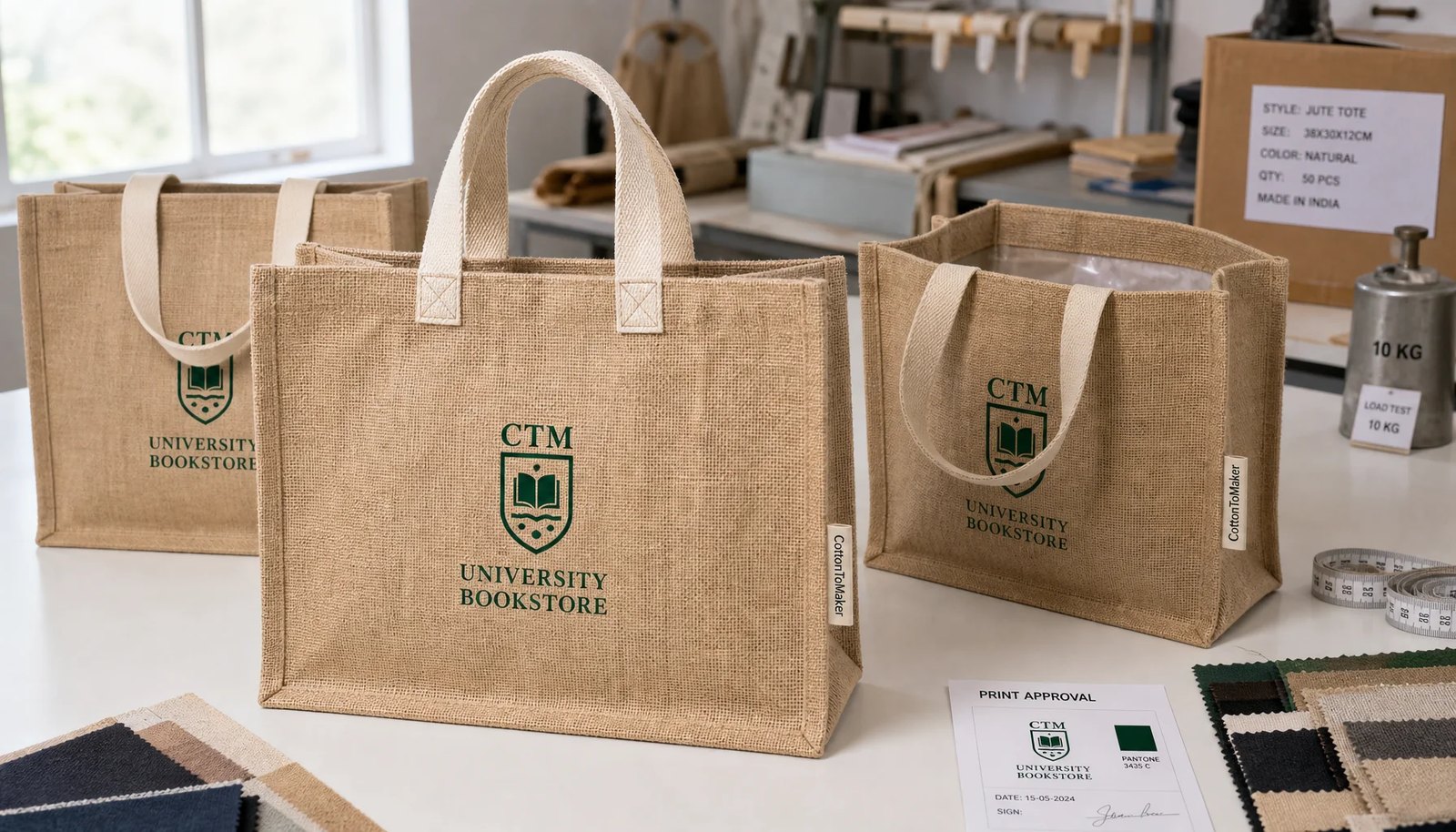
Wholesale jute tote bags for university bookstores should not begin with a catalog photo and a target unit price. Start with the campus use. A checkout tote, register-side resale item, move-in orientation giveaway, graduation merchandise piece, alumni gift, sponsor bag, and distributor stock program all ask different things from the same basic product. The use case changes the best jute GSM, weave compactness, lamination choice, handle strength, logo method, finishing level, packing plan, and lead-time buffer.
A cost-controlled checkout tote still needs to carry normal bookstore purchases without handle failure or open seams. A resale tote needs a cleaner face, better shape, neater stitching, lower odor, and more consistent logo placement because students, parents, and alumni are paying for it directly. Orientation bags live or die by schedule discipline, carton accuracy, and delivery before the event. Alumni or donor gifts may justify upgraded cotton handles, a woven side label, a hangtag, or cleaner retail packing.
The buying channel matters too. A bookstore ordering through a distributor may care most about domestic landed delivery, SKU labels, carton marks, and warehouse receiving rules. An importer buying FOB needs carton cube, port name, inspection timing, export documentation, and payment milestones. A campus department may be focused on licensed artwork approval and a fixed event date. Put the use case and buying channel at the top of the RFQ so every supplier prices the same product intention.
- For textbook and hoodie purchases, specify gusset depth, reinforced handles, and a load target rather than a flat promotional tote.
- For resale, define retail appearance standards: trimmed threads, straight seams, lower odor, cleaner jute, and consistent logo position.
- For orientation or event bags, confirm in-hand date, receiving location, and delivery buffer before adding complex decoration.
- For distributor stock, request carton dimensions, gross weight, SKU labels, mixed-design rules, and pallet requirements early.
- For licensed university marks, identify whether approval is required from the bookstore, licensing office, marketing, athletics, or alumni team.
Turn the RFQ into a controlled specification
A procurement-grade RFQ turns vague preferences into measurable requirements. Words like premium jute, strong handle, large tote, good print, natural look, and retail quality sound helpful, but they are not enough for fair B2B comparison. They let suppliers quote different constructions while appearing to answer the same request. A stronger spec states finished dimensions, GSM range, weave description, lamination, handle material, handle drop, print method, packing, inspection expectations, and lead-time assumptions.
Keep required specifications separate from optional upgrades. Inside PP lamination may be essential for a structured retail tote but unnecessary for a rustic event giveaway. Individual polybags may be required for distributor resale, barcode handling, or clean shelf presentation, yet waste cost and labor for a bookstore that unpacks cartons immediately. Woven labels, hangtags, custom carton labels, desiccants, and palletization can be valuable, but they should be visible quote lines rather than buried inside a unit price.
The spec sheet should control the quote, sample, production approval, inspection, and dispute resolution. If a buyer may reject goods later for an issue, the requirement belongs in writing before production starts. This is especially important for university bookstore orders because artwork versions, event dates, receiving labels, and carton counts can be as critical as the bag construction itself.
- Use one spec sheet for finished size, gusset, handle drop, handle spacing, print size, print position, fabric, lamination, and packing.
- Set practical tolerances before sampling, such as +/- 0.5 in for bag size and tighter limits only where the factory confirms feasibility.
- List optional items separately: woven labels, hangtags, barcode stickers, individual polybags, desiccants, palletization, and custom carton marks.
- Name the approved artwork file version and Pantone references so outdated logos or wrong department marks do not enter production.
- Use the same specification for all tiered prices so 500-piece and 2,500-piece quotes are genuinely comparable.
Specify jute GSM, weave, and lamination accurately
Jute is often quoted with loose factory labels: standard, economy, heavy, export quality, premium, or eco. Those labels do not tell procurement enough. Mills and workshops can use different yarns, weave densities, and finishing methods under the same wording. For many medium gusseted university bookstore totes, natural jute around 270-320 GSM is a practical starting range, but the right range depends on finished size, boxed bottom, lamination, handle reinforcement, expected contents, and desired retail appearance.
Weave compactness can matter as much as headline GSM. A loose weave may feel collapsible and show visible gaps even when the supplier calls it heavy. A tighter weave usually improves print coverage and shelf appearance, although it can add cost and weight. Natural jute shade also varies by lot, so approve a shade range from real swatches or a pre-production sample instead of expecting one exact color. If the tote will touch apparel, paper goods, or gifts, check fiber shedding and interior cleanliness early.
Lamination is both a structure decision and a cleanliness decision. Inside PP lamination can help the tote hold shape, reduce shedding, and give notebooks, folded clothing, and gifts a smoother interior surface. It is useful for boxed-bottom retail totes and bags displayed upright. Unlaminated jute may fit a rustic or lower-cost program, but it can collapse more easily and shed more fibers. If lamination is quoted, ask for lining finish, approximate thickness, odor expectation, fold behavior, and seam edge quality.
- Request GSM range, weave description, and physical swatch instead of accepting only the supplier’s fabric name.
- Approve natural shade from a real sample and allow a controlled range for normal jute fiber variation.
- Use lamination for structured retail totes, boxed-bottom shapes, and programs where shedding onto apparel or books is a concern.
- Check lamination for odor, fold cracking, bubbling, wrinkles, and exposed sharp edges near seams or gussets.
- Avoid very light or loose-weave jute for bags expected to carry textbooks, bottles, binders, and bundled bookstore merchandise.
Define dimensions, gusset, and printable area
Bags that look similar on a quote sheet can behave very differently in a bookstore. A flat 14 x 15 in tote is not the same product as a 15 x 16 x 6 in gusseted tote. The gusset adds fabric, cutting time, sewing complexity, carton cube, and real carrying value. It also changes how the logo looks once the bag is filled. A front print that appears centered on a flat sample may shift visually when the gusset pulls the panel outward.
A general university bookstore tote usually needs enough volume for folded sweatshirts, notebooks, binders, textbooks, mugs, bottles, and small gift items. Bigger is not always better. Oversizing raises material cost and freight cube without guaranteeing stronger resale value. Undersizing may make the unit price look attractive, then disappoint customers at the register. Fill the sample with realistic bookstore products, not only tissue paper or showroom props.
The RFQ should state finished dimensions after sewing, not cut panel size. It should also define how measurements are taken: flat, opened, standing, or filled. For many soft sewn jute bags, +/- 0.5 in on width, height, and gusset is a reasonable starting point, but agree on tighter or looser limits before sampling. Logo placement tolerance should be measured from fixed edges, seams, or centerlines rather than judged by eye.
- Use a clear format such as finished size 15 in W x 16 in H x 6 in gusset, measured after sewing and normal packing recovery.
- State whether width means front panel width only or total bag width including gusset folds.
- Confirm printable area after top hem, side seams, bottom seam, gusset folds, and handle attachment are deducted.
- Test sample capacity with actual items such as one hoodie, two notebooks, one bottle, one binder, and one textbook.
- Decide whether the tote must stand when empty, stand when filled, or simply fold flat for efficient carton packing.
Treat handles as a strength specification
Handle construction is one of the easiest places for a low quote to hide weakness. A university bookstore jute tote must be comfortable enough for campus carrying and strong enough for books. Handle material, width, length, attachment method, thread, and reinforcement should be defined before price comparison. Cotton webbing is common because it feels softer on the shoulder, gives a clean retail look, and can match many university color palettes. Jute rope or twisted handles can look rustic, but they may be less comfortable under load and more variable at attachment points.
For heavier bookstore use, handles should be sewn into a secure top hem or attached with a defined reinforcement pattern. Box-X stitching is easy to inspect because the reinforcement is visible. Bartacks can also work at stress points if the factory has the right equipment and consistent thread tension. Define total handle length and finished drop. A short hand-carry drop may suit checkout bags, while a shoulder-friendly drop makes the tote more reusable around campus.
Load testing belongs in the specification, not as a last-minute request. For many bookstore totes, a static load test of 10-12 kg for 30 minutes is a practical starting point, adjusted by bag size and buyer expectations. Premium retail programs may also need repeated lifting or short dynamic carry checks. Test random finished bags from packed cartons because showroom samples and factory-retained samples may not represent normal bulk production.
- Specify handle material and width, such as 1.25 in or 1.5 in cotton webbing, instead of saying standard handle.
- Define total handle length, finished drop, handle spacing, color, thread, and whether shoulder carry is required.
- Require box-X stitching, bartacks, or another visible reinforcement method at handle stress points.
- Check that stitching does not tear through laminated jute when load is applied.
- Record load-test method, weight, time, sample quantity, and pass/fail criteria before the PO is issued.
Match logo method to jute texture and brand rules
Jute is not smooth cotton canvas. The weave is coarse, the face is uneven, and the natural tan base changes how ink appears. Screen printing is usually the most practical method for university bookstore logos, department names, event text, sponsor marks, and one to three solid colors. It offers predictable setup and reasonable repeatability when the artwork is prepared for the fabric.
Artwork expectations need discipline before production starts. Fine outlines, small legal copy, gradients, distressed textures, halftones, and detailed mascot features may not reproduce cleanly on jute. Heat transfer can handle more detail, but it must be tested on actual jute for adhesion, edge lifting, cracking after folding, gloss level, and hand feel. A glossy transfer can look out of place on rustic jute if the bookstore expects a natural finish. Digital mockups help with layout, but they do not prove ink coverage, registration, or color on the woven surface.
Licensed university marks add approval risk. Suppliers should receive approved vector artwork, Pantone references, logo clear-space rules, print size, print position, and the exact artwork file version. Approve a physical strike-off before mass printing, especially for school colors, mascots, athletics marks, and co-branded sponsor graphics. Define acceptable variation as well, because some texture show-through is normal on jute.
- Provide vector artwork with Pantone references, print dimensions, clear-space rules, and the approved version name.
- Use screen print for solid bookstore names, department marks, simple mascots, and one to three color graphics.
- Use heat transfer only after testing adhesion, edge lift, folding behavior, appearance, and hand feel on actual jute.
- Avoid small type, thin outlines, and complex gradients unless the supplier proves acceptable results with a strike-off.
- Measure logo placement from fixed references such as top edge, side seam, bottom seam, or panel centerline.
Compare MOQ, tiers, and cost drivers fairly
MOQ for wholesale jute tote bags is shaped by fabric procurement, cutting efficiency, print setup, labor scheduling, and export packing. A supplier may accept a low quantity for a simple natural jute tote, but the unit price often carries setup inefficiency. For university bookstore programs, 500-1,000 pieces per artwork is often a useful quote comparison range, while 2,500 pieces and higher may improve material yield and spread screen or setup charges over more units.
Request tiered pricing against the exact same specification. A 500-piece quote with narrow handles and no lamination should not be compared with a 1,000-piece quote using laminated jute, wider webbing, and barcode labels. Custom dyed jute, special handle colors, woven labels, hangtags, multiple logos, individual polybags, palletization, and split shipments can all affect MOQ or add separate charges. Artwork count deserves special attention because universities often need versions for campuses, departments, athletics, alumni, sponsors, and events.
A useful quote separates unit price from setup and service costs. Screen charges, sample fees, label costs, barcode sticker costs, carton label costs, packing upgrades, palletization, inspection, and special shipping instructions should be visible. The lowest unit price is not automatically the best procurement result. The better comparison is landed cost per usable accepted bag that matches the approved sample and arrives on time.
- Request tiered pricing at 500, 1,000, 2,500, and 5,000 pcs using the same size, fabric, handle, logo, and packing spec.
- Separate MOQ by bag size, fabric color, handle color, artwork version, label type, packing style, and shipment date.
- Ask for line items for sample charge, screen charge, setup charge, unit price, packing charge, and optional add-ons.
- Treat split shipments, mixed designs, barcode labeling, and individual polybags as cost drivers, not small administrative details.
- For replenishment, consider one core bookstore design instead of many small designs that each trigger setup cost.
Approve samples as production standards
A pre-production sample is not just a presentation piece. It becomes the production standard for fabric shade, lamination, handle feel, seam construction, print coverage, logo placement, bag shape, odor, labels, and packing. If the sample is made with substitute jute, available webbing, different thread, or a different print process, it should be treated as a development sample only. A true pre-production sample should use the same materials and process planned for bulk production.
Sampling is especially important for university bookstores because approvals may involve the bookstore manager, licensing office, athletics department, marketing team, alumni association, sponsor, or outside distributor. Each stakeholder notices different details. Licensing checks logo accuracy and color. Retail checks shelf appearance. Procurement checks price, lead time, inspection terms, and receiving data. A signed sample reduces confusion when bulk goods arrive.
Evaluate the sample like a working bag. Measure it. Fill it with intended products. Carry it by the handles. Fold it and open it again. Place it in a closed carton or polybag overnight, then check odor after opening. Compare the print with the approved artwork and Pantone reference while allowing for jute texture. If the sample fails, record the correction clearly and request a revised sample or written corrective confirmation before production.
- Measure sample width, height, gusset, handle drop, handle spacing, print size, and print location.
- Confirm the same jute, lamination, handle webbing, thread, print method, labels, and packing planned for bulk production.
- Check odor after the bag has been enclosed in a carton or polybag for at least 24 hours.
- Load test the sample with realistic bookstore contents instead of light display filler.
- Sign or label the approved sample and keep a buyer-side reference sample for final inspection comparison.
Build comparisons from landed cost and receiving data
Two wholesale jute tote bag quotes can look close on paper and still create very different landed costs. Unit price is only one line. Buyers also need setup charges, sample fees, carton quantity, carton dimensions, gross weight, net weight, estimated CBM, packing method, payment terms, inspection cost, freight basis, and delivery term. A lower unit price with bulky cartons, weak packing, or higher defect risk can lose against a slightly higher unit price with better carton efficiency and tighter production control.
For importers and distributors, the quote should clearly state whether the price is EXW, FOB, CIF, DDP, or another agreed term. FOB quotes need port name and export packing assumptions. DDP or domestic delivered quotes should clarify whether duties, customs clearance, delivery appointment, liftgate, palletization, or inside delivery are included. Even when a university bookstore buys through a domestic supplier, carton cube affects warehouse handling, freight allocation, and final wholesale pricing.
Receiving data matters because bookstores and campus warehouses operate on schedules. Carton marks should show PO number, SKU, artwork version, quantity, carton number, destination, and country of origin where required. If multiple departments or event designs are packed together, mixed-carton rules must be clear. A procurement comparison should ask not only what the tote costs, but how accurately the order can be received, counted, stored, and distributed.
- Require carton dimensions, pieces per carton, gross weight, net weight, and estimated CBM before supplier selection.
- Compare landed cost per usable accepted bag, including setup charges, freight impact, inspection, and expected defect allowance.
- Record quote validity because jute, cotton webbing, labor, and freight costs can change between RFQ and purchase order.
- Clarify trade term, port, delivery point, payment terms, palletization, and delivery appointment requirements.
- Ask for a packing list format before shipment so receiving teams can verify SKUs without opening every carton.
Control packing, moisture, QC, and lead time
Packing choices affect freight cost, receiving labor, product appearance, and defect risk. Jute totes are often flat packed, but pieces per carton should match bag size and structure. A medium laminated tote may pack well at 40-60 pieces per carton, depending on gusset, handle bulk, and panel stiffness. Overstuffed cartons can create permanent fold lines, crushed corners, distorted laminated panels, and handle creases. Individual polybags protect against dust, yet they add cost, plastic waste, and unpacking labor, so use them only when retail presentation, barcode rules, or distributor requirements justify them.
Moisture control deserves attention because jute is a natural fiber. Cartons should be clean, dry, and strong enough for stacking. Desiccants or other moisture-control steps may be needed during humid production seasons, long ocean transit, or storage in variable warehouse conditions. Mold odor, mildew marks, damp cartons, and visible contamination should be treated as serious defects for bookstore retail goods. If goods are palletized, specify pallet size, maximum height, wrapping, mixed-SKU rules, and carton label position.
Quality control should be written before production. Define critical, major, and minor defects for wrong artwork, mold, odor, open seams, skipped stitches, loose threads, stains, broken yarns, print bleeding, print misplacement, carton shortage, barcode errors, and wrong packing. Many buyers use an AQL-style final random inspection, but the exact sampling plan, acceptance level, and defect classification should be agreed in writing. Include random load testing from packed cartons and measurement checks against the approved tolerance sheet.
Lead time planning must protect bookstore selling dates. Demand often ties to move-in week, orientation, graduation, homecoming, alumni weekend, new semester launches, or sponsor events. Work backward from the required store or warehouse arrival date and include artwork approval, sample production, revision time, material booking, cutting, printing, sewing, inspection, inland transport, export handling, freight transit, customs if applicable, and campus receiving. If artwork approval slips, the buyer should expect schedule risk or rush cost.
- Define carton marks with PO number, SKU, artwork version, quantity, carton number, destination, and country-of-origin marking if required.
- Use flat bulk packing unless individual polybags, hangtags, barcode stickers, or retail presentation requirements justify the cost and labor.
- Add moisture-control requirements for humid-season production, long transit, or storage-sensitive bookstore programs.
- Set inspection plan, defect definitions, tolerances, load-test method, and inspection timing before issuing the purchase order.
- Protect fixed campus dates with latest artwork approval, latest sample approval, inspection window, ship date, and required delivery date.
Specification comparison for buyers
| Spec decision | Recommended option | When it fits | Buyer risk to check |
|---|---|---|---|
| Primary use case | Define checkout, resale, orientation, alumni, department, sponsor, or distributor stock before requesting prices | Helps align construction, packing, logo finish, and lead time with the actual campus program | A generic RFQ can produce quotes with different fabric weights, handle strengths, carton counts, and finishing levels |
| Jute fabric | Natural jute approx. 270-320 GSM for many medium bookstore totes; confirm with bulk swatch and finished sample | Gusseted bookstore totes carrying books, apparel, notebooks, bottles, and gift items | Supplier terms such as standard, heavy, premium, or eco are not measurable; request GSM range and weave description |
| Lamination | Inside PP lamination, commonly matte or semi-matte, low odor, smooth at seams, and resistant to cracking after folding | Retail totes, boxed-bottom bags, apparel programs, and orders needing cleaner interior surfaces | Low-grade lamination can smell strong, wrinkle, crack at folds, or leave sharp edges near seams and gussets |
| Finished size | Example all-purpose size: 15 in W x 16 in H x 6 in gusset, with +/- 0.5 in tolerance unless a tighter tolerance is approved | Bookstore shopping, sweatshirt purchases, textbooks, graduation gifts, and reusable campus carrying | A smaller gusset lowers cost but can make the tote poor for bulky hoodies, binders, mugs, and mixed purchases |
| Handles | 1.25-1.5 in cotton webbing, shoulder-friendly drop, sewn into the hem or reinforced with box-X or bartack stitching | Reusable retail totes and any bag expected to carry several books or heavy merchandise | Thin webbing, short drop, light thread, and weak handle attachment are common hidden downgrades in low quotes |
| Load target | Set a practical static load test, such as 10-12 kg for 30 minutes, plus visual inspection after unloading | Bookstore bags used for textbooks, bottles, notebooks, and apparel bundles | Fabric may look acceptable but fail at handle stitching, top hem, side seam, or gusset under real weight |
| Logo method | Screen print for solid marks; heat transfer only after adhesion, folding, and edge-lift testing on actual jute | University logos, bookstore names, event marks, department versions, sponsor marks, and licensed artwork | Jute texture breaks fine detail; digital mockups do not prove ink coverage, registration, or Pantone appearance |
| MOQ and price tiers | Quote 500, 1,000, 2,500, and 5,000 pcs per artwork using the same controlled specification | Annual replenishment, move-in week, graduation, homecoming, and distributor stock planning | Low MOQ can increase setup cost, sample cost, screen charge per unit, carton inefficiency, and limited customization options |
| Sample approval | Approve a true pre-production sample using actual fabric, lamination, handles, thread, print method, and packing | Orders needing bookstore, licensing, athletics, marketing, alumni, or distributor approval | A showroom or substitute sample cannot validate bulk material shade, odor, print behavior, handle strength, or carton recovery |
Buyer checklist before sampling
- Define the distribution channel and use case first: checkout tote, retail resale item, orientation giveaway, alumni gift, department merchandise, sponsor bag, or distributor replenishment stock.
- State finished dimensions with width, height, gusset, handle drop, handle spacing, printable area, and measurement method instead of sending only a catalog photo.
- Set tolerances before sampling: common starting points are +/- 0.5 in for bag dimensions, +/- 0.25 in for handle drop, and +/- 0.25-0.5 in for logo placement depending on artwork size.
- Specify jute by GSM range, weave compactness, natural or dyed color, lamination requirement, lining finish, shade range, odor expectation, and acceptable fiber variation.
- Confirm intended contents such as textbooks, hoodies, binders, bottles, laptops, notebooks, or gifts, then set a load test such as 10-12 kg static load for 30 minutes.
- Define handle material, width, color, total length, finished drop, attachment method, seam allowance, thread quality, stitch pattern, and reinforcement at stress points.
- Provide approved vector artwork with Pantone references, print dimensions, minimum line thickness, logo clear space, placement references, and separate files for each campus or department version.
- Ask the supplier to confirm print method on actual jute, number of colors, maximum printable area, screen charge, setup charge, strike-off cost, and artwork approval timing.
- Separate quote lines for sample charge, screen charge, label or hangtag charge, barcode sticker charge, unit price, packing charge, carton dimensions, gross weight, CBM, and freight term.
- Request carton data before PO approval: pieces per carton, carton size, gross weight, net weight, carton marking layout, estimated CBM per 1,000 pcs, and palletization rules if applicable.
Factory quote questions to send
- What exact jute GSM range, weave description, yarn construction if available, and fabric width are included in this quote, and can you provide a bulk swatch before sample approval?
- Is the jute laminated, and if yes, what lining material, approximate thickness, finish, odor-control process, and compliance information can you provide if required by our buyer?
- What finished size tolerance do you apply for width, height, gusset, handle drop, handle spacing, handle attachment position, and print placement after sewing and packing recovery?
- Which handle material, width, total length, finished drop, color, thread, and reinforcement method are quoted, and is the handle sewn into the top hem or attached only to the panels?
- Which print method is quoted, how many colors are included, what is the maximum printable area, and what screen, setup, strike-off, or transfer charges apply per artwork?
- Can you print our exact logo on actual production jute before bulk approval, and can you define acceptable limits for texture show-through, registration shift, bleeding, and color variation?
- What is the MOQ per size, fabric color, handle color, artwork, label type, packing style, and shipment, and how does price change at 500, 1,000, 2,500, and 5,000 pieces?
- What sample lead time, revision lead time, bulk lead time after sample approval, inspection window, and latest artwork approval date are required to meet our requested warehouse date?
- What carton dimensions, pieces per carton, gross weight, net weight, estimated CBM per 1,000 pcs, and recommended pallet quantity are included in the quote?
- Does the quote include individual polybags, hangtags, barcode stickers, country-of-origin labels, carton labels, desiccants, palletization, or retailer-specific packing instructions?
Quality-control points to confirm
- Bulk jute fabric should match the approved sample in natural shade range, weave compactness, fabric weight, lamination feel, panel stiffness, fiber shedding level, and odor.
- Finished dimensions should stay within agreed tolerances for width, height, gusset, handle drop, handle spacing, and print position after sewing and normal packing recovery.
- Logo placement should be measured from fixed reference points such as top edge, side seam, bottom seam, or panel centerline instead of judged only by visual centering.
- Screen print should match the approved strike-off for ink coverage, registration, line clarity, color appearance, and texture show-through, with no excessive bleeding, smearing, cracking, or missed areas.
- Heat transfer, if used, should be checked on actual jute for adhesion, edge lifting, cracking after folding, color accuracy, gloss level, and hand feel.
- Handles should be symmetrical, securely attached, correctly spaced, and reinforced with consistent box-X stitching, bartacks, or the approved stress-point construction.
- Top hems, side seams, bottom seams, and gusset folds should be straight and secure, with no open seams, skipped stitch runs, exposed sharp lamination edges, or loose thread clusters.
- Load testing should be performed on random finished bags from packed cartons, not only on factory-retained samples, with results recorded against the approved test weight and time.
- Odor, moisture, mold, mildew marks, oil stains, rust stains, dark contamination, and strong chemical smell should be treated as serious defects for bookstore retail goods.
- Carton count, SKU label, artwork version, PO number, country-of-origin marking, barcode, carton quantity, and packing list should match the purchase order and receiving instructions.