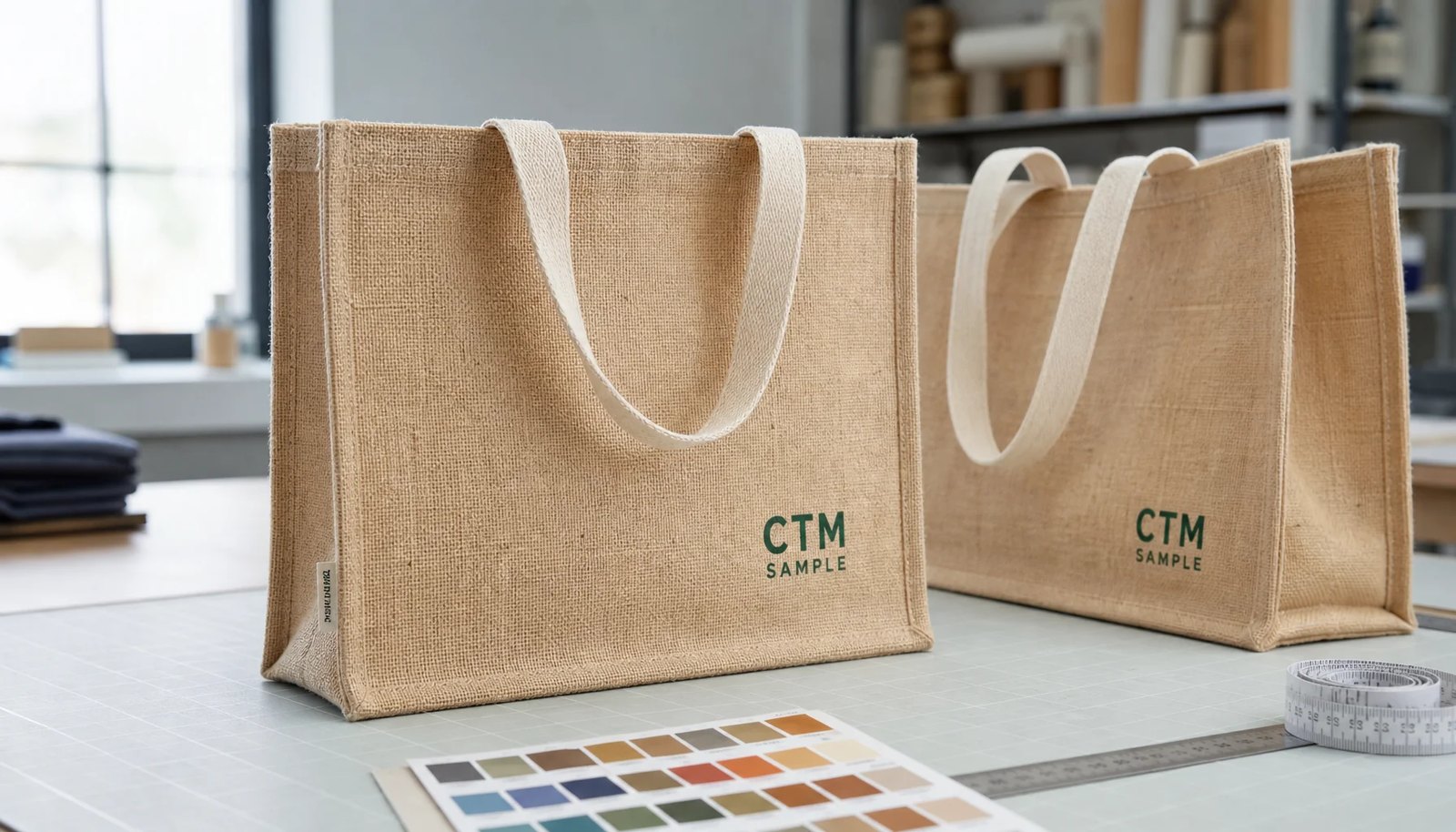
Start With The Event Job, Not The Product Photo
Wholesale jute tote bags for trade show exhibitors should be sourced around the job they must perform, not around the nicest product photo in a supplier catalog. A photo can show natural jute, handles, a gusset, and approximate shape. It cannot prove that a catalog fits flat, that the handle survives a loaded show day, that the print is readable from an aisle, or that cartons arrive sorted for booth setup.
The first procurement question is simple: what will this bag do at the event? A registration giveaway needs dependable volume, clear branding, efficient packing, and quick handout. A VIP buyer kit may need heavier jute, a cleaner laminated interior, softer handles, tighter logo placement, and better carton protection. A retail resale tote needs stronger cosmetic control because the attendee is judging it as a product, not only as packaging.
Jute brings useful texture and a natural look, but it is not a smooth printing surface. Slubs, fiber shade variation, raised yarns, and uneven weave are part of the material. The goal is not to erase every natural variation. The goal is to decide which variations are acceptable and which defects would make the tote unsuitable for an exhibitor program with fixed dates and brand visibility.
A good RFQ gives the supplier context: distribution method, expected contents, artwork approval process, shipping destination, packing rules, and event date. Those details help the factory quote the correct construction and help the buyer compare suppliers fairly. A low unit price is not useful if it excludes reinforced handles, physical proofing, carton sorting, or the print process the artwork actually needs.
- For mass giveaways, prioritize stable construction, clear front-panel logo visibility, quick handout, and predictable carton counts.
- For hosted-buyer or VIP kits, specify stronger handles, heavier jute, cleaner finishing, and tighter cosmetic inspection.
- For press packs, confirm folder and sample dimensions so the bag does not bend or distort the contents.
- For sponsor bags, approve logo hierarchy early and avoid layouts crowded with small marks.
- For direct venue delivery, treat carton marks, destination splits, and packing orientation as part of the product specification.
Turn Marketing Language Into A Buyable Specification
Marketing briefs often sound polished but leave procurement exposed. Phrases such as natural jute tote, premium quality, centered logo, and strong handles are directionally useful. They are not enough to buy from. A procurement-ready specification names the finished size, gusset, jute weight, lamination, handle material, handle drop, decoration method, logo dimensions, print position, tolerances, packing plan, and inspection criteria.
Start with finished size in millimeters. A 380 x 420 x 150 mm tote behaves very differently from a flat 350 x 400 mm tote. The gusset changes capacity, standing shape, carton volume, and how the printed panel looks when the bag is opened. State whether measurements are taken on the flat finished bag, the opened bag, or another agreed method. For many sewn promotional bags, a body tolerance around +/-10 mm may be realistic, but the supplier should confirm what they can hold for the chosen construction.
Then define the contents. A bag carrying lightweight brochures does not need the same reinforcement as a bag carrying catalogs, bottles, apparel, sample boxes, and chargers. If an A4 folder, sample kit, notebook, or packaging insert must fit flat, include that item size in the RFQ. If the tote must stand upright for kit assembly or booth display, say that before the sample is built.
Receiving requirements also belong in the early quote. Will the bags be stacked behind a registration counter, kitted by a third party, shipped to a hotel receiving dock, or split across several regional shows? Do they need individual polybags, tissue, desiccant, barcodes, item labels, or carton marks by booth number? These are not afterthoughts. They affect labor, cost, carton size, and delivery risk.
- State finished bag size as width x height x gusset in mm, plus the measurement method.
- Include tolerance for body dimensions, handle drop, and print position instead of approving vague size language.
- List expected contents and approximate carry weight rather than asking for a generally strong bag.
- Identify must-fit items such as A4 folders, catalogs, sample boxes, or notebooks.
- Add packing, carton marking, and destination sorting requirements to the RFQ before price comparison.
Specify Jute Weight, Weave, Lamination, And Shade Range
Many trade show jute totes are sourced in the 13-15 oz range, often discussed as roughly 380-430 GSM equivalent depending on mill practice, lamination, finishing, and measurement method. Buyers should be careful with these numbers. Ounce weight and GSM are not always quoted consistently, and lamination can blur the comparison. The safer route is to approve a fabric swatch or pre-production sample and reference that control material in the purchase order.
Lighter jute can reduce cost, carton weight, and freight. It can also produce a looser panel, softer shape, and weaker print definition. Heavier jute can feel more substantial and may stand better at a booth, but it increases volume and handling weight. There is no single correct weight for every event. A short-run registration giveaway and a reusable VIP kit do not need the same construction.
Lamination is one of the most important choices. Inside laminated jute can improve shape retention, reduce loose fiber inside the bag, and provide mild protection for paper contents from light surface moisture. It also creates a cleaner interior for kit packing. The tradeoffs are real: lamination may affect environmental messaging, add odor risk, crack if folded tightly, and show creases if cartons are compressed.
Unlaminated jute can support a more natural material story, but the buyer should accept a softer structure, a rougher interior, and more fiber shedding. If the event brief includes sustainability language, avoid broad claims unless the full product supports them: jute body, lamination, handle material, labels, inks, and packaging. Ask for material composition instead of relying on general eco wording.
Shade variation is normal with natural jute. The RFQ should define an acceptable shade range using approved swatches or sample photos under consistent lighting. Natural jute will not behave like dyed cotton or a coated paper substrate. Decide early whether the warm, variable base is part of the desired look or a risk for brand consistency.
- Approve a jute swatch or control sample instead of relying only on quoted GSM.
- Ask whether weight is for fabric before lamination, after lamination, or finished composite material.
- Use laminated jute when structure, cleaner interior, and mild moisture resistance are priorities.
- Use unlaminated jute only when the brief accepts softer shape, rougher interior, and more natural variation.
- Define acceptable shade range, odor level, lamination behavior, and weave character before bulk production.
Match Print Method To Artwork Reality
Screen print is usually the practical choice for wholesale jute tote bags when the artwork uses one to three solid colors. It works well for bold logos, large sponsor marks, simple icons, and direct event messaging. Its limitation is the surface. Ink sits on raised fibers and uneven gaps, so small counters inside letters, tight spacing, fine rules, and pale colors can lose clarity.
Transfer or digital transfer methods can help when artwork includes gradients, photographic images, many colors, or strict multi-color brand marks. They may hold detail that direct screen print cannot reproduce cleanly on jute. The buyer still needs to review the finish. A transfer can look like a film on top of natural fiber, and its edge, gloss, flexibility, handfeel, and adhesion should be checked on an actual sample.
The print decision should follow artwork review, not precede it. A simplified one-color logo may be far more visible across a busy aisle than a full-color mark that becomes muddy on textured fabric. Sponsor grids may need to be rearranged so the smallest marks remain legible. QR codes, URLs, legal lines, certification icons, and narrow script fonts deserve special caution.
Ask the supplier for minimum recommended positive line width and reversed text height on the specific jute being quoted. As a working guardrail, be cautious with positive lines below about 1 mm and reversed text below about 8-10 mm high, especially in narrow fonts. These are not universal rules. They are starting points until the factory proves smaller detail on the selected material.
Color changes on jute. Pantone references help with ink mixing, but the tan base warms and dulls many colors. White may not look crisp. Yellow can lose contrast. Light gray may almost disappear under exhibition lighting. Darker tones such as black, deep green, navy, and dark brown often read better from a distance, but physical proofing should make the final decision.
- Use screen print for bold solid artwork, large type, simple icons, and high-contrast exhibitor logos.
- Use transfer printing when many colors or gradients are required, but approve surface feel and edge quality physically.
- Ask the factory to mark risky artwork areas before screens or transfers are made.
- Avoid designs that depend on tiny reversed type, fine rules, low-contrast colors, or exact edge sharpness.
- Scan QR codes from a physical printed sample with a normal phone under indoor lighting before approval.
Build A Print Proofing Checklist Buyers Can Enforce
A useful proofing process separates layout approval from production approval. A digital proof confirms artwork position, size, spelling, logo version, color references, and sponsor order. It does not confirm how ink behaves on jute. It also cannot prove whether a QR code scans, whether color reads correctly on the natural base, or whether the logo still looks centered when the bag is opened.
The purchase order should state print dimensions in millimeters and define position from fixed reference points. A clear instruction might read: front panel screen print, 180 mm wide, centered horizontally, top of logo 80 mm below top edge, print-position tolerance +/-5 mm. If the tote has a large gusset or bottom fold, check the logo on both a flat bag and an opened standing bag.
Proofing should include edge quality, opacity, registration, and readability. Inspect whether small letters fill in, thin lines break, ink bleeds into the weave, pinholes appear in solid areas, or multi-color elements shift. If a sponsor logo is barely readable on the proof, bulk production will not make it better. Fix the artwork before mass printing.
Color acceptance should be tied to the approved physical sample, not only to a Pantone number. Natural jute changes perceived color, and fabric batches can shift the result. Define acceptance in practical terms: close visual match to approved sample under consistent lighting, no obviously wrong ink, no patchy opacity, and no major color drift across panels.
Keep one approved control sample for production, inspection, and repeat orders. Label it with supplier name, date, artwork version, bag size, jute specification, handle specification, print method, and approval status. That one sample can prevent long arguments when the warehouse, inspector, distributor, or event team checks the bulk order.
- Confirm correct logo version, spelling, sponsor order, print size, and placement on the digital proof.
- Approve final color, edge quality, opacity, readability, and QR scanability on physical jute.
- Measure print position from top edge, side seam, handle base, or bottom fold rather than from a mockup only.
- Reject proofs with filled-in letters, broken lines, tilted placement, heavy smudging, or major registration errors.
- Label and retain an approved control sample for bulk inspection and future reorders.
Test Handles, Carry Load, Shape, And Odor On The Sample
A pre-production sample should be handled like an event bag, not treated like a photo prop. Load it with realistic contents, lift it repeatedly, place it on a table, open and close it, and check whether it still looks presentable. Trade show attendees may add catalogs, bottles, garments, electronics, chargers, and personal items. An empty tote can look tidy while a loaded one twists, sags, or strains.
Handle drop affects comfort and logo visibility. A short drop may work for hand carry but feel awkward over a jacket. A longer shoulder drop can improve comfort, yet it may make the bag hang low, tangle during packing, or reduce front-logo visibility when carried. Specify handle drop with tolerance and test it with the kind of clothing staff and attendees are likely to wear at the event.
Handle material should be named, not assumed. Cotton webbing is common because it suits the natural look and packs relatively well. Rope handles can feel more premium but may increase carton volume and require different reinforcement. Webbing width, rope diameter, stitching pattern, and handle attachment method should all appear in the quote.
For heavier kits, specify reinforcement such as box-X stitching, cross-stitching, or agreed bar tacks. Ask the supplier to state the load test method. A practical test may load the tote to the agreed kilogram weight and lift it for a defined period or number of cycles. Methods vary by supplier, but handle strength should never be approved by photo alone.
Odor is worth checking early. Jute has a natural smell, and laminated or recently packed bags may also carry odor from coating, ink, adhesive, humidity, or storage. A mild natural fiber smell may be acceptable. Strong chemical, musty, or damp odor is a problem for indoor venues and VIP kits. Open the sample, air it briefly, and decide what odor level is acceptable before bulk shipment.
- Load the sample with realistic event contents and check handle strain, panel distortion, and bag balance.
- Specify handle drop in centimeters or millimeters with tolerance, and test hand carry versus shoulder carry.
- Confirm handle material, width or diameter, color, stitch pattern, and reinforcement method.
- Check laminated interiors for cracking, bubbling, sticky feel, sharp edges, delamination, and odor.
- Reject samples with severe handle twist, rough handfeel, loose stitches, musty smell, or obvious panel sag under expected load.
Prevent Sponsor Logo, QR Code, And Artwork File Mistakes
Many jute tote problems start before the factory touches fabric. Sponsor artwork is often collected late, supplied in mixed formats, and squeezed into a layout that is too small for the material. Jute is not label stock. Fine sponsor logos, thin legal lines, delicate icons, and pale colors can disappear into the weave.
Procurement should ask the brand or agency for a print-ready hierarchy. One primary logo should dominate. Secondary marks should be large enough to read. Nonessential details can move to a hangtag, insert, printed label, landing page, or booth signage if they cannot print cleanly on jute. Equal prominence for every stakeholder often creates a layout that satisfies no one.
QR codes need their own approval step. They should be large enough, high contrast, and surrounded by adequate quiet space. They should not sit too close to seams, gusset folds, or heavy texture changes. A code that scans perfectly from a PDF may fail once printed on coarse fiber. Always scan the physical proof with normal phones under likely indoor lighting.
File quality affects both cost and timing. Send vector AI, EPS, or production-ready PDF files with fonts outlined, linked images embedded or supplied, Pantone references noted, and final dimensions stated. Screenshots, website JPEGs, unoutlined fonts, and vague color notes force the factory to redraw or guess. That is where proof delays and brand disputes begin.
If the supplier adjusts artwork for printability, those changes should be shown and approved. This includes thickening lines, increasing spacing, simplifying small details, changing colors for contrast, or resizing sponsor marks. The approved proof must match final production artwork, not an earlier brand file that was later modified on the factory side.
- Collect final sponsor files before sampling, not after the first proof is made.
- Use vector artwork with outlined fonts and clear Pantone or color references.
- Keep positive line weight around 1 mm unless the supplier proves finer detail works on the selected jute.
- Avoid reversed text below roughly 8-10 mm height on textured jute unless physically approved.
- Place QR codes with strong contrast, quiet space, and enough size for physical scanning.
- Move tiny compliance text, complex sponsor grids, or detailed URLs to an insert or tag when direct jute printing is unsuitable.
Compare Quotes By Specification, Not Unit Price Alone
Jute tote quotations can look wildly different because suppliers may not be pricing the same bag. One quote may include heavier jute, inner lamination, screen setup, reinforced cotton handles, physical sampling, inspection support, and export cartons. Another may price a lighter loose-weave bag with basic handles and minimal packing. Unit price alone cannot tell you which supplier is more efficient and which requirement is missing.
MOQ should be clarified by version. A 5,000-piece order is straightforward if all bags share one size, one jute color, and one print. It becomes more complex with ten exhibitor logos, multiple destinations, different carton marks, or staggered event dates. Each logo version may require separate screens or transfers, proof approval, packing separation, carton labels, and inspection counts.
Ask suppliers to break out cost drivers. Useful line items include base bag, decoration charge, screen or setup fee, sample fee, artwork adjustment fee if applicable, packaging cost, carton marking or sorting cost, inland freight, and export handling. This structure makes quote comparison cleaner and explains why pricing changes after artwork or packing is clarified.
Freight data belongs in the buying decision. Request pieces per carton, carton dimensions, gross weight, net weight, and CBM. A slightly cheaper tote can cost more landed if bulky handles, inefficient packing, or poor carton planning increase freight and warehouse labor. For fixed-date event orders, late or unusable goods can cost far more than a small unit-price difference.
The quote should state assumptions in writing. If production time begins only after sample approval, say so. If the price assumes one-color screen print, standard handle, no individual polybag, and mixed cartons, say so. Written assumptions reduce the familiar procurement problem where the buyer believes a requirement is included and the supplier priced a simpler product.
- Compare quotes against the same bag size, jute weight, lamination, handle, print method, sample, and packing standard.
- Confirm MOQ per logo, per size, per color, per print method, and per shipment split.
- Separate base bag cost from print setup, sample fees, packing charges, carton sorting, and freight-related data.
- Request carton dimensions, gross weight, net weight, CBM, and pieces per carton before deciding supplier value.
- Ask what changes reduce cost without increasing event risk, such as fewer print colors or standard handle material.
Write QC Criteria Before Bulk Production Starts
Quality control for jute totes should be written before production begins. Once cartons are ready, inspection becomes more subjective and harder to enforce. The purchase order should define the approved sample, measurable tolerances, critical defects, acceptable natural variation, and inspection process.
Finished size, handle drop, print placement, and carton quantity are measurable checks. Print defects need visual criteria. Identify unacceptable issues such as major smudges, wrong logo version, severe print tilt, missing ink, filled-in important text, broken QR codes, heavy color drift, open seams, loose handles, strong odor, dirty panels, and cracked lamination.
Separate natural jute character from defects. Minor slubs, slight shade variation, and normal surface texture are expected. Large stains, oil marks, mold, excessive loose fibers, severe shade mismatch, fabric holes, and sharp laminate edges are not normal acceptable variation. This distinction keeps inspection realistic while still protecting the brand.
Inspection sampling should cover every logo version and carton split. If a multi-exhibitor order has five designs, checking only the first design is not enough. Each version can carry its own artwork error, print-position issue, color problem, or packing mistake. Carton marks should be verified against the packing list so receiving teams can find the correct goods quickly.
When timing allows, conduct final inspection before shipment release. For fixed event dates, inspection photos and defect reporting help buyers decide whether to approve shipment, request sorting, hold defective cartons, or authorize controlled repair. The standard does not need to be complicated. It needs to be clear enough that supplier, inspector, and buyer reach the same decision.
- Use the approved physical sample as the control for fabric, handle, print, placement, and overall appearance.
- Measure finished size, handle drop, logo size, and print position on random bulk pieces.
- Check every logo version and destination split, not only the largest or first-produced version.
- Define critical defects such as wrong artwork, unreadable QR code, open seam, loose handle, strong odor, mold, or severe print smear.
- Verify carton marks, carton count, pieces per carton, packing list accuracy, and whether mixed cartons are allowed.
Plan Packing And Delivery Around Venue Reality
Packing is part of the product for trade show exhibitors. Bags may ship to a brand warehouse, distributor, booth builder, hotel receiving dock, convention center, or several regional events. If cartons are mixed by logo, marked vaguely, packed too tightly, or missing purchase order references, the event team can lose hours during setup.
Many jute totes are packed 25-50 pieces per export carton, depending on bag size, gusset, lamination, handle bulk, and whether individual polybags are used. Treat that range as a discussion point, not a rule. The supplier should provide actual carton dimensions, gross weight, net weight, CBM, and packing orientation before shipment booking.
Flat packing usually protects shape better than hard folding. Over-compression can crease laminated jute, press handle marks into printed panels, cause transfer marks, or make bags harder to separate at the booth. If printed panels face each other, confirm curing time, interleaving, tissue, or another approved method to prevent ink transfer.
Plastic policy should be decided before quote approval. Individual polybags can reduce scuffing, support cleaner counting, and add moisture protection, but they add plastic and labor. Bulk packing uses less plastic but increases the risk of rubbing, dust, and handling marks. If the brand has packaging rules, include them in the RFQ.
Carton marks should be operational, not decorative. Useful marks may include purchase order number, item code, artwork code, event name, logo version, destination, booth number, carton number, total carton count, and quantity per carton. For multi-logo programs, packing by version and destination is often worth more than a small saving on packing labor.
- Pack by logo version, bag color, destination, event date, booth number, or kit sequence when sorting matters.
- Confirm pieces per carton, carton dimensions, net weight, gross weight, CBM, and packing orientation.
- Avoid hard folds and over-compression that create permanent creases or print transfer marks.
- Decide individual polybag, tissue, liner, desiccant, or bulk-pack policy before the order is priced.
- Make carton marks match the purchase order and packing list so venue receiving can find the right goods quickly.
Specification comparison for buyers
| Buying decision | Procurement-ready specification | Why it matters for exhibitors | QC or quote risk to confirm |
|---|---|---|---|
| Finished bag size | State width x height x gusset in mm, measured on the finished bag, with an agreed tolerance such as +/-10 mm for body dimensions unless a tighter standard is confirmed | Controls whether catalogs, folders, press kits, sample boxes, notebooks, and giveaways fit without bending or distorting the tote | Nominal catalog sizes may not match usable finished size; confirm whether measurements are taken flat, opened, or after sewing |
| Jute body weight | Common trade show range is about 13-15 oz, often discussed as roughly 380-430 GSM equivalent, verified by swatch or approved sample | Gives the bag enough structure for booth presentation while keeping carton volume and freight within reason | Loose weave, weak yarn, uneven slubs, or substituted lighter fabric can reduce print clarity and perceived value |
| Lamination | Inside laminated jute when structure, mild moisture resistance, and a cleaner interior are priorities; unlaminated only when the brief accepts softer shape and rougher interior | Helps bags stand better and protects paper contents from light surface moisture during event handling | Check odor, cracking, delamination, recyclability claims, and whether lamination thickness is included in the quote |
| Print method | Screen print for 1-3 solid colors; transfer or digital transfer when gradients, photographic detail, or many colors are truly required | Most exhibitor logos need visibility at aisle distance, not delicate decorative detail | Ask for minimum line weight, minimum reversed text height, color limits, setup charges, and a physical proof on actual jute |
| Logo placement | Specify print size and position from fixed edges, with at least 25-35 mm clearance from seams, bottom fold, gusset turns, and handle bases | Prevents logos from looking tilted, crowded, or disappearing around the side when the tote is opened | Agree print-position tolerance, commonly +/-5 mm for standard front-panel prints, before production starts |
| Handle construction | Name the material, such as cotton webbing or padded cotton rope; specify width or diameter, handle drop, stitch pattern, and carry-load expectation | Attendees may load bags unevenly with catalogs, bottles, garments, electronics, and samples over several show days | Photo approval cannot prove handle strength; require load testing and check stitch tearing, panel distortion, and handle twist |
| Artwork files | Vector AI, EPS, or production PDF with outlined fonts, Pantone references, final print dimensions, placement notes, and approved sponsor hierarchy | Reduces redraw errors, proof delays, brand disputes, and unnecessary sample remakes | Screenshots, low-resolution logos, embedded fonts, and unclear color references should be rejected before sampling |
| MOQ and versions | Quote MOQ per bag size, bag color, logo version, and print method, not only total order quantity | Multi-exhibitor or sponsor programs often have many small logo versions inside one order | Each version may need separate screens, proofing, packing, carton marks, inspection counts, and receiving labels |
| Sample approval | Approve a physical pre-production sample using actual bulk jute, handle material, print method, logo size, and placement whenever schedule allows | Shows print edge quality, color on natural fiber, handle comfort, odor, shape, and packing behavior | Digital proofs are layout tools; they do not confirm ink absorption, weave distortion, stiffness, odor, or carry performance |
Buyer checklist before sampling
- Define the event job: registration giveaway, VIP kit, hosted-buyer gift, press pack, retail resale item, booth staff bag, sponsor bag, or sample carrier.
- List expected contents with approximate weight: catalogs, folders, sample boxes, drink bottles, apparel, electronics, notebooks, or lightweight literature only.
- Specify finished size as width x height x gusset in millimeters, measured on the finished bag, with acceptable tolerance and must-fit item dimensions.
- Confirm jute weight or GSM target, acceptable weave character, shade range, lamination requirement, and whether a control swatch must be matched.
- Name the handle material, handle width or diameter, handle drop, reinforcement stitch, and target carry load in kilograms.
- Send vector artwork with outlined fonts, Pantone references, final logo dimensions, placement from fixed edges, and sponsor logos in final hierarchy.
- Ask the factory to identify artwork risks before proofing, including thin lines, small reversed text, tight spacing, low-contrast colors, QR codes, and details near seams.
- Treat digital proof approval as layout approval only unless the purchase order clearly says otherwise.
- Approve a physical pre-production sample or strike-off when color, logo detail, QR scanability, or sponsor compliance matters.
- Measure print size and placement on the actual sample, including whether it still looks centered when the bag is opened and standing.
Factory quote questions to send
- What finished bag size, gusset, body tolerance, handle drop tolerance, and measurement method are included in this quotation?
- What jute weight or GSM, weave type, shade range, and lamination thickness are included, and can you provide a swatch or control sample?
- Is the quoted decoration screen print, heat transfer, digital transfer, or another process, and how many colors are included before extra charges apply?
- What is the minimum recommended positive line width, minimum reversed text height, and minimum gap between letters on this specific jute?
- Which artwork areas should be enlarged, simplified, trapped, recolored, or removed before making screens or transfers?
- Will the pre-production sample use bulk jute, bulk ink, bulk handle material, final logo size, and final placement, or substitute materials for layout only?
- What is the MOQ per logo, per bag color, per size, and per print method, and how do setup charges change for multiple exhibitors or sponsors?
- What handle material, handle width or diameter, handle drop, reinforcement stitch, and carry-load test are included in the quoted specification?
- What inspection standard will be used for finished size, print position, print defects, color variation, stitch quality, odor, and packing?
- What are the proposed carton quantity, carton dimensions, gross weight, net weight, CBM, packing orientation, and inner packaging method?
Quality-control points to confirm
- Finished bag dimensions should be measured from bulk pieces, with width, height, gusset, and handle drop checked against the purchase order tolerance.
- Print position tolerance should be agreed before production, commonly within +/-5 mm for standard centered panel prints unless the design requires tighter control.
- Logo color should be compared with the approved physical sample under consistent lighting, allowing realistic variation from natural jute fiber shade and surface texture.
- Small text, QR codes, thin rules, sponsor marks, and reversed elements must be verified on physical jute rather than only on a digital proof.
- Screen print edges should be checked for ink bleeding, dry gaps, heavy buildup, pinholes, smudges, poor opacity, and inconsistent coverage across the weave.
- Multi-color prints should be checked for registration shift, haloing, color contamination, and whether small gaps close up on the fabric surface.
- Seams should be straight, locked, and free from skipped stitches, broken threads, exposed sharp fibers, open seam ends, or twisting that changes bag shape.
- Handle attachment should withstand the agreed load test without stitch tearing, handle separation, severe twisting, or obvious panel distortion.
- Laminated interiors should not show strong cracking, bubbling, delamination, sticky surfaces, heavy odor, contamination, or sharp laminate edges after normal opening.
- Printed panels should not be packed face-to-face in a way that causes transfer marks unless tissue, interleaving, curing time, or another approved method is used.