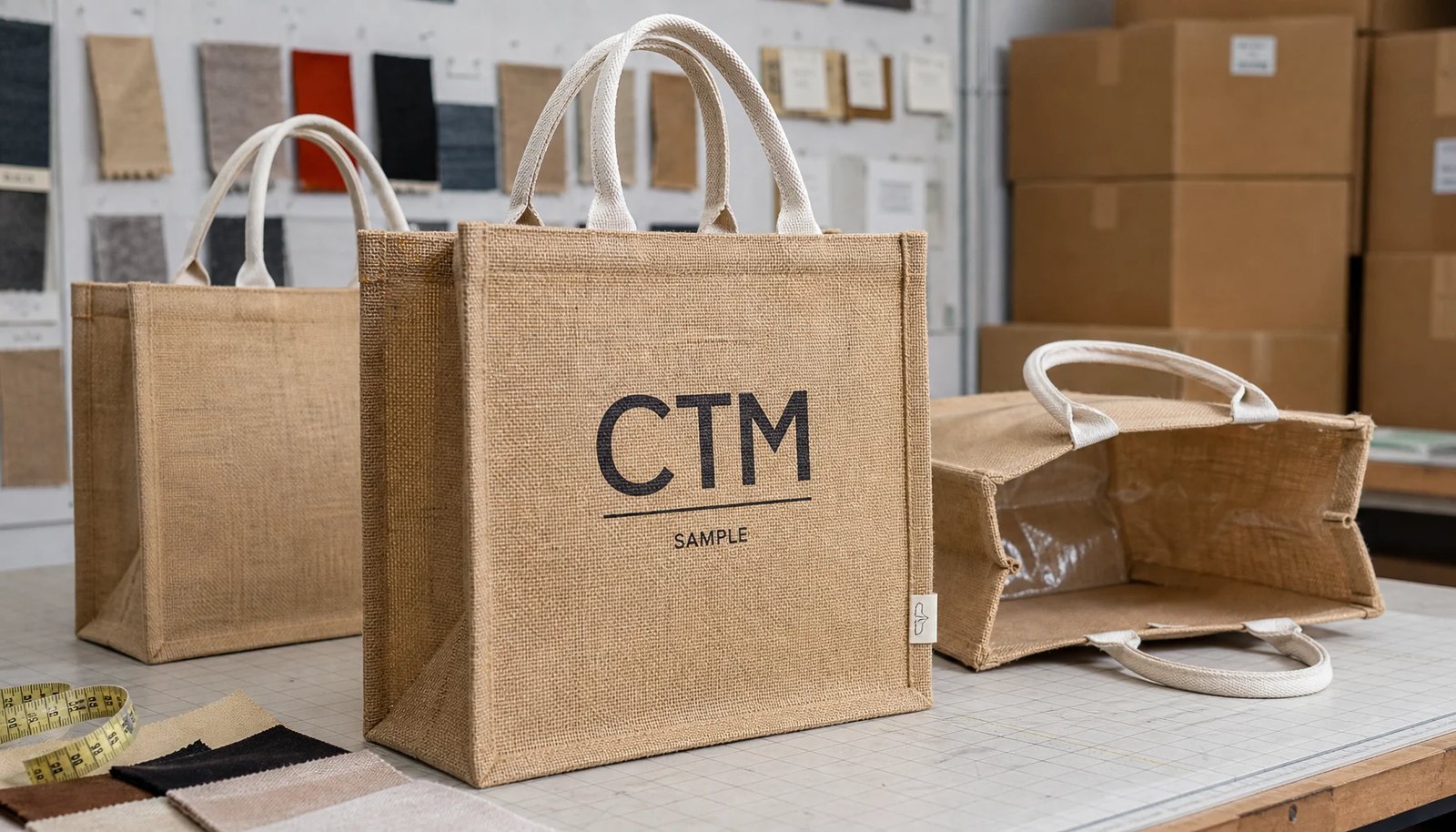
Start With the Event Job, Not the MOQ
MOQ negotiation for wholesale jute tote bags for trade show exhibitors works best when the buyer describes the job first. A tote that holds a badge insert and a few flyers is not the same product as a bag that must survive catalogs, product samples, a water bottle, and constant handling during a full exhibition day. If procurement opens with that context, the supplier can recommend a structure that fits the use case instead of protecting itself with a broad minimum that says little about the real bag.
The tote is both packaging and a visible brand surface. It will be stacked behind a counter, handed out in seconds, photographed, and carried past competitor booths in the same hall. A low minimum order does not matter if the handle twists, the logo looks broken across the weave, or the cartons arrive mislabeled. For trade show work, the useful target is not the smallest possible MOQ in isolation. It is the lowest workable MOQ that still protects appearance, load performance, packing accuracy, and delivery timing.
Write the distribution path into the RFQ. Will the bags be handed out empty at the booth, pre-packed as registration kits, shipped to regional sales teams, or reserved for VIP visitors? Each path changes the right packing method, handle comfort, carton marking, and inspection priority. A registration kit usually needs cleaner interior finishing and tighter fold control. A booth handout can often use simpler bulk packing. A VIP sponsor bag may justify heavier fabric, more controlled printing, and a stricter sample approval process.
- For literature-only use, confirm the maximum catalog size and whether the bag must keep flat documents unbent.
- For mixed giveaways, list expected contents and approximate total weight instead of saying the bag must be strong.
- For booth handouts, prioritize quick carton opening, clean stacking, and simple version identification.
- For sponsor or VIP use, specify cleaner stitching, tighter logo placement, and more controlled packing.
- For repeat event programs, keep one base construction so future MOQ discussions start from an approved standard.
Write a Factory-Ready Specification
A reliable quote starts with a precise specification. If the RFQ says only natural jute tote with logo, suppliers will fill in the blanks differently. One may assume a smaller size, another a lighter fabric, another a different handle tape, and another a simplified print method. Those assumptions make pricing impossible to compare and create the usual surprise later, when the approved sample does not match the number on the quotation.
Turn the brand brief into measurable terms: finished width, height, gusset depth, fabric GSM, lamination, handle material, handle drop, print size, print color count, logo placement, carton pack count, destination, and delivery deadline. Add the expected load as well. A tote that carries flat brochures needs a different structure from one that will hold boxed samples or apparel. These details help the factory calculate fabric consumption, cutting yield, sewing time, screen setup, carton volume, and production schedule before the order is placed.
Separate fixed requirements from optional ones. The logo size and delivery date may be non-negotiable, but handle color, inner lining color, or carton pack count may be adjustable. That distinction matters in MOQ negotiation because factories can often reduce the minimum when custom variables are reduced. A buyer who can accept stock natural jute, standard cotton handles, and one shared base size has more leverage than a buyer asking for special dyed fabric, uncommon handles, multiple sizes, and several logo versions at the same time.
- Specify finished size as width x height x gusset, not only approximate capacity.
- Define handle width, handle drop, total handle length, and reinforcement style.
- Confirm whether the bag must stand upright, fold flat, or fit inside a registration carton.
- List print colors, print area, logo placement, and artwork file format.
- Identify which details are fixed and which can change to improve price or MOQ.
Choose the Right Jute GSM, Finish, and Tolerance
Fabric weight is one of the main quality and cost variables in wholesale jute tote bags. For standard exhibitor giveaways, laminated jute around 270-320 GSM is often a practical baseline. It provides enough body for brochures and light samples while keeping cost and freight under control. For premium programs, heavier loads, or bags expected to be reused after the event, 340-380 GSM can create a more substantial feel and better structure. The answer should be driven by contents, presentation standard, and budget, not by GSM in isolation.
Jute is a natural fiber, which means shade, slub, yarn thickness, and surface texture vary more than with synthetic fabrics. Procurement teams should not write the spec as if every panel will look identical. Approve a current swatch and define acceptable variation. Natural jute may show darker flecks, an uneven weave, and visible fiber hairs. Those are not automatically defects. They do affect print appearance, though, so if the logo uses pale colors, fine lines, or reversed text, test it on the exact material before production.
Lamination changes the bag's behavior. Inside lamination can reduce shedding, hold the shape, and create a cleaner interior for documents. It can also add stiffness and may trap odor if storage or curing is poor. Unlaminated jute feels more raw and flexible, but it may shed fibers onto dark brochures or apparel. For trade show buyers, laminated jute is often the safer default unless the brand explicitly wants an unfinished natural feel.
Odor control should be part of acceptance criteria. Jute can pick up moisture, oil, warehouse smell, or mildew if it is stored badly. At a trade show, a strong smell is not a minor preference issue. It affects booth staff, visitors, and enclosed registration kits. Ask the supplier how fabric is stored, how finished bags are dried or aired before packing, and what moisture protection is used in export cartons.
- Use 270-320 GSM laminated jute for cost-controlled standard event totes.
- Use 340-380 GSM for heavier contents, sponsor bags, or programs where reuse matters.
- Approve a real swatch because natural shade, stiffness, and texture vary by lot.
- Define acceptable natural fiber marks separately from true defects such as mildew, holes, stains, or delamination.
- Treat strong chemical, oil, or mildew odor as a shipment risk, not a minor preference.
Size the Bag for the Contents and the Carrying Pattern
Finished dimensions affect both usability and cost. A 38 x 35 x 10 cm tote can work for flat literature, while 38 x 35 x 15 cm or 40 x 35 x 15 cm is more forgiving for catalogs, sample jars, and boxed giveaways. Add width, height, or gusset depth and the fabric consumption rises. Cutting efficiency may drop too. Carton volume also increases, which affects sea freight, storage, and final-mile delivery to the event.
The gusset should match what the bag will actually hold. A deeper gusset helps the tote accept samples without bulging, but it also changes how the front logo looks when the bag is full. If the bag is too narrow for the contents, booth staff tend to overfill it and stress the handles. If it is too large, attendees find it awkward in crowded aisles and the buyer pays for extra material and freight. A simple contents mock-up during sampling prevents both problems.
Handles deserve their own line in the spec. Cotton webbing is common for trade show jute totes because it feels better than rough jute handles and can be standardized across runs. Handle width often sits around 2.5-3.8 cm, but the supplier's actual stock width should be confirmed. Handle drop should be chosen intentionally: shorter for hand carry and compact booth stacking, longer for shoulder carry. Shoulder carry improves comfort for heavier loads, but it adds material and is unnecessary for some giveaway programs.
Load performance comes from the combination of fabric, handle tape, stitch type, and reinforcement. For heavier event loads, specify box-x stitching or bar tack reinforcement at each handle attachment. A practical load test for literature bags is often in the 8-10 kg range, depending on intended contents. The point is not to over-engineer every giveaway. It is to make sure the tote survives normal event use without tearing at the handle attachment or bottom corners.
- Confirm whether dimensions are finished measurements after sewing, not flat fabric cut size.
- Use a 10-15 cm gusset for most mixed literature and sample programs.
- Specify handle drop based on actual carrying style, not habit.
- Require reinforced handle stitching for heavy catalogs or boxed samples.
- Test a filled sample before mass approval when the bag will carry more than paper.
Match Print Method to the Artwork You Actually Have
Screen printing is usually the most practical method for trade show jute totes with one to three solid logo colors. It is efficient at repeat quantities and works well with bold marks. But jute is textured and absorbent compared with smooth cotton canvas or coated paper. Thin strokes, small reversed text, tight registration, and gradients can break up or look uneven. Procurement should treat print method as a technical decision, not just a branding preference.
Heat transfer can help when artwork has fine detail, gradients, or multi-color complexity that screen printing cannot reproduce cleanly. It may deliver sharper detail, but it changes the surface feel and can look less integrated with natural jute. Transfers also need durability checks, especially along folds and edges. If a sponsor insists on complex artwork, ask the supplier to quote both a simplified screen print and a transfer option, then compare them on the actual bag material rather than on the PDF alone.
Pantone control on natural jute needs a realistic tolerance. The base material is not white, so ink color changes with the jute shade unless an underbase or other adjustment is used. A digital proof is useful for layout, but it is not enough for color or edge quality. Approve a strike-off on actual jute at the intended logo size. If several factories are quoting, request strike-offs before final award for high-visibility programs rather than assuming all screen prints will look the same.
Artwork files should be production-ready. Send vector files, outline fonts, define Pantone references, and state the print size in centimeters. Ask the supplier to confirm minimum line width and minimum text height. If the logo includes a registered trademark, sponsor lockup, QR code, or a small date line, test legibility at normal viewing distance and on the actual weave. A QR code on jute should be scanned from printed samples, not approved only in a PDF proof.
- Use screen print for bold one-color or two-color exhibitor logos.
- Avoid small legal text, thin strokes, delicate reverses, and tight gradients where possible.
- Approve a physical strike-off on actual jute before bulk printing.
- Measure logo placement from top edge and side seam, then add that to the spec sheet.
- Test QR codes, small sponsor marks, and fine icons after printing if they must be included.
Negotiate MOQ by Reducing Custom Variables
MOQ is usually driven by factory constraints: fabric purchasing, cutting yield, handle stock, print setup, sewing line planning, labor allocation, carton packing, and export handling. A supplier may quote a low MOQ for a stock-size bag with stock jute and one-color printing, then raise the minimum sharply for custom-dyed fabric, uncommon handles, special lamination, or multiple small logo versions. If procurement understands those drivers, the negotiation becomes much more practical than simply asking for a lower number.
The strongest tactic is often to separate the base-bag MOQ from the print-version MOQ. Suppose the buyer needs 3,000 total bags across six exhibitor logos. If every version uses the same finished size, same fabric, same handle, same lamination, and same carton pack count, the supplier may be able to cut and sew one blank production batch, then print the smaller logo lots afterward. That is much easier than treating six 500-piece custom orders as unrelated products.
Buyers can also trade flexibility for MOQ relief. If the supplier has stock natural jute and standard cotton handles available, accepting those inputs may reduce material minimums and lead time. If the print can be one color instead of three, screen setup and production risk decrease. If carton marks can be standardized with a simple version sticker, packing labor stays manageable. These are practical levers that protect the visible brand result while lowering the number of custom operations.
Watch for extremely low MOQ offers. A supplier may accept a small order by using leftover fabric, outsourcing printing, packing loosely, or skipping normal sample steps. That can work for a rush order only if the buyer understands the trade-offs. For dated trade shows, a failed small order can be more expensive than a slightly higher MOQ because replacement often requires air freight or local emergency sourcing.
- Ask for MOQ by blank bag, by print design, and by carton destination.
- Keep one base size and one fabric where multiple exhibitors or regions share the program.
- Use stock fabric and standard handles when MOQ is more important than customization.
- Negotiate setup charges and version splits separately from unit price.
- Document all approved variables so the supplier does not lower MOQ by quietly downgrading the bag.
Request Quotes That Expose the Real Cost
A useful supplier quote should make the construction visible. Unit price alone is not enough because two quotes can describe very different bags. Ask suppliers to list finished size, fabric GSM, lamination, handle material, handle dimensions, print method, number of print colors, setup charges, sample charges, carton quantity, carton dimensions, lead time basis, and payment terms. When those details are missing, the buyer cannot tell whether the quote is competitive or simply under-specified.
Normalize the quote before comparing suppliers. If one quote includes 320 GSM laminated jute, cotton webbing handles, two-color screen print, and 50 pieces per carton, while another includes lighter jute, one-color printing, and unspecified packing, the unit prices are not comparable. Procurement should send a clarification sheet and request revised quotes on the same basis. This matters even more for distributors and agencies quoting to their own clients, because a hidden downgrade can damage the relationship after delivery.
Landed cost matters more than ex-factory price. Jute totes are often bulky relative to unit value, especially when gusseted bags are packed loosely to avoid creasing. Ask for estimated carton dimensions, gross weight, and total CBM before making a supplier decision. Add freight, duty, customs fees, destination handling, inspection, warehousing, event delivery, and possible repacking. A cheaper bag can become more expensive if it uses larger cartons, has a higher reject rate, or forces an air freight rescue because the production schedule was unrealistic.
Clarify what is included in sample and setup costs. Some suppliers include one digital proof but charge for strike-offs, revised samples, or multiple logo screens. Others may include one pre-production sample after deposit but not before order confirmation. Those terms are not automatically bad, but they need to be visible before procurement compares total cost per usable bag.
- Ask for a quote table with construction, printing, packing, sample, and setup details separated.
- Compare landed cost per usable bag, not only FOB or ex-factory unit price.
- Request carton CBM and gross weight before freight booking or event delivery planning.
- Check whether setup charges apply per logo, per color, per side, or per revision.
- Include inspection and rework allowance when the logo is high visibility or the delivery date is fixed.
Choose a Supplier Who Can Control Versions and Handoffs
Supplier selection should focus on capability, not only catalog photos. A direct factory is often better when the bag has custom dimensions, a tight event date, or multiple print versions. The buyer can discuss fabric, sampling, line capacity, print limitations, and packing details with the team that actually touches production. A trading company can still be useful for multi-category consolidation or local communication, but the buyer should know who controls the critical steps.
Ask which operations are in-house and which are outsourced. Lamination, cutting, printing, sewing, trimming, pressing, and packing may not all happen under one roof. Outsourcing is common in many supply chains, but it adds coordination risk. If printing is subcontracted, the supplier should explain how strike-offs are approved, how printed panels or finished bags move between workshops, how color consistency is checked, and how defects are sorted before packing. The more handoffs involved, the more schedule buffer the buyer needs.
Version control becomes a major issue when one order contains several exhibitor logos, sponsor marks, regional destinations, or language versions. The supplier should assign clear artwork file names, screen labels, approved sample labels, carton marks, and packing lists. Each carton should show logo version, quantity, PO number, and destination where applicable. For split shipments, confirm whether cartons are sorted by version at the factory or at a consolidation warehouse.
Do not rely only on front-panel photos. Ask for images of handle stitching, inside seams, bottom gusset, lamination, carton packing, carton marks, and random packed cartons. Those photos do not replace inspection, but they reveal whether the supplier is paying attention to the details that usually create event problems.
- Request current production photos and real finished samples, not only catalog renders.
- Confirm who performs printing and who owns final quality control.
- Use unique artwork codes for every logo or version.
- Require carton marks that match the packing list and purchase order.
- Keep approved samples labeled by version when multiple logos are in production.
Approve Samples, Tolerances, and QC Before Bulk Production
Sample approval should be treated as a controlled procurement step. A complete approval path may include a fabric swatch, handle swatch, print strike-off, blank construction sample, revised sample, and full pre-production sample. The right number of steps depends on order value, event risk, and schedule. For a repeat order with no changes, a swatch and production confirmation may be enough. For a new high-visibility exhibitor program, a physical pre-production sample is worth the time.
Approval comments should be measurable. Instead of saying the logo is too low, state the approved distance from the top edge and side seam. Instead of saying the handle is uncomfortable, specify handle width, handle drop, or material. Instead of saying the bag feels flimsy, confirm GSM, lamination, and load requirement. Measurable comments prevent disputes because the factory, buyer, and inspector can all compare bulk goods against the same reference.
Set tolerances before production. For sewn jute totes, buyers often allow about +/- 1 cm on finished dimensions, depending on bag size and construction. Print placement tolerance may sit around +/- 5 mm to +/- 10 mm, depending on artwork size and factory capability. Color tolerance should be judged against the approved strike-off under consistent lighting, with awareness that natural jute varies. Handle strength, stitch defects, odor, carton count, and version accuracy should also be written into the order.
A practical inspection plan should include incoming material check, inline review, and final random inspection where risk justifies it. For many trade show orders, final inspection before shipment is the most important checkpoint. Inspectors should measure dimensions, review print quality, load-test handles, check seams, open cartons, confirm carton marks, count pieces, and document defects with photos. If the event date cannot move, require evidence before releasing the final balance payment.
- Keep one signed approved sample with the supplier and one with the buyer or inspector.
- Record print size, placement, Pantone target, handle dimensions, and packing method in writing.
- Inspect fabric, printing, sewing, trimming, odor, and carton accuracy as separate categories.
- Use photos and carton numbers when reporting defects or requesting rework.
- Do not release bulk production until fabric, handle, print, and construction are all approved.
Plan Packing, Freight, and Venue Delivery Early
Packing decisions affect both appearance and delivery cost. Flat packing 25-50 pieces per export carton is common for jute tote bags, depending on size, stiffness, and handle shape. Too many pieces per carton can crush gussets, crease laminated panels, distort handles, or make cartons too heavy to handle easily. Too few pieces increase CBM and freight cost. Ask the supplier to propose carton quantity, then check whether it supports export transit and event handling at the same time.
Moisture protection matters with jute. Bulk individual polybags are not always needed for booth handouts, and many buyers prefer to reduce plastic waste. Even so, export cartons should still use practical moisture protection such as an inner liner or other barrier suitable for the shipping route and season. Cartons should be clean, strong, and marked clearly with item code, logo version, quantity, PO number, and destination. If cartons go directly to a venue or event warehouse, labeling requirements can be strict and should be confirmed in advance.
Freight planning should start before sample approval, not after production ends. Jute totes can take meaningful space because gussets and laminated panels resist tight compression. Request estimated carton dimensions, gross weight, and total CBM during quotation, then update them after the final packing method is approved. Compare sea, rail, truck, and air options according to the event deadline. Air freight can work for a partial urgent quantity, but bulky totes get expensive fast.
Work backward from the booth delivery date. Include sample creation, sample transit, revision time, bulk production, inspection, supplier packing, export documents, freight transit, customs clearance, warehouse receiving, appointment delivery, and internal distribution. For trade shows, arriving one week late is often the same as not arriving at all. A realistic calendar is part of MOQ negotiation because suppliers may accept a lower quantity only if they can fit it into an efficient production window.
- Confirm pieces per carton, carton size, gross weight, and CBM before booking freight.
- Use clear carton marks for logo version, PO number, quantity, and destination.
- Avoid excessive compression that creates deep creases in laminated jute.
- Choose bulk packing, individual polybags, or retail packing based on distribution method.
- Reserve time for inspection, customs, and final-mile event delivery, not only factory production.
Specification comparison for buyers
| Spec decision | Recommended option | When it fits | Buyer risk to check |
|---|---|---|---|
| Fabric weight | Laminated jute around 270-320 GSM for standard exhibitor bags; 340-380 GSM for premium or heavier loads | Most trade show giveaways need to hold brochures, sample packs, badge inserts, and a water bottle without sagging or showing through | Very light fabric may shed more fiber, distort at the seams, crease during packing, and make print edges look uneven |
| Bag size | Common event formats include 38 x 35 x 10 cm, 38 x 35 x 15 cm, and 40 x 35 x 15 cm | Fits catalogs, one or two small product samples, and registration materials while staying manageable in crowded aisles | A few extra centimeters can raise fabric yield loss, carton CBM, and freight cost even when the unit price seems close |
| Handle material | Cotton webbing, padded cotton, or flat cotton tape with box-x stitching or bar tack reinforcement | Better hand feel for attendees carrying the tote for several hours; easier to standardize across repeat orders | Thin jute handles, narrow tape, or weak stitching are common failure points when bags carry catalogs or boxed samples |
| Handle dimensions | Typical handle width 2.5-3.8 cm; drop length chosen for hand carry or shoulder carry | Hand-carry totes can use shorter drops; shoulder carry needs more length and cleaner attachment points | Unspecified handle length leads to inconsistent comfort, higher complaints, and mismatched sample approvals |
| Printing method | Screen print for one to three solid colors; heat transfer only for fine detail, gradients, or artwork that cannot be simplified | Best for exhibitor logos, sponsor marks, event dates, and distributor programs | Jute texture breaks thin lines; Pantone matching is approximate unless a strike-off on actual fabric is approved |
| MOQ structure | Negotiate one shared base bag, then split print versions where the supplier can keep cutting, sewing, and packing efficient | Useful when several exhibitors, regions, or sales teams need the same bag with different logos | Too many design splits increase screen setup, proofing, carton marking, version control, and inspection workload |
| Inner finish | Laminated jute for shape retention, cleaner inside surface, and reduced shedding; unlaminated jute only for a deliberate raw finish | Trade show bags usually need to look clean under booth lighting and protect printed collateral | Poor lamination can wrinkle, delaminate at folds, trap odor, or create a plastic-like feel the brand did not expect |
| Packing | Flat pack 25-50 pcs per export carton with moisture protection and carton marks by logo version | Helps warehouse teams, booth staff, and event contractors count and distribute quickly | Overcompressed cartons can crease laminated panels; loose packing increases CBM and may damage carton corners |
| Inspection basis | Use approved pre-production sample plus written tolerances for size, print, handles, stitching, odor, and carton count | Required when event dates cannot move and bags are a visible brand touchpoint | Without measurable tolerances, disputes become subjective and late corrections often require expensive air freight |
Buyer checklist before sampling
- Define finished width, height, gusset depth, handle drop, handle width, fabric GSM, lamination, lining color, and print area before asking for price.
- State the event use case: booth giveaway, registration kit, VIP sponsor bag, distributor handout, or retail-style conference merchandise.
- List expected contents and target load, such as catalogs, sample jars, small boxes, apparel, water bottles, or badge packs.
- Send vector artwork with Pantone references, minimum line-width concerns, logo size, placement from top edge and side seam, and any no-print zones.
- Separate total order quantity from per-design quantity when asking about MOQ, especially for multiple exhibitor logos, sponsors, or regional versions.
- Ask whether stock fabric, standard handles, or shared blank production can reduce MOQ without changing the visible brand result.
- Request a fabric swatch, handle swatch, print strike-off, blank construction sample, and full pre-production sample where schedule allows.
- Set written tolerances for finished size, print placement, color variation, handle strength, stitch defects, odor, jute shedding, and carton count accuracy.
- Confirm pieces per carton, carton dimensions, gross weight, carton marks, inner moisture barrier, polybag policy, pallet pattern, and destination labeling before freight quoting.
- Build the production calendar backward from the required booth or warehouse delivery date, including sample transit, corrections, inspection, customs, and final-mile delivery.
Factory quote questions to send
- What exact jute fabric construction, approximate GSM, and current-stock shade are included in this quote, and can you send a swatch from the same material lot or closest available lot?
- Is the quoted bag laminated or unlaminated, and what coating or lining thickness is used? If laminated, is the lamination on the inside only or visible at seams and folds?
- What are the finished dimensions, gusset depth, and acceptable size tolerance after sewing and pressing?
- What is the MOQ for one size with one print design, and how does the MOQ change if the same blank bag is split across several logos or carton destinations?
- Which print method is included, how many colors are priced, what ink type is used, and what screen, plate, transfer, or setup charges apply per design?
- Can you print our artwork at the requested size on actual jute, and what minimum line width, minimum text height, or color limitations should we adjust before approval?
- What handle material, width, total length, drop length, color, and reinforcement method are included in the unit price?
- What sample stages are available: fabric swatch, handle swatch, print strike-off, blank sample, revised sample, and full pre-production sample? What are the fees and timing for each?
- What normal tolerances can you hold for size, print placement, logo color, handle position, stitch density, and carton count in mass production?
- Which steps are in-house and which are outsourced, especially lamination, cutting, printing, sewing, trimming, pressing, and final packing?
Quality-control points to confirm
- Measure finished bag width, height, and gusset against the approved sample; many B2B buyers use about +/- 1 cm for sewn jute totes unless the design requires tighter control.
- Check handle width, drop length, attachment position, and reinforcement stitching against the signed sample and specification sheet.
- Verify fabric weight by cutting and weighing a measured sample area when allowed, or compare hand feel, stiffness, and appearance against the approved swatch when destructive testing is not practical.
- Inspect lamination for wrinkles, bubbling, peeling at folds, cracking at seams, strong odor, and inconsistent lining color.
- Measure print position from the top edge and side seam; common tolerances are about +/- 5 mm to +/- 10 mm depending on artwork size, bag texture, and supplier capability.
- Review logo edges, broken lines, ink coverage, pinholes, smudges, registration between colors, and visible color difference from the approved strike-off under consistent lighting.
- Rub the printed logo with a dry white cloth and a slightly damp white cloth to screen for poor curing, ink transfer, or surface tackiness.
- Load test handles above expected event use, such as 8-10 kg for literature and sample bags, and hold long enough to reveal weak stitching or fabric tearing around the attachment.
- Check inside seams, bottom corners, gusset alignment, loose threads, skipped stitches, sharp trimming, and panel distortion because these defects become visible when bags are filled.
- Open cartons from different parts of the shipment to verify piece count, logo version, carton mark, moisture barrier, odor, and packing fold.