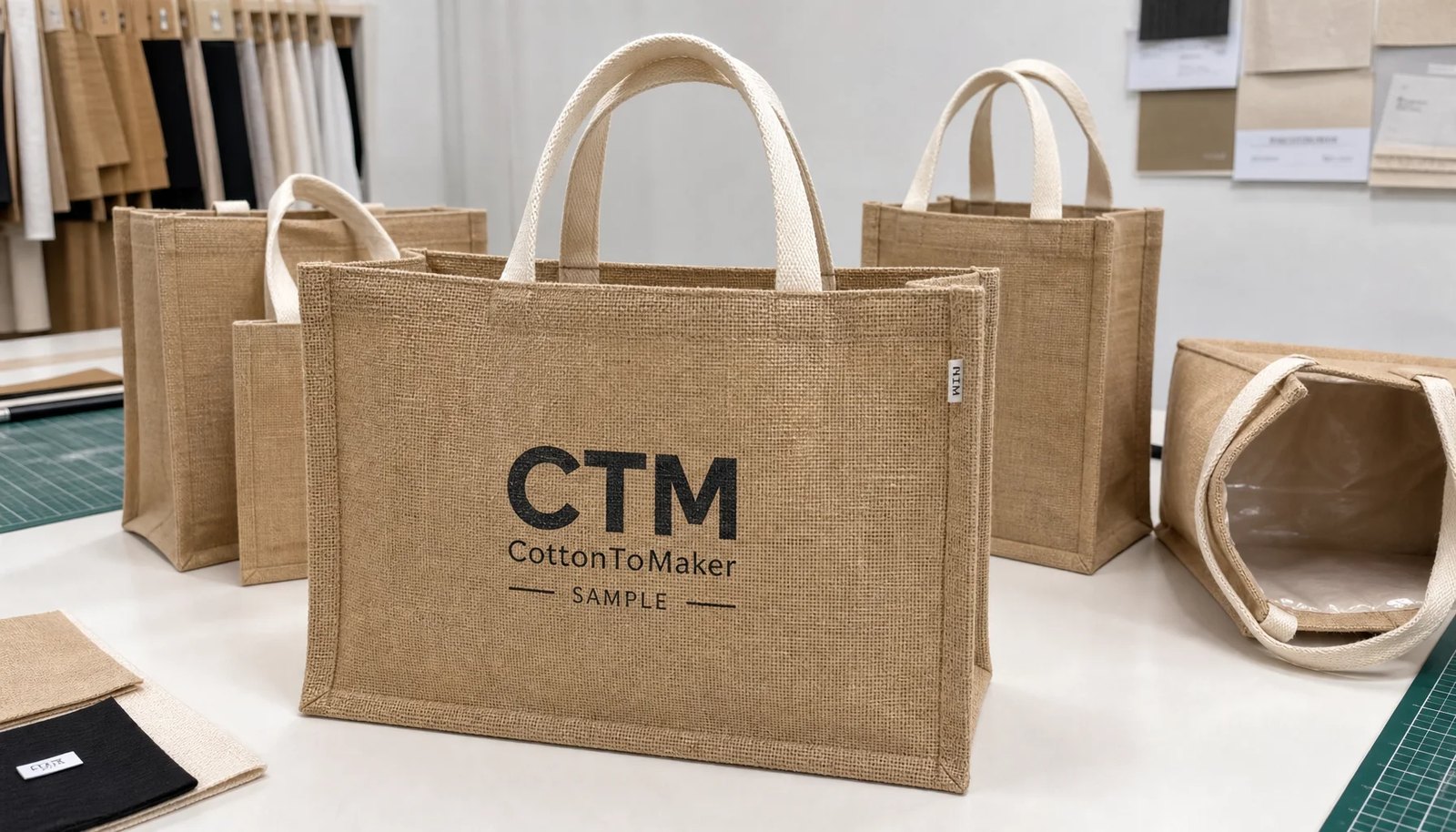
Define The Buying Problem Before You Quote
Jute tote bags for trade show exhibitors are not the same as retail jute shoppers sold on a store shelf. The exhibitor bag has to work under a fixed event deadline, carry mixed materials, display a logo clearly from several meters away, and survive being packed, shipped, handled, and distributed quickly at a booth. A low unit price is useful only if the bag arrives on time, smells acceptable, prints cleanly, and holds the expected load.
The RFQ should therefore be written around usage, not only around size and quantity. Tell the supplier whether the bag is a visitor giveaway, a VIP sponsor bag, a catalog carrier, a sample kit, or a paid retail item at the event. Each use changes the right GSM, handle, lamination, print process, and packing method. A supplier can quote more accurately when they understand the failure you are trying to avoid.
- For high-volume giveaways, prioritize stable construction, simple artwork, efficient packing, and predictable lead time.
- For sponsor or VIP bags, increase fabric weight, improve handle comfort, and allow more time for print approval.
- For sample kits, test handle strength and gusset depth with the real product load, not with an empty bag.
- For venue delivery, treat carton marking and carton strength as part of the product specification.
Choose Jute Weight And Finish With Real Load In Mind
Most trade show jute totes should sit in the 13 oz to 15 oz range, often around 370-425 GSM depending on the weave and finish. Lighter jute can reduce cost, but it tends to wrinkle more, print less evenly, and lose shape when filled with brochures or samples. Heavier jute gives a more premium hand feel, but it increases material cost, carton weight, and freight volume.
Lamination is another important decision. Inner PP lamination helps the bag keep shape, reduces lint and dust inside, and gives light moisture resistance during shipping and booth use. It also changes the bag feel: too much lamination can make the tote stiff, noisy, or prone to cracking along fold lines. For trade show bags, a clear or matte inner lamination is usually more practical than external lamination because it keeps the natural jute appearance outside while improving structure.
- Request actual GSM or oz, not only descriptions such as premium jute or thick burlap.
- Approve a fabric swatch from the production lot when color tone matters across multiple exhibitors.
- Use laminated interior for shape and cleanliness when bags hold printed materials.
- Avoid very coarse jute for detailed logos because small letters and fine lines will break on the texture.
Set Size, Gusset, And Handle Standards
The common exhibitor mistake is ordering a tote that looks large on a flat drawing but cannot carry real event materials. A bag around 14-16 inches wide, 15-16 inches high, and 5-7 inches deep works for many trade show programs because it carries catalogs, folders, and product samples without looking oversized. If your client hands out binders, apparel, drinkware, or boxed samples, load-test the size before locking the order.
Handle details affect both comfort and failure rate. Cotton webbing handles usually feel better than jute rope for long carrying periods, especially when attendees carry several bags. The RFQ should state handle width, handle drop, color, stitching pattern, and reinforcement. A small saving on handle material can turn into visible complaints if handles twist, fray, or tear out at the booth.
- State finished size as width x height x gusset and define whether dimensions are measured flat or opened.
- For hand carry, shorter drops may be acceptable; for shoulder carry, specify a longer handle drop and test with a filled bag.
- Use X-stitch, box stitch, or bar tack reinforcement for heavier loads.
- Set a practical size tolerance, often plus or minus 0.5 cm to 1 cm, because jute and lamination can shift during sewing.
Match Print Method To Jute Texture
Screen printing is usually the safest method for simple trade show logos on jute. It works well for bold artwork, solid sponsor names, and one to three spot colors. Because jute is coarse and uneven, the print will not behave like ink on cotton canvas or paper. Small reversed text, thin lines, tight registration, and large solid ink blocks need extra attention before production.
Heat transfer can help when artwork contains gradients, many colors, or small details, but it may look less natural on rough jute and can change the hand feel. Embroidery is possible for premium programs, but it is slower, more expensive, and not always suitable for large front logos. The best quote is not the one that promises every artwork is possible; it is the one that explains what must be simplified to print cleanly on the selected fabric.
- Supply vector artwork and Pantone references instead of low-resolution JPG files.
- Set minimum line thickness and minimum letter height based on the factory's print test on jute.
- Approve print placement with a measured layout, not only a visual mockup.
- For multi-color screen print, confirm registration tolerance because jute surface movement can cause small misalignment.
- Do a rub test after curing to catch tacky ink or transfer risk before bulk packing.
Understand MOQ Logic Before Negotiating
MOQ for wholesale jute tote bags is not one simple number. A factory may have separate minimums for bag style, fabric purchase, handle color, lamination setup, print screen, and logo change. If you need 5,000 bags split across ten exhibitor logos, the commercial question is different from a single 5,000-piece logo order. The most efficient route may be one shared blank bag construction with separate print runs.
Buyers often push only on total MOQ and miss the cost drivers behind it. A supplier can sometimes reduce the finished goods MOQ if you accept standard fabric, standard handle color, standard size, and one print position. But if every exhibitor wants a different size, different handle color, and separate carton marks, the real factory workload increases. A practical RFQ should separate what is fixed across the program from what changes by logo.
- List total quantity and quantity per logo or per destination.
- Separate blank bag MOQ from print MOQ and screen charges.
- Use standard natural jute and standard cotton handles when schedule and budget are tight.
- Group logo approvals into one production window to avoid repeated setup and delayed packing.
- Confirm whether overrun or underrun tolerance applies, especially for small logo splits.
Read Supplier Quotes Beyond Unit Price
A clean quote for trade show jute totes should tell you what is included in the unit price and what is not. The minimum useful quote includes fabric weight, lamination, finished size, handle material, print method, print area, number of colors, packing method, carton data, sample cost, production lead time, payment terms, and Incoterm. Without these details, two suppliers may look close in price while quoting different products.
Landed cost is especially important because jute bags are bulky. A slightly cheaper bag with poor carton efficiency can cost more after freight. For urgent trade show programs, air freight may erase any savings from a low unit price. Procurement teams should compare quote data in one sheet and include estimated CBM, carton weight, and destination charges before recommending a supplier.
- Compare unit price only after fabric GSM, lamination, handle, print, and packing are aligned.
- Require carton dimensions, gross weight, and pieces per carton for freight calculation.
- Clarify Incoterm, export carton standard, and whether inspection support is included.
- Watch for missing charges such as screen setup, sample remake, inner polybag, palletization, or delivery to forwarder.
- Use landed cost per usable approved bag, not only FOB unit price.
Approve Samples With Measurable Criteria
A printed sample is not just a selling tool; it is the control document for production. The sample should represent the actual fabric weight, lamination, handle, thread, print method, print size, and packing fold. If the factory sends a nicer stock sample and quotes a cheaper construction, the buyer may approve a quality level that is not included in the price.
For tight deadlines, sample stages can be adjusted, but the risk must be understood. A blank sample confirms construction. A printed strike-off confirms logo behavior on jute. A pre-production sample confirms all details together before bulk sewing and printing. Photo approval can save days, but it cannot verify odor, hand feel, handle strength, or actual fabric weight.
- Measure the sample size, gusset, handle drop, and print position with a ruler.
- Load the bag with the expected trade show contents for at least several minutes and inspect handle stitching.
- Fold and unfold the laminated bag to see whether lamination cracks or creates permanent hard creases.
- Rub the print with a dry white cloth and, when relevant, a slightly damp cloth after full curing.
- Keep one approved sample at the buyer side and one sealed golden sample at the factory.
Control Packing, Cartons, And Venue Handling
Packing is where many trade show bag orders become messy. Jute totes are often folded flat, bundled, and packed into export cartons. If cartons are overfilled to reduce freight volume, bags can arrive with deep creases, crushed corners, or print transfer. If cartons are too weak, they may collapse during ocean shipping or warehouse stacking.
The right packing depends on the delivery route. For direct-to-venue delivery, carton labels must be readable and match the event receiving rules. For 3PL delivery, carton count, SKU labels, PO number, and barcode requirements may matter more than the bag itself. For distributor programs with multiple logos, packing must prevent logo mix-up during final delivery.
- Specify pieces per carton, carton dimensions, gross weight limit, and whether bags are flat packed or bundled.
- Use moisture control for ocean shipments, especially during humid seasons or long storage periods.
- Require carton marks showing PO number, item number, logo version, quantity, carton number, and destination if needed.
- Avoid packing freshly printed bags before ink is fully cured.
- For premium bags, consider inner paper or individual polybags only when the brand accepts the extra cost and packaging waste.
Build The Schedule Backward From The Show Date
Trade show deadlines are unforgiving because the value of the bag drops sharply after the event. A workable schedule starts with the in-hand date, then works backward through local delivery, customs clearance, freight, export booking, final inspection, packing, printing, sewing, material preparation, sample approval, and artwork approval. The production lead time in a quote usually starts after sample and artwork approval, not after the first email.
Jute materials, lamination, and printing can all add time when the order is not based on standard stock. Multi-logo programs also slow down approval because one late artwork can hold a shared production run. Buyers should define the latest approval date in the purchase order and keep a controlled artwork list. A factory cannot protect the schedule if logo files continue changing after screens are made.
- Reserve time for artwork cleanup before the official production clock starts.
- Add buffer for printed sample shipping if physical approval is required.
- Do not plan inspection on the same day as final packing for urgent export.
- Allow time for cartons to dry and ink to cure before container loading or air freight pickup.
- Use air freight only after comparing the cost impact against reducing quantity, simplifying packing, or using a local backup.
Set QC Thresholds Before Mass Production
QC for jute bags must reflect the nature of the material. Natural jute has shade variation, slubs, and texture differences. The buyer should not expect plastic-level uniformity, but should reject defects that affect appearance, function, or brand perception. The practical approach is to define acceptable natural variation and unacceptable production defects before the factory starts bulk work.
For most wholesale exhibitor programs, the inspection should cover material, sewing, print, odor, cleanliness, packing, and quantity. The best time to catch major issues is before all goods are packed. A mid-production review can identify print shift, weak handle stitching, or fabric stains while there is still time to correct the line.
- Define major defects such as broken handles, wrong logo, severe print smearing, mildew odor, large stains, and incorrect size.
- Define minor defects such as small loose threads, slight natural color variation, and tiny slubs that do not affect use.
- Set print position tolerance, commonly within plus or minus 5 mm for a simple front logo unless the design requires tighter control.
- Use AQL or a simple mutually agreed defect limit, but write it into the PO or inspection instruction.
- Inspect random cartons from different production times, not only the top cartons prepared for viewing.
Specification comparison for buyers
| Spec decision | Recommended option | When it fits | Buyer risk to check |
|---|---|---|---|
| Jute fabric weight | 13 oz to 15 oz jute, roughly 370-425 GSM depending on weave and finishing | Most exhibitor giveaways where the bag must hold catalogs, samples, and brochures without feeling flimsy | Low GSM quotes may look cheap but can sag, wrinkle heavily, or distort during printing; require actual GSM and finished weight per bag |
| Bag size and gusset | Around 14-16 in width, 15-16 in height, 5-7 in gusset for trade show use | Booth visitors carrying folders, water bottles, small samples, and multiple brochures | A narrow gusset saves cost but reduces perceived value; confirm finished size tolerance and whether dimensions are measured flat or expanded |
| Interior finish | Clear or matte PP lamination inside, usually 18-25 micron | Events where the bag needs shape, dust control, and better moisture resistance during transit | Overly stiff lamination can crack at folds; request fold test and odor check on pre-production sample |
| Handle type | Cotton webbing handles, 1-1.5 in width, with reinforced X-stitch or bar tack | Brands wanting softer hand feel and more comfortable shoulder or hand carry | Thin rope or weak webbing can fail when visitors load the bag; set pull-strength expectation and handle drop length |
| Print method | Screen print for solid logos; heat transfer only for detailed artwork on rough jute texture | One to three spot colors, simple exhibitor branding, sponsor logos, or event message | Fine lines can break on coarse jute; approve print on actual jute, not paper proof only |
| MOQ structure | Use one bag construction with shared fabric and separate logo print runs where possible | Distributors ordering multiple exhibitor logos in one shipment | Supplier may quote attractive MOQ per style but add hidden setup charges per logo; separate bag MOQ from print MOQ |
| Packing format | Flat packed in export cartons with moisture control and carton strength suitable for stacking | Ocean or air shipment to show venue, warehouse, or 3PL | Over-compressed cartons crease laminated jute; specify carton weight limit, polybag choice, and carton markings |
| Supplier route | Direct factory for controlled specs; trading company only when consolidating many product categories | Repeat programs, distributor catalogs, and brand campaigns needing consistent quality | Middleman quotes may omit fabric GSM, print tolerance, and QC standards; require factory photos, sample history, and itemized quote data |
| Schedule buffer | Approve sample and artwork before mass production slot is booked; add buffer for print curing and packing inspection | Fixed trade show dates where missing delivery has high commercial damage | Rushed production often causes wet ink transfer, odor, poor carton labeling, or skipped incoming material checks |
Buyer checklist before sampling
- Define finished bag size in width x height x gusset, and state whether tolerance is measured flat before packing.
- Specify jute fabric weight in oz or GSM, not only the word natural jute.
- State whether the interior must be laminated, unlaminated, or laminated only for shape and dust control.
- Confirm handle material, width, drop length, color, and reinforcement method.
- Provide artwork as vector files with Pantone references and minimum line thickness.
- Decide whether print approval must be on actual jute fabric before bulk production.
- Separate bag MOQ, print MOQ, logo setup charges, and carton packing cost in the quote.
- Set acceptance criteria for color variation, print position tolerance, loose threads, odor, stains, and handle pull strength.
- Confirm packing method, carton dimensions, gross weight, carton markings, and pallet requirements if shipping to a 3PL or venue.
- Build the order schedule from the fixed event date backward, including sample approval, production, inspection, freight, customs, and local delivery.
Factory quote questions to send
- What is the actual jute fabric weight in GSM or oz, and can you provide a fabric swatch from the same lot planned for production?
- Is the bag laminated inside, outside, or not laminated, and what lamination thickness will be used?
- What are the finished dimensions, gusset construction, handle drop, and size tolerance after sewing?
- Which print method do you recommend for this artwork on jute, and what is the minimum line thickness you can hold cleanly?
- Is the MOQ based on bag style, fabric color, logo design, print color count, or total order quantity?
- What costs are separate from unit price, including screen charge, sample charge, artwork adjustment, inner packing, carton upgrade, and inspection support?
- How many cartons, carton dimensions, gross weight, and cubic meters are expected for the quoted quantity?
- What sample stages are included: blank sample, printed sample, pre-production sample, or photo approval only?
- What quality standard will your QC team use for print position, stains, odor, loose threads, handle strength, and carton damage?
- What production lead time begins after which approval point, and what is the latest artwork approval date for the required shipment date?
Quality-control points to confirm
- Fabric weight matches approved swatch within agreed tolerance and has no heavy slubs, holes, oil marks, or mildew smell.
- Finished size stays within agreed tolerance, commonly plus or minus 0.5 cm to 1 cm depending on bag construction.
- Gusset depth is consistent and the bag stands reasonably square when opened.
- Handles are centered, securely stitched, and meet the agreed pull test for expected trade show load.
- Print placement is within agreed tolerance, typically plus or minus 5 mm for simple front logos on jute.
- Ink coverage is solid enough for the approved artwork, with no severe bleeding, ghosting, tackiness, or ink transfer.
- Lamination is bonded evenly without bubbling, cracking at folds, or strong chemical odor.
- Loose threads, skipped stitches, dirty marks, and crooked labels are within the approved AQL or buyer standard.
- Cartons are dry, clean, correctly marked, and strong enough for the chosen freight method.
- Random cartons include the correct logo, quantity, color, packing method, and shipping marks before release.