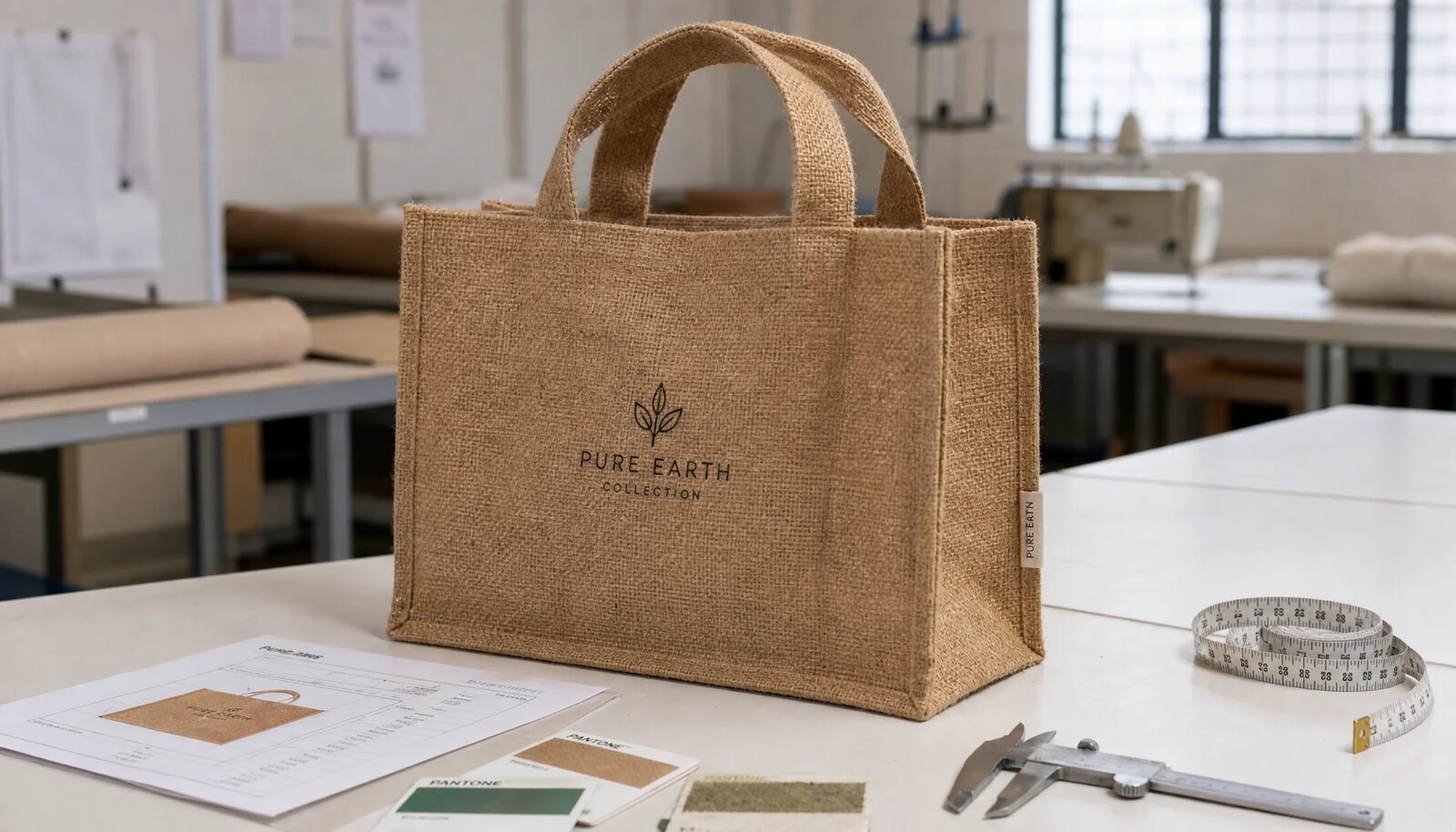
Start With the Procurement Use Case
Good proofing starts before a designer drops the logo onto a mockup. Procurement first needs to define what the jute tote must do in the real supply chain. A retail gift-with-purchase bag has a different job from a showroom sample carrier, an event giveaway, a store packaging replacement, or a subscription apparel bundle. That job drives the load target, handle comfort, size, structure, print area, packing method, and acceptable finish level.
For eco apparel brands, the tote often appears at the handoff moment: checkout, trade show, wholesale meeting, launch kit, or unboxing. It is visible proof of the brand's sourcing choices. If the logo is distorted, the fabric is stained, or the handle stitching feels weak, the message suffers even when the unit price looks attractive. Treat the proof as a product approval step, not just a design review.
Open the RFQ with a short commercial brief. Say where the bag will be used, what it will carry, how it will be distributed, and how long it should remain presentable. If it will hold folded garments, include folded product dimensions and approximate packed weight. If it is for a trade show, mention catalogs, hangers, line sheets, or multiple samples. If it replaces disposable store packaging, define whether it must stand upright, fold flat at checkout, or survive transit inside an outer carton.
- Define the channel: retail packaging, wholesale showroom, event giveaway, launch kit, subscription bag, or employee merch.
- List expected contents by size and loaded weight, not only by product category.
- State whether the tote must fold flat, stand upright, protect contents, or present as a premium branded item.
- Confirm whether the order is a one-time launch, seasonal replenishment, or repeat wholesale program.
Translate the Bag Into a Written Spec
Jute totes look simple, which is exactly why vague specs cause trouble. Lock the finished measurements before asking anyone to proof the artwork. Include width, height, gusset depth, handle drop, handle width, and the tolerance the factory can hold. If the bag must fit a folded hoodie, a boxed set, or a stack of tees, test the contents first. A tote that looks balanced while empty can become too shallow, too narrow, or awkward once packed.
Material should be described in practical terms. For many wholesale retail and promotional uses, 320 to 350 gsm natural jute is a sensible starting range because it gives the tote body without making it overly stiff or expensive to ship. A 400 gsm or reinforced construction can suit premium retail programs, heavier contents, or repeated use, but it may increase stiffness, sewing effort, carton cube, and freight cost. The best GSM is the one that fits the load, presentation goal, and landed-cost plan.
The spec also needs to state whether the bag is unlined, lined, or laminated, and whether the buyer wants natural jute only or a jute-cotton combination. Lining can tidy the inside and improve presentation, but it adds sewing steps and inspection points. Lamination may help shape and print definition, yet it changes hand feel and may not fit every sustainability position. Handles deserve the same attention. Cotton webbing, jute, rope, and padded handles all affect comfort, appearance, cost, and durability. Reinforcement at the attachment points should be written down so the supplier does not improvise under production pressure.
- Specify finished width, height, gusset depth, handle drop, handle width, and acceptable tolerance.
- Choose natural, lined, laminated, or jute-cotton construction before approving print.
- Define handle material and reinforcement stitching, especially for retail or repeated-use programs.
- Ask the factory whether the selected GSM and weave suit the planned print method.
Set Artwork Rules Around Jute Behavior
Artwork that prints cleanly on smooth cotton canvas may not behave the same way on jute. The weave has ridges, valleys, slubs, and fiber gaps. Ink can break over high points, spread along yarns, or lose sharpness at small edges. Before the first strike-off, ask the factory to turn the brand file into production rules: minimum line width, minimum type size, maximum print area, registration tolerance, opacity expectation, and likely color shift on the chosen fabric shade.
Bold one- or two-color artwork usually performs best with direct screen printing. Large marks, simple initials, and clean typography are easier to control than fine taglines, thin serifs, or detailed illustrations. Vector artwork is necessary, but it is not a guarantee. If a brand mark uses hairline details or very small reversed-out text, do not assume it will print just because the file is high resolution. On coarse jute, small counters can close, thin outlines can feather, and reversed text can disappear.
Pantone references help, but they are targets rather than promises unless the supplier confirms what the fabric and ink can realistically hold. Natural jute shade changes from lot to lot, and the base color affects the final print. White ink may need stronger opacity. Black can read slightly textured. Warm earth tones may lose contrast against natural fiber. Judge the proof on the actual substrate, not on paper or screen. Place the logo away from seams, handle bars, gussets, and fold lines, then define placement from fixed points such as the top edge and side seam instead of saying only 'centered.'
- Supply vector artwork with Pantone targets and final print dimensions.
- Ask for written minimum stroke width, minimum font size, and registration tolerance for the selected jute.
- Keep logos and taglines clear of seams, gussets, handle stitching, and fold lines.
- Move fine details to a woven label, cotton patch, or sewn badge when direct print will not hold cleanly.
Choose the Branding Method by Risk, Not Preference
Direct screen printing is the default for many wholesale jute tote bags because it scales well and is cost-efficient for bold artwork. It is usually the right choice when the color count is low and the brand wants a straightforward retail or promotional look. Still, it needs proofing. Check ink opacity, edge gain, fill-in of small details, placement consistency, and how solid areas sit on the uneven weave.
Some suppliers may suggest heat transfer or digital options. Those can be useful in certain programs, but compatibility must be verified on the exact fabric and finish. Coarse jute, uneven yarns, and lamination status can all change adhesion and visual quality. A method that looks crisp on a smooth tote can disappoint on natural jute if the surface is too rough or the ink cannot bond evenly. Method names are not proof. Physical strike-offs are.
Woven labels, sewn cotton patches, and fabric badges are often the cleaner answer when artwork contains small text, thin lines, or a premium brand mark. They move the detail onto a more controlled surface. They also add their own quality risks: crooked placement, puckering, wrong thread color, loose corners, uneven stitch tension, or patch edges that curl. The practical question is not which branding method looks best in a presentation deck. It is which one can pass repeatable inspection at the target cost and lead time.
- Use screen print for large, high-contrast, low-color artwork with simple edges.
- Use labels or patches for fine text, small marks, or artwork that must stay crisp at close viewing distance.
- Request method-specific defect criteria, such as ink bleed for print or crooked placement for labels.
- Compare branding methods by landed cost and approval risk, not only by unit price.
Use a Three-Step Proofing Sequence
One sample rarely controls wholesale jute tote risk. A PDF proof is useful for artwork size and approximate position, but it cannot show fabric shade, ink spread, stitch quality, handle feel, odor, stiffness, or pack-out behavior. A blank material sample confirms the construction direction. A printed strike-off shows how the artwork behaves on the actual substrate. A finished pre-production sample proves the assembled bag, print, stitching, label, and packing plan as one product.
Write the sequence into the purchase process. First, approve the technical spec sheet and artwork file. Second, review a material swatch or blank bag sample for GSM, shade, weave, handle, and construction. Third, approve a strike-off using the real ink or label method on the selected material. Fourth, approve a finished pre-production sample made as close as possible to bulk production conditions. If the first strike-off is not readable, fix the artwork or switch the branding method before bulk material and production screens are committed.
Each approval needs an owner. Brand teams can approve visual appearance. Procurement should approve cost, MOQ, and SKU structure. Quality should approve tolerances, defect categories, and inspection criteria. Keep the approved strike-off, final sample, artwork version, Pantone references, and packing instruction together. If there is a delivery claim later, those records define the standard. Without them, every disagreement becomes subjective and slow.
- Approve technical spec and artwork before any tooling or screen work begins.
- Review blank material before judging print quality.
- Approve a physical strike-off for color, opacity, edge quality, and readability.
- Release production only after a full pre-production sample matches the approved spec and packing plan.
Read Supplier Quotes Like a Sourcing Document
A low unit price is not useful if the quote leaves out the items that create the real cost. Wholesale jute tote bag quotes can hide differences in GSM, weave quality, handle reinforcement, printing setup, sample fees, carton packing, and inspection readiness. Ask for a structured quote response rather than accepting a one-line price for 'jute tote with logo.' The quote should explain exactly what is included and what is excluded.
At minimum, the response should identify finished size, GSM, construction, handle type, print method, print area, number of print colors, label or patch details, MOQ, sample process, production lead time, packing method, carton data, and payment terms. One-time charges should be separated from recurring unit cost. Screen setup, plate charges, artwork adjustments, sample fees, courier fees, and testing costs can distort comparisons when one supplier includes them and another adds them later.
MOQ deserves extra attention. A supplier may quote one minimum for a single bag size and one print version, then require separate minimums for every colorway, artwork version, handle color, label version, or packing method. If an apparel brand wants three seasonal graphics, procurement should ask whether that is one order or three production lots. The answer changes pricing, lead time, and inspection workload. Also request carton count, carton dimensions, net weight, and gross weight early. Jute bags are bulky, and freight can change the landed cost more than a small unit-price difference.
- Require every supplier to quote from the same master spec sheet and artwork version.
- Separate unit price, tooling, sample cost, courier cost, packing cost, and optional upgrades.
- Ask MOQ by SKU variable: size, print version, fabric shade, label, handle, and packing.
- Compare carton cube and gross weight before choosing a supplier on unit price alone.
Define Tolerances and Defect Categories
Jute is a natural material, so some variation is part of the look. Fiber shade, yarn thickness, small slubs, and surface texture will not be identical across every panel. That does not mean workmanship standards should be loose. Procurement needs written tolerances that separate acceptable natural character from rejectable defects. The inspection sheet should be clear enough for factory QC, third-party inspectors, and internal receiving teams to use without guessing.
Start with dimensions. Define finished width, height, gusset depth, handle drop, handle width, and logo size with a tolerance that matches the product's function. A simple event tote may allow more variation than a retail packaging bag made to fit a specific apparel set. Print placement should be measured from fixed points: top edge, side seam, bottom seam, or handle centerline. If the logo must look centered, state how far it can move before it becomes a defect.
Print defects should be judged against the approved strike-off. Common issues include ink bleed, uneven opacity, broken lines, filled-in type, ghosting, registration shift, wrong color, contamination, and placement drift. Some texture show-through is normal on jute; loss of brand readability is not. Sewing and finishing need equal attention. Inspect handle attachments, bartacks or cross-stitch reinforcement, side seams, bottom seams, gusset corners, lining joins, and loose threads. Stains, oil marks, mold marks, holes, broken yarns, strong odor, and obvious weaving flaws should be classified in the QC sheet. If the buyer uses AQL, split defects into critical, major, and minor categories before production starts.
- Define tolerance bands for size, handle drop, print placement, and logo dimensions.
- Use the approved strike-off as the standard for color, opacity, and edge clarity.
- Classify stains, holes, weak seams, wrong artwork, severe misprints, and mold marks as rejectable defects.
- Allow normal fiber variation only when it does not affect shelf appearance, function, or brand readability.
Lock Packing and Carton Data Before Production
Packing is easy to postpone because it is less exciting than artwork. For wholesale jute tote bags, it can materially change freight cost, warehouse handling, and retail presentation. Jute is bulkier than many apparel trims, and carton cube can climb quickly if the bags are packed in a way the channel does not require. Decide packing based on distribution, not factory habit.
Flat packing is usually the most efficient option for larger wholesale orders. It reduces carton volume and makes counting, storage, and consolidation easier. Some retail programs, however, need individual bags, paper bands, hang tags, tissue, inserts, or shape retention. Those choices can be valid, but they must be quoted and approved before production. If the brand avoids plastic packaging, write that into the packing instruction and list acceptable alternatives. Do not leave the finishing team to guess at the end of the line.
Request carton specifications before supplier selection. Ask for units per carton, carton dimensions, net weight, gross weight, carton material, carton marks, SKU labels, and whether cartons are suitable for export handling. If the order has multiple artwork versions, carton marks should identify each SKU without opening every case. Freight planning should use the approved pack-out data. Air freight can turn a low-cost tote into an expensive item because jute bags often rate by volume. Ocean freight or consolidated freight may be more economical for larger programs, but only if the calendar allows it.
- Choose flat, folded, bundled, individual, or retail-ready packing before final quote comparison.
- Request carton count, dimensions, net weight, gross weight, and carton marks for every SKU.
- Confirm whether inner packing materials match the brand's sustainability and retail handling requirements.
- Use carton data to compare landed cost and freight method before production starts.
Map Lead Time From the Launch Date Backward
The lead time that matters is not only sewing time. Printed jute tote bags move through artwork preparation, spec confirmation, material sourcing, blank sample review, strike-off development, pre-production sample approval, bulk cutting and sewing, printing, finishing, inspection, packing, freight booking, transit, customs, and final delivery. If procurement asks only for 'production lead time,' the schedule may miss the weeks consumed by approvals and logistics.
Work backward from the retail launch, event date, or wholesale delivery window. Build in at least one realistic correction cycle if logo clarity, color, or construction is important. Jute proofing often needs adjustment because fabric shade, weave, and ink interaction are easier to judge physically than digitally. If the first strike-off has poor readability, the artwork may need thicker lines, larger type, stronger contrast, or a move to a patch or label. That decision is much cheaper before production pressure begins.
Supplier capacity also affects the calendar. Sewing lines, print rooms, and material availability can become constraints at different times. Adding a second artwork version, a different handle color, or a special label can extend setup time even when the quantity is modest. Holiday periods, factory closures, and peak promotional seasons should be discussed in the RFQ. The safest wording is 'lead time after final sample approval.' That prevents confusion between purchase order date, deposit date, and the true production release date.
- Ask suppliers to quote sample lead time, production lead time after approval, inspection time, and freight timing separately.
- Build a correction cycle into the calendar for color, print clarity, or construction changes.
- Confirm factory closure dates, peak-season capacity, and material availability before placing the order.
- Treat the approved pre-production sample date as the true production release point.
Close the RFQ With a Landed-Cost File
The final buying decision should balance landed cost, approved quality level, and execution risk. Factory unit price is only one line. A complete comparison includes product cost, tooling, samples, courier fees, labels or patches, packing materials, inspection cost, inland freight, international freight, duty, destination charges, and any special handling. For bulky items such as jute totes, carton cube can shift the result more than a small unit-price discount.
Build one comparison sheet using the same specification for every supplier. Include construction, GSM, size, handle, print method, number of colors, sample sequence, MOQ, lead time after approval, carton quantity, carton dimensions, gross weight, and payment assumptions. Mark every supplier exception clearly. If one factory quotes 350 gsm with reinforced handles and another quotes 300 gsm without reinforcement, those are not equal bids. Normalize the specification or request a corrected quote.
Before issuing the purchase order, attach the approved spec sheet, artwork file, Pantone references, proofing sequence, QC checklist, packing instruction, carton mark artwork, and final delivery terms. Confirm who keeps the approved physical sample and whether bulk goods will be inspected against it before shipment. The goal is a purchase order that is boring in the best way: every important decision has already been made, priced, documented, and approved. That is what reduces rework, claims, and schedule pressure on repeat wholesale jute tote programs.
- Compare landed cost, not only ex-factory unit price.
- Attach spec, artwork, approved sample references, QC checklist, and packing instructions to the PO.
- Record supplier exceptions before deposit or production release.
- Keep the approved sample file ready for reorder consistency and post-delivery claims.
Specification comparison for buyers
| Procurement decision | Best-practice specification | Where it fits | Proofing or sourcing risk to control |
|---|---|---|---|
| Factory-direct sourcing with in-house sewing and print coordination | Best for repeat wholesale programs where one supplier owns the full sample-to-shipment process | Ongoing retail totes, launch kits, showroom carriers, or store packaging | Confirm who controls fabric sourcing, print strike-off, sewing QC, packing, and final signoff |
| Trading company or sourcing agent | Use when the buyer needs multi-category consolidation or supplier management across several materials | Orders that combine bags with apparel trims, boxes, pouches, hang tags, or multiple material groups | Responsibility can split unless quote ownership, sample approvals, and claim handling are written clearly |
| Blank jute bags printed locally | Useful for urgent small runs or when artwork is still changing late in the schedule | Short promotional runs where speed matters more than unit price optimization | Blank bag shade, weave, seam position, and handle placement can vary and change print behavior |
| 320 to 350 gsm natural jute | Balanced starting point for standard retail and promotional apparel use | Folded garments, lookbooks, sample kits, light accessories, or event handouts | Too-light fabric can warp under print pressure; confirm seam reinforcement, hand feel, and loaded shape |
| 400 gsm or reinforced construction | Use for premium feel, heavier fills, or bags expected to be reused often | Retail gifting, subscription boxes, heavier apparel bundles, showroom kits | Higher stiffness can change fold behavior, carton cube, sewing neatness, and freight cost |
| One- or two-color screen print | Most reliable direct print method for bold logos on coarse jute | Large marks, solid fills, high-contrast eco branding, simple typography | Fine strokes may fill in; ask for minimum line width, minimum type size, opacity target, and edge gain tolerance |
| Woven label, cotton patch, or sewn badge | Safer for small text, thin marks, or brand details that need clean edges | Premium apparel branding, care-message panels, small taglines, multi-detail logos | Label color, stitch thread, placement tolerance, puckering, and corner lifting need their own QC rules |
| Physical strike-off before pre-production sample | Required before releasing production artwork | Any order where color, opacity, placement, or logo readability matters | PDF proofs do not show jute texture, ink spread, fabric shade, opacity, or seam distortion |
| Defined AQL or inspection checklist before shipment | Needed for consistent bulk approval and claims handling | Wholesale programs with retail presentation standards or multiple store deliveries | Natural fiber variation must be separated from real defects such as stains, weak seams, misprints, wrong packing, or mold marks |
Buyer checklist before sampling
- Define the commercial use: retail gift bag, store packaging, event tote, showroom sample carrier, subscription insert, or apparel bundle bag.
- Set finished width, height, gusset depth, handle drop, handle width, and target loaded weight before asking for print proofs.
- Specify natural jute shade expectations, GSM range, weave appearance, lining or no lining, lamination status, and whether the bag must stand upright.
- Confirm whether handles are cotton webbing, jute, rope, or padded, and define reinforcement stitching at the attachment points.
- Provide vector artwork, Pantone references, logo placement dimensions, minimum clear space from seams, and the print size in millimeters or inches.
- Ask the factory to confirm safe minimum line width, minimum readable font size, opacity limits, and whether small taglines should move to a sewn label or patch.
- Request a blank material sample, print strike-off, and full pre-production sample before bulk production approval.
- Confirm whether quoted pricing includes screen setup, plate charges, artwork adjustment, sampling, courier fees, woven labels, patches, and inner packing.
- State MOQ by design, fabric shade, print colorway, size, handle version, label version, and packing version so the supplier prices the real SKU plan.
- Ask for production lead time after final sample approval, not only after deposit or purchase order confirmation.
Factory quote questions to send
- What jute GSM, weave construction, fabric shade range, lining, lamination, and handle material are included in the quoted price?
- Is the bag cut and sewn in-house, and is the print handled by the same facility or an outside print shop?
- Does the quote include screen setup, plate making, color matching, strike-off samples, pre-production samples, and courier charges?
- What is the MOQ by bag size, fabric shade, print version, label version, handle version, and packing method?
- What print method do you recommend for this artwork, and what are your safe minimum line width and minimum readable font size on this jute?
- Can you produce a blank material swatch, printed strike-off, and finished pre-production sample before production release?
- What tolerances do you normally hold for finished bag size, handle drop, print placement, logo size, and color variance?
- What AQL level or inspection checklist do you use before shipment, and can it include our defect categories?
- How do you classify natural fiber variation versus rejectable stains, broken yarns, loose threads, odor, mold marks, or print defects?
- What is the normal lead time after final sample approval, and what items commonly delay production?
Quality-control points to confirm
- Measure finished width, height, gusset depth, handle drop, and handle width against the approved tolerance band.
- Check jute GSM, weave appearance, fabric shade, odor, stiffness, and lamination or lining status against the approved material sample.
- Inspect handle attachment position, bartack or cross-stitch reinforcement, thread tension, and seam security at all stress points.
- Check print placement from fixed reference points such as top edge, side seam, bottom seam, and handle centerline.
- Verify logo size, color, opacity, edge clarity, registration, and readability against the approved strike-off under daylight-type lighting.
- Reject ink bleed, heavy ink crushing the weave, missing ink in solid areas, blurred small type, ghosting, and obvious registration shift.
- Check that sewn labels or patches are straight, centered within tolerance, securely stitched, and free from puckering or lifted corners.
- Inspect for stains, oil marks, mold marks, excessive loose fibers, broken yarns, holes, and weaving defects visible at retail viewing distance.
- Review stitching on side seams, bottom corners, gussets, lining joins, and handle joins for skipped stitches, loose threads, or open seams.
- Confirm fold method, pack count, inner pack, moisture protection if used, carton marks, SKU labels, and purchase order references.