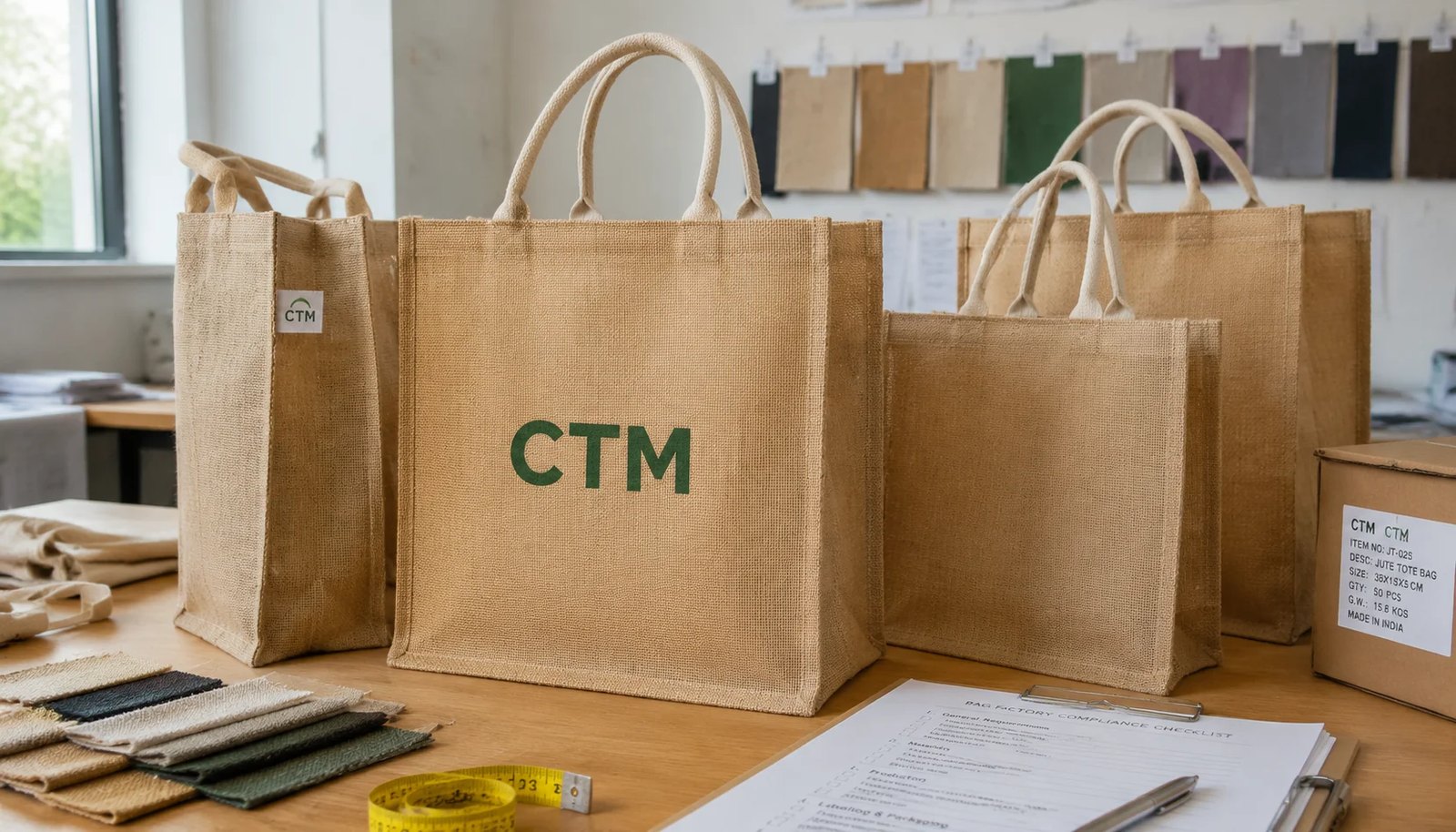
The main buying problem: a usable compliance checklist, not just a cheap jute bag quote
Natural grocers usually do not struggle to find a jute tote supplier. The harder part is comparing quotes that look similar on price but are based on different bag constructions, different print assumptions, and very different compliance readiness. One supplier may quote unlaminated jute with self-material handles, another may quote laminated jute with cotton webbing handles, and a third may leave out testing support and packing details altogether. If procurement teams compare only FOB price, the lowest quote often becomes the highest-risk option once samples, compliance documents, and shipping claims start moving.
A practical compliance checklist for wholesale jute tote bags should solve one clear problem: making sure the quoted bag can actually pass internal brand review, retail onboarding, and real grocery use. That means defining fabric construction, handle reinforcement, print limitations, packaging rules, and supplier evidence before the PO is placed. For natural grocers, the bag is not just a promo item. It is handled by store staff, stacked at checkout, reused by shoppers, and often associated with sustainability claims. Those conditions make spec discipline more important than small unit-price differences.
- Do not compare quotes until bag construction is aligned.
- Retail compliance readiness matters as much as stitching quality.
- A jute tote for grocery use needs load-bearing and packing standards, not just logo approval.
Start with the right jute tote specification for grocery use
For natural grocers, the safest starting point is a medium-to-heavy body construction with a practical size that carries produce, dry goods, and bottles without becoming awkward at checkout. Many buyers work in a range such as 30-38 cm width, 15-20 cm gusset, and 30-38 cm height, with cotton webbing handles long enough for hand carry or short shoulder carry depending on store preference. Body construction commonly lands around 250-320 GSM equivalent, but the quote should describe whether that figure applies to raw jute fabric alone or to a laminated composite. A vague term like premium heavy jute is not enough for RFQ use.
Natural grocers also need to decide early whether the bag should look rustic or more retail-finished. Unlaminated jute gives a more natural, textured appearance and stronger handmade character, but it sheds more fiber and prints less cleanly. Laminated jute gives better shape retention and cleaner logo presentation, especially for larger print areas, but may require more careful review if the retailer makes narrow sustainability claims. Neither route is automatically better. The decision should be based on store image, expected use cycle, and how the compliance team wants product claims worded.
- Useful RFQ data: finished size, gusset style, body construction, handle width, handle drop, print side, and target load use.
- Typical handle widths for grocery totes: 2.5-4 cm cotton webbing depending on bag size and load.
- If bottles or jars are common contents, request reinforced stitching and a structure sample loaded with real weight.
Compliance documents buyers should expect from a credible supplier
Supplier compliance for jute tote bags is often handled too late, after design signoff and price negotiation. That creates avoidable delays because some vendors can make the bag but cannot support the document package needed by a retailer, importer, or private-label team. For natural grocers, a workable supplier file usually includes a material declaration, restricted substance or azo dye statement where relevant, packaging material declaration, country-of-origin details, and any test support required by the buyer's internal standards. If the bag uses cotton webbing handles, inks, lamination film, side labels, or swing tags, those components may need to be covered too.
The key point is traceability and order relevance. Generic certificates from another factory or undated declarations are weak evidence. Buyers should request documents that match the product family, identify the supplying entity, and can be linked to the PO or production batch if needed. Even when formal third-party testing is not mandatory, the supplier should be able to state what chemicals are used in printing, whether azo-sensitive dyes are involved, and how packaging compliance is managed for export cartons, polybags, and labels.
- Request signed declarations, not only screenshots or verbal statements.
- If the buyer has a restricted substances list, send it with the RFQ rather than after order placement.
- Clarify whether compliance documents cover all components: body, handles, thread, print ink, labels, and packing materials.
How fabric weight, lamination, and print method change your quote
In jute tote sourcing, cost does not move only with size. It moves with construction details that are often hidden inside brief quotations. A bag with 280 GSM body fabric, cotton webbing handles, and one-color screen print may price very differently from a similar-size bag using thinner body fabric, self-jute handles, and no lamination. Add PE lamination, inner pocket, piping, or colored gusset panels and the quote shifts again. That is why procurement teams should request a quote breakdown by main cost drivers rather than a single all-in line item. Even a simple split between fabric, handle, print, packing, and sampling makes quote comparison easier.
Print method is another common source of mismatch. On coarse unlaminated jute, one- or two-color screen print is usually the most commercially stable option. Fine text, solid flood areas, or halftones often break up because of the weave. On laminated jute with a smoother face, more detailed print methods can work better, but setup and approval needs change. If the buyer sends only a logo and asks for best print method, each supplier may make different assumptions. Better practice is to specify acceptable print routes and ask the supplier to flag any artwork that is risky on the chosen substrate.
- Typical quote cost drivers: body fabric weight, lamination, handle material, print colors, print area, gusset depth, inside finishing, and export packing.
- A larger print area can raise cost even with the same color count due to setup, rejection risk, and slower print speed.
- If artwork includes fine lines or small text, request a print strike-off on actual jute before approval.
MOQ logic for natural grocer programs and how to keep it workable
MOQ on jute totes is rarely just one number. It usually reflects the production economics of fabric sourcing, cutting efficiency, print setup, and packing by SKU. Buyers often run into trouble when they request too many variations in the first order: multiple bag sizes, multiple logo versions, mixed handle colors, and custom labels for each store group. The supplier then either raises the MOQ per variant or hides the inefficiency in unit cost. For natural grocers rolling out regional or chain-wide programs, the smarter route is usually to standardize the bag body and handle construction first, then vary only the front print where volume supports it.
From a merchandiser's viewpoint, MOQ becomes easier when components are shared. If all stores use one natural body fabric, one gusset size, one handle color, and one carton pack, then the only changing element may be artwork. That reduces waste and shortens line setup. Buyers should also distinguish between sample MOQ, trial order MOQ, and repeat-order MOQ. A direct factory may be flexible on a first PO if the bag can fit an existing material platform, while a highly customized construction may require a firm minimum from the start.
- Consolidate size and color wherever possible in the first launch.
- Ask for MOQ by finished SKU and by shared base bag structure.
- Clarify whether quoted MOQ is per artwork, per colorway, or total order quantity.
Sample approval should test load, print realism, and retail presentation
A jute tote sample should do more than show logo placement. For grocery use, it needs to prove that the bag keeps shape, handles weight, and presents cleanly at checkout or on a retail fixture. Buyers should request a pre-production sample made from the actual intended materials, not a nearest-available fabric substitute. If the supplier sends a showroom sample using thicker fabric than the quote basis, the later production risk increases immediately. The sample should include actual handle attachment, exact seam construction, and the proposed print method on the real jute surface.
Approval should also involve practical handling tests. Load the sample with realistic grocery weight such as produce, cartons, bottles, or jars, and look at seam distortion, handle comfort, and top opening behavior. If the bag tips over too easily or the handle drop is awkward for store staff, those are commercial design problems, not minor factory details. Buyers should photograph and document what was approved, including front, side, inside seam, base gusset, and print close-up, because many repeat-order disputes start with vague sample records.
- Approve against actual material and actual print route, not concept art.
- Review smell, fiber shedding, seam neatness, and bag squareness in addition to logo appearance.
- Keep dated approval photos and a signed sample comment sheet linked to the PO.
QC thresholds that prevent avoidable disputes on bulk jute bags
Jute is a natural fiber with more visual variation than canvas or nonwoven bags, so QC should focus on commercially meaningful defects rather than unrealistic cosmetic perfection. A workable standard separates acceptable natural variation from rejectable production faults. Slight weave inconsistency or small shade variation may be tolerable if agreed in advance, while seam opening, major print misplacement, heavy oil marks, mildew odor, or weak handle reinforcement are not. Procurement and QC teams should define these thresholds before mass production, not during final inspection when the goods are already packed.
For natural grocers, the highest-risk defects are usually functional and presentation-related: inaccurate dimensions affecting shelf stack or checkout storage, print inconsistency across store-branded programs, loose stitching at handle joins, and dirty packing conditions that create odor or dust. Carton count errors are another frequent issue, especially when mixed artwork programs are packed in similar outer cartons. Inline checks reduce this risk because print registration, handle placement, and cut panel size can be corrected early instead of discovered after all units are sewn.
- Set acceptable tolerance for body size, gusset depth, and handle drop in writing.
- Define major defects: seam failure, serious print smudge, wrong artwork, incorrect carton count, strong odor, mold, or damaged lamination.
- Use inline photos or third-party inspection if the order includes multiple SKUs or retailer-specific branding.
Packing rules matter more than many buyers expect
Packing is not just a warehouse topic. It affects bag shape, print condition, DC receiving, and landed cost. Jute totes that are over-compressed in cartons can arrive with crushed gussets, wrinkled laminated panels, or rubbed print surfaces. If cartons are too heavy, handling damage rises and receiving teams complain. For natural grocer programs shipping to a distribution center, flat packing with counted bundles and clear carton marks is usually the cleanest route. Each carton should identify SKU, PO, color or artwork code, quantity, gross weight, net weight, and carton number sequence.
Buyer policy on inner polybags should be stated early because different retailers have different packaging expectations. Some want no individual polybag for sustainability reasons; others still require moisture protection or bundle liners for import handling. Jute can pick up dust and ambient odor if packed in uncontrolled conditions, so even when individual polybags are not used, a clean liner or controlled dry packing environment may still be needed. Carton dimensions should also be optimized for container loading, especially if the program mixes multiple reusable bag types in one shipment.
- Common packing controls: bundle count, carton count, maximum carton weight, shipping marks, and moisture protection method.
- Do not allow unknown carton substitutions if the buyer has pallet or DC limits.
- Request packing photos before shipment release on first orders.
Lead time planning: where natural grocer bag orders usually slip
Jute tote lead time often looks simple on paper but slips in three places: artwork approval, material readiness, and consolidated packing by SKU. If the buyer changes logo size or print method after sampling, the production sequence resets. If custom webbing, dyed trim, or lamination color is involved, material lead time can become longer than sewing time. And if the order has several regional artworks or store codes, final sorting and carton marking can add more days than expected. That is why buyers should request a milestone-based schedule instead of a single shipment date.
A practical schedule usually breaks into sample development, approval revision if any, material booking, bulk cutting and printing, sewing, inline inspection, final inspection, and packing completion. Importers should also hold time for booking and export paperwork before vessel cutoff. As an example only, a simple repeat order on existing materials may move much faster than a first-time custom order requiring sample revision and compliance review. The real value is not promising the shortest lead time; it is identifying which approvals must happen by which date to protect the ship window.
- Request a critical path with approval deadlines, not only a total production lead time.
- Artwork changes after sample approval are a common source of delay and waste.
- Mixed-SKU orders need extra packing and count verification time.
Use landed-cost thinking, not FOB-only thinking, when comparing suppliers
A supplier quote that is slightly lower FOB may still be the more expensive sourcing route if it creates higher rejection risk, poor packing efficiency, or extra compliance admin. For jute tote programs, landed cost should consider unit price, sample and print setup, carton efficiency, defect exposure, rework risk, and internal labor spent chasing missing documents. A factory that provides clean packing lists, stable carton counts, and complete compliance paperwork often saves more than the apparent price gap versus a loosely managed source.
This is especially true for importers and distributors supplying retail channels with strict receiving processes. A carton shortage claim, wrong artwork packed into the wrong SKU carton, or undocumented material substitution can cost more than several cents per bag. Buyers do not need a complex finance model to improve decisions. Even a simple comparison that adds quote basis, included services, inspection plan, and compliance support to the price review can reveal which offer is commercially safer.
- Compare what is included: sample, print setup, carton marks, inspection support, and compliance documents.
- Lower fabric weight can reduce FOB but increase returns or shorten useful life.
- Receiving errors and repacking costs should be treated as sourcing costs, not warehouse noise.
Specification comparison for buyers
| Supplier option | What to verify | Commercial advantage | Buyer risk to control |
|---|---|---|---|
| Direct sewing factory | jute roll photos, lamination sample, odor-control process, handle pull evidence, and pre-shipment carton condition photos | Better sample-to-bulk control and faster production feedback | May be weaker on export paperwork or branded packing unless checked early |
| Trading company | Factory name, production photos, trim-source proof, and who owns QC decisions | Can coordinate small mixed orders and extra services | Markup can hide real factory capability and slow defect decisions |
| Specialized bag workshop | handle stitching, side gusset, lamination edge control, inner seam cover, and fiber shedding tolerance | More practical for detailed construction, trims, and repeat programs | Capacity may be limited during peak seasons |
| Low-price general supplier | laminated or unlaminated jute, cotton-jute blend, inner coating, odor control, yarn thickness, and color shade variation | Useful for simple promotional runs with loose specs | Material downgrades, weak packing, and vague inspection scope can erase savings |
| Retail-ready supplier | airing time, moisture absorber, carton liner, bundle wrap, odor separation, and warehouse ventilation before loading | Can handle labels, SKU separation, carton marks, and receiving rules | Higher unit cost must be compared against reduced warehouse work |
| Compliance-focused supplier | Fabric records, labeling review, test plan, and production traceability | Safer for retail programs and repeat brand orders | Documentation claims need evidence, not only sales language |
| Local sample room plus bulk factory | Signed sample, bulk factory handoff, first-piece photos, and deviation owner | Good for complex branding before large production | Sample room quality may not match bulk line unless handoff is controlled |
Buyer checklist before sampling
- Define whether the bag is unlaminated or laminated jute before requesting quotes; this changes print, cost, and compliance review.
- State finished size with width x gusset x height and note whether measurements are taken on an empty, laid-flat, or filled bag.
- Specify target fabric construction in practical terms such as natural jute body around 250-320 GSM equivalent, not just heavy duty.
- List handle material, width, finished drop length, and reinforcement stitch requirement at each attachment point.
- Attach artwork with print size, print colors, print side, and acceptable rustic print appearance on jute weave.
- State safe working load expectation for grocery use, especially if jars, bottles, or produce are typical contents.
- Require a pre-production sample showing actual fabric, handle, stitching, and print method before bulk approval.
- Include carton pack quantity, carton maximum weight, shipping marks, and whether inner polybags are allowed or restricted.
- Request supplier compliance documents in the same RFQ cycle instead of after price approval.
- Set acceptance criteria for size tolerance, print position, odor, loose fibers, seam security, and carton count accuracy.
Factory quote questions to send
- Is the quoted bag body unlaminated jute, PE laminated jute, or jute blended with another backing material?
- What is the actual fabric specification in GSM or ounce equivalent, and how is it measured across body panels and gusset?
- Are handles cotton webbing, self-jute, or another material, and what stitch pattern is used at each handle attachment point?
- Does the quote include screen setup, print strike-off, pre-production sample, export carton, and carton markings?
- What is the MOQ by size, by color, and by artwork version, and which components drive a higher MOQ?
- Which parts of production are in-house and which are outsourced, especially printing and lamination?
- What compliance documents can be provided with the order: material declaration, restricted substances statement, packaging declaration, and COO data?
- What are standard tolerances for finished size, handle drop, print placement, and carton count?
- How many days are needed for sample, lab-dip or print approval if relevant, bulk production, and booking before vessel cutoff?
- What inspection points are recorded during bulk production, and can inline photos or measurement reports be shared by PO?
Quality-control points to confirm
- Finished size tolerance should be agreed in writing, commonly around ±1 cm for body dimensions and ±0.5-1 cm for handle drop depending on construction.
- Fabric shade should be matched to approved sample within commercially reasonable jute variation; jute is naturally less uniform than cotton canvas.
- Print position should be measured from fixed seams or top edge, not estimated visually, especially on gusseted bags.
- Print coverage on coarse jute should show no major broken areas, smudging, ghosting, or obvious color contamination beyond approved rustic character.
- Handle reinforcement stitches must be consistent, locked, and free from skipped stitches or loose thread ends at stress points.
- Side seams and bottom join must hold shape under test loading without seam opening, edge burst, or severe panel distortion.
- Laminated bags should be checked for peeling, bubbling, odor, and wrinkles that affect packing or shelf presentation.
- Carton count, bundle count, and carton markings must match packing list and PO exactly to avoid DC receiving shortages.
- Needle policy, metal contamination controls, and clean packing conditions should align with the buyer's compliance requirements.
- Random packed cartons should be opened to verify no mildew smell, damp fabric, insect contamination, or excessive dust from raw jute handling.