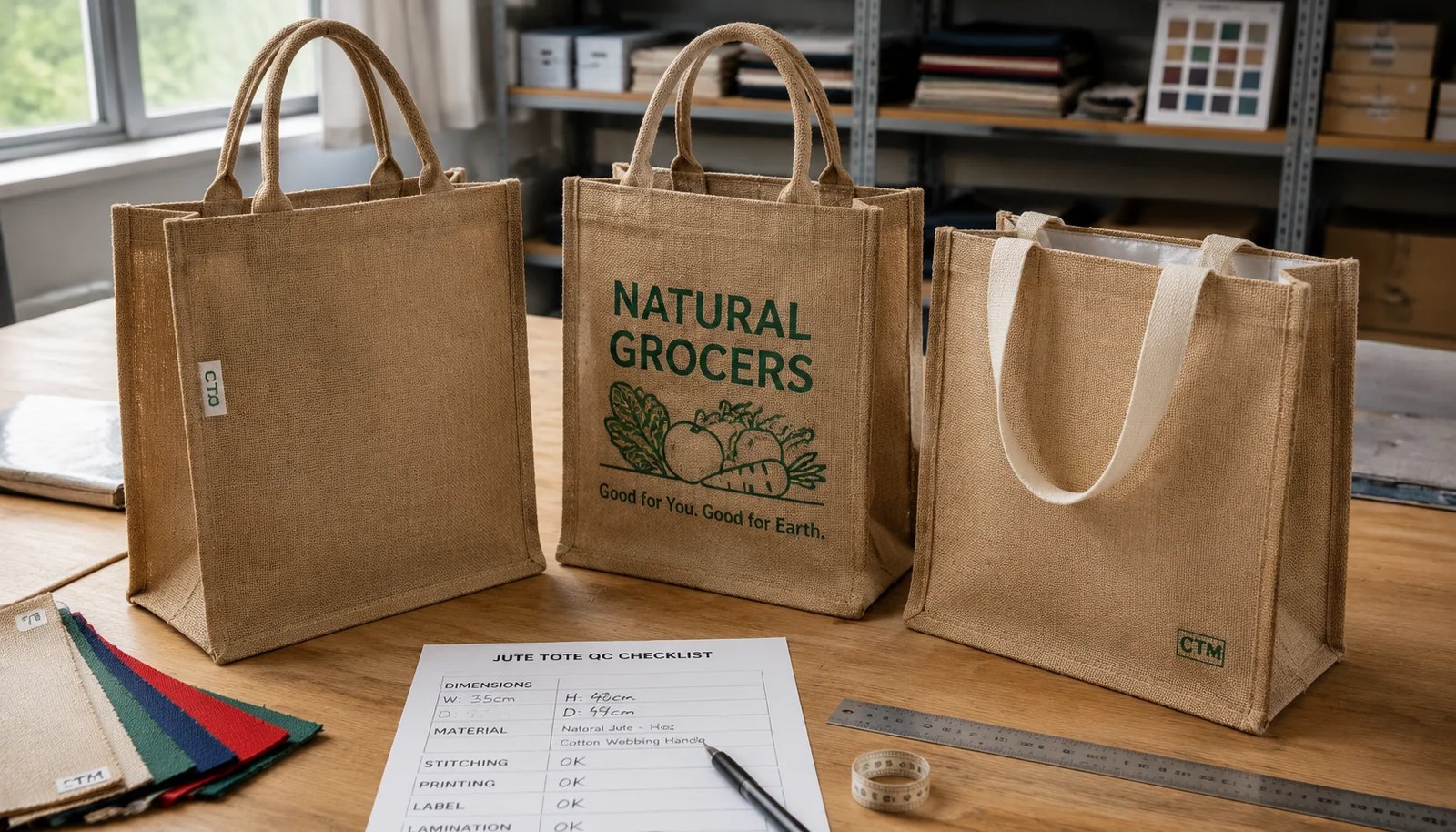
Start with the grocery use case
A jute tote for a natural grocer is not the same product as a trade-show giveaway. It may carry jars, bottles, produce, boxed pantry items, chilled goods, and cleaning products in one trip. That mixed load stresses handles, gussets, seams, and body fabric. Procurement should therefore write the RFQ around the actual store use instead of beginning with only dimensions and logo size.
The buyer also has a brand problem to manage. Natural grocer customers notice odor, fiber shedding, rough handles, poor print quality, and whether the bag feels consistent with the retailer's sustainability message. A bag can meet a low unit price target and still fail commercially if store teams do not want to display it or customers complain after use.
- Define expected contents: produce, bottles, jars, boxed goods, chilled packs, or general checkout use
- State expected load as a buyer assumption, not a universal standard; many grocery totes are tested around 6-10 kg when jars or bottles are likely
- Decide whether the bag must stand upright at checkout or only function as a carry tote
- Align merchandising, procurement, and compliance before choosing lamination or printed claims
Specify construction before price
Many quote disputes start because the buyer asks for a size and a photo, then receives several prices that appear comparable. They are rarely comparable. One supplier may quote lighter jute, simpler handles, no reinforcement, looser print tolerances, and basic packing, while another includes a stronger construction. The quote sheet should lock the construction first, then compare prices.
For grocery retail, a practical starting point is a medium-heavy jute body, boxed gusset, reinforced handles, and clean top hem. A 280-340 GSM equivalent is often used as a working range for sturdier reusable bags, but it should not be treated as a universal rule. Weave density, lamination, seam construction, and handle reinforcement can make two fabrics with similar weight perform differently.
- Avoid vague PO terms such as standard jute, export quality, regular handle, or normal packing
- Ask whether fabric weight is measured before or after lamination
- Specify finished dimensions, not only cut-panel dimensions
- Use the approved physical sample as the visual benchmark for jute shade, weave, and hand feel
Choose lamination carefully
Inside PE lamination can improve structure, reduce dusting, and make the interior easier to wipe. It may help the bag stand better at checkout and protect the body from light moisture contact. It does not make the tote waterproof because seams, stitch holes, and the open top still allow moisture entry.
For natural grocers, lamination is also a claim and positioning issue. A laminated bag may still be a useful reusable jute tote, but buyers should not imply it is fully natural or plastic-free unless that claim is accurate under applicable local rules. Procurement should verify retailer sustainability language, hangtag copy, and local labeling requirements before approving production.
- Choose unlaminated jute when raw texture and lower synthetic content matter most
- Choose inside lamination when structure, reduced shedding, and wipe-clean convenience matter more
- Inspect laminated bags for bubbling, peeling, tackiness, edge film, and strong plastic odor
- Review laminated and unlaminated samples side by side before finalizing the spec
Set handle and seam requirements
Handles are the highest-visibility failure point because customers feel them immediately and load failures are obvious. Cotton webbing handles usually provide better comfort than twisted jute handles for heavier groceries. The specification should include handle width, handle drop, total length, insertion depth, stitch pattern, and reinforcement method.
Seam quality matters as much as fabric weight. A strong body cloth will not help if the bottom gusset opens or handle stitching pulls through the panel. Buyers should ask the factory to define its stitch density and construction method, then confirm those details on the pre-production sample. For example, stitch density can be approved as an agreed range from the sample rather than presented as a universal number.
- Common grocery-friendly handle widths are often about 2.5-3.8 cm, subject to buyer comfort and cost targets
- Use box stitch or X-stitch at handle attachment where the bag is expected to carry heavier goods
- Check handle pair matching so the loaded bag hangs evenly
- Reject skipped stitches, loose locking, seam grin, missing reinforcement, and raw-edge unraveling
Control artwork expectations
Jute is coarse, textured, and naturally irregular. It does not print like smooth canvas, coated paper, or nonwoven polypropylene. Direct screen printing works best with bold logos, simple typography, and limited colors. Fine outlines, tiny reversed text, tight registration, and large heavy solids can break, blur, or look uneven on the weave.
Artwork approval should include a real print strike-off on production jute. A digital mockup can confirm placement and general design, but it cannot prove ink behavior on the material. If the brand requires sharper detail, a canvas patch or smoother print panel may be a better option, though it adds cost and another sewing checkpoint.
- Ask for minimum line thickness and minimum text height based on the actual jute weave
- Approve color against a physical strike-off, especially for greens, browns, and muted natural tones
- Define print placement tolerance, such as an agreed plus or minus range from the approved sample
- Inspect for smudging, ghosting, unreadable text, off-center logos, poor adhesion, and registration drift
Approve samples like production
A sample should prove that the supplier can repeat the bag, not just make one attractive piece. Salesman samples and hand-finished development samples may be cleaner than mass production. The important approval is the pre-production sample made with final jute, final handles, final stitching, final artwork, and the intended folding or packing method.
Sample comments should be written as production instructions. Instead of saying the handle feels weak, state whether to increase webbing width, add reinforcement, deepen handle insertion, or change the stitch pattern. Instead of saying the logo looks rough, state whether to enlarge text, thicken lines, reduce color count, or move to a patch.
- Approve one physical pre-production sample before bulk cutting
- Load the sample with realistic grocery contents and observe balance, comfort, gusset shape, and seam stress
- Retain a golden sample for repeat orders and shade comparison
- Record accepted natural jute variation so inspectors do not reject normal slubs or minor tone shifts
Use clear inspection tolerances
A useful inspection checklist separates natural-material variation from defects. Jute may show small slubs, minor shade variation, and slight surface hair. Those are acceptable when they match the approved sample range. Defects include weak yarn areas, holes, mildew, heavy contamination, unreadable print, burst seams, missing reinforcement, peeling lamination, or wrong size beyond the agreed tolerance.
For AQL planning, many buyers use general inspection levels and defect classifications rather than inspecting every piece. The exact AQL level should be set by the buyer's risk tolerance, product value, and retailer requirements. As an example, hygiene and safety issues are normally treated as critical, structural and branding failures as major, and loose trimmable threads as minor.
- Example size tolerance to discuss: plus or minus 1 cm on width and height, and plus or minus 0.5-1 cm on gusset
- Example print placement tolerance to discuss: plus or minus 5 mm for simple centered artwork, if the factory confirms it is realistic
- Critical defects: mold, insect contamination, unsafe fragments, broken handles, burst seams
- Major defects: severe print smudge, wrong dimensions, missing reinforcement, mixed SKUs, peeling lamination
- Minor defects: loose thread ends, small cosmetic slubs, slight shade variation within approved range
Inspect packing, not only bags
Packing can create quality failures after production is complete. Jute can absorb moisture, and compressed cartons may sit through humid storage or sea transit. If bags are packed damp, over-compressed, or without a suitable liner, the buyer may receive musty odor, mildew spots, distorted gussets, or creased laminated interiors.
Packing also affects warehouse labor. Mixed SKUs in one carton, unclear carton marks, inconsistent counts, or missing barcode placement can slow receiving and allocation. These issues are easy to prevent when carton rules are approved before production, but difficult to fix after shipment.
- Define pieces per carton, carton dimensions, carton marks, and SKU separation
- Use a moisture barrier liner for sea freight when humidity risk is meaningful
- Keep carton gross weight within the buyer's warehouse handling rules; under 16 kg is a common practical target, not a universal standard
- Inspect random cartons for count accuracy, odor, moisture, carton strength, liner use, and label placement
Normalize quotes before awarding
The lowest unit price may simply reflect missing requirements. Before awarding, compare quotes on the same construction: body fabric, lamination, handle type, reinforcement, print method, packing, carton marks, samples, and inspection readiness. Ask suppliers to show what changes at different quantity breaks so procurement can separate real efficiency from specification downgrade.
MOQ guidance should be treated as commercial context, not a fixed industry rule. Some suppliers can support small custom runs, but pricing, material control, and setup cost are usually more stable at higher quantities. For many custom grocery tote programs, 1,000, 3,000, and 5,000 pieces per size or artwork are useful quote breakpoints.
- Compare cost per usable bag, not only FOB price per shipped bag
- Ask whether sample fees, screen charges, labels, carton upgrades, and moisture liners are included
- Reduce cost first through simpler artwork or shared print colors before weakening structure
- Confirm whether repeat orders can use the same construction and retained reference sample
Plan lead time and risk gates
Lead time should be broken into sample, artwork approval, raw material purchase, printing, cutting, sewing, inline checking, packing, final inspection, and cargo handover. A single promised ship date hides too many dependencies. First orders need more buffer because artwork, construction, and packing standards are still being aligned.
Risk gates keep the order from drifting. Approve the strike-off before print production, check handle material before sewing starts, review inline photos or inspection notes before the lot is finished, and inspect packed cartons before cargo release. These steps are not substitutes for a capable supplier, but they catch common errors early enough to correct.
- Illustrative sample timing: often 5-10 working days, depending on artwork and material availability
- Illustrative production timing: often 25-45 days after final approval for standard custom programs, subject to capacity and season
- Higher delay risk: custom-dyed handles, multiple artworks, special labels, mixed carton packing, late artwork changes
- Confirm the number of days between passed inspection and cargo handover
Specification comparison for buyers
| Procurement option | Best use | Cost and quality tradeoff | Inspection outcome to verify |
|---|---|---|---|
| Unlaminated jute body | Retailers prioritizing a raw natural hand feel and simpler material story | Usually lower material complexity, but less structure and more fiber shedding than laminated bags | Check shedding, open weave, body collapse under load, and whether sustainability or labeling claims match local rules |
| Inside PE-laminated jute | Grocery totes needing better shape retention, easier wipe-cleaning, and reduced dusting | Adds cost and synthetic content; can create odor, bubbling, edge film, or delamination risk | Inspect bond strength, odor after carton opening, bubbling, tackiness, and buyer-approved claim language |
| Cotton webbing handles | Reusable grocery bags expected to carry mixed loads comfortably | Higher cost than basic jute handles, but better hand feel and more predictable stitching | Measure handle width and length, check pair matching, box or X-stitch quality, and pull-test samples |
| Direct screen print on jute | Simple one- or two-color grocery branding with bold artwork | Efficient for volume orders; fine detail and tight registration are limited by the coarse weave | Verify print legibility, placement tolerance, ink adhesion, smudging, and color against approved strike-off |
| Canvas logo patch | Brands needing sharper artwork than direct jute printing can hold | Adds sewing labor and material cost; may pucker if patch and jute behave differently | Check patch alignment, edge sewing, panel puckering, print sharpness, and colorfastness |
| Medium-heavy grocery construction | Regional chains, distributors, or repeat retail programs carrying produce, jars, and dry goods | A practical range is often around 280-340 GSM equivalent, but suitability depends on weave, lamination, gusset, and handle reinforcement | Confirm whether weight is measured before or after lamination and test loaded samples instead of relying on GSM alone |
| Very low MOQ trial order | Short seasonal test, single-store pilot, or merchandising validation | Can work, but unit price, material consistency, and customization options may be less stable | Ask what changes at 500, 1,000, 3,000, and 5,000 pcs and whether the same materials will be used for reorder |
| Moisture-protected export packing | Sea freight, humid seasons, or warehouse programs where cartons may sit before allocation | Moisture liner, correct carton strength, and sensible carton weight add cost but reduce arrival claims | Check carton count, liner use, desiccant plan if specified, carton gross weight, odor, mildew, and SKU separation |
Buyer checklist before sampling
- Define intended use: checkout sale, loyalty program, private-label reusable bag, produce tote, gift-with-purchase, or distributor resale.
- State target finished dimensions with tolerances for width, height, gusset, and handle drop after sewing and normal shaping.
- Specify fabric construction by weave, target weight range, and whether the weight is base jute or finished laminated material.
- Confirm lamination status: required, prohibited, or optional. Align this with brand, sustainability, and local labeling requirements before RFQ release.
- Define handle material, width, total length, handle drop, insertion depth, stitch pattern, and whether reinforcement patches are required.
- Set artwork rules for jute: maximum colors, minimum line thickness, minimum text height, print position tolerance, and approved color reference.
- Require a pre-production sample in actual materials, not only a digital mockup, salesman sample, or substitute fabric sample.
- Include acceptance criteria for odor, mildew, contamination, print legibility, lamination bond, stitch quality, size, and packing count.
- Define AQL or sampling plan before production. Treat hygiene and structural defects more severely than minor cosmetic variation.
- Approve carton count, carton marks, barcode placement, moisture protection, SKU separation, and maximum carton gross weight before packing starts.
Factory quote questions to send
- What exact jute construction is quoted, including weave, weight range, and whether the figure is measured before or after lamination?
- Is the price based on unlaminated jute, inside PE lamination, or another lining? What lining thickness or grade is normally used?
- What finished-size tolerance can you hold for body width, height, gusset depth, handle drop, and print placement after sewing?
- What handle material, width, insertion depth, stitch pattern, and reinforcement are included in the quoted price?
- What load test or pull test do you use internally for handle attachment and side or bottom seams? Can you describe the method?
- What artwork limitations do you recommend for this jute weave: minimum line width, minimum text height, maximum print area, and color count?
- Can you provide a printed pre-production sample using production jute, production handles, production ink, and final packing fold?
- How does unit price change at 500, 1,000, 3,000, and 5,000 pieces per size or artwork? Which MOQ gives stable material purchasing?
- What is included in export packing: pieces per carton, moisture liner, desiccant if any, carton grade, carton dimensions, and gross weight?
- How do you control jute shade variation across one purchase order and across repeat orders? Can you retain a production reference sample?
Quality-control points to confirm
- Fabric weight and weave consistency: compare random pieces to the approved sample and reject weak yarn sections, severe open weave, large holes, or major shade mismatch.
- Finished dimensions: measure after removing compression and shaping the bag naturally. Example tolerance may be plus or minus 1 cm on width and height and plus or minus 0.5-1 cm on gusset, if approved in advance.
- Handle construction: verify handle width, handle drop, pair matching, insertion depth, stitch pattern, and reinforcement. No skipped stitches, loose locking, or missing reinforcement at stress points.
- Stitch density and seam security: define expected stitch density with the supplier, such as an agreed stitches-per-inch range on approval sample, then reject seam grin, burst seams, raw unraveling, or broken threads.
- Print quality: check color, adhesion, legibility, smudging, ghosting, registration, and placement. Example placement tolerance may be plus or minus 5 mm for simple logos, if realistic for the artwork and approved sample.
- Lamination where used: inspect for bubbling, peeling, film exposure, tackiness, sharp edges, and strong plastic odor after cartons have been opened and bags separated.
- Odor and hygiene: reject mildew, musty smell, insect contamination, oil marks, wet cartons, or foreign matter that would be unacceptable in grocery retail.
- Defect classification: treat mold, unsafe fragments, broken handles, and burst seams as critical; wrong size, missing reinforcement, severe print defects, and peeling lamination as major; loose trimmable threads as minor.
- Packing accuracy: verify pieces per carton, SKU separation, carton marks, barcode placement, moisture barrier use, carton strength, and gross weight.
- Functional checks: lift selected samples with the buyer's expected grocery load and repeat handling cycles to watch for handle distortion, seam opening, body collapse, or uncomfortable carrying.