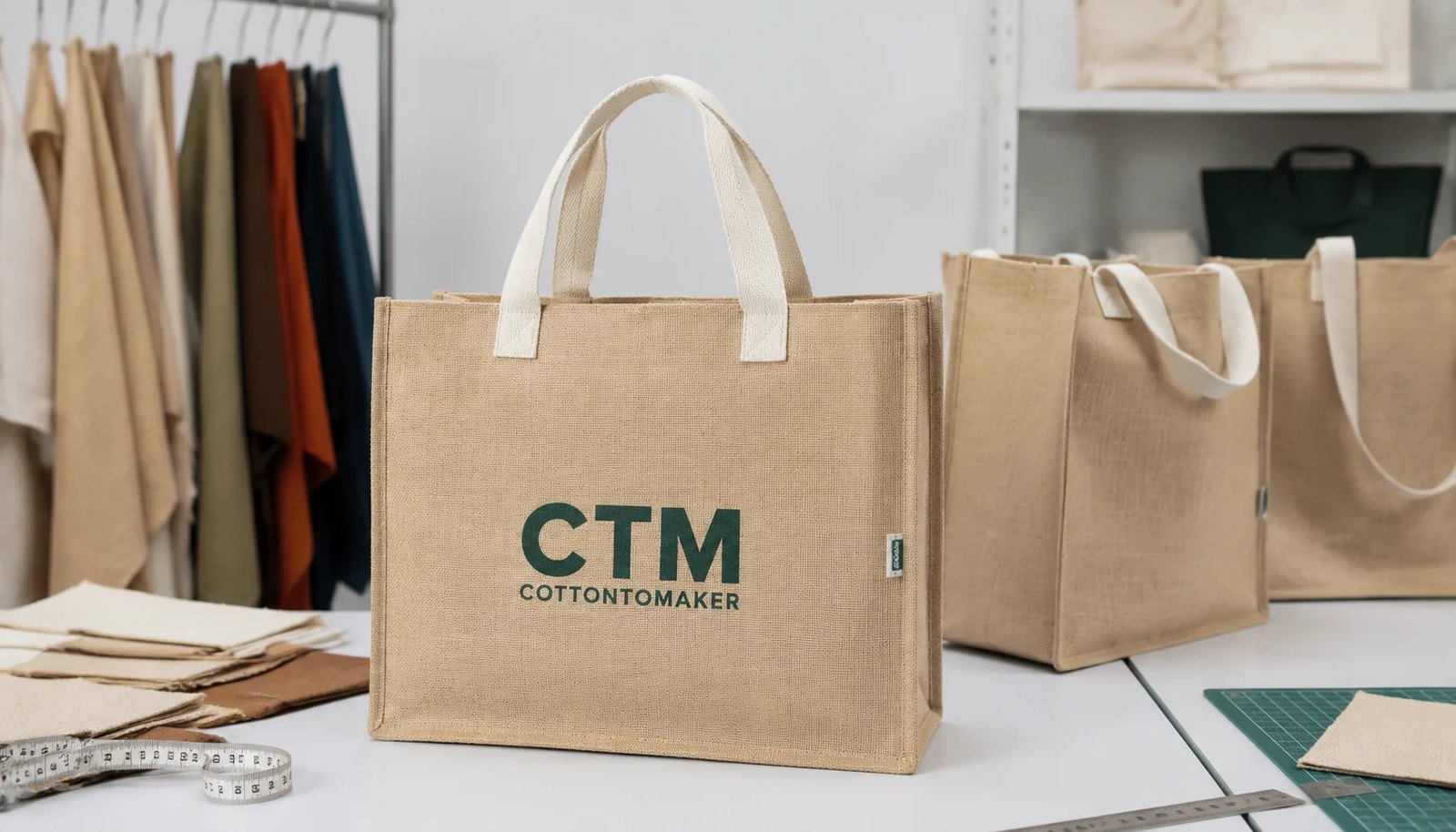
Start With The Grocery Use Case, Not The Catalog Photo
The first step in a strong wholesale jute tote bags for natural grocers buying checklist is defining what the bag must do inside the buyer's actual operation. Natural grocers use jute totes for several very different jobs: reusable checkout bags, paid branded merchandise, seasonal produce promotions, vendor co-marketing, holiday gift sets, and community event giveaways. These jobs look similar at a glance, but they demand different construction choices. A promotional tote for a weekend farmers market may only need to carry a few boxed items for a short time. A paid reusable grocery bag sold near checkout must survive repeated use with jars, bottles, canned goods, and bulk foods.
Procurement teams often send a broad RFQ such as 'quote jute tote bag with logo' and then receive prices based on whatever standard bag the supplier already produces most often. That usually creates avoidable revisions. A factory may assume a simple merchandise tote with light-duty handles, while the buyer actually needs a checkout bag with reinforced attachments and enough gusset depth for heavy groceries. The result is either a misleading low quote or a painful re-quote after sample review.
A better buying process starts with operational details. Decide whether shoppers will hand-carry or shoulder-carry the bag, whether cashiers need the bag to stand open during packing, whether the bag will be stored in a dry retail area or a humid stockroom, and whether the bag is a low-cost giveaway or a revenue-generating retail item. Each answer changes the right balance of jute weight, handle comfort, print quality, and packing method.
It is also useful to identify the internal owner of the project. For many natural grocers, reusable bags sit at the intersection of merchandising, store operations, sustainability, and procurement. If only one department reviews the sample, common issues get missed. Merchandising may approve the appearance, but store staff may later report that the handles are too short, the bag collapses while packing, or the gusset is too narrow for real basket transfers. Aligning these stakeholders before quote comparison prevents the sample from becoming the first time anyone tests the design in practice.
- For checkout use, prioritize handle strength, gusset width, ease of loading at the register, and repeat-use durability.
- For paid retail merchandise, prioritize cleaner jute appearance, straighter stitching, better print registration, and cleaner shelf presentation.
- For produce or farmers market promotions, decide in advance whether damp environments make lamination necessary.
- For gift baskets, test whether the bag stands upright after filling and whether gusset corners keep shape under display conditions.
- For community events or vendor-funded campaigns, confirm whether a lower-cost promotional build is acceptable or whether the bag still represents the store brand long term.
Choose Jute Fabric Weight And Weave With Clear Written Tolerances
Fabric is one of the biggest cost drivers and one of the easiest specifications to misunderstand. Jute suppliers may quote weight in ounces, GSM, local mill counts, or internal grades. Some quote fabric-only weight; others refer to the finished laminated composite. That is why buyers should not rely on general phrases such as 'standard jute' or 'thick quality.' For most natural grocer tote programs, a practical starting range is about 13-15 oz or roughly 270-320 GSM, depending on the mill's conversion method. This is often heavy enough to support grocery use while still workable for folding, printing, and freight.
But weight alone is not enough. Two bags with similar GSM can feel very different because of weave openness, yarn quality, slub variation, and finishing. One bag may look cleaner and stand up better because the weave is tighter and the panel cuts are more consistent. Another may technically meet the weight target but appear coarse, gap-prone, or visibly inconsistent from piece to piece. Buyers who sell the bag at retail should review not only the nominal weight but also the fabric's visual uniformity.
The safest approach is to lock both a target and a tolerance in the purchase order. For example, the buyer can state the required jute body range and request confirmation of whether the measurement is taken before or after lamination. The approved sample should become the reference standard for bulk. Without this written control, a supplier may source from a different batch or downgrade slightly in order to hit a tighter price, especially if the original RFQ left room for interpretation.
Natural grocers should also think about fiber shedding and edge fray. Coarser, looser jute can create more dust and fibers in transit and during store handling. That may be acceptable for low-cost promotions but less acceptable for retail display near premium packaged foods or branded gift items. If bag appearance matters, ask the supplier to comment on expected fiber shedding and edge finishing methods during sample review.
Finally, fabric weight affects more than the unit cost. Heavier jute can improve body and perceived durability, but it raises shipping weight and carton cube. It may also stiffen the bag enough to change folding efficiency. Procurement teams should review the fabric decision alongside packing density and freight estimates, not in isolation.
- State the target weight in oz or GSM and ask the supplier to show the conversion basis.
- Clarify whether the quoted weight is fabric-only, pre-lamination, or finished laminated construction.
- Request tolerance for fabric weight so sample and bulk are judged against the same standard.
- Review weave tightness, visible gaps, slubs, and panel consistency, not only nominal GSM.
- For retail-facing programs, ask whether the chosen jute grade is likely to shed loose fibers in normal handling.
Decide On Lamination Before Sampling, Because It Changes The Product
Lamination is often treated as a small technical option, but for jute totes it changes the bag in meaningful ways. Natural grocers frequently prefer unlaminated jute because it aligns with a more natural look and feel. The texture is breathable, matte, and familiar to shoppers who associate jute with produce, pantry goods, and low-plastic merchandising. For dry grocery use, store-branded merchandise, and gift programs, unlaminated construction is often fully adequate.
However, unlaminated jute also has real tradeoffs. It absorbs moisture more easily, can transfer fibers, and may mark or soften in damp conditions. If the bag will be used around chilled produce, refrigerated goods, wet herbs, flowers, or condensation-prone environments, buyers should at least consider inside lamination. A thin clear inner film can provide a moisture barrier while preserving a more natural outer surface. This can be useful for stores that want some practical wipeability without losing the visual identity of jute.
Outside lamination creates a smoother surface and may support cleaner print edges, but it changes the hand feel more dramatically. For many natural grocers, this can make the bag feel less authentic. It may also show fold marks differently and can introduce concerns about film bubbles, cracking, or peeling if not well executed. If sustainability messaging is central to the bag program, the lamination choice should also be reviewed by the marketing or compliance team so that product claims remain accurate.
Lamination affects quoting, too. It can change the declared material structure, the print process, the amount of ink needed, and the way bags pack into cartons. Some suppliers quote a laminated version by default because it is common in mass-market shopping bags, while the buyer may assume the price is for plain jute. This is one reason wholesale jute tote bags for natural grocers must be specified in writing as unlaminated, inside laminated, or outside laminated from the start.
The sample stage is the wrong time to make a casual lamination switch. If the buyer changes from unlaminated to laminated after approving the artwork and target cost, the handle feel, print look, bag stiffness, and freight cube may all shift. Make the call early, then test the exact construction that will be ordered.
- Unlaminated jute: more natural hand feel, lower plastic content, and a classic grocery aesthetic.
- Inside lamination: useful when contents or store conditions create intermittent moisture exposure.
- Outside lamination: smoother outer surface and potentially cleaner print edges, but a less natural feel.
- QC concern for laminated bags: inspect for bubbles, edge lifting, cracking at fold lines, and trapped odor.
- Claims concern: make sure sustainability or recyclability language reflects the actual material structure.
Set Size, Gusset, And Shape Around Real Grocery Loads
Bag size should be based on the products shoppers actually carry, not only on a standard mold or a nice-looking mockup. A common grocery tote format around 35 x 40 x 15 cm is often a sound baseline, but many natural grocers need adjustments depending on what the bag is meant to hold. Checkout bags may need a gusset wide enough for boxed pantry items, jars, and produce containers. Gift or seasonal baskets may need extra base stability more than extra height. Merchandise totes sold at the register may need to look compact and stylish rather than maximize volume.
The gusset is especially important. Some RFQs focus on front panel width and height while under-specifying the bottom and side construction. In use, that usually becomes a problem. A bag can look large when laid flat but become awkward once filled if the gusset is too narrow or inconsistently sewn. Bags intended for groceries benefit from a bottom structure that opens cleanly and distributes weight across the base instead of forcing the contents into a narrow vertical column.
Oversizing also creates hidden costs. Larger bags consume more fabric, require stronger handles, occupy more carton volume, and may reduce pieces per export carton. If a buyer compares only FOB unit price, the larger format can seem attractive because the cost increase per bag may look modest. But once CBM, pallet density, and store storage are considered, the larger tote may be much more expensive to run across a program year.
This is why sample evaluation should include actual load simulation. Fill the proposed size with glass bottles, jars, cereal boxes, canned items, produce packs, or whatever mix reflects the intended use. Then check how the bag carries, whether it tips over when set down, and whether the handle drop feels correct when full. A bag that works on paper may still feel unbalanced in the hand if the height-to-gusset ratio is wrong.
For retail programs, shelf presence matters too. If the bag will hang or stand on a display, confirm that the finished proportions support that fixture plan. A tote that fits well operationally but collapses into an untidy shape on shelf may reduce conversion if the bag is sold as branded merchandise.
- Quote finished size as width x height x gusset, with units clearly stated.
- Clarify whether dimensions are measured flat or with the bottom opened and squared.
- Add tolerance, typically around +/- 1 cm unless tighter control is required.
- Test the sample with actual grocery assortments, not just estimated load weight.
- Review pieces per carton after size changes, because a small dimensional increase can materially change freight cube.
Specify Handles As A Performance Component, Not A Decoration
Many bag failures start at the handles, not the jute body. For natural grocers, that matters because the typical contents are dense: jars, bottles, oils, canned goods, bulk grains, and produce all put concentrated stress on the attachment area. The handle specification therefore deserves the same level of detail as the fabric. Buyers should define material, width, exposed length, insertion depth if relevant, attachment pattern, and target load performance.
Cotton webbing is a common and practical choice. It is softer in the hand than many jute tapes, supports color coordination, and often aligns with the visual language of natural food retail. Jute tape handles can look consistent with the body, but comfort depends heavily on width and finish. Thin rope handles may seem attractive in pictures, yet they are usually a poor choice for grocery loads because they create pressure points in the hand and can place more stress on a small sewn area.
Handle length must be chosen around the use case. Shorter handles often work well at checkout because they are easier to grab quickly and can reduce leverage stress during heavy hand-carry use. Longer shoulder handles provide convenience for shoppers walking from store to car or carrying mixed purchases for longer distances, but they increase strain at the upper seam and generally require stronger reinforcement. If the bag is large and intended for shoulder carry, buyers should be especially careful not to approve a decorative handle build that has not been tested under realistic weight.
The RFQ should also call out the stitch method. A reinforced box stitch with cross-stitch or a suitably specified bartack arrangement is generally more reliable than a simple straight line seam. During sample review, inspect not only whether the stitching looks neat but also whether the sewn area distorts under load. If the panel puckers or starts to tear near the handle box after basic testing, the construction is not ready for grocery duty.
A good procurement question is simple: what load has this exact construction passed, and under what conditions? The answer should refer to the actual combination of body fabric, handle material, and stitch pattern being quoted, not to some other bag the factory made previously.
- Hand-carry handles are often better for quick checkout use and dense grocery loads.
- Shoulder handles improve convenience but require stronger reinforcement and careful load testing.
- Cotton webbing: comfortable, familiar, and usually easier for brand color coordination.
- Jute tape: visually natural, but width and edge finish strongly affect comfort.
- Ask for the handle attachment method in writing, not just a sample photo.
- Request an agreed load test target and verify it on the pre-production sample.
Design Artwork For Jute's Surface Limits And Retail Reality
Jute does not print like smooth canvas, coated paper, or synthetic nonwoven fabric. Its open weave, natural slubs, and irregular texture influence every logo edge and every fine line. For that reason, a natural grocer's bag artwork should be adapted for the substrate rather than copied directly from a packaging file or digital brand sheet. Screen printing is usually the most practical method for store logos, simple produce graphics, slogans, and one- to three-color concepts. It tends to suit the honest, tactile look that many natural grocers want from jute.
The biggest mistake is over-detailing the design. Fine reversed text, very small symbols, gradients, thin outlines, and tiny certification-style marks may not reproduce clearly on coarse jute. Even if the proof looks acceptable digitally, the woven surface can cause skips, fill-in, and edge irregularity. Buyers should send vector artwork with Pantone references, but they should also ask the supplier to flag any details likely to fail on the chosen weave. That conversation is a normal part of technical sampling, not a sign that the supplier is weak.
Placement matters as much as artwork. On jute totes, visual centering can be affected by panel distortion, seam take-up, and slight fabric variation. Buyers should therefore define logo placement using measurable distances from the top edge, side seam, or bottom seam area. If the bag has a gusseted structure, the approved print area should also respect how the panel looks once the bag is filled. A logo that appears centered on a flat sample can look too high or too low in real use if the bottom expansion was not considered.
For multi-store or multi-event programs, quote discipline matters. Procurement teams should ask whether each logo version creates a separate screen charge and whether artwork splits can be combined if the bag body remains the same. This often matters for regional natural grocer chains that need multiple location names or seasonal taglines. A supplier with a seemingly low unit price can become expensive once repeated screen setups are added.
Physical print sampling is essential. The buyer should approve actual ink on actual jute, ideally on the same weight and finish planned for production. That sample should be checked for color, edge clarity, legibility, and consistency under natural retail lighting rather than only under office fluorescent light or in a factory photo.
- Use vector files and Pantone references for all print colors.
- Avoid fine reversed text and very thin strokes on coarse jute surfaces.
- As a working rule, keep critical lines around 1.5 mm or thicker where possible.
- Define print placement with measurable distances from seams or edges.
- Confirm whether each logo variant carries a new screen charge or can share setup logic.
- Approve a physical print sample on the actual bulk-intended jute construction.
Break Down MOQ, Setup Charges, And Quote Logic Before Comparing Suppliers
MOQ is one of the most misunderstood areas in jute bag sourcing. A supplier may advertise a low minimum, but that headline number often applies only to a standard bag in stock natural jute with limited print options. Once the buyer adds custom dimensions, dyed fabric, special handle colors, woven labels, barcode stickers, or multiple logo versions, the effective MOQ can rise quickly. That is why buyers should ask for MOQ by specification category instead of accepting one simple figure.
For example, the true minimum may be different for fabric booking, cutting, printing, and shipment. A factory might agree to sew 1,000 bags total if all use the same body and handle construction, but require 500 pieces per print design or per colorway. Another supplier might quote a low MOQ but offset it with high setup charges, making the trial order unattractive. Without this breakdown, procurement cannot compare quotes fairly.
This issue is especially relevant for natural grocers operating multiple store formats, regional branding variations, or seasonal promotions. A chain may want one core bag construction with several city names, campaign messages, or event logos. In that case, the ideal supplier is one willing to keep the construction common while splitting artwork efficiently. Buyers should ask whether gang scheduling or grouped screen preparation is possible and what cost impact follows.
Quote comparison should also separate recurring and non-recurring costs. Screen charges, sample fees, carton mark changes, barcode sticker application, and hangtag setup are not all the same kind of expense. Some occur once per design; others recur every order. Procurement teams that isolate these line items can model the difference between a pilot launch and a repeat annual program much more accurately.
Another useful habit is requesting quantity breaks at realistic purchase levels. Instead of asking only for 1,000 and 10,000 pieces, ask for trial, seasonal reorder, and annual forecast quantities that match the company's likely buying path. This creates a more operationally useful quote and reveals how the supplier expects efficiencies to scale.
- Ask MOQ by bag size, fabric color, print design, handle color, and shipment quantity.
- Separate recurring costs from one-time setup costs such as screens or labels.
- Clarify whether the quoted MOQ assumes stock natural jute or newly booked mill fabric.
- For multi-logo programs, ask whether the body construction can stay common while prints are split.
- Request realistic price breaks for pilot order, planned reorder, and annual volume.
Approve Samples As A Written Standard, Not Just A Visual Check
A pre-production sample should function as the commercial and technical reference for the order. Too often, buyers approve a sample with a casual note such as 'looks fine' and then discover later that the factory interpreted important details differently in bulk. A disciplined sample approval process for wholesale jute tote bags should cover appearance, dimensions, comfort, strength, print quality, odor, and packing assumptions.
Start with measurement. Confirm finished width, height, gusset depth, handle length, and logo placement against the intended specification. Then review material feel. Does the jute match the expected weight and stiffness? Does it shed heavily? Is there any noticeable damp, chemical, or storage odor? Next, move to functional testing. Fill the sample with a realistic grocery load and carry it long enough to feel whether the handle width is comfortable and whether the seams show stress. Set the bag down while loaded and see if the base remains stable.
A useful approval note is specific. If the logo should move up by 6 mm, write that. If the cotton webbing needs to widen from 2.5 cm to 3 cm, write that. If the bag is acceptable only if the same heavier jute is used in bulk, record that directly. Vague comments such as 'please improve quality' create no measurable obligation and leave room for disputes later. Procurement should attach marked photos or a dimension sketch to the approval wherever possible.
If the order is meaningful, the buyer should keep one approved reference sample and ensure the supplier keeps a matching signed version. This is especially important when production lead time is long enough that staff, subcontractors, or material lots may change before bulk completion. A shared physical reference reduces the chance that the production team relies only on a quote sheet or a compressed photo message.
For programs sold at retail, sample review should include packaging and merchandising, not only the bare bag. If the buyer wants a paper band, barcode sticker, or retail hangtag, these should ideally be sampled or at least fully specified before bulk starts.
- Measure body dimensions, gusset, handle drop, and print position on the physical sample.
- Check odor, fiber shedding, stitching neatness, and fabric consistency.
- Load-test the sample with realistic grocery contents, not just an estimated static weight.
- Issue written approval notes listing exact corrections or locked standards.
- Keep one signed sample with the buyer and one with the supplier for bulk reference.
- If retail presentation matters, include label, band, or tag requirements before final approval.
Control Packing, Cartons, Moisture Protection, And Freight Cube
Packing details have a direct effect on delivered cost, store readiness, and product condition. Jute is bulky compared with many synthetic promotional bag materials, so the folding method and carton count can meaningfully change freight economics. Buyers should therefore review packing at quote stage, not after confirming price. Ask for pieces per carton, carton dimensions, gross and net weight, and estimated CBM per 1,000 bags. This makes it possible to compare true landed value across suppliers.
Flat packing is the most common export format and usually the most efficient for wholesale distribution. But not all flat packing is equal. Aggressive compression may help carton efficiency yet create deep fold lines, especially on laminated versions. If the bags are sold at retail, the buyer should decide how much cosmetic creasing is acceptable. Individual polybags can improve cleanliness and shelf presentation, but they add labor, material, and plastic use. For many natural grocers, a middle-ground option such as paper bands or cleaner inner carton liners may support presentation goals with less packaging impact.
Moisture control is especially important with jute. If finished bags sit on damp factory floors, in humid storage, or in weak cartons, odor and mildew risk rise quickly. Procurement teams should ask what moisture protection is used before export packing and whether cartons are lined or otherwise protected during storage. The receiving team should also know what a fresh opening should smell like and when odor is severe enough to trigger an exception report.
Carton marking is another small detail that matters operationally. If the bags are going to multiple distribution centers, stores, or campaigns, master carton marks should include whatever identifiers the buyer's warehouse system requires: item code, PO number, color or artwork code, quantity, and destination marking if needed. Missing or vague carton marks slow receiving and increase the chance of mix-ups during peak seasonal periods.
For buyers moving volume through distribution networks, it is worth asking for pallet estimates as well. Even if ocean freight is quoted by container or LCL, domestic warehouse handling can be affected by how efficiently the cartons stack and move. Good carton planning supports both freight cost and downstream labor efficiency.
- Request pieces per carton, carton dimensions, gross weight, net weight, and CBM per 1,000 bags.
- Review whether compression used to reduce cube could damage appearance or lamination.
- Choose between bulk flat pack, individual polybags, paper bands, or other retail presentation options based on actual store needs.
- Require dry export-grade cartons and protection from damp storage conditions.
- Define master carton marks clearly for warehouse receiving and multi-destination distribution.
- If the program is large, ask for pallet loading estimates in addition to carton data.
Inspect Quality, Compare Landed Cost, And Manage Schedule Risk Before Bulk Release
Final buying decisions should combine quality control, landed cost, and schedule reliability. A low FOB unit price can be misleading if it comes with weaker handles, lower fabric weight, inflated setup charges, poor carton density, or a lead time that creates launch risk. For natural grocers, the best supplier is usually the one that can hold the agreed standard repeatedly, not simply the one that submits the cheapest first quote.
Quality control should be defined before production starts. At minimum, the inspection standard should cover finished dimensions, fabric weight range, visible weaving defects, stains, odor, seam quality, skipped stitches, handle reinforcement, print color and placement, lamination defects if relevant, and carton condition. Jute deserves special attention because its natural variation can tempt factories to over-normalize defects. Some variation is expected in a natural fiber product, but the buyer still needs written limits on what is acceptable for retail-facing merchandise.
Inspection sampling should not be limited to one top bag per carton. Random checks should include top, middle, and bottom layers and should span multiple cartons because jute appearance can vary by bale, by cutting spread, and by packing sequence. If the order includes several print versions, each should be checked separately for placement and screen consistency. Where possible, reserve time for inspection before cargo handover rather than after pickup has already been scheduled.
Landed cost analysis should include more than the bag price. Review setup fees, sample charges, packing add-ons, expected freight cube, and any quality-related risk that could lead to markdowns or replacements. A slightly heavier or better-finished bag may be commercially wiser if it supports retail sell-through or reduces complaints from shoppers who use the bag for real grocery loads.
Schedule risk should also be mapped honestly. Delays commonly come from artwork revision loops, waiting on fabric booking, sample corrections, drying time after printing, peak-season sewing capacity, or rework after inspection findings. Procurement should ask for lead time starting from final sample approval and deposit, then identify which steps are on the critical path. For seasonal grocery promotions, it is smart to build in a fallback plan, such as a neutral stock print or reduced-SKU artwork option, in case the full custom version slips.
- Write inspection criteria before production so defects are judged against a shared standard.
- Inspect dimensions, odor, stains, weaving flaws, stitching, handle strength, print quality, and carton condition.
- Sample from multiple cartons and carton layers, not just visible top pieces.
- Compare true landed cost by adding setup charges, packing costs, and freight cube to FOB price.
- Ask for the production schedule from sample approval through packing, not only the final lead-time number.
- Build contingency options for seasonal programs where launch timing matters as much as cost.
Specification comparison for buyers
| Spec decision | Recommended option | When it fits | Buyer risk to check |
|---|---|---|---|
| Jute body fabric | 13-15 oz jute or about 270-320 GSM, depending on mill standard | Everyday grocery retail, produce promotions, natural food store merchandise walls | Very light jute can collapse on shelf, expose loose weave gaps, and reduce perceived value; very heavy jute raises freight, stiffens the bag, and may require carton count changes |
| Inner structure | Unlaminated for a natural feel, or clear LDPE/PP lamination only when moisture resistance is required | Unlaminated works for dry goods and gift programs; laminated works for refrigerated or damp produce environments | Lamination affects recyclability claims, odor, stiffness, print behavior, folding marks, and import declarations |
| Handle material | Cotton webbing or padded jute/cotton handle with reinforced cross-stitch | Retail shoppers carrying bottles, jars, bulk grains, and multiple produce items | Thin rope handles can dig into hands; poor bartack or cross-stitching causes early handle failure |
| Print method | Screen print for solid logos; heat transfer only for complex small details on smoother panels or labels | Natural grocer logos, produce icons, store slogans, private-label launch bags | Jute weave breaks fine type; artwork under about 1.5 mm stroke width may fill, skip, or look uneven |
| Bag size | Medium grocery format around 35 x 40 x 15 cm or custom size tied to shelf and carton plan | Checkout bags, farmers market promotions, gift baskets, and reusable grocery programs | Oversized bags look attractive in photos but become expensive to ship and can fail load tests if handle specs are not upgraded |
| MOQ structure | One fabric and bag construction with color or print splits negotiated by artwork setup | Multi-store rollouts where buyers need several store logos or seasonal messages | Suppliers may quote a low MOQ per design but charge hidden screen, dye, cutting, or label setup fees |
| Packing method | Flat pack in export cartons with moisture barrier or polybag only if retail cleanliness requires it | Wholesale distribution, retail backroom storage, and ecommerce pick-pack operations | Compressed packing can crease laminated jute; individual polybags add labor, plastic use, and carton cube |
| Supplier route | Direct factory for custom construction; trading company for mixed SKUs and smaller trial quantities | Direct factory fits repeat programs; trader fits buyers combining jute totes with pouches, cotton bags, or seasonal packaging | Direct factory requires clearer specs; trader convenience can hide the real production source and reduce control over QC changes |
Buyer checklist before sampling
- Define the actual use case: checkout reusable bag, produce promotion, gift basket, member reward, or branded merchandise item.
- Specify finished size with gusset, not only flat width and height; include tolerance such as +/- 1 cm for body dimensions.
- State jute fabric target in oz or GSM and request the supplier's conversion standard because mills do not always quote both the same way.
- Decide whether the bag is unlaminated, laminated inside, or laminated outside; record the impact on claims, odor, stiffness, and cleaning.
- Set handle material, handle length, handle width, and reinforcement method; request a load test target before sampling.
- Send vector artwork with Pantone references and minimum line thickness; avoid fine reversed type on coarse jute.
- Require a pre-production sample using actual bulk fabric, actual handle material, and the intended print method.
- Request carton dimensions, gross weight, net weight, pieces per carton, and pallet loading estimate before approving price.
- Confirm whether quoted MOQ is per bag size, per print design, per handle color, per fabric color, or per shipment.
- Record inspection criteria for stains, odor, broken yarns, skipped stitches, handle strength, print position, and carton moisture protection.
Factory quote questions to send
- What jute weight are you quoting in oz and GSM, and is the weight measured before or after lamination?
- Is the jute from current stock, booked mill production, or a special dyed lot, and what is the minimum fabric quantity?
- What tolerance will you hold for finished bag size, handle length, print position, and fabric weight?
- What handle construction is included in the quoted price: cotton webbing, jute tape, rope, padded handle, or another option?
- What load weight has this construction passed in your factory test, and for how long was the load held?
- Which print method is included, how many colors, and what screen or setup charges apply per design?
- Can you provide a photo or short video of the actual jute fabric, handle material, stitching, and print test before sample dispatch?
- How many pieces per export carton, what are the carton dimensions, and what is the estimated CBM per 1,000 bags?
- Are individual polybags, retail hangtags, barcode labels, or master carton marks included or charged separately?
- What is the production lead time after sample approval and deposit, and what parts of the schedule depend on fabric availability?
Quality-control points to confirm
- Finished size within agreed tolerance, measured with the bag flattened and gusset opened consistently.
- Jute GSM or oz weight within approved range, with no unauthorized downgrade from sample to bulk.
- No strong mildew, chemical, oil, or damp storage odor when cartons are opened.
- Handle attachment passes agreed static load test and shows no tearing around the stitch box.
- Stitching is straight enough for retail presentation, with no open seams, skipped lockstitches, or loose thread clusters.
- Print color is within approved tolerance against the signed sample, with no heavy bleeding into the jute weave.
- Logo placement is centered or positioned according to the proof, within agreed millimeter tolerance.
- Laminated bags have no obvious bubbles, delamination, cracking, or sharp film edges at seams.
- Cartons are dry, export grade, correctly marked, and packed to prevent crushing, odor transfer, and dirt contamination.
- Random carton inspection includes top, middle, and bottom layers because jute defects often vary within a bale or packing stack.