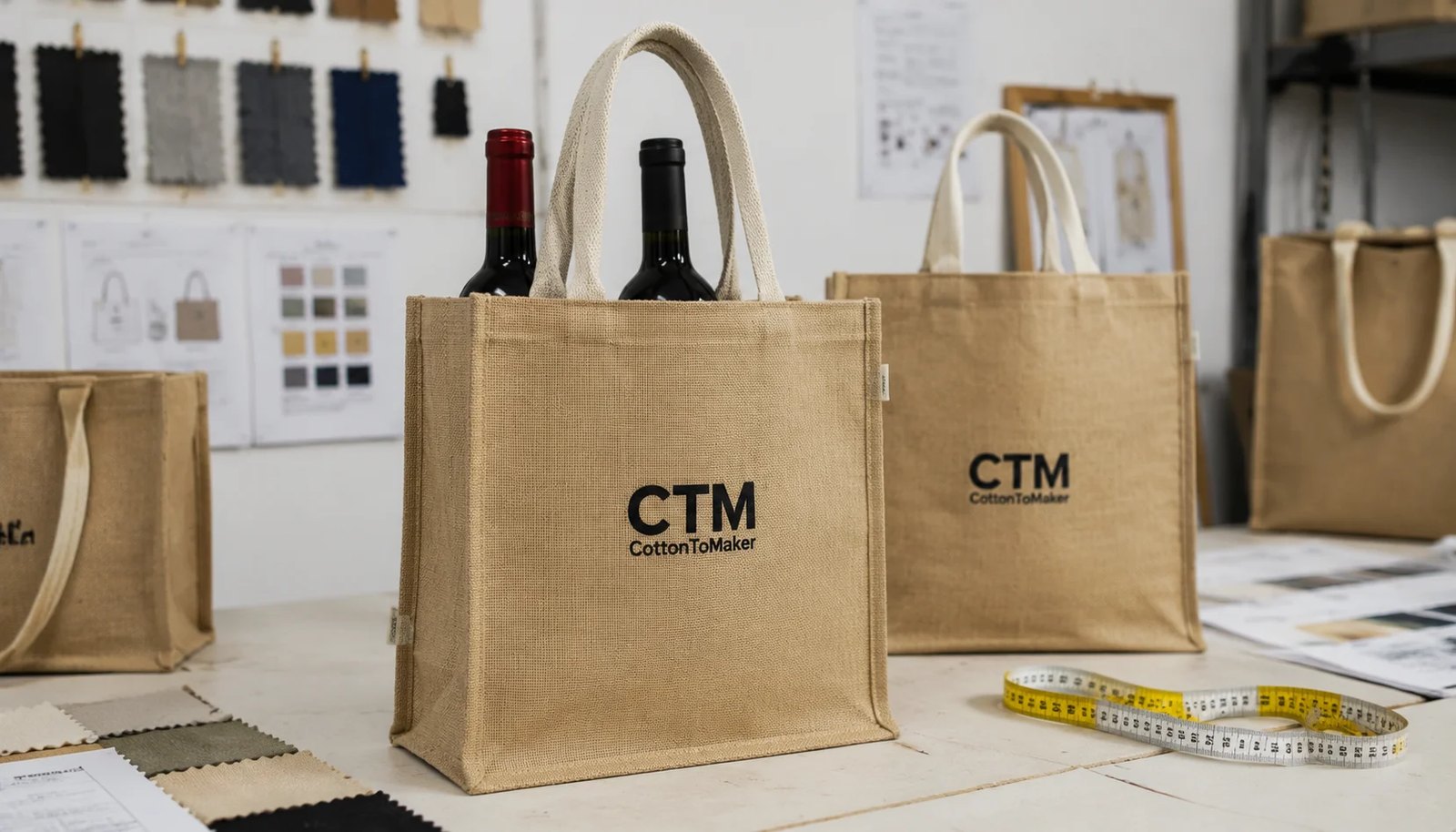
Start With Bottle Load, Not Bag Size
For liquor retailers, the first buying problem is not whether the tote looks natural. The first issue is whether the bag can carry the actual bottle format without stretching, tearing, tipping over, or looking crushed after unpacking. A jute tote for one wine bottle, a two-bottle gift carrier, and a general liquor store checkout bag should not share the same RFQ unless the supplier is allowed to build different constructions.
Give the factory the loaded use case before requesting a unit price. A 750 ml wine bottle is different from a squared spirits bottle, and a two-bottle set creates a different bottom stress than a single centered bottle. If the bag will be sold as gift packaging, the front panel must stay clean and upright. If it will be used as a checkout carry bag, handle comfort and speed of packing at the register matter more.
- One-bottle wine tote: narrow width, deep gusset, stable bottom, short to medium handles.
- Two-bottle carrier: wider base, stronger handle stitching, optional divider or bottom board.
- General liquor store tote: wider opening, 25-35 mm cotton webbing handles, stronger side seams.
- Premium gift bag: cleaner jute grade, controlled print position, better carton packing to avoid creasing.
- Distributor promotion bag: practical GSM, efficient carton count, simple one-color print for repeat ordering.
Choose Jute GSM by Load and Presentation
Jute tote bag quotes can look attractive when the GSM is left vague. That is where many liquor buyers lose control of quality. A supplier may quote a lighter jute to win the order, while another factory quotes a heavier fabric that supports better shape and seam strength. The two prices are not equal even if the bag size and logo are the same.
For most wholesale jute tote bags for liquor retailers, 280-320 GSM is a practical range for standard promotional totes and light gift use. Heavier 340-380 GSM jute gives a firmer hand feel and better structure for bottle gift packaging, but it also increases material cost, carton weight, and freight volume. Very light jute may be acceptable for decorative packaging only, not for loaded bottle carry.
- Use 260-280 GSM only when the bag is mainly decorative or for very light carry.
- Use 280-320 GSM for common liquor retail promotions and one to two bottle applications.
- Use 340-380 GSM for premium gifting, heavier bottle sets, or bags expected to be reused.
- State whether the GSM refers to the jute fabric before lamination or the finished laminated material.
- Request a fabric swatch or blank sample before approving an order based only on photos.
Lamination Changes Cost, Shape, and Odor
Many jute tote bags use an inner lamination layer to improve strength, reduce fiber shedding, and help the bag keep a square shape. For liquor retail, lamination also helps when bottles are cold and may create condensation. However, lamination is not only a yes-or-no option. The buyer needs to know where the lamination sits, what material is used, and whether the smell is acceptable for a retail environment.
Unlaminated jute has a more natural hand feel and can be a good fit for eco-positioned promotions, but it may shed fibers and collapse more easily. Laminated jute is usually cleaner for printing and packing, but poor lamination can bubble, peel at the seams, or create a strong odor when cartons are opened. This is a sample-stage issue, not something to discover after the goods arrive at the warehouse.
- Inside lamination is common for shape retention and cleaner bottle contact.
- Outside lamination changes the surface appearance and can make the bag look less natural.
- Ask whether the lamination is PP or PE and whether recycled content is involved.
- Open the sample carton after 24 hours closed to judge odor in realistic packing condition.
- For sustainability claims, verify the full construction before marketing the bag as plastic-free.
Handle Strength Is the Main Failure Point
Bottle weight concentrates stress at the handle attachment area. A jute panel may look strong, but a narrow handle with weak stitching can still fail during carry. For liquor retailers, handle specification should include material, width, length, stitch pattern, thread quality, and loaded test requirement. If these points are missing, the supplier may choose the cheapest handle that looks acceptable in a photo.
Cotton webbing handles are usually the safest choice for wholesale liquor tote bags because they are comfortable and can be box-stitched securely. Jute handles match the body fabric but may feel rough and can be less comfortable under load. Rope handles can look gift-like, but they need proper reinforcement and are not always ideal for heavy bottle carry.
- Recommended handle width: 25-35 mm for bottle carry bags.
- Common handle drop: short hand carry for bottle gift bags; longer shoulder carry only if the bag body supports it.
- Preferred stitching: reinforced box stitch or cross stitch at each attachment point.
- Sample test: load the bag with intended bottle weight and carry with repeated lifting motion.
- Reject bulk pieces with skipped stitches, loose thread at handle base, or visibly uneven handle placement.
Print Method Must Match Jute Texture
Jute is not a smooth cotton canvas. The open weave and uneven fibers affect logo edges, fine lines, small legal text, and color coverage. A print design that looks clean on a PDF can look broken on natural jute. The factory should review the artwork before quoting, especially when the design includes thin type, gradients, QR codes, metallic effects, or multiple tight registration colors.
Screen printing is usually the most practical method for simple liquor retail logos, campaign marks, and one to three solid colors. Heat transfer can handle more detail, but it may change the surface feel and can look less integrated with natural jute. Woven labels or sewn side labels are useful when the buyer wants a premium brand mark without forcing fine artwork onto a coarse surface.
- Use screen print for bold logos, solid marks, and cost-controlled promotions.
- Use heat transfer only after testing adhesion and appearance on the selected laminated jute.
- Use a woven label when the logo is detailed or the natural jute surface should remain mostly clean.
- Avoid small reversed text and thin lines below the factory's recommended minimum line width.
- Approve a print strike-off under normal lighting, not only a digital proof.
MOQ Logic Behind the Quote
MOQ for jute tote bags is driven by fabric availability, cutting efficiency, handle color, printing setup, label production, and packing complexity. A low MOQ is possible when the order uses existing fabric, standard handle colors, and simple artwork. The same quantity becomes harder when the buyer splits it into several sizes, several store brands, different print colors, and individual packing requirements.
Procurement teams should separate MOQ by size, artwork, and material option. A supplier quoting 1000 pieces may mean 1000 pieces per design, not 1000 pieces total across five store logos. If the program includes regional liquor chains, franchise locations, or distributor co-branded bags, this point needs to be settled before artwork development.
- Clarify MOQ per size and per artwork.
- Clarify MOQ per handle color if colored webbing is required.
- Clarify whether woven labels have a separate MOQ from the bag body.
- Clarify whether lower MOQ uses stock jute and standard carton packing.
- Clarify price breaks at 500, 1000, 3000, 5000, and 10000 pieces when planning repeat buys.
Sample Approval Should Be Physical
A photo approval is not enough for liquor retail jute bags. The buyer needs to hold the sample, load it with bottles, inspect odor, check handle comfort, and see whether the bottom stands correctly. This is especially important when the bag will be sold as gift packaging or placed near premium spirits and wine displays. A poor sample decision can create thousands of bags that are technically usable but commercially weak.
The best pre-production sample uses the actual fabric weight, actual lamination, actual handle, and actual print method. If the factory sends a blank size sample only, treat it as a construction reference, not final approval. If the order is urgent, approve the bag in stages: fabric and size first, print strike-off second, final pre-production sample before bulk cutting.
- Measure width, height, side gusset, bottom gusset, and handle drop on the physical sample.
- Load the sample with the intended bottle quantity and leave it hanging for a defined period.
- Rub the print lightly after curing to see whether ink transfers or cracks.
- Open and close the bag repeatedly to see whether lamination creases or separates.
- Place filled bags side by side to judge retail presentation and standing stability.
Packing Affects Store Presentation
Jute bags can be damaged by poor packing even when bulk sewing is acceptable. Over-compressed cartons create deep creases, especially on laminated jute. Loose packing allows bags to shift and corners to crush. For liquor retailers, carton planning matters because store teams often unpack directly to display or checkout areas. If the bags arrive wrinkled, dusty, or mixed by SKU, the retailer spends labor fixing a preventable issue.
A practical packing plan includes pieces per carton, folding method, inner bundle count, carton strength, carton marks, and SKU separation. Individual polybags are usually not necessary for every jute tote, but they may be used for premium gift bags or e-commerce resale packs. Buyers should decide this based on handling route, not habit.
- Use flat packing when the front logo must remain clean and visible after unpacking.
- Use bundle packing by 10 or 25 pieces when stores need quick count verification.
- Avoid excessive compression that crushes gussets and weakens shelf presentation.
- Mark cartons with PO number, SKU, artwork name, quantity, carton number, and destination if needed.
- Request carton dimensions, gross weight, and CBM before finalizing freight estimates.
Lead Time Risks in Seasonal Liquor Programs
Liquor retail bag programs often connect to holidays, wine festivals, tasting events, new store openings, or distributor promotions. The date matters. A factory lead time of 25 days may sound workable, but it may exclude sample approval, artwork revision, material booking, inspection, export handling, and vessel schedule. Buyers should build the calendar from the retail launch date backward.
The biggest schedule risks are artwork that is not print-ready, late sample comments, unavailable handle colors, delayed label production, and packing changes after production starts. If the order has several store allocations or mixed cartons, the distribution file must be locked before packing begins. Changing allocation at the end of production can slow delivery and increase error rates.
- Allow time for artwork review before sample making.
- Separate sample lead time from bulk production lead time in the purchase plan.
- Confirm material booking only after sample approval and deposit or order confirmation.
- Schedule inspection before the final shipping handover, not after cartons are already sealed for dispatch.
- For seasonal launch dates, compare sea freight, rail, truck, and air options early instead of after production delay.
Compare Quotes by Landed Cost and Usable Quality
A low FOB unit price can become expensive when the bag is underbuilt, packed poorly, or shipped in inefficient cartons. For wholesale buying, the best comparison includes fabric GSM, lamination, handle construction, print setup, packing, carton CBM, inspection readiness, and defect risk. Two quotes with the same bag size may have very different landed costs and very different retail outcomes.
Build a quote sheet that forces suppliers to answer the same data points. Do not let one supplier quote a laminated 320 GSM jute tote with reinforced cotton handles while another quotes an unlaminated lighter bag with basic stitching under the same product name. The buying team should compare construction to construction, not description to description.
- Compare FOB price together with carton CBM to estimate freight per piece.
- Add print screen charges, label costs, sample fees, and packing upgrades to the true unit cost.
- Review defect risk: weak handles and poor print clarity can create chargebacks or store complaints.
- Include warehouse handling cost if cartons are too heavy or poorly marked.
- Give more weight to suppliers who provide clear specs, sample photos, test method, and packing data without repeated chasing.
Specification comparison for buyers
| Spec decision | Recommended option | When it fits | Buyer risk to check |
|---|---|---|---|
| Jute fabric weight | 280-320 GSM laminated jute for standard bottle promotions; 340-380 GSM for heavier gift packaging | Use 280-320 GSM when the bag carries one to two bottles and needs a firm retail look without excessive freight weight | Low GSM can stretch at seams; very heavy GSM increases carton weight and may reduce pieces per carton |
| Interior lamination | Clear PP lamination or food-safe PE lamination on the inside face | Useful when liquor bottles may sweat from cold storage or when the retailer wants better shape retention | Confirm odor level, lamination thickness, and whether the destination market allows the selected plastic layer |
| Handle construction | Cotton webbing handles, 25-35 mm width, cross-stitched with reinforced box stitch | Best for liquor retail because bottles create point load at the handle attachment area | Thin rope or narrow jute handles may look natural but can be uncomfortable and fail under loaded display use |
| Bottom design | Gusseted bottom 10-14 cm with optional stiff bottom insert for two-bottle gift sets | Needed when bottles must stand upright at checkout, in gift aisles, or during hand carry | Unreinforced gussets collapse in cartons and may create a poor shelf presentation after unpacking |
| Print method | Screen print for simple logos; heat transfer for tight artwork; woven label for premium natural branding | Screen print gives the most reliable cost and color result for one to three solid colors on jute | Fine text, gradients, and small legal marks can fill in because jute surface is coarse |
| MOQ logic | Start from 500-1000 pieces per size and artwork; lower MOQ may require stock fabric and limited color choices | Works for seasonal liquor promotions, regional distributor programs, and store chain tests | Mixing several sizes, handle colors, and print designs can split production and raise unit cost |
| Packing format | Flat packed, 25-50 pieces per export carton, with carton marks by SKU and store allocation if needed | Suitable for distributors shipping to multiple retail doors or central warehouse replenishment | Over-compressed cartons crease laminated jute and make bags hard to present on the sales floor |
| Supplier route | Direct factory for custom specs; trading company for mixed bag categories; local wholesaler for urgent small runs | Direct factory is strongest when the buyer needs controlled GSM, handle strength, printing, and repeat orders | Compare what is included in the quote: sample fee, artwork setup, inland freight, export carton quality, and inspection support |
Buyer checklist before sampling
- Define the bottle use case first: one wine bottle, two bottles, spirits bottle, mixed gift set, or general liquor store carry bag.
- Set finished bag dimensions with width, height, side gusset, and bottom gusset; do not quote only a flat panel size.
- Specify jute GSM range and whether lamination is required; include acceptable fabric tolerance in the RFQ.
- Confirm handle material, width, length, stitch pattern, and loaded carry requirement before approving price.
- Provide artwork as vector files and state print size, print position, Pantone references, and whether fine text must remain readable.
- Request a pre-production sample using production fabric, production handle, and actual print method, not only a blank size sample.
- Set sample approval points: dimensions, GSM feel, odor, handle pull, print clarity, gusset shape, and carton packing.
- Ask for MOQ by size, artwork, and handle color so the supplier does not hide split-order costs in a later revision.
- Require carton dimensions, gross weight, pieces per carton, and packing method to estimate freight and warehouse handling.
- Include inspection criteria for stains, broken yarn, loose stitching, print offset, lamination bubbles, odor, and carton damage.
Factory quote questions to send
- What jute GSM options are available for this bag size, and what tolerance do you apply during bulk inspection?
- Is the jute laminated inside, outside, both sides, or unlaminated? What lamination material and thickness are used?
- What handle material, width, length, and stitch pattern are included in the quoted price?
- What is the safe loaded weight you recommend for this construction, and how do you test handle attachment strength?
- Which print method do you recommend for our artwork on jute, and what minimum line width should we follow?
- Is the quoted MOQ based on one size, one artwork, one handle color, and one packing method?
- What are the sample cost, sample lead time, and bulk lead time after sample approval?
- Can you provide carton size, pieces per carton, gross weight, and CBM for the quoted spec?
- Are setup charges, print screens, woven labels, bottom inserts, hang tags, and individual polybags included or separate?
- What defect categories do you use for jute bags, and what AQL level can be supported for third-party inspection?
Quality-control points to confirm
- Finished dimensions within agreed tolerance, commonly plus or minus 0.5 cm for small bags and plus or minus 1 cm for larger totes.
- Fabric weight checked against the approved GSM range, with no obvious thin panels mixed into the shipment.
- Handles aligned evenly, with reinforced stitching secure at every attachment point.
- Loaded carry test performed using the intended bottle weight for a defined time and movement condition.
- Print position consistent within agreed tolerance, with no severe skew, bleeding, cracking, or unreadable small text.
- Lamination smooth and bonded, with no major bubbles, peeling edges, or strong chemical odor.
- Jute surface free from unacceptable stains, oil marks, mildew smell, broken yarn clusters, and sharp fiber contamination.
- Gussets open cleanly and allow the bottle format to stand as intended.
- Cartons strong enough for export handling, correctly marked by SKU, artwork, quantity, and purchase order.
- Packing count verified carton by carton, especially when multiple artworks or store allocations are included.