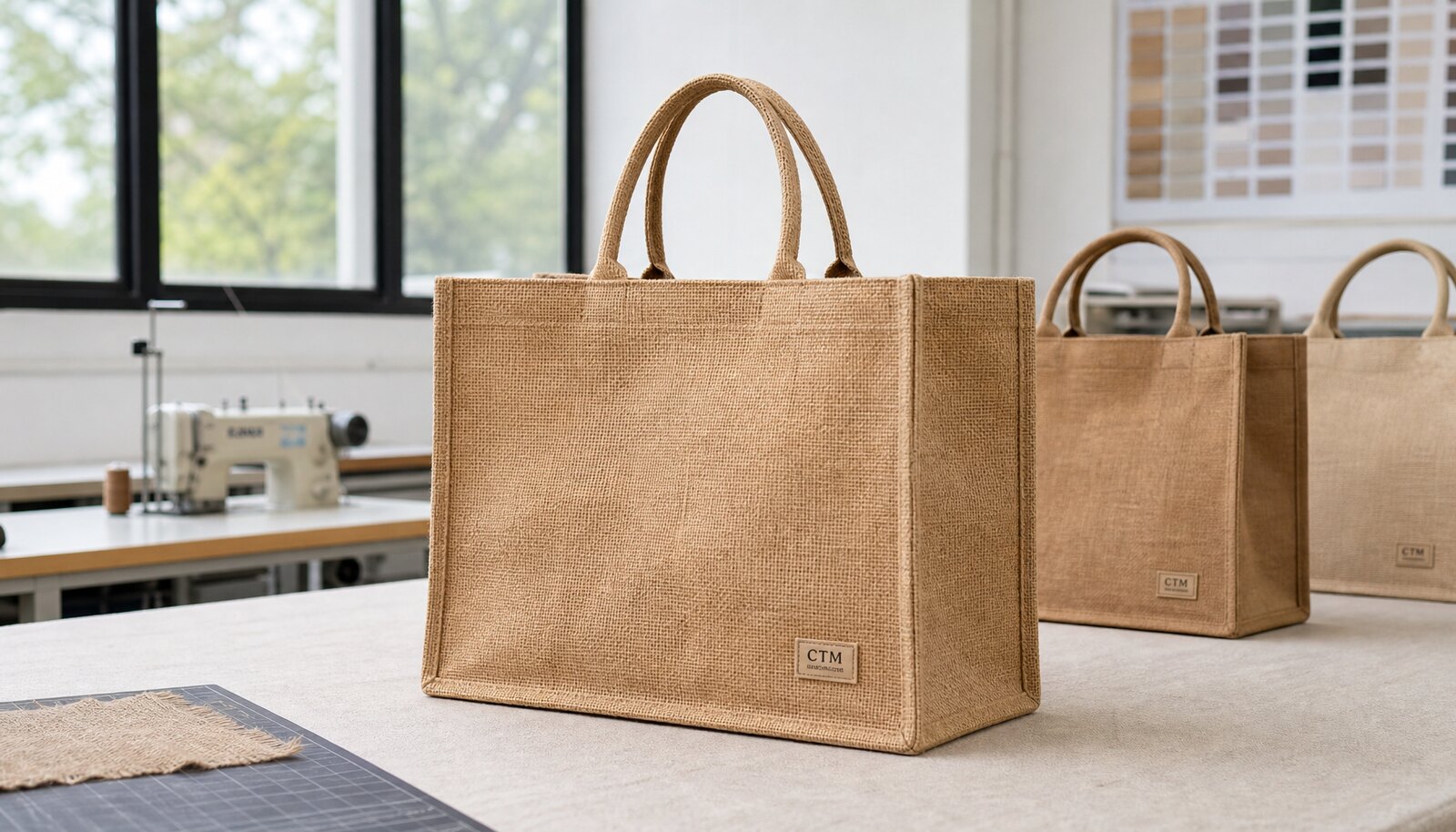
1. What gift shop buyers actually need the tote to do
Wholesale jute tote bags for gift shops have a different job from ordinary promotional carriers. They sit in a retail setting, where the buyer judges the bag in seconds, and the store team needs product that arrives ready to display. That means the bag has to look clean, hold its shape, and still perform like a real carry item when shoppers load books, boxed gifts, candles, or mixed souvenirs into it.
The most common mistake is to source from a generic tote brief instead of a store-use brief. A museum shop, resort boutique, tourist gift store, and homeware retailer all sell for different basket sizes and customer expectations. A bag that looks fine for lightweight souvenirs may be disappointing if customers use it for heavier purchases. A stronger build may be unnecessary if the tote is only meant as a counter add-on. The procurement decision should begin with that use case, because the right size, handle length, and construction all depend on it.
Gift shop buyers should also decide what the tote is supposed to signal on shelf. Some bags are meant to be simple and low-cost, used as a practical add-on at checkout. Others are part of the store brand and need a more polished finish, cleaner printing, and a better feel in the hand. Once that role is clear, the buyer can set inspection priorities without overpaying for strength that the customer will never need or underbuying a bag that will not survive daily retail use.
- Define the tote’s role before you compare quotes: impulse add-on, premium branded item, or reusable carrier.
- Match the construction to the merchandise weight the store actually sells.
- Separate shelf appearance from carry performance so the supplier cannot trade one for the other.
2. Start with the material spec before you talk about artwork
The body material drives both appearance and durability. In jute, the weave quality, fabric weight, and surface finish affect whether the tote stands up neatly, wrinkles heavily, or looks uneven after packing. For gift shop buyers, that matters because the bag is part of the retail display, not only a shipping item. The buyer should ask for the actual material description, not just the supplier’s quality language. Terms like 'heavy duty' or 'premium' are not enough to compare offers.
Ask the supplier to state whether the tote is made from plain woven jute, laminated jute, lined jute, or a jute blend with another backing material. Each option changes stiffness, print behavior, cost, and odor profile. A laminated bag may hold shape better and resist moisture more effectively, but it may also feel less natural and add weight. A lined bag may present better at retail, but the extra sewing step can influence both lead time and seam quality. The material choice should be tied to the store use case and the shelf price, not to what happens to be easiest for the factory.
Shade control also matters. Natural jute is inherently variable, but the buyer still needs a tolerance band that defines what is acceptable for the lot. If a display will hang several bags together, wide variation in tone can make the wall look inconsistent. If the store wants a natural, earthy look, some variation is expected and even desirable. The key is to ask the supplier to compare the lot to the approved sample and to state whether visible shade variation is acceptable across the order or only within a narrow range.
- Request the material structure in writing: plain jute, laminated jute, lined jute, or blended construction.
- Ask for fabric weight with a written tolerance, not a general promise of quality.
- Set a shade tolerance against the signed sample before bulk production starts.
3. Choose construction that fits the store’s carry pattern
Construction determines whether the tote feels like a gift item or a disposable carrier. Flat totes are simpler to make and often lower in cost, but they do not always present as well on a hook or shelf. Gusseted bags are usually better for gift shops because they hold more volume and keep a fuller, neater shape when filled with merchandise. That fuller profile often makes the product look more valuable, especially if the tote is part of a branded retail assortment.
Handle style should be specified by function, not by habit. A short hand-carry handle can look neat and compact, while a longer handle may be more convenient for shoppers carrying a bag after leaving the store. The wrong handle drop can make a tote awkward to use or visually unbalanced in display. Buyers should state the finished handle length, the drop, and whether the bag is meant for hand carry, shoulder carry, or both.
Reinforcement is where cheap-looking products are often exposed. A tote can look acceptable on a sample table yet fail once a real load is added. Ask the supplier to define how the handle is attached and how the stress points are reinforced. Common methods include bar-tacks, box stitching, and patch reinforcement. For gift shop use, the key is not choosing the most expensive reinforcement, but choosing one that is repeatable, visible in the spec, and appropriate to the intended load.
- Use gusseted construction when you want better shelf shape and more usable volume.
- State handle drop and handle length in the spec, not after sampling.
- Require a named reinforcement method at the handle stress point.
4. Build the quote around the real variables, not just the unit price
A tote quote is only useful if it is built from the same assumptions across all suppliers. Buyers often compare prices that look similar but include different scopes. One supplier may quote the bag only, another may include one-color print, and another may include polybags or labels. If the scope is not aligned, the lowest number can become the most expensive landed result once packaging, labeling, or artwork setup is added later.
A cleaner quote breaks out the main cost drivers: base bag price, fabric type, print setup, print unit cost by color count, label or hangtag application, retail packing, and carton packing. This also helps the buyer see what changes the MOQ. For example, a one-color logo, a two-color logo, and a no-print bag may not share the same minimum even if the tote body is identical. If the supplier can explain those thresholds clearly, the quote is much easier to use in a real sourcing decision.
Lead time should be treated the same way. Sample production, artwork sign-off, bulk sewing, packing, and shipment booking are different stages. If the factory gives only one total number, the buyer cannot tell where the delay risk sits. For gift shop programs that are tied to seasonality or store events, that matters more than it would for an ordinary replenishment bag. A useful quote should make it clear when the schedule can still be corrected and when it is already locked.
- Compare only like-for-like quotes with the same materials, print scope, and packing scope.
- Ask the supplier to show which line items affect MOQ and which are included in the unit price.
- Request lead time broken into sample, bulk production, packing, and dispatch stages.
5. Compare sourcing routes with buying risk in mind
The sourcing route changes more than the quote format. It changes who controls quality, who owns the sample, and how easy it is to correct defects. A direct factory usually gives the buyer the most control over material, construction, and repeatability. A trading company may be helpful when the buyer needs several styles or wants help coordinating communication, but the actual production site still needs to be confirmed. A stockist is faster, but the buyer gets less control over the exact lot and less opportunity to adjust the product to the store’s needs.
The right route depends on the program. If the order is a small seasonal test, a low-MOQ source may make sense even if the unit price is higher. If the tote will be reordered across a gift shop chain, the buyer should prioritize repeatability, packaging consistency, and a clear QC trail. That is why procurement decisions should be based on the order profile rather than on supplier type alone.
For any route, verify the actual source behind the sample. Ask for the production address, business registration details, and sample photos tied to the same bag style. If a trading company says it can source from several factories, ask which factory will make the approved sample and which factory will make the bulk order. The buyer needs that answer before approval, not after the shipment has already been built.
- Verify the actual production site behind the sample and quote.
- Choose the sourcing route based on the order risk, not just the apparent convenience.
- Use one sample standard across suppliers so your comparison is commercially meaningful.
6. Treat print method as both branding and durability
Print on jute is not the same as print on a smooth cotton twill or coated canvas. The weave texture can soften fine detail, make thin lines harder to read, and expose weak registration more easily. That is why print method should be evaluated as a production choice, not only as a design choice. For many gift shop programs, a bold one-color logo is more reliable than a detailed image with small text, because it remains readable on the shelf and is less sensitive to slight process variation.
The buyer should specify the print process, the number of colors, the size of the print area, and the side of the bag that will carry the artwork. Screen print is common because it is direct and easy to inspect. Woven labels, sewn patches, embroidery, and heat-transfer options may be appropriate for premium branding, but each method introduces its own QC risk: edge lift, placement variation, adhesive durability, or thread distortion. A nicer-looking method is not automatically the better one if it becomes harder to control in production.
The safest artwork approval happens on the actual production fabric, not on a paper proof. Natural jute changes how color reads, especially with pale inks or fine fonts. Ask for a pre-production sample in the real bag color, under normal light, and check it from shelf distance rather than only at close range. If the logo is complex, ask the supplier to confirm the minimum line width or text height they can hold reliably. That one question can prevent a lot of weak print failures later.
- Keep the logo bold and legible; avoid ultra-fine detail unless the supplier can prove the print can hold it.
- State one-side or two-side print explicitly.
- Approve artwork against the actual fabric color and not against a white mockup.
7. Use a sample ladder, not a single yes-or-no approval
One sample is usually not enough when the order includes custom printing. A better approval process uses a sample ladder. Start with a development sample to check shape, size, and general build. Then approve a golden sample that becomes the production reference. For larger or higher-risk orders, request a production reference lot so the factory and buyer both have a physical standard that reflects the approved finish, not just a photo.
The sample should be measured and handled like a mini production run. Check width, height, gusset, handle drop, and seam alignment. Load the bag with the kind of merchandise the gift shop actually sells. A bag designed for lightweight souvenirs does not need the same carry test as a tote that will routinely hold books or ceramic items. The approval note should explain what was tested and what the bag is expected to withstand.
If a sample is not right, write down the issue before it becomes a bulk dispute. Common problems include off-center print, twisted handles, weak seams, surface stains, or a bag that collapses when placed upright. A verbal promise to fix it later is not enough. The revised sample should show the correction, and the buyer should keep one signed golden sample for later inspection against the bulk lot.
- Measure the sample before approval and compare it with the drawing or spec sheet.
- Test the bag with real merchandise, not empty only.
- Sign and archive one golden sample as the production reference.
8. Inspection checklist: define defects by type and severity
This is where buyers can make the checklist genuinely useful. A QC checklist for jute tote bags should separate the defect types and state which ones are major, which are minor, and which are unacceptable under any circumstance. A usable framework is to divide inspection into visual, dimensional, structural, print, and packing categories. That keeps the team from treating every issue the same and helps the supplier understand what matters most for retail presentation.
Visual defects include stains, discoloration, excessive lint, foreign fibers, mildew odor, and obvious damage to the display face. Dimensional defects include width, height, gusset, and handle drop outside the agreed tolerance. Structural defects include seam slippage, open stitching, loose handles, or uneven reinforcement. Print defects include fuzzy edges, smudging, missing elements, off-center placement, and color drift from the approved sample. Packing defects include wrong count, mixed cartons, damaged cartons, missing labels, and incorrect carton marks.
For first orders, buyers should state practical pass/fail thresholds. For example, visible open seams, loose handle attachment, and unreadable logos should be major defects. A stain on the front panel or a mildew smell on a retail-facing tote should be treated as a serious issue, not a cosmetic note. Minor variation may be acceptable on the hidden side of a natural fiber bag if it does not affect use or presentation, but that rule should be written into the QC brief before production begins. If the buyer wants a premium standard for upscale gift stores, the tolerance should be stricter and stated upfront.
- Classify inspection into visual, dimensional, structural, print, and packing defects.
- Reject open seams, loose handles, or unreadable logos as major defects.
- Write the defect severity rules before production, not after the lot is finished.
9. Inspection and test thresholds buyers can actually use
A checklist is only useful if it leads to a consistent inspection decision. For larger orders, apply an AQL-style sampling plan rather than checking a few neat-looking units. Randomly inspect cartons from different parts of the lot and open bags from the top, middle, and bottom positions. That reduces the chance of passing a mixed lot that only looked good on the outside. If the buyer uses a formal inspection agency, the inspection brief should still include product-specific points rather than only generic workmanship language.
The most practical test on a tote is the load-and-handle check. Use the type of merchandise the gift shop is expected to sell, not just an empty bag. Watch whether the handles stay symmetric, whether the stitching holds, whether the bag sags excessively, and whether the seam opens under normal carry movement. The supplier does not need to run a lab test to give useful data, but the method should be written and repeatable so the buyer can compare future lots to the same standard.
Stitch quality deserves more attention than it often gets. Ask the factory what stitch count per inch it uses at the handle, top edge, and side seams, then verify that the bulk lot is consistent with the approved sample. The buyer does not need to set an unrealistic number, but the seam should not be loose or irregular. On jute, stitch consistency matters because the fabric can show weakness quickly if the seam line is uneven. A visibly tidy seam is good, but a seam that also holds under load is better.
- Use AQL-style random sampling for larger lots and inspect cartons from different positions.
- Perform a real-load handle check using the merchandise type the gift shop sells.
- Ask for stitch count per inch on key seams and verify consistency against the sample.
10. Packing, carton rules, and shipment acceptance checks
Packing is part of the product for gift shop buyers. A tote that arrives wrinkled, dusty, or inconsistently folded may still be technically usable, but it creates extra work for the store team and weakens shelf presentation. That is why the packing method should be decided alongside the bag spec. Bulk packing is efficient, but it may leave the bags less retail-ready. Individual polybags, tissue, or insert cards protect the product and improve presentation, but they increase labor and carton volume.
Carton requirements should be written into the purchase order. Ask for the number of units per carton, the carton dimensions, the gross weight, and the shipping marks. If the cartons are too heavy, warehouse handling becomes harder and carton crush risk goes up. If they are too large, freight cube can rise quickly. If the gift shop chain stores inventory centrally, carton size should also support easy picking and store replenishment. The carton spec is not paperwork; it affects shipping cost, damage risk, and how quickly the product can be used after receipt.
At shipment stage, acceptance should include carton count verification, a random carton open, and photo documentation. Compare the packing list to the actual cartons, then check that the labels, inserts, and barcode format match the approved plan. If cartons arrive wet, crushed, or re-taped, the shipment should be flagged before final acceptance because carton damage can hide product damage inside. The cleanest way to avoid disputes is to make the packing and acceptance standard part of the order from the beginning.
- Write carton size, units per carton, and gross weight into the PO.
- Choose bulk or retail-ready packing based on how the store will receive and sell the bags.
- Verify carton count and open random cartons before final acceptance.
Specification comparison for buyers
| Procurement route | Best fit for | MOQ / flexibility | Lead time pattern | Primary QC watchouts |
|---|---|---|---|---|
| Direct factory | Custom tote programs, repeat orders, and packaging control | Usually the most flexible on size, handle length, lining, and print scope; MOQ often changes by fabric, print colors, and packing format | Sample timing is controlled by the factory, but approval delays can push the schedule if artwork is not frozen | Verify that the approved sample is tied to the same production line, reinforcement method, and carton pack plan |
| Trading company with factory network | Buyers needing coordination across multiple styles or accessory items | Often moderate flexibility, but the factory behind the quote may change unless you ask for the actual production site | Quoting can be quick; production timing depends on which factory is assigned and how busy it is | Confirm who is making the bags, who is inspecting them, and who owns defect correction if issues appear |
| Stockist or importer | Small tests, urgent replenishment, or simple unprinted bags | Lowest customization and usually the least room for changes | Fastest availability because goods are already in inventory | Inspect carefully for mixed lots, shade variation, packing damage, and mismatch with your store presentation |
| Low-MOQ export factory | Seasonal trials and first-time SKU launches | Useful for smaller orders, but revision rounds may be limited and pricing often includes setup spread | Can move quickly once the sample is approved, but small changes after approval may add time and cost | Make sure the buyer has a signed golden sample before the bulk lot starts |
| Large-volume program factory | Chain rollouts and stable reorder programs | Best cost efficiency at volume; changes after approval may be expensive | Longer front-end setup, then smoother repeat production once the spec is locked | Use strict change control so the factory does not substitute materials or packing details |
| Mixed-material supplier | Jute totes with lining, lamination, cotton trim, inserts, or zippers | Flexibility depends on the complexity of the build and whether all materials are in one place | Lead time usually extends because sewing, lamination, and accessory sourcing must align | Check seam integrity, odor, layer alignment, and edge finishing carefully |
| Private-label retail packer | Gift shops that want barcodes, hangtags, tissue, or retail-ready cartons | More coordination up front, but better for store-ready delivery | Approval is slower, then order handling is more predictable after sign-off | Confirm label placement, barcode readability, fold direction, and carton markings before shipment |
Buyer checklist before sampling
- Define the tote’s role: impulse add-on, premium gift item, or reusable shopping carrier.
- Lock the finished size, gusset, handle drop, and intended merchandise load before requesting price.
- Specify the fabric type clearly: plain jute, laminated jute, lined jute, or a blended build.
- Ask for the fabric weight in GSM or ounces with a written tolerance, not a vague quality description.
- Provide print artwork in vector format and state print side, colors, placement, and minimum text size.
- Request a pre-production sample and keep one signed golden sample for all later inspections.
- State the packing format: bulk packed, polybagged, tissue-wrapped, barcode labeled, or retail-ready carton pack.
- Ask for carton size, units per carton, and gross weight so freight and warehouse planning are accurate.
- Require written tolerances for size, shade, logo placement, and handle symmetry before production starts.
- Ask the supplier to confirm their inspection standard, defect grading, and pre-shipment photo set.
Factory quote questions to send
- What exact jute construction is this quote based on: plain woven, laminated, lined, or a blended build?
- What fabric weight do you recommend for this tote size, and what tolerance will you hold during bulk production?
- Does the MOQ change by print color count, bag size, lining, or retail packing requirement?
- Which print method is included, and what setup charges apply for screens, plates, or sample development?
- What reinforcement do you use at the handle attachment and top edge: bar-tack, box stitch, patch reinforcement, or another method?
- What are the finished size tolerances for width, height, gusset, handle drop, and logo position?
- How many units go in each carton, what are the carton dimensions, and what gross weight should we expect?
- Can you produce a sample on the actual production material before we approve bulk?
- Which inspection standard do you use for this order, and how do you classify major and minor defects?
- Are labeling, polybagging, insert cards, and barcode application included in the unit price or charged separately?
Quality-control points to confirm
- Check fabric consistency against the approved sample. Reject lots that are visibly thinner, overly loose in weave, or have weak spots in the load-bearing areas.
- Measure width, height, gusset, and handle drop on a random sample. Set a written tolerance before production; do not accept 'about the same' as a quality standard.
- Inspect handle attachment for symmetry and reinforcement. Look for bar-tacks, box stitches, or equivalent reinforcement; loose thread ends or twisting handles should be flagged.
- Review top edge and side seams for puckering, seam slippage, raw edges, or skipped stitches. Visible seam opening is a major defect.
- Check print legibility, placement, and color. Reject smudging, broken letters, severe misregistration, and artwork that cannot be read at normal shelf distance.
- Inspect the bag face for stains, oil marks, mildew odor, foreign fibers, and excessive lint. Visible contamination on the retail-facing side should be treated as a major defect.
- If the bag includes lining, lamination, or a mixed-material insert, verify layer alignment, edge sealing, and odor. Delamination, bubbling, or wavy edges should trigger review.
- Use a practical stitch check on the sample or first production units: ask the factory to state stitch count per inch for key seams and verify consistency across the lot.
- Use a simple load and handle pull check with representative merchandise. The bag should not distort excessively, open at the seams, or fail at the handle attachment under normal retail carry conditions.
- Apply AQL-style sampling for larger orders. Inspect random cartons from top, middle, and bottom positions so the lot does not pass on the strength of only the outer cartons.