Start With the Real Load
A trade show tote is not judged by a catalog description. It is judged by what it carries, how long it is carried, and how it behaves after repeated lifts, handoffs, and repacking. Before you ask for pricing, define the actual use case. Is this a flat brochure carrier, a midweight literature bag, or a reusable tote for samples, a water bottle, a notebook, and small premiums? That answer drives fabric weight, gusset depth, handle reinforcement, and even the packing method.
Write the load profile in plain operational terms. List the heaviest expected fill, whether the contents have sharp corners, whether the load shifts while someone walks the floor, and whether the bag must stand upright on a table or registration counter. A bag that only holds a catalog and pen can be lighter. A bag that carries printed collateral plus product samples needs more structure and a stronger anchor package.
The event workflow matters too. A tote used by booth staff and prepacked at origin has a different stress pattern than one handed to attendees who will carry it across a venue all day. A quick lift from booth to session room is not the same as being set down, refilled, and carried again. Your specification should reflect that real use, not a generic promo-bag idea.
For procurement, the key is to tie every design choice back to a function. If a supplier cannot explain why a certain body weight or handle build matches the load profile, they are selling a shape, not a usable product.
- State the heaviest actual contents, not only the bag category.
- Tell the factory whether the tote must stand up on a table or floor.
- Define whether the bag is a one-day giveaway or a reusable carrier.
- List whether the tote is prepacked at origin or filled on site.
- Keep the print area clear of seams, folds, and handle anchors.
Turn the Brief Into a Measurable Spec
A buyer-ready bag brief should read like a spec sheet, not a wish list. Record finished dimensions, gusset depth, handle drop, seam allowance, decoration area, packing method, and the tolerance for each critical dimension. A practical trade show tote might be specified as 35 x 40 x 12 cm finished, with a tolerance of plus or minus 1 cm on height and width and plus or minus 0.5 cm on the gusset. Those numbers are not universal, but they make the quote comparable across vendors.
Ask for finished dimensions, not cut dimensions. If one supplier quotes panel size and another quotes sewn size, the comparison is already broken. Record logo placement, no-print zones, and the distance from seams or handle anchors. Once the bag is sewn and folded, the printable surface is smaller than the flat panel on a screen, so the supplier should quote the real sewn area, not a theoretical blank canvas.
If the bag must match a larger event kit, keep the spec tight. Bag size, artwork placement, and fold pattern should be approved together because each one affects the others. A tote that looks fine in a flat mockup can become awkward once the gusset is sewn and the handle anchor consumes usable print space.
If a supplier cannot state tolerance, treat that as a risk signal. You do not need laboratory precision, but you do need repeatability. The goal is a bag that looks consistent across cartons and reorders, not one that depends on a particularly good sample maker.
- Specify finished dimensions and tolerance, not only nominal size.
- Write decoration zones and no-print zones before artwork starts.
- Treat cut size as supporting detail, not the primary quote basis.
- Require the same spec sheet across all quote candidates.
- Keep the approved sample, dieline, and artwork file together.
Pick the Body Construction Before You Chase Price
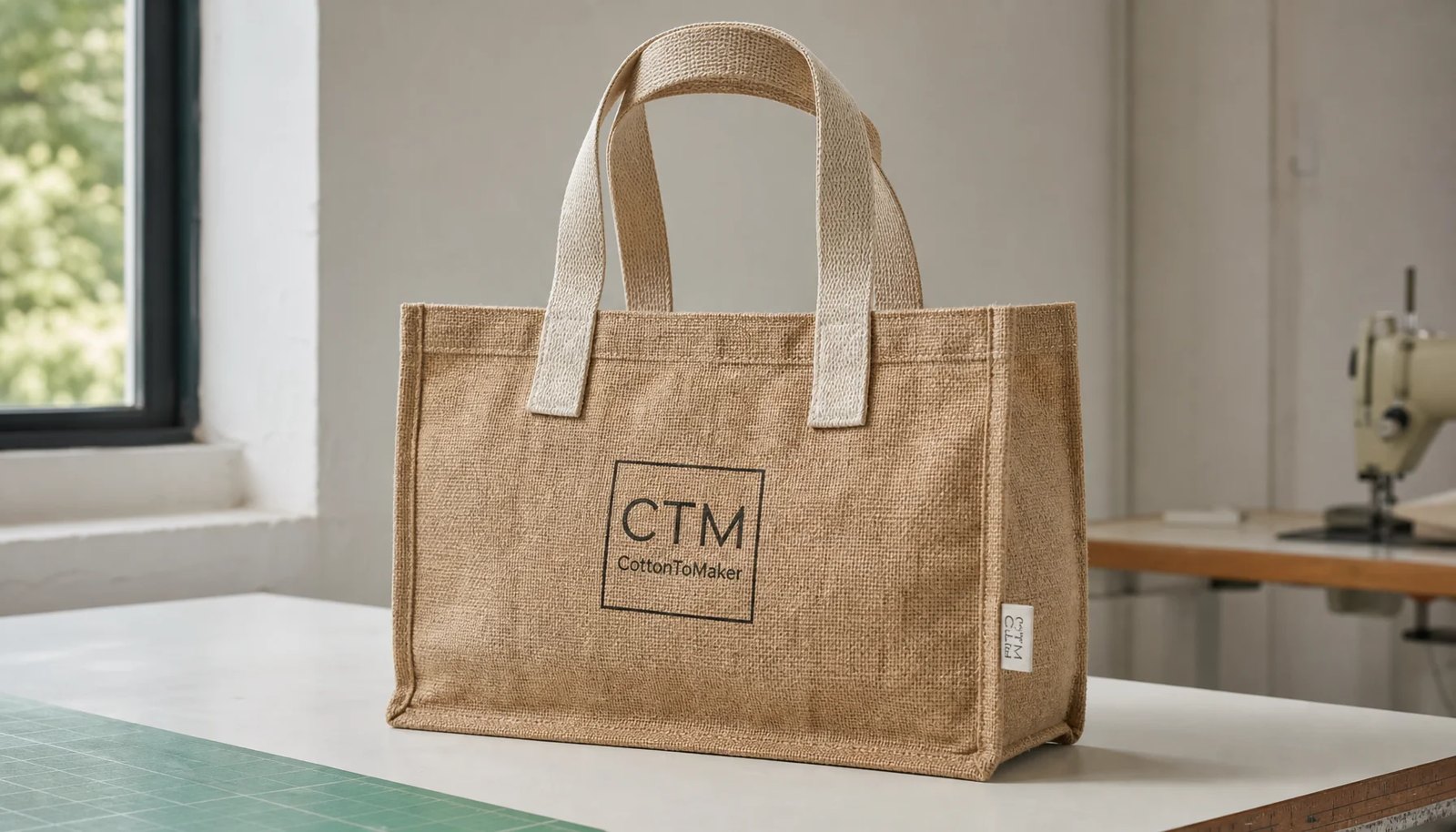
Most jute tote bags fall into a practical weight band, often around 280-400 gsm depending on weave, finishing, gusset, and handle package. Lower weights can work for brochure-only kits, but they often feel looser, shed more fiber, and distort faster under load. Around 330-360 gsm is a common middle ground for exhibitor bags because it gives a firmer hand without making the tote needlessly bulky or expensive to ship.
GSM alone does not tell you how the bag will perform. Yarn quality, weave density, finish, edge treatment, seam allowance, and handle attachment all matter. Two 340 gsm bags can behave differently if one has a tighter weave, cleaner top edge, or better stitch control. Ask the factory for the exact body construction, whether the bag uses plain weave or a laminated backing, how the top edge is finished, and whether the side seams are enclosed or raw internally.
A good quote should explain the build, not just name a weight. Procurement needs repeatable inputs: fabric weight, weave structure, seam allowance, handle reinforcement, and any lining or interfacing. If the supplier cannot describe how the bag is built, they cannot price durability with confidence. That is especially important for repeat programs where the bag must match between runs.
Use heavier construction when the contents are rigid or the bag will be reused after the show. It is usually cheaper to specify the right build once than to replace weak bags later.
- Use 280-320 gsm for brochure-only kits and lighter inserts.
- Use 330-360 gsm for mixed collateral and moderate sample weight.
- Move heavier or add reinforcement when the tote carries sharp items.
- Ask for weave type, finish, and seam allowance rather than GSM alone.
- Request a fabric swatch with the quoted construction, not only a finished sample.
Treat Handles as the Load Path
In a tote, the handle is not a trim detail. It is the load path. A strong body with weak handles still fails in the customer's hand. Ask whether the handles are self-fabric, cotton webbing, or another tape, then confirm the width, length, drop, and stitch package. Handle length affects carry style; handle drop affects whether the bag sits under the arm, in the hand, or swings too low while someone walks the floor.
Reinforcement should be explicit in the quote. Box-X stitching is common because it spreads stress at the anchor points, and bar-tacks can add another layer of durability at the ends. If the handles are only top-stitched into a thin seam allowance, the bag can tear under repeated lifting or side loading. Also check whether the handle is stitched through the outer body only or through both the outer body and lining. A neat sample can still fail if the inside anchor is too short or the stitch density is too light for a loaded tote.
For comparison shopping, ask for close-up construction photos of the handle anchor from both the inside and outside. That is more useful than a hero image because it exposes the stitching, reinforcement shape, and thread path. If a supplier cannot show the anchor detail, they may not be controlling it consistently in production.
Handle build is one of the easiest places for a low quote to hide risk. You are not paying for the textile alone. You are paying for the way the textile survives repeated lifting.
- Define handle width, length, and drop in the RFQ.
- Require box-X or bar-tack reinforcement for bags that will carry real weight.
- Ask for inside and outside handle-anchor photos before approval.
- Check whether the handle is sewn into the body seam, the lining, or both.
- Reject handle packages that rely on a single light top-stitch for a heavy load.
Choose Decoration That Survives Handling
Screen print remains the safest default for jute when the artwork is simple. It gives strong color, handles rough texture reasonably well, and is easier to quote consistently across factories. The downside is detail loss on very fine lines and the risk of cracking if the ink is under-cured or the bag is folded before it is fully set. Heat transfer can look cleaner at sample stage, but on coarse jute it often telegraphs the fabric texture and can lift at the edges after repeated folding.
If the logo needs a premium feel and long wear, a woven label, sewn patch, or simple embroidered badge may survive handling better than a tiny printed wordmark. The right answer depends on art detail, fold lines, and how often the bag will be reused. A simple mark on a rough surface is usually safer than trying to force a thin, intricate logo onto fabric that cannot hold it cleanly.
Placement matters as much as the method. Keep the logo away from seams, folds, and handle anchors. A graphic that crosses a crease line will age badly no matter how good the ink is. Ask the supplier to show the decorated sample after a rub test and after one fold-open cycle. If the art contains fine type, legal copy, or hairline rules, confirm the minimum line width and minimum font size in the factory's production language instead of assuming a digital proof can be copied directly.
If your brand uses strict color standards, ask how the factory will match ink or thread. For most promotional programs, consistent legibility and carton-to-carton repeatability matter more than lab-grade color language.
- Use 1-2 color screen print for the simplest and most repeatable result.
- Use a woven label or sewn patch when the logo needs more durability than print can give.
- Keep fine copy and gradients out of the main artwork unless the factory has proven it can hold them.
- Request rub testing and fold testing on the decorated sample.
- Confirm artwork position relative to seams, handles, and the gusset crease.
Set a Durability Test the Factory Can Actually Fail
A durability checklist should test the bag the way the show floor will use it. Start with a static load at 125% of the expected filled weight for 30 minutes, capped at 15 kg unless the tote is designed for heavier samples. That single test catches weak seams, creeping handle anchors, and body distortion that a quick lift will miss. Then add repeated carry cycles by the handles, alternating between one-hand and two-hand lifts, and check whether the mouth stays open or collapses.
Do not stop at whether the bag broke. Appearance after the test is part of the acceptance decision. Jute is natural, so some fiber lint is normal, but the bag should not show open seams, a twisted gusset, distorted corners, or print transfer. If the tote is meant to carry rigid items, add a simple drop from table height and a side-load check because a heavy corner can expose a different weakness than flat brochures do.
Use hard thresholds so the supplier knows what passes. A practical buyer standard is no seam opening greater than 2 mm, no handle-anchor shift visible to the eye, no visible cracking in the logo, and no odor or staining from packing materials after the test and a short airing period. For decoration, a basic rub-resistance check should include at least 3 dry rubs and 3 wet rubs with a white cotton cloth. Reject if there is visible transfer, if the logo loses legibility, or if the cloth picks up strong color.
Ask the factory to document the test method: load weight, hold time, cycle count, and failure mode. If the supplier can describe the test in writing, quotes become easier to compare and defects are easier to discuss.
- Run a static load test at 125% of expected fill for 30 minutes.
- Add lift cycles to expose handle and seam weakness.
- Use 3 dry rubs and 3 wet rubs with a white cotton cloth for print checks.
- Reject seam openings greater than 2 mm or visible handle movement.
- Document the load, timing, and failure mode in the approval record.
Approve Samples in Two Gates
Do not approve a trade show tote from a single decorated sample. First ask for a blank construction sample so you can approve size, gusset depth, handle length, handle drop, stitch type, and body stiffness before decoration starts. The blank sample shows whether the bag stands up, whether the mouth opens cleanly, and whether the carry feels balanced. If the construction is wrong, print will not fix it. This first gate saves time because the factory can correct the body spec before it spends screen and labor on artwork.
The second gate is the decorated sample, made with the actual print method, label, and pack style you intend to ship. Measure it with a ruler, not a photo. Confirm logo position against the handle and seam line, the color match under natural light, and whether the bag arrives folded the way it will be packed in cartons. For larger orders, a pilot lot is more useful than a beautiful single piece because it exposes stitch drift, print variation, and pack compression across multiple units.
Treat approval as a documented decision. Keep the approved sample, spec sheet, artwork file, and packing note together. If there is any change after approval, record it as a revision with date and reason. That makes the bulk lot easier to defend if the supplier later says the print or size drifted because the order changed. When the event date is fixed, that paper trail matters.
In short: approve the structure first, then the decoration, then the packing method. Anything less leaves you guessing at the point where the factory is already committed.
- Approve blank construction before paying for print setup.
- Measure the decorated sample against the approved spec and artwork.
- Check how the bag looks after the intended fold and carton pack-out.
- Use a pilot lot when the order is large, time-sensitive, or artwork-sensitive.
- Archive the approved sample and final spec sheet together.
Pack for Clean Arrival, Not Just Low Freight
Packing is one of the easiest places to lose quality. The bag can be sewn correctly and still arrive creased, dusty, or odor-affected if it was packed badly. Because jute is coarse and can absorb moisture, the bag should be protected from abrasion, dust, and damp cartons during transit. Flat packing saves freight, but it can create hard fold lines that show through the print. If the tote has a dark logo, premium placement, or a light body color, tissue or kraft interleave can prevent ink rub and crease transfer without adding much cost.
Match the pack spec to the route. Sea freight usually needs stronger cartons, clearer carton marks, and better moisture control than a short domestic shipment. If the bags are going to an expo warehouse, ask for carton counts that make receiving easy, not just whatever fills a case efficiently. A carton that is too heavy slows handling and increases crush risk. A carton that is too light wastes cube and can raise freight cost. If the tote is going straight to attendees, make sure the fold style and carton appearance do not create a first-impression problem at registration.
Ask the supplier to specify carton size, gross weight limit, bundle count, and whether any desiccant or polybag protection is used. If the bags are going into a humid market, this is not a minor detail. Moisture and odor complaints are one of the fastest ways to turn a low-cost promo bag into a brand liability. The packing note should also say whether the bags are packed by lot, by carton count, or by order line so receiving can verify the shipment quickly.
The right pack is the one that arrives saleable, not the one that looks cheapest on paper.
- Use flat packing only if the fold lines will not damage the logo or shape.
- Add tissue or kraft interleaving when print rub is a concern.
- Keep carton weights practical for warehouse handling and expo receiving.
- Match carton marks and bundle counts to the receiving process, not only to production convenience.
- Specify moisture control if the bags will travel by sea or through humid storage.
Compare Suppliers on Control, Not Just Unit Price
A direct factory is usually the best route when you care about handle reinforcement, line-level control, and repeat production. You pay for clearer communication and more sampling discipline, not just for the bag. A trading company can help if you are bundling jute totes with other promo items, but the quote may hide where the fabric or print is actually sourced. A stock program is fast, yet it usually forces you into the supplier's body size, weave, and packing style. Local decorators can be convenient for small domestic runs, but they are often weaker on raw jute sourcing and may not control the sewing process themselves.
The useful comparison is not which vendor gives the lowest line item. It is which sourcing route gives you the most control over the failure points. Ask each vendor to quote the same bag body, same handle, same print count, same packing, and same overrun policy. If one price is much lower, look for a hidden difference in fabric weight, print area, carton count, handle tape width, or reinforcement. Those small changes usually explain the gap.
Press for evidence when a supplier says they can do anything. Ask for examples of similar construction, not just similar decoration. A bag that looks close in a catalog may still be built with a different seam allowance, thread, or packing method that changes durability. You are trying to compare manufacturing control, not marketing presentation. That matters when the order has a fixed show date and no room for rework.
If the vendor cannot quote the same spec in the same terms, the quote is not comparable yet.
- Direct factory works best when you need repeat orders and one accountable production owner.
- Trading companies are useful when you need multiple product categories in one shipment.
- Stock programs are fast but can lock you into someone else's size and packing spec.
- Ask every source to quote the same spec sheet so you can compare apples to apples.
- Request similar-construction examples, not just similar-looking finished bags.
Price the Full Order, Then Lock the Terms
A cheap tote can become expensive after freight, damage, and rework. The landed cost should include sample fees, print setup, carton cost, packing labor, overrun allowance, inland freight, and any repacking needed for the booth or expo warehouse. For jute totes, shipping volume matters because the bag looks simple but still consumes carton space. A slightly more expensive bag that packs flatter and rejects fewer pieces can be the lower-cost choice once the bags reach the trade show floor.
Use a simple decision rule. If the tote only carries brochures, prioritize consistent print, clean packing, and low freight volume. If it carries heavier samples, spend on body weight, reinforced handles, and a stronger seam package. Do not let the quote hide the cost of correcting a weak sample or replacing a ruined batch. Ask whether the supplier's price includes trim, labels, carton marks, and a spare percentage for production variance. If those items are excluded, the apparent savings can disappear quickly.
Commercial terms matter as much as unit price. Clarify overrun and underrun tolerance, payment milestone timing, replacement policy for defects, and who pays if the sample approval was correct but the bulk lot drifts. Those terms are part of the price even if they are not shown in a spreadsheet cell. If the supplier will not state them in writing, the risk is not priced; it is deferred.
For a buyer, the right outcome is not the lowest quote. It is the quote that delivers the correct bag on time with the least rework.
- Compare sample cost, setup cost, carton cost, and freight together.
- Watch for hidden differences in fabric weight, print area, and handle reinforcement.
- Treat overrun and underrun terms as part of the real quote.
- Pick the construction that lowers reject risk, not only the one that lowers unit price.
- Ask what is excluded from the price before you compare vendors.
Specification comparison for buyers
| Spec decision | Practical default | When it fits | Buyer risk to check |
|---|---|---|---|
| Supplier route | Direct factory with in-house sewing and print | Best when you need repeat orders, one accountable owner, and controlled rework | Confirm who owns fabric sourcing, stitching, decoration, packing, and final inspection |
| Fabric weight | 330-360 gsm for most trade show kits | Good balance for brochures, catalogs, and moderate sample weight | Do not compare GSM without checking weave density, yarn quality, and seam reinforcement |
| Body size | About 35 x 40 x 12 cm with a bottom gusset | Fits folders, brochures, a bottle, and a few sample items | Ask for finished dimensions and tolerance, not cut size only |
| Handle construction | Cotton webbing or self-fabric with box-X or bar-tack reinforcement | Use when bags will be carried all day and reused after the show | Single top-stitch can fail if the bag is overfilled or side-loaded |
| Handle drop | About 22-28 cm for shoulder carry or 12-15 cm for hand carry | Match to booth staff use, attendee carry style, and pack density | If the drop is too short the bag is awkward; too long and it swings under load |
| Print method | 1-2 color screen print or sewn woven label | Best for simple logos on rough jute texture | Fine type, hairline rules, and gradients may blur, fill in, or crack |
| Liner or lamination | Light lining, partial lamination, or no liner unless needed | Use for sharp, wet, or moisture-sensitive contents | Too much lining adds stiffness, freight cost, and can make the bag feel less natural |
| Packing method | Flat-packed with tissue or kraft interleaving, cartonized by lot | Best for sea freight, warehouse receiving, and clean arrival | Loose folding can create crease lines, print rub, and moisture issues |
Buyer checklist before sampling
- Lock finished size, gusset depth, handle length, handle drop, and tolerance before requesting quotes.
- State the expected fill weight in kilograms and list the actual items the bag must carry at the show.
- Choose the jute GSM, weave density, and whether a liner, coating, or partial lamination is required.
- Confirm logo size, print method, color count, and exact placement away from folds, seams, and handle anchors.
- Request both a blank construction sample and a decorated preproduction sample before approval.
- Set test criteria for load, seam strength, rub resistance, odor, and appearance after packing.
- Specify packing style, carton count, carton weight limit, and whether tissue or kraft interleaving is needed.
- Ask for MOQ by variant, not one blended MOQ for all sizes and decoration options.
- Confirm lead time for sampling, preproduction approval, bulk production, and booking buffer before the event date.
- Compare landed cost including freight, carton cost, sample fees, inspection, and overrun terms.
Factory quote questions to send
- What exact jute fabric weight, weave, finish, and seam allowance are you quoting?
- What is the finished size tolerance for body width, height, and gusset depth?
- Is the bag made directly in your factory, or are you reselling a finished bag?
- What is the MOQ per size, print color, handle style, and decoration method?
- What sample fees apply, and are they deductible if we place the order?
- Can you provide a blank construction sample before decoration starts?
- Which print method will you use, and what minimum line width and font size can you hold reliably?
- How are the handles attached, and is box-X or bar-tack reinforcement included?
- What thread type, stitch density, and seam allowance are used on the main seams?
- What packing method, carton count, and carton weight are included in the quoted price?
Quality-control points to confirm
- Measure body size, gusset depth, handle length, and handle drop against the approved spec on random samples from multiple cartons. Accept finished dimensions within plus or minus 1 cm for width and height, plus or minus 0.5 cm for gusset depth, and plus or minus 1 cm for handle drop unless your program requires tighter control.
- Run a static load test at 125% of the expected filled weight for 30 minutes, capped at 15 kg unless the bag is specified for heavier use. Reject if any seam opens more than 2 mm, any handle anchor shifts, or any stitch line visibly tears.
- Check handle anchors for pull-away, stitch slippage, uneven reinforcement, or distorted top edges. For reusable bags, require box-X or bar-tack reinforcement and reject any anchor with loose threads, skipped stitches, or visible gaps at the stress point.
- Inspect print position, color, and logo clarity under natural light after one dry rub cycle and one fold-open cycle. Reject if the logo shifts more than 5 mm from the approved position, or if the print shows cracking, blocking, or blurred edges that hurt legibility.
- Use a rub-resistance check that includes at least 3 dry rubs and 3 wet rubs with a white cotton cloth. Reject if the ink transfers visibly, if the cloth picks up strong color, or if the logo becomes hard to read after the test.
- Reject large weave holes, weak fabric patches, stains, oil spots, or foreign fibers in the body. Set a simple AQL rule for your lot if the order is large, and keep the approved sample nearby so the factory cannot argue over cosmetic drift.
- Confirm that odor, moisture, and carton smell are acceptable after unpacking and after 24 hours of airing. Reject if there is persistent chemical odor, mustiness, or dampness that would be noticed in a booth or warehouse.
- Match carton count, carton marks, and packing list to the approved shipping plan. Verify that fold style, interleaving, and carton weight match the signed sample or pilot lot, and that no carton exceeds the handling limit you set.
- Check shade consistency across the lot so one carton does not look different from the next. Natural jute will vary slightly, but the overall tone should stay within the approved range across cartons and reorders.
- Confirm that the bag stands, fills, and closes the way the booth team will actually use it at the event. If it tips, sags, or collapses during a normal pack-out, treat that as a functional failure even if the bag passed the static test.