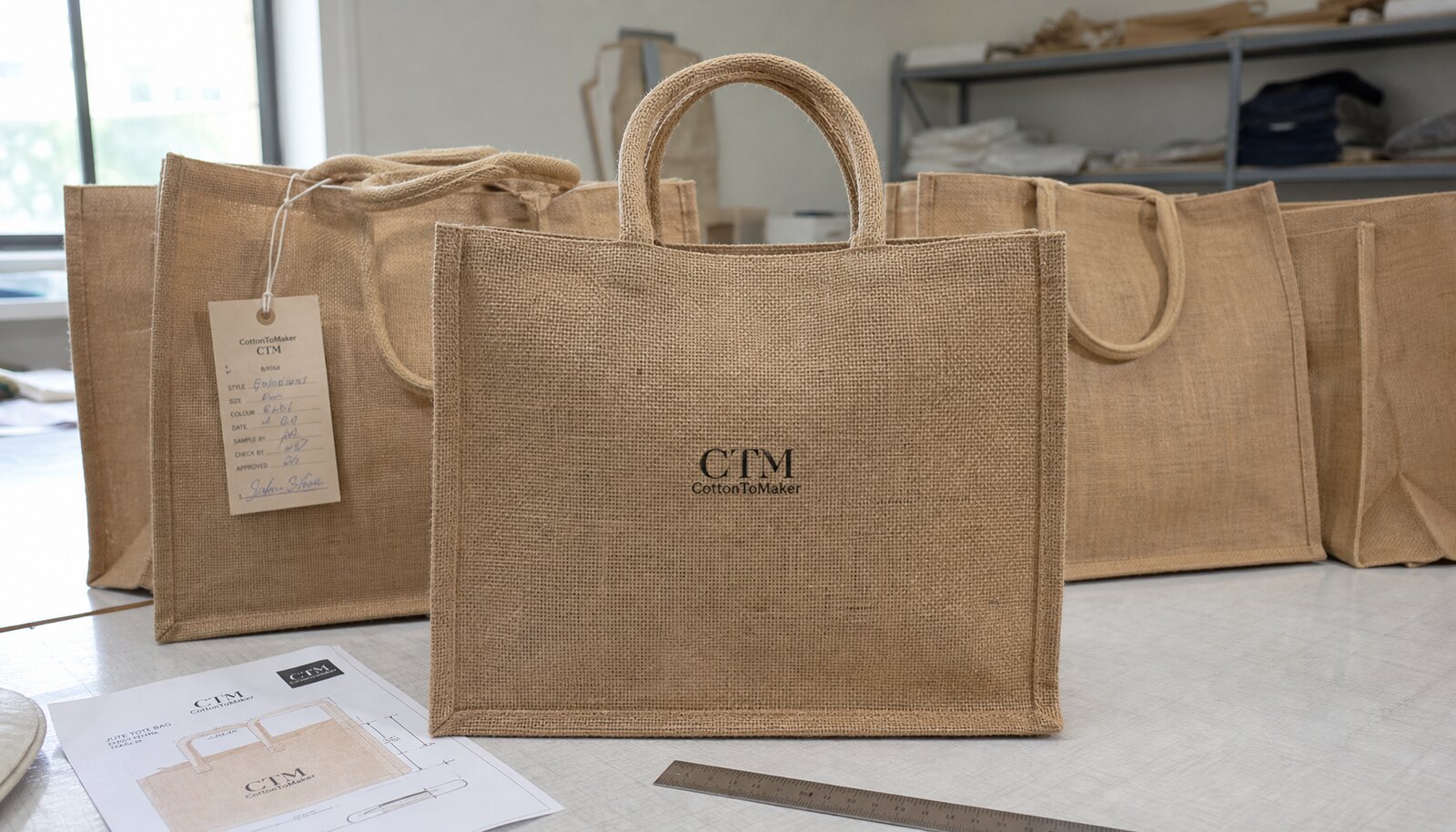
Start with the retail job, not the bag family
Gift shops buy jute totes for very different reasons. Some bags are low-cost checkout add-ons, some are souvenir carriers, and some need to feel like a premium branded item that stays on display after purchase. The proofing checklist should follow the retail job first, because the use case determines what the supplier must show you before you place a bulk order.
That means the buyer should define the bag’s role in the line before artwork starts. If the bag is meant to hold boxed gifts, the buyer needs more structure, stronger handles, and a print that remains legible when the bag is full. If it is a lightweight souvenir bag, the bag can be simpler, but the print still needs to stay sharp on coarse jute. The key procurement step is to write the business purpose into the spec so the factory cannot optimize for the wrong priority.
- State whether the bag is a premium gift item, a checkout add-on, or a practical carry tote.
- Decide if the bag must stand upright on shelf or only function as a carrier.
- Link the target retail price to the level of print detail, structure, and packing quality you can afford.
Lock the spec before artwork approval
A lot of proofing problems start because the artwork is approved before the bag structure is frozen. On jute, that creates avoidable failures: the logo lands too near a seam, the handle hides part of the print, or the fold used for packing cuts through the decoration. Procurement buyers should treat the final bag drawing as the control document, not the logo file.
At minimum, the spec should include finished size, gusset depth, handle length, handle width, seam allowance, reinforcement points, and whether the bag uses lining, lamination, or a stiff base. If the supplier quotes one build and samples another, stop the process and reconcile the spec first. The buyer should not accept “same style” language in place of measured dimensions and construction notes.
The spec should also include what the bag looks like when packed. A retail buyer often cares about the hanging appearance, not just the open bag. If the bag will be folded for cartons, the fold direction and the final visible face should be part of the approval record.
- Freeze size, gusset, handle, and base construction before artwork proofing.
- Use measured diagrams, not just verbal style names.
- Approve the packed fold layout if the bag will ship flat or pre-folded.
Build the proofing sequence in the right order
The correct sequence is spec, artwork, strike-off, pre-production sample, then pilot lot or inspection release. Skipping from artwork to bulk order is how buyers end up with unreadable logos, shifted placement, or a sewn bag that does not match the mockup. The strike-off is especially important on jute because the weave changes the way ink lands and how sharply edges hold.
The strike-off should be made on the actual fabric and with the actual print method that will be used in production. A logo that looks clean on coated paper or a different cloth can fail once it touches natural jute fibers. After the strike-off passes, review a sewn sample that includes handles, seams, final trim, and folding. The buyer needs to see the whole finished unit, not just a printed panel.
For larger or seasonal orders, a short pilot lot or line check is useful. It shows whether the approved result can be repeated under real production pace. One approved sample proves capability; the pilot proves repeatability.
- Do not approve bulk from a digital proof alone.
- Require the strike-off to use the final fabric and print method.
- Review the sewn sample in its folded, packed, and retail-facing condition.
Use comparison questions that expose the real price
A quote for printed jute totes is only useful if the buyer knows what is inside it. The visible price often excludes setup, sampling, screens or plates, inner packaging, carton labels, and labor for folding or bundling. Those omissions become expensive when the product needs to be saleable to a retail buyer, not just technically finished.
To compare suppliers fairly, ask them to quote the same bag spec, the same print count, the same handle build, and the same packing method. Then ask what changes if you alter one element, such as adding a second logo position or a retail-ready hang tag. That gives the buyer a real cost map rather than a single low number that may not survive revision.
It also helps to ask who pays for corrections. If the strike-off passes but the bulk run drifts, the buyer should know whether the factory will rework, replace, credit, or dispute the issue. Without that answer, the lowest quote can become the most expensive supplier to manage.
- Ask for itemized setup and sampling charges.
- Compare MOQ by bag style, colorway, and logo position.
- Request packing and carton details with the quote so landed cost can be calculated properly.
Choose the supplier route by control, not by headline price
The comparison table is most useful when the buyer uses it to test control, not just cost. Direct factories, outsourced-print factories, trading companies, domestic converters, and marketplace resellers each create a different proofing path. The buyer should know who actually touches the bag at each stage and who signs off when something changes.
A direct factory with in-house printing and sewing usually gives the best visibility because the same team can manage the sample and the bulk line. A factory that outsources printing can still work, but only if the buyer gets clear ownership of the strike-off and the factory can prove that the printed panels feeding into sewing are the approved ones. Trading companies add coordination convenience, but buyers should not confuse coordination with manufacturing control.
Where the product is simple, a local converter may be worth the higher unit price because proof review, corrections, and escalation are easier. Marketplace resellers can be suitable for tiny tests, but they are the weakest route when the bag must be consistent across a retail range. If the route is unclear, assume the risk is higher than the quote suggests.
- Identify who prints, who sews, who packs, and who signs the final lot.
- Treat any subcontracting as a risk factor requiring extra proof traceability.
- Do not compare quotes until the supplier route is known and documented.
Verify the factory before you trust the sample
Supplier verification should go beyond a business card and a certificate folder. Ask for the exact product spec sheet, current production photos from the same fabric weight and decoration method, and a clear statement of whether printing is done in-house or by a subcontractor. If the seller is a trading company, ask for the named factory and a route for contacting the production side if a dispute appears later.
The best verification evidence is order-specific. A generic compliance certificate or an unrelated test report does not prove the factory can make your exact bag. Ask the supplier to show how your sample relates to the quoted run: which line made it, which fabric lot was used, and whether the sample passed through the same print and sewing sequence intended for bulk. If they cannot answer those questions cleanly, the buyer has not yet confirmed capability.
For markets with compliance requirements, request evidence only when it is relevant to your product and region. The document pack should be tied to the actual order, not used as a marketing bundle. The goal is traceable confidence, not document volume.
- Request the exact spec sheet and production photos for the quoted configuration.
- Ask who owns the sample and who owns the bulk run if there is a subcontractor.
- Keep compliance requests tied to the target market and the actual product spec.
Set QC thresholds that are measurable and defensible
Quality thresholds on jute should be practical and tied to the artwork and construction, not copied from a random template. Placement tolerance is one example: a centered retail logo may tolerate about 3 mm, but small text or visually sensitive layouts may require a tighter window. The buyer should define the measurement reference points on the actual bag and specify who measures them.
Color control needs the same discipline. A Delta E target can be helpful, but only if both buyer and supplier agree on the instrument, lighting, and reference sample. If the color is being judged against the natural variation of jute itself, a single number may not capture the real acceptance decision. In those cases, tie color approval to a signed master sample under controlled light and use the number as a support tool rather than the sole pass-fail rule.
Registration should be tied to the artwork. A simple one-color logo can tolerate more than a multi-color mark with fine text and knockouts. Instead of a blanket registration figure, define the maximum offset allowed between colors based on the smallest readable feature in the design. That makes the requirement harder to argue and easier to inspect.
The same logic applies to stitch quality and durability. A bag can look acceptable on the table and still fail once it is filled, folded, and handled. Ask for a practical flex and rub check that matches the way the gift shop customer will use the bag.
- Measure placement from the same reference points every time.
- Use a signed master sample for color approval under controlled light.
- Tie registration tolerance to the design’s smallest readable detail.
- Test the bag in the way it will actually be handled in retail use.
Inspect the first lot as a production test, not a sample review
The first production lot is where repeatability is proven. It should be inspected as if it were a reorder, because the sample has already done its job. The real question now is whether the factory can maintain the approved result across multiple cartons, not just on one good unit. Buyers who inspect only the top carton may miss drift in placement, shade, stitching, or packing quality.
Look for variation across cartons, not just inside a single carton. If the first set of bags is correct and later units show logo movement or handle inconsistency, the line is drifting. Compare the bulk lot against the signed sample, not against memory or a digital image. A physical control sample is the only reliable reference once production starts.
If you are buying for a holiday or seasonal gift program, the first lot may be your only chance to correct a problem before store launch. That is why the inspection should not be casual. The buyer should escalate quickly when the lot starts to diverge, because small visual shifts can become large retail problems once the bags hit shelves and checkout counters.
- Inspect enough cartons to see line variation.
- Compare every lot to the signed physical sample.
- Escalate if the approved standard begins to drift during inspection.
Protect the print during folding, packing, and shipping
A good print can be ruined after approval if folding and cartonization are handled poorly. Jute bags are often folded to save freight and warehouse space, but the fold should not run directly through the printed area unless the design can tolerate that crease. A fold line through a logo may look minor in the factory and obvious in retail presentation.
Ask the supplier to show the packed orientation before bulk packing begins. If the bag has a printed front, confirm which side faces out, whether tissue or a polybag is used, and whether the carton is designed to protect the print from compression. The answer matters because some damage is not visible until the cartons are opened in the warehouse.
Moisture control is also a real procurement issue. Jute can pick up odor or board dampness during long transit, and that can make otherwise acceptable goods hard to sell. If the route is humid or slow, ask for the specific moisture protection plan instead of assuming the factory uses one by default. Cartons that arrive wet, crushed, or musty should be rejected even if the bags inside are technically intact.
- Keep fold lines away from the logo whenever possible.
- Approve the pack orientation before the first bulk carton is sealed.
- Specify carton dryness, strength, and odor-free condition as receiving requirements.
Write a reorder file so the next season is easier
Gift shop buying often repeats by season, event, or assortment refresh. If the buyer does not save the approved spec, the signed sample, the quote revision, and the inspection notes, the next order will start from memory instead of evidence. That leads to new mistakes on an old product.
A reorder file should hold the final artwork version, the approved bag dimensions, the print method, the carton spec, and the acceptance notes from the first lot. It should also record what the supplier did well and where the risk was highest. If a factory produced a good first lot but struggled with moisture, placement, or packing, the next purchase order should call that out explicitly.
This file is also useful when the same tote is adapted for a new gift shop message or seasonal campaign. The buyer can reuse the proven construction and only change the decoration content. That reduces proofing time and helps prevent accidental spec creep.
- Save the signed sample, quote revision, and inspection record together.
- Record any drift points so the next order can tighten those controls early.
- Reuse the proven construction whenever only the artwork changes.
Specification comparison for buyers
| Supplier route | What the buyer can verify before order release | Typical commercial trade-off | Primary risk to proofing | Best-fit program |
|---|---|---|---|---|
| Direct factory with in-house printing and sewing | Ask for the actual sample line, production photos from the quoted spec, the same fabric weight, and a signed pre-production sample from the same team that will run bulk. | Usually strongest balance of price, repeatability, and accountability once the order is large enough to justify setup. | A factory may claim the right capability but still switch you to a different line, fabric lot, or decoration team after approval. | Repeat gift shop assortments, seasonal reorders, and branded retail programs that need stable placement and packing. |
| Factory with outsourced printing but in-house sewing | Verify who owns the print strike-off, which subcontractor prints, and whether the sewn sample will use the same printed panels approved by the buyer. | Can be competitive on sewing cost, but coordination adds time and often creates a visible handoff cost in sampling. | Color drift, registration changes, and dispute over who is responsible when the printed panel and sewn bag do not match the proof. | Simple one- or two-color artwork when the buyer can tolerate a longer proof cycle and tighter document control. |
| Trading company or sourcing agent | Request named factory identification, the actual production facility, and traceable sample photos tied to the quoted order, not a generic catalog. | Convenient if the buyer needs multi-category coordination, but the real landed cost can rise once service fees and rework are included. | Weak traceability; the sample may come from one source while the bulk order is placed elsewhere. | Multi-supplier purchasing, bundled gift shop programs, or buyers that need one commercial contact but can manage extra verification. |
| Domestic converter or local assembler | Confirm where the body material comes from, where the print is applied, and whether the same line can repeat the package spec without changing components. | Higher unit cost, often offset by lower freight risk, faster response, and easier in-person review. | Material options may be narrower and the product may not match offshore cost structures. | Short lead times, small launches, event retail, or buyers that need fast proof corrections and easy escalation. |
| Marketplace broker or reseller | Ask for factory documents, sample traceability, and proof the seller controls the production line or has signed responsibility for rejects. | Lowest apparent quote is often not the lowest landed cost once hidden setup, sampling, and reshipment are added. | Spec drift, poor traceability, and weak remedy if the bulk lot does not match the approved sample. | Very small test buys only, or early-stage category validation when the buyer is still testing market response. |
| Material route comparison | Compare jute GSM, weave tightness, linings, handles, inner coating, odor control, and color consistency on the same spec sheet. | If the spec is not normalized, suppliers can appear cheaper by quoting lighter cloth or weaker construction. | Unclear equivalency between quotes; a low price may simply mean a different bag build. | Use this comparison before sampling so every offer is based on the same fabric and structure. |
| Construction route comparison | Compare handle stitch pattern, seam allowance, side gusset depth, reinforcement, and edge finishing on the same approved drawing. | Small construction differences can change durability, shelf shape, and print position even when the bag looks similar in a catalog. | Bulk bags may twist, collapse, or show different logo alignment after folding. | Use this route when the bag must stand, carry boxed gifts, or survive repeated retail handling. |
| Decoration route comparison | Compare screen print, heat transfer, woven label, embroidery, or patch application based on the actual jute surface and the artwork size. | The wrong decoration method can crack, blur, fray, or disappear into the texture of the fabric. | Artwork may pass on screen but fail in bulk because the method does not suit coarse jute. | Use this route when brand visibility, fine text, or color accuracy matters more than the lowest setup cost. |
Buyer checklist before sampling
- Lock the final bag spec before artwork approval: finished size, gusset, handle length, seam allowance, and finished fold position.
- Approve the print on the actual fabric and actual bag build, not a generic art proof or a similar cloth sample.
- Require a signed strike-off or pre-production sample that matches the quoted fabric lot, decoration method, and pack method.
- Write acceptance criteria for print placement, color, registration, seam quality, handle reinforcement, and carton condition before production starts.
- Ask the supplier to state what is included in the quote: setup, screens or plates, sampling, labels, inner packing, and export cartons.
- Verify who prints, who sews, who packs, and who signs off the final lot if any part of the process is subcontracted.
- Define the remedy process for bulk drift: replacement, rework, credit, or chargeback, and who pays freight if the order fails inspection.
- Confirm the packing fold, carton count, carton dimensions, and moisture protection before production starts.
- Keep one master approval file for each approved version so reorders can be compared against the same benchmark.
Factory quote questions to send
- What exact jute GSM, weave type, and any inner coating or lining are you quoting for the body and handles?
- Is the print price based on screen print, transfer, embroidery, or another method, and how many colors are included in the base price?
- Will the pre-production sample be made on the same fabric lot, size, handle construction, and packing method as bulk production?
- Who actually prints the bags, your factory or a subcontractor, and who owns responsibility if the bulk lot differs from the approved sample?
- What is included in the quoted price: art setup, screens or plates, sampling, polybags, carton labels, and export cartons?
- What MOQ applies per colorway, per logo position, and per packaging version?
- What are your written tolerances for placement, color variation, and dimensions, and how are those measured?
- What lead time applies after sample approval, and which steps most often delay this type of order?
- Can you share carton size, gross weight, and estimated loading quantity for the quoted packing method?
- If the sample passes but the bulk lot changes, what is the remedy process and turnaround time for correction?
Quality-control points to confirm
- Print placement should be measured against a written reference point on the final sewn bag. For centered retail logos, a practical starting tolerance is plus or minus 3 mm, but the buyer should tighten or relax that window based on artwork size, visual sensitivity, and the fabric’s natural variation. If the logo is small or text-heavy, the tolerance should be stricter than for a large graphic.
- Color should be judged against a signed master sample under controlled light, not against a screen image. On natural jute, a numeric Delta E target can be useful only if both sides agree on the measurement method, instrument, illuminant, and whether the material’s natural tone is being included in the comparison. If calibration is not aligned, use visual approval tied to the signed reference sample instead of a hard number alone.
- For multi-color artwork, define the allowable gap or overlap between layers in a way that matches the design. Instead of using a universal registration figure, tie the tolerance to the smallest readable detail in the artwork. Fine text and outlines need a tighter standard than simple block graphics.
- Handle attachment should use the specified reinforcement pattern, such as box stitch or bar-tack, with no skipped stitches, thread breaks, loose tails, or asymmetric placement. Inspect both handles on multiple units because one good bag does not prove the full line is stable.
- Side seams and bottom seams should stay straight and consistent when the bag is filled. If the bag twists, bows, or loses shape under a normal load test, the construction is not suitable for retail presentation even if the print is acceptable.
- The printed area should survive a practical flex and rub check on the approved sample. Use the buyer’s own expected handling scenario when possible: folding, refolding, light abrasion, and contact with packaging materials. The pass condition should be defined as no print flaking, no obvious peeling, and no transfer that would make the bag unsellable.
- Do not rely on a single generic wash or rub number if the bag will not be laundered in use. For gift shop totes, handling, shelf display, and fold wear are usually more relevant than laundry performance. The test should match the actual end use.
- Finished dimensions should be checked after sewing and after packing if the bag is folded to a fixed format. A bag can meet cut dimensions and still fail once seams, handles, and folding change the finished shape.
- Cartons should be checked for dryness, structural integrity, and odor. Reject cartons with damp board, crushed corners, water marks, or musty smell, because those issues can transfer to the bags or distort the printed face during storage.
- If the route is humid, slow, or likely to involve long sea transit, ask for a moisture control plan. That can include carton orientation, desiccant, stronger outer cartons, or better inner protection, but the buyer should confirm which measures are actually included rather than assuming they are standard.