Why the material spec matters more than the artwork
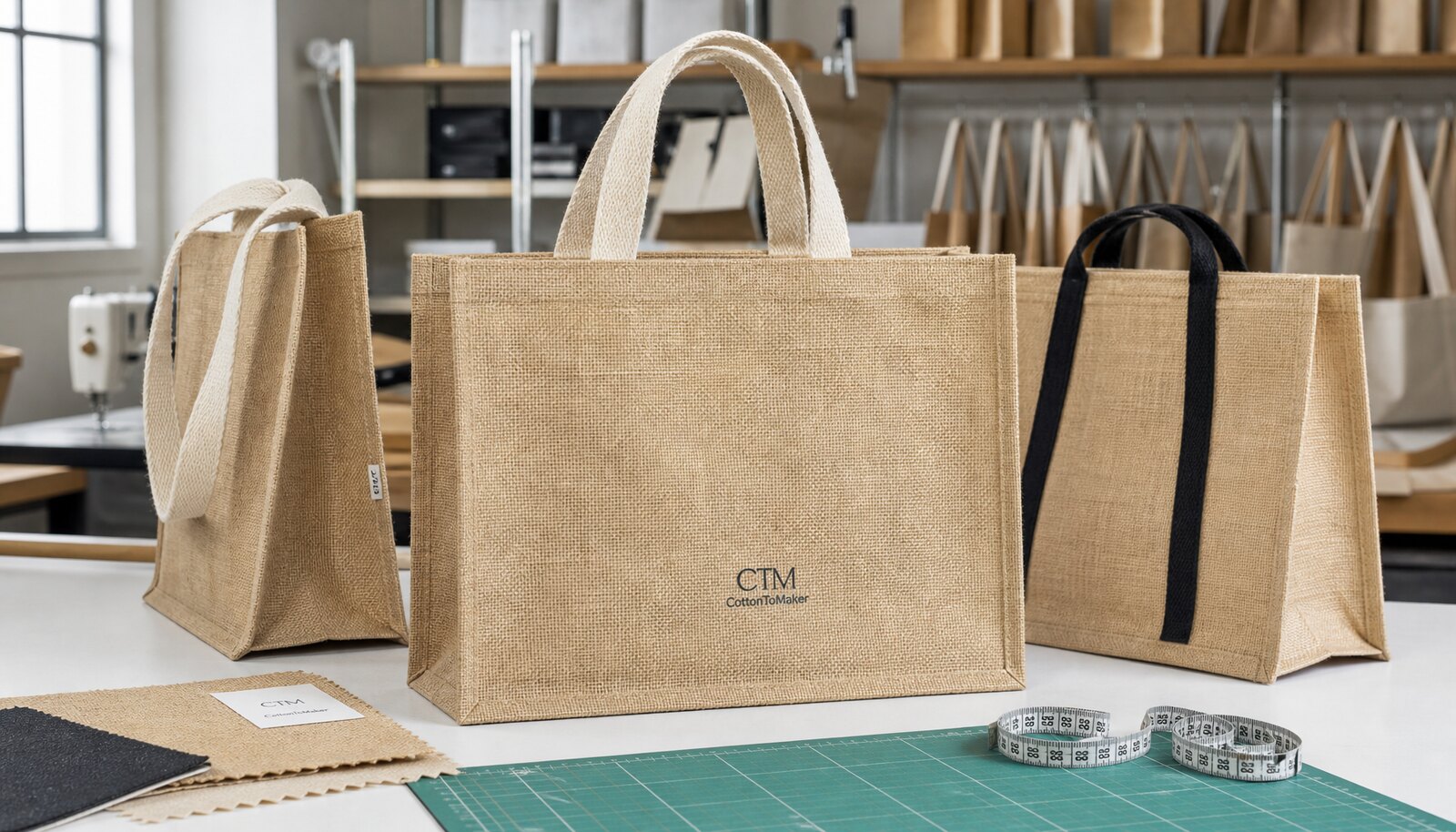
For gift shops, a tote bag is both packaging and product. Customers do not judge the logo first; they judge the hand feel, structure, smell, and finish. That is why buying wholesale jute tote bags for gift shops starts with material selection, not artwork approval. If the fabric is thin, the seams wander, or the bag collapses on the shelf, even a clean logo will not rescue the presentation.
Procurement teams often compare quotes that look similar on size and artwork but are built very differently. One supplier may be quoting bare jute with simple handles and bulk packing, while another is including lining, reinforcement, better trim, and shelf-ready packing. The right comparison is the one that shows how each spec affects usability, defect risk, and landed cost.
- Treat the bag like a retail item, not a disposable promo item, unless the use case truly is disposable.
- Compare total construction, not only dimensions or print color count.
- Ask which detail is responsible for the quote gap before assuming one supplier is overpriced.
Start with the use case and load profile
Before you ask for quotes, define what the bag must actually carry. A souvenir tote for postcards and small gifts has different needs from a premium gift-shop bag that may hold candles, ceramics, or boxed sets. The load profile determines fabric weight, handle width, seam reinforcement, and whether the bag must stand up on display. If the use case is vague, the factory will price a generic tote and you will pay later in sampling revisions.
The easiest way to make the RFQ usable is to write the retail scenario into it. State whether the bag will sit on a shelf, be handed over as packaging, or be sold as a reusable shopping bag. That single sentence changes how the supplier should think about top edge finishing, lining, closure style, and how much tolerance is acceptable in body shape and print placement.
- Gift packaging: prioritize light weight, low cost, and clean logo presentation.
- Souvenir retail: prioritize shelf presence, consistent shape, and low odor.
- Reusable retail bag: prioritize handle comfort, reinforcement, and higher load tolerance.
Choose jute weight and weave with a measurable target
For most gift-shop programs, 300-350 gsm plain weave jute is the practical starting point. It gives enough body for a retail appearance without making the bag feel overly stiff or expensive. If you need the bag to stand upright or handle denser merchandise, move into the 360-400 gsm range and confirm that the added weight does not make sewing and printing sloppy. Avoid the phrase thick jute in sourcing documents; it is too vague to control quality.
Weave behavior matters as much as gsm. A loose weave can look rustic, but it can also show uneven shading, print bleed, and fiber shedding. Ask the supplier to confirm whether the fabric is natural, bleached, or dyed, because color treatment changes both print contrast and appearance across the lot. If the buyer wants a more premium retail look, request a close weave with visible but even texture rather than an open, airy weave that reads as unfinished.
- 300-320 gsm: entry retail, lightweight gifts, lowest-cost shelf programs.
- 330-350 gsm: best all-around option for natural-looking gift-shop totes.
- 360-400 gsm: better structure and shape retention, but verify seam strength and print quality.
- Ask for finished fabric weight tolerance in writing, not only a visual sample approval.
Specify lining, handles, closure, and reinforcement as one system
Lining changes more than appearance. It affects shape, labor, and the feel of the bag in the customer’s hand. Unlined jute is acceptable when the bag is intentionally rustic and price-sensitive, but it can shed fibers and show the back side of the stitching. Nonwoven lining is a sensible middle option when the buyer wants a cleaner interior without pushing the bag into a fully premium price point. Cotton lining gives the best retail finish, but it adds cost and sewing time.
Handles are where many retail totes fail early. Cotton webbing between 25 mm and 30 mm is usually the safest specification for gift-shop buying because it feels familiar in hand and looks deliberate on shelf. Rope handles can work, but only when the design language supports that style. For bulk orders, require a reinforcement method in the sample spec. A bag that looks fine in the photo but has weak handle anchoring will trigger avoidable claims after first use.
- Unlined: lowest cost, fastest production, more rustic presentation.
- Nonwoven lined: cleaner interior and improved structure with moderate cost increase.
- Cotton lined: best retail finish, but higher labor and more QC points.
- Ask for handle drop, anchor stitch pattern, and reinforcement length in the approved sample.
- If the bag includes a closure, request a separate sample for the closure alone before bulk release.
Use the print method that matches jute texture, not the one that looks best in a mockup
Jute is not a smooth substrate. Fine type, gradients, and hairline details often disappear into the weave or become visually muddy after production. For the majority of wholesale jute tote bags for gift shops, one or two-color screen print is the most reliable option because it gives stable color and predictable setup. Heat transfer can work for smaller runs or more detailed artwork, but it should be tested on the actual fabric, not on a digital rendering.
Artwork should be built for the material from the beginning. Keep small text away from the edge of readability, and avoid reverse type that depends on tiny openings in the weave. A practical rule is to keep the thinnest line at least 0.75 mm and avoid type below 6 pt unless the logo has been proven in a strike-off. Ask the supplier to send a physical strike-off and check it from normal retail viewing distance, not under laboratory lighting.
- Screen print: best for simple logos, stable color, and repeat orders.
- Heat transfer: useful for short runs or detailed graphics, but verify edge adhesion and rub resistance.
- Embroidery: possible on some constructions, but it can distort lighter jute bodies and raise cost sharply.
- Define print position with a centerline and top margin, then allow no more than 5 mm shift from the approved sample.
Compare supplier routes and landed cost, not just unit price
A jute tote quote only becomes useful when you understand the route behind it. Direct factories usually give the cleanest cost split and the best visibility into sewing and printing control. Trading companies can be useful when you need mixed products, faster coordination, or lower internal sourcing effort, but they can hide the production source and compress your room to negotiate. Small workshops are fine for sample development or pilot runs, yet they are usually the weakest choice for repeat retail supply.
Landed cost is also shaped by the quote basis. EXW may look cheap until inland freight, export handling, and repacking are added. FOB gives a better basis for comparing supplier bids because it shows more of the production cost on one line. When you compare bids, ask for a line-item split: fabric, lining, handles, print, sewing, packing, and any special QC or compliance charge. That is the only way to see whether one supplier is genuinely cheaper or simply less complete.
- Direct factory: best for repeatability, transparency, and stable QC.
- Trading company: best when you need mixed sourcing or limited internal bandwidth.
- Workshop: useful for sample development, not ideal for ongoing retail replenishment.
- Compare price on the same basis: same Incoterm, same packing, same QC scope, same carton count.
- If a quote omits compliance, testing, or export packing, treat it as incomplete rather than inexpensive.
Ask RFQ questions that reveal capability, not just price
The best RFQ questions are the ones that expose how the supplier actually works. Ask what is in stock, what is made to order, and which component drives lead time. Ask whether the factory controls cutting, sewing, printing, and packing in-house or whether one of those steps is outsourced. Ask for the most recent audit record or internal QC summary if no third-party audit exists. These questions are not ceremonial; they tell you whether the supplier can repeat a bulk order without improvising the spec.
You should also ask for proof that the factory can support your market. If you are selling into the EU or US, ask for the material declarations that support your product claims, especially for inks, coatings, and synthetic trims. If your retail partner wants a documented supply chain, ask who owns the traceability record and how long they keep it. For gift-shop buyers, audit proof matters because the bag is often sold under a store brand, even when the factory name never appears on the shelf.
- What is in stock today, and what must be sourced after PO?
- Which step is in-house, and which step is subcontracted?
- Can you share audit proof, compliance statements, and traceability records?
- What is your claim process for seam failure, odor, print shift, or carton damage?
- Who signs off the golden sample and how is it stored after approval?
Build QC thresholds into the approval package
QC guidance should be specific enough that a factory can inspect against it without guessing. Set critical defects to zero. Put major defects under AQL 2.5 and minor defects under AQL 4.0 if you are buying for retail, because the cost of a bad shelf presentation is usually higher than the cost of a stricter inspection. Define dimensional tolerances, print shift, seam quality, and odor limits in the sample approval package so the final lot can be judged against a single reference.
Test the bag as a customer would use it. Fill it with realistic contents, hold it by the handles, and look for seam opening, distortion, or handle bite. A useful handle pull test for entry retail bags is 3 kg for 60 seconds without failure; for premium reusable bags, 5 kg is a better target. Check that the bag stands reasonably flat if that is part of the approved shape, and reject any lot with mold, wet odor, or visible contamination on retail-facing surfaces.
- Critical defects: wrong SKU, severe odor, mold, contamination, or load-bearing failure.
- Major defects: seam opening, missing reinforcement, logo shift beyond tolerance, or obvious size mismatch.
- Minor defects: small loose threads, slight print variance, or edge irregularity that does not affect use.
- Keep a sealed golden sample, approved strike-off, and signed measurement sheet with the PO.
- Inspect the first production output before the run is completed if the order is large enough to justify it.
Treat packing, moisture control, and regional supply risk as part of the spec
Packing is not an afterthought for jute. Jute absorbs moisture, and a damp carton can turn into odor, staining, or mildew by the time the shipment reaches your warehouse. For export packing, ask for dry cartons, clear carton marks, and a moisture target below 12% at packing. If the bags are going straight to stores, define whether they should arrive in bulk packs, individual polybags, or retail-ready tickets with barcode labels already applied.
Regional supply risk should also be part of the buying decision. Jute availability, webbing supply, and carton timing can all move with seasonality, port congestion, or inland trucking delays. Ask the supplier which component has the longest lead time and whether a backup source exists if the usual mill or trimming vendor runs short. If you are placing a seasonal order for gift-shop replenishment, build the schedule around sample approval plus production plus shipping, not around the first quote date.
- Define carton count, carton dimensions, gross weight target, and labeling in the RFQ.
- Ask whether double-wall cartons or palletization are available if the route is long or humid.
- Require a storage plan that keeps finished bags dry, off the floor, and away from direct moisture.
- Confirm whether the supplier can rebook production if a long-lead trim or print screen is delayed.
Lock claim handling before you release the order
A good sourcing file includes the answer to what happens when something goes wrong. Buyers should define a claim window for visible damage on receipt and a separate window for manufacturing defects found during stocking. For example, you may want 7 days for carton damage and receiving errors, plus 30 days for hidden construction defects after inspection. The point is not the exact number; the point is to stop arguments later about when a defect was still the supplier's responsibility.
Replacement handling should also be written down. Decide whether the supplier will replace confirmed defect units, issue credit, or credit the next order, and decide who pays for freight on the replacement lot. If the order is seasonal, replacement timing matters more than the unit credit because a late replacement may have zero retail value. A practical buyer policy is to require photo evidence, retain one sealed reference carton, and state that repeated defect types can trigger a hold on the balance payment until corrective action is documented.
- Write a visible-damage claim window and a manufacturing-defect claim window separately.
- Define whether the remedy is replacement, credit, or refund, and who pays freight.
- Keep one sealed carton and one sealed golden sample for dispute resolution.
- Ask the supplier to document corrective action if the same defect appears in more than one inspection lot.
Specification comparison for buyers
| Comparison point | Recommended option | When it fits | Buyer risk to check |
|---|---|---|---|
| Outer jute fabric weight | 300-350 gsm plain weave jute | Standard gift-shop totes that need structure without a rigid feel | Ask for finished fabric weight, not only yarn count; check for thin patches and shade banding |
| Lining choice | Unlined for lowest cost; cotton or nonwoven lining for retail-ready bags | When the bag needs a cleaner interior, more shape, or smaller-item retention | Confirm whether seams are bound or left exposed and how lining changes lead time |
| Handle type | 25-30 mm cotton webbing with reinforced ends | Most gift-shop programs that need comfortable carry and a natural look | Insist on handle drop, stitch count, and pull-test requirements in the sample spec |
| Closure style | Open top for low-cost SKUs; button tab or zipper for premium sets | When contents are higher value or the bag is sold as a reusable retail item | Closure hardware can create scrap and alignment issues; request a pre-production closure sample |
| Print method | 1-2 color screen print for simple logos | When the artwork is clean and repeat orders justify setup | Ask for strike-off on actual jute; fine lines and gradients usually break up on rough weave |
| Supplier route | Direct factory with in-house sewing and printing | Repeat programs needing cost transparency and repeatable QC | Verify the factory actually controls production, not just sales and consolidation |
| Supplier route | Trading company with documented QC and export coordination | Buyers who need mixed SKUs or limited internal sourcing bandwidth | Confirm where the production happens, who approves samples, and who handles claims |
| Supplier route | Small workshop or pilot maker | Sample development or short test runs only | Lower control over consistency, packaging, and export readiness |
| Quote basis | FOB or EXW with line-item cost breakdown | When you want to compare true landed cost across bids | Watch for hidden packing, screening, compliance, or rework charges |
Buyer checklist before sampling
- Define the end use first: gift packaging, souvenir retail, corporate gifting, or lightweight shopping carry.
- Lock the fabric spec in gsm, weave type, color, and finish before requesting quotations.
- Specify lining, handle width, handle drop, closure type, and reinforcement points in the RFQ.
- Approve the artwork at final size with a placement tolerance and a clear color reference.
- Ask for a pre-production sample, a print strike-off on real jute, and a sealed golden sample.
- Request compliance documents up front: business license, factory audit if available, and material safety statements for inks or coatings.
- State carton count, barcode needs, retail tagging, and whether packing is bulk or shelf-ready.
- Confirm moisture handling, storage conditions, and claim response terms before release.
Factory quote questions to send
- What exact fabric gsm, weave, and finish are you quoting, and can you send a swatch or fabric data sheet?
- Which input is the long lead item in your quote: jute fabric, lining, webbing, zipper, print screens, or packing materials?
- What is the exact price difference between unlined, lined, and reinforced construction, and what is included in each price?
- What is the logo placement tolerance, and how do you verify print position before bulk cutting starts?
- Can you provide recent factory audit proof, or if none is available, what internal QC and traceability records do you keep?
- What compliance documents can you supply for the inks, coatings, or synthetic trims used in the bag?
- What is your process if the lot arrives with seam defects, odor, print shift, or carton damage?
- What is the production lead time after sample approval, and what events usually extend it?
- Who owns the claim if a packing mistake or SKU mix-up is discovered at receiving?
- Can you confirm the country of origin, the factory address, and whether any steps are outsourced?
Quality-control points to confirm
- Set critical defects to zero, major defects to AQL 2.5, and minor defects to AQL 4.0 for final inspection.
- Finished bag dimensions should stay within +/-5 mm for bags under 35 cm and within +/-8 mm for larger formats unless your approved sample says otherwise.
- Handle drop should stay within +/-10 mm of the approved sample, and left-right symmetry should be visually even from normal retail viewing distance.
- Logo placement should stay within 5 mm of the approved position; crooked prints, blurred edges, and color breaks at the logo edge should be treated as major defects.
- Load-bearing seams should show no skipped stitches or seam opening; a handle pull test should hold 3 kg for 60 seconds on entry retail bags and 5 kg for premium reusable bags without failure.
- Jute moisture content should be below 12% at packing, with no mold, damp odor, oil marks, or visible contamination on retail-facing surfaces.
- Cartons should arrive dry, intact, and correctly labeled, with the SKU, quantity, and carton count matching the packing list exactly.
- Keep a sealed golden sample, approved print strike-off, and signed measurement sheet with the PO so disputes can be settled against a single reference.