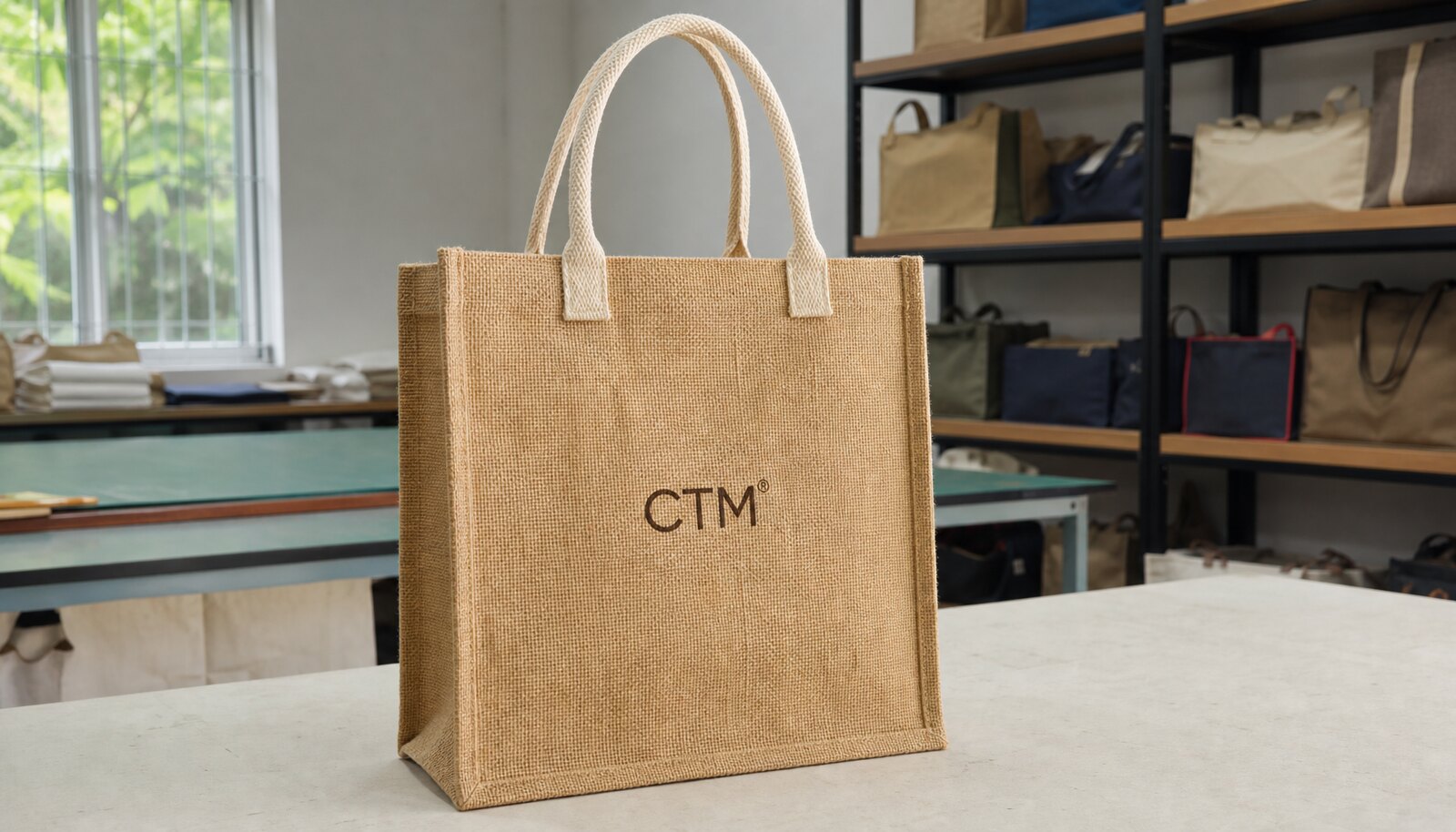
What gift shop buyers are actually sourcing
A jute tote for a gift shop is not the same buying decision as a trade-show giveaway or a commodity grocery bag. In retail, the bag is part of the product mix. It sits on a shelf, needs to photograph well, and often carries items that are heavier or more delicate than a flyer or brochure. That is why procurement should start with the use case, not the fabric alone.
If the tote is meant to be resold, the customer will judge shape, handle comfort, print quality, and odor in addition to price. If it is a gift-with-purchase item, the bag still needs to look deliberate, because a flimsy or uneven tote can drag down the perceived value of the item it carries. The bag is a packaging decision, a merchandising decision, and sometimes a margin item at the same time.
The common buying mistake is to ask for a size and a logo, then compare quotes as if all jute bags are interchangeable. They are not. Fabric density, stitch quality, handle build, print method, and pack-out all affect shelf appeal and landed cost. If those variables are not fixed up front, a quote that looks cheap can become expensive once it reaches the warehouse.
- Define whether the tote is for resale, bundling, checkout, or promotion.
- Treat the bag as part of the customer experience, not just a container.
- Write one real-world load example into the spec so suppliers design around actual use.
Start with the spec, not the quote
The first sourcing decision should be the bag specification. A 280 GSM jute tote with cotton webbing handles and no lining is a very different product from a 320 GSM lined tote with reinforced stitching and a branded patch. If one supplier is quoting a simpler build and another is quoting a fully finished retail bag, the unit prices will never line up fairly.
A practical middle ground for many gift shops is a mid-weight jute body with a stable handle system and clean edge finishing. That gives enough structure to stand on a shelf and enough durability for consumer use without making the bag so stiff that it loses its retail feel. If the tote must hold bottles, boxed candles, or heavier souvenirs, prioritize handle reinforcement and a base that keeps shape after filling.
The spec should also define what the bag is not. If you do not want lamination, say so. If you do not want mixed fibers, say so. If a lining is optional, decide whether the extra cost is worth the cleaner interior and lower fiber shedding. A vague spec invites supplier interpretation, and supplier interpretation is where quote comparisons break down.
- Use a written spec for fabric weight, handle width, and lining so suppliers quote the same build.
- Do not compare a lined tote to an unlined one without adjusting for cost and handling differences.
- If the bag must fit a specific retail insert or bottle, put that internal dimension in the RFQ.
Match construction to shelf use and carry load
Construction decisions should follow the way the bag will live in a store. A flat promotional tote can survive with simpler handles and a lighter body. A resale tote that sits beside candles, books, or packaged food needs better shape retention, stronger handle attachment, and more consistent trim. If the bag has to sit upright on a shelf, the seam build matters more than the logo.
For gift shop assortments, the most useful tradeoff is usually structure versus freight. More fabric weight and lining improve presentation, but they also increase cost and cube. A bag that is slightly too soft can look cheap on shelf, while a bag that is too rigid can be harder to fold and ship. The right answer is not maximum GSM; it is the lowest spec that still looks finished and carries the planned contents safely.
Use the same logic for handles. Cotton webbing handles in the 25-30 mm range are common because they feel more retail-ready than thin jute strips and usually hold up better under repeated customer use. The handle must also suit how the customer will carry the bag. If it is meant for shoulder carry, finished length matters. If it is only for hand carry, you can keep the handle shorter and reduce excess material.
- Choose the lightest build that still supports the intended merchandise and shelf presentation.
- Ask the supplier to confirm handle length in finished form, not only cut length.
- For heavier loads, require the same reinforcement pattern on every unit, not just on samples.
Compare suppliers by landed cost, route, and region
The quote comparison only works if you understand the supplier model. A direct factory in a jute-producing region usually gives the best control over fabric, sewing, and repeat orders. A trading company can be useful for low-volume, mixed-SKU, or urgent programs, but it may hide the actual maker and add an extra margin layer. A domestic converter can be the fastest option for short replenishment cycles, but usually at a higher landed cost.
Region affects more than price. It affects transit time, port choice, paperwork, and how much buffer you need before a seasonal launch. A lower ex-works number can lose once you add inland pickup, export cartons, and a longer freight leg. A quote that looks a little higher on FOB or FCA terms can actually be cheaper once you account for better pack density and fewer logistics surprises.
Do not compare unit price without freight context. Jute bags are bulky, so dimensional weight and carton size can move the final number as much as sewing cost. For example, a better-packed 25-piece carton can cost less to move than a smaller unit price packed in oversized cases that waste cube. If a supplier cannot give carton dimensions and gross weight, they are not giving you a real landed-cost quote.
- Ask which office is selling the order and which site is actually making the bag.
- Normalize quotes to the same Incoterm, carton size, and pack count before comparing price.
- Treat oversized cartons as a freight problem, not just a packing detail.
Choose decoration based on the artwork, not the default method
Jute is textured, so the decoration method should follow the artwork. A simple one-color brand mark usually works well with screen printing. If the artwork contains fine lines, small text, or a premium retail identity, a stitched patch or woven label can look cleaner than forcing a detailed print onto a rough surface.
The real test is not whether the design looks good on a screen. It is whether the approved size still reads well on the actual bag panel. Ask the supplier for a pre-production placement mock-up on the exact tote size, and do not approve artwork based only on a flat digital proof. Small type often disappears or fills in on jute, especially when the weave is open or the ink deposit is heavy.
For multi-SKU gift shop programs, keep the decoration rules simple. One or two standard print sizes across the range reduce rework and make reorders easier. If you plan to refresh artwork seasonally, standardize the bag body and vary the print panel instead of changing the entire construction every time. That keeps the program easier to source and easier to replenish.
- Use screen print for simple branding and larger logo areas.
- Use a woven label or stitched patch when you want a cleaner premium finish.
- Approve artwork size on the actual bag panel, not on a flat mockup alone.
Check compliance and material risk before bulk approval
Natural fiber bags need a different quality lens than synthetic totes. Jute can vary in color tone, slub level, and odor from lot to lot, so the buyer should define what variation is acceptable and what is not. A little natural variation is normal; a bag that looks patchy, dusty, or musty is not retail-ready.
Odor and mold are the most overlooked risks. If the cartons were stored in humid conditions or the fabric was packed before it was fully dry, the smell can show up only after the boxes are opened in your warehouse. Make that a formal reject condition. A normal plant-fiber smell is acceptable. Musty, sour, mildew, or chemical odor is not. Visible spotting, damp marks, or dark patches should also trigger rejection.
If the bag is dyed or printed with darker ink, ask for colorfastness and rub-test evidence that matches your market requirements. Some buyers also need restricted-substance paperwork or retailer-specific declarations depending on destination. Do not wait until the shipment is in transit to discover that a document is missing. Ask what the supplier can provide before you approve the order, and match the document list to the market you are shipping into.
- Set an odor standard in writing and reject musty or moldy cartons.
- If the bag is dyed or dark printed, ask for dry and wet rub evidence.
- Confirm market-specific documentation before bulk production starts.
Use QC checkpoints that catch real failures
A useful QC plan starts with measurable targets. If the approval standard only says the bag should look good, the factory and the buyer will disagree later. For wholesale gift shop programs, write down what counts as acceptable on size, stitching, print placement, stains, odor, and carton count. That reduces disputes and keeps the order from drifting once production moves from sample to bulk.
A strong inspection flow usually includes a golden sample, a pre-production sample, an in-line check for larger orders, and a final carton check before shipment. The factory should know which defects are major, minor, and critical before cutting starts. Major issues usually include broken stitches, visible stains, misaligned handles, badly placed print, and damaged or mismatched cartons.
Do not ignore surface consistency. Jute can show fiber slubs, dust, loose weave, and panel-to-panel tone variation. Some of that is natural, but not all of it is acceptable in retail. If the bags are for a gift shop floor, the front panel needs to look clean from normal viewing distance. What passes in a sample room may not pass on shelf under store lighting.
- Set size tolerances in writing before bulk cutting.
- Define defect categories for stitching, print, stains, odor, and carton integrity.
- Keep the golden sample with the PO file and use it for every inspection comparison.
Make sample approval control the whole order
A sample is only useful if it reflects the production route. Sales samples often look correct but may use different fabric, thread color, handle length, or packing. For a gift shop buyer, the sample must prove that the final bag can be built consistently, not just that the logo can be applied once.
The approval record should include the exact bag size, handle length, stitch pattern, print position, carton configuration, and any special finishing. If the factory needs to change any of those after sample approval, treat it as a formal revision, not an informal adjustment. That is how orders drift and how the receiving team ends up with bags that do not fit the intended shelf, display basket, or shipping carton.
If the order is seasonal or tied to a store launch, ask for a milestone schedule. You want dates for material booking, sample approval, bulk start, sewing completion, packing, inspection, and handoff to freight. That gives you a better risk-control structure than a single promised ship date and makes delays visible before they hit the launch date.
- Approve a pre-production sample that matches the intended bulk spec.
- Write down every approved dimension and decoration placement.
- Treat any post-approval spec change as a formal revision.
Packing and freight can move your margin more than the bag itself
Jute totes are lightweight, but they are bulky. That makes packing efficiency a bigger cost lever than many buyers expect. A change in folding method, inner pack quantity, or carton size can alter freight cost materially, especially on air shipments or mixed pallet moves. The buyer should know the carton plan before the PO is released.
For warehouse distribution, flat-folded bags with clear master carton labels are usually easier to receive than loose-packed assortments. If the bags go directly to stores, you may want a pack format that supports fast allocation and minimal repacking. For premium retail presentation, individual polybags may be justified, but they add labor, plastic, and volume. That tradeoff should be intentional, not accidental.
Choose the freight mode based on order value, urgency, and carton density. Ocean freight is usually the practical choice for regular wholesale replenishment. Air freight only makes sense when the launch window is tight or the order is small enough that speed matters more than cost. Whatever you choose, make sure the supplier and forwarder agree on carton dimensions, gross weight, and readiness date before anything leaves the factory.
- Get carton dimensions and gross weight before approving shipment terms.
- Choose packing that matches your warehouse or store allocation workflow.
- Use air only when the schedule justifies the higher freight cost.
When to hold the order and when to place it
Hold the order if the sample is not repeatable, the quote leaves out major features, or the supplier refuses to state tolerances. That is not being difficult; it is managing commercial risk. The cost of a delayed PO is often lower than the cost of a bulk order that arrives with weak handles, off-center print, musty cartons, or packaging that does not match the packing list.
Place the order when the spec is fixed, the sample is approved, the quote basis is clear, and the supplier has given a realistic production schedule. If the order is for a gift shop launch, add buffer time for artwork signoff and shipping. If the bag is part of a seasonal display, make the timeline more conservative than the factory's first promise.
For repeat programs, lock a version-controlled spec sheet and keep the golden sample with the purchasing file. That makes reorders cleaner and gives you a basis for comparing future production lots against the original approval. It also makes supplier performance easier to score when you decide whether to renew the program.
- Hold the PO until the sample, spec, and quote basis all match.
- Add schedule buffer for artwork, packing, and freight.
- Version-control the spec so reorders stay consistent.
Specification comparison for buyers
| Spec decision | Recommended option | When it fits | Buyer risk to check |
|---|---|---|---|
| Source route | Direct factory for repeat programs; trading company or local converter for small mixed runs and urgent fills | Use direct sourcing when the spec is stable and you need better control of fabric, stitching, and repeatability; use a middleman when SKU variety matters more than margin | Ask for the real production site, not just the sales office. A low quote can hide subcontracting, inconsistent mills, or a switch in print location that changes lead time and quality |
| Body fabric weight | 280-320 GSM jute | Gift shops that need a retail-ready tote with enough structure for boxed gifts, candles, books, or souvenirs | Below this range the bag can feel thin, shed more fiber, and lose shelf shape; above it the bag can become stiff and raise freight cost |
| Weave and finish | Tight, even weave with clean edge finishing | Retail lines where the bag must look consistent on a shelf and accept print cleanly | Open or uneven weave can make the logo look patchy and can expose inconsistent color, fiber slubs, or rough edges |
| Handle construction | Cotton webbing handles, 25-30 mm wide, with box-X or reinforced bar-tack stitching | Best for repeat customer use and heavier retail contents | Short, narrow, or lightly stitched handles are a common failure point; ask how the handle is load tested and whether both sides are matched for length |
| Lining choice | Unlined for low-cost promo; cotton or light recycled lining for retail resale | Unlined works for giveaways; lining fits gift shops that want a cleaner interior and less fiber shedding | Lining adds cost, labor, and lead time, and it can change how the bag folds, packs, and sits in a display basket |
| Decoration method | 1-2 color screen print for standard branding; stitched patch or woven label for premium positioning | Simple logos, short slogans, or retail SKUs that need a cleaner brand finish | Fine detail, gradients, or small text can blur on jute; approve the actual artwork size on the actual bag panel, not only a digital proof |
| Finished size tolerance | Target +/- 0.5 cm for small totes and +/- 1.0 cm for larger totes; gusset within +/- 0.5 cm | Useful when the bag must fit a retail insert, bottle, or boxed set | If the supplier will not state tolerances, you may receive bags that vary enough to affect display, packing, or shelf fit |
| MOQ strategy | 300-500 pcs per artwork for a test run; higher volumes for stable replenishment | Works for new gift shop programs, seasonal collections, or first-time supplier qualification | Very low MOQ can indicate stock fabric, mixed materials, or weaker process control. Ask whether the MOQ changes if you split artwork or colors |
| Carton pack-out | Flat-folded, master carton packed, with carton marks and pack count confirmed in writing | Wholesale programs that move through a warehouse or store allocation flow | Loose packing, unmarked cartons, or oversized cases increase receiving disputes and dimensional freight cost |
Buyer checklist before sampling
- Define the retail job before you compare quotes: checkout bag, gift-with-purchase item, resale tote, seasonal souvenir carrier, or premium branded merchandise.
- Write one usage example into the spec, such as one boxed candle, two folded shirts, or a 750 ml bottle with tissue, so suppliers can size the tote to a real load instead of a vague capacity claim.
- Lock the finished dimensions with usable space in mind, not just outside measurements. Include body width, height, gusset depth, and whether the opening must fit a retail insert or bottle neck.
- Specify the fabric clearly: natural jute, laminated jute, jute-cotton blend, or jute with lining. Use GSM or oz rather than words like heavy or premium.
- State the handle material, width, finished length, and reinforcement method. If the bag must carry weight, ask the supplier to confirm the intended load range or use case in writing.
- Choose the decoration method based on logo detail, shelf distance, and reprint risk. Simple screen print is usually safer on rough jute than small type, gradients, or fine lines.
- Ask for sample photos of the exact fabric base, trim, and print method you plan to order, not a generic catalog image from the factory.
- Require a pre-production sample and written sign-off on fabric, print placement, handle length, carton marks, and packing count before bulk cutting begins.
- Confirm every included feature in the price: lining, lamination, closure, internal pocket, patch, zipper, swing tag, and special finishing.
- Request the packing detail in writing: inner pack quantity, master carton count, carton dimensions, gross weight, and whether cartons are export grade and stackable.
Factory quote questions to send
- What is the exact fabric specification in the quote, including GSM, weave density, and finishing, and is it made from stock fabric or reserved for this order?
- Who owns each production step: fabric sourcing, cutting, printing, sewing, packing, and carton labeling? If any step is subcontracted, where does it happen?
- What is the MOQ per size, per color, and per artwork, and do those quantities change if I split the order across two print designs?
- Which Incoterm are you quoting, and what charges are included under that term? If the quote is EXW or FOB, what charges are excluded?
- What is the handle material, width, finished length, and reinforcement method, and can you confirm the stitch pattern used at the stress points?
- What is the maximum number of print colors included in the price, and what are the setup charges, plate charges, or screen charges for additional colors?
- Can you provide a decorated pre-production sample before bulk cutting, and what exact elements of that sample will be matched in production?
- What are the finished-size tolerances for width, height, and gusset, and what inspection method do you use to verify them?
- What is your defect standard for stains, odor, mold, print smudging, broken stitches, loose threads, and misaligned handles?
- How many units go into each master carton, what are the carton dimensions and gross weight, and are the cartons marked with SKU, quantity, and destination label?
Quality-control points to confirm
- Finished size should stay within the agreed tolerance: a practical target is +/- 0.5 cm for small tote formats and +/- 1.0 cm for larger bags.
- Gusset depth should match the approved sample within +/- 0.5 cm so the bag holds its shape and still fits the intended carton and shelf display.
- Handle length should match the approved sample, and both handles should be even side to side. Any visible asymmetry is a sign of weak process control.
- Handle attachment points should be centered and aligned. Visible shift should be no more than 0.5 cm from the approved placement on either side.
- Handle stitches should be even, secure, and fully cover the reinforcement area. For load-bearing handles, require the same reinforced stitch pattern on every unit.
- Print placement should remain within a defined tolerance. For simple single-color logos, a practical target is within 3 mm of the approved position on the main panel.
- Print edges should remain legible without heavy bleeding, haloing, or double images. On rough jute, agree in advance what level of edge spread is acceptable.
- Front-panel appearance should be clean from a normal viewing distance. Reject bags with visible oil marks, mold spots, water stains, or discoloration on the retail-facing side.
- Loose thread tails should be trimmed and not exceed a small visible allowance. Long loose ends suggest weak finishing and create a retail presentation issue.
- If the bag includes lining or lamination, the interior should not show peeling glue, sharp exposed seams, or wrinkling that reduces usable space.