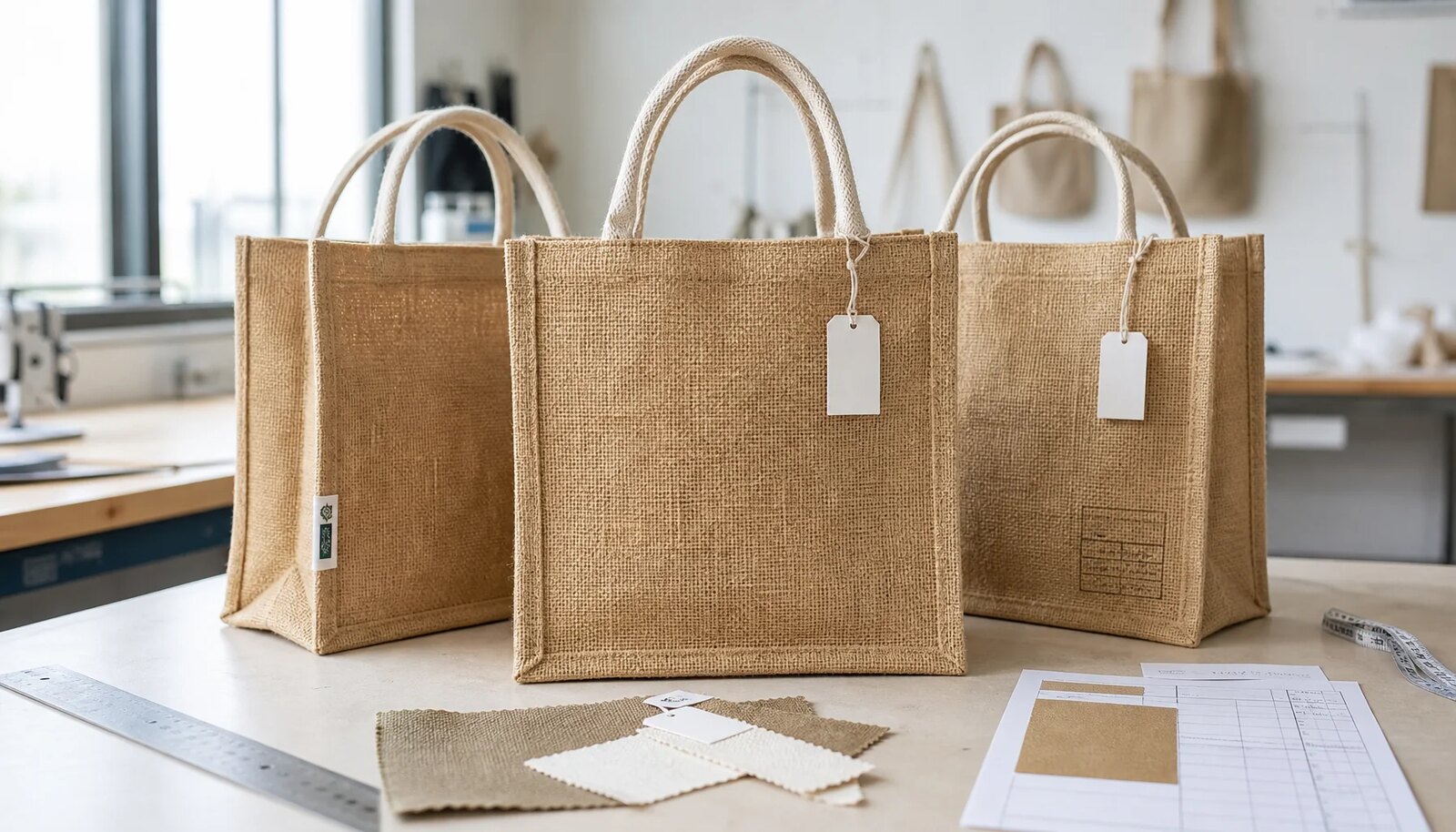
Start With Event Risk
Wholesale jute tote bags look simple in a catalog, but event orders have fixed-date risk. The bags must arrive before registration build-out, carry the planned contents, show sponsor artwork clearly, and reach the right venue in sorted cartons. A cheap unit price is not useful if the shipment arrives damp, the logo is unreadable, or city-specific cartons are mixed.
Build the supplier compliance checklist around the event use case first. A badge-and-brochure giveaway, conference kit, VIP gift bag, retail-style merchandise tote, and heavier sample carrier do not need the same fabric weight, handle reinforcement, or packing presentation.
Jute is a natural fiber, so buyers should expect texture, slubs, visible yarns, and some shade movement. The procurement issue is uncontrolled variation: weak handles, lighter body fabric, uneven gussets, poor odor control, or print placement that drifts across the order.
- Define the bag's job before asking for price: giveaway, kit, VIP gift, resale, employee pack, or product-sample carrier.
- Treat compliance as control over material, construction, decoration, packing, documents, and release evidence.
- Ask every supplier to quote against the same written specification so price differences are meaningful.
- Separate acceptable natural jute character from defects that affect strength, branding, cleanliness, or receiving accuracy.
Write a Tight Bag Specification
A request for a natural jute tote with logo leaves too much open. Suppliers may assume different sizes, gussets, handle drops, fabric weights, lamination, print areas, carton quantities, or tolerances. Those assumptions create quote gaps that usually appear after sampling, when the event schedule is already tighter.
A practical spec sheet should list finished width, height, gusset depth, handle drop, handle material and width, body construction, target GSM, lining or lamination, print method, artwork colors, label requirement, inner pack, master carton quantity, carton marks, and inspection tolerances. For most event programs, one clear page plus the artwork file is stronger than a long RFQ with repeated procurement language.
Fabric weight needs special attention. Light event bags are often quoted around 280 to 320 GSM when carrying brochures, badges, and small items. Buyers wanting a firmer hand feel, larger size, or repeat-use presentation often review 340 to 400 GSM options. These are quoting starting points, not universal standards; bag size, lamination, lining, handle choice, and load requirements change the right answer.
Ask how GSM is measured. One supplier may quote jute before lamination, while another quotes the finished laminated material. A 320 GSM unlaminated body and a 320 GSM laminated construction can feel and perform differently. Put the GSM basis in the RFQ and purchase order.
- Specify finished dimensions, gusset, handle drop, handle material, fabric weight, lining or lamination, print area, and packing method.
- State whether GSM is measured before or after lamination, coating, backing, or lining.
- Include expected contents and loaded weight so the factory can recommend suitable reinforcement.
- Use one dimension sheet and one approved artwork file for all supplier quotes.
Confirm Material and Handles
Jute tote bags can look similar in product photos while being different products in production. Natural unlaminated jute has a rustic surface and flexible hand. Laminated jute or jute with backing can add body, reduce some fiber shedding, and help the bag hold shape, but it also changes feel, folding behavior, odor risk, and environmental language.
Cotton-jute blends may print more evenly than coarse natural jute and can suit premium events. They should not be quoted or labeled as pure jute unless that is accurate. If the order involves resale, client fiber claims, public-sector procurement, or brand compliance review, ask for the exact material description before sampling.
Dyed jute adds shade and rubbing controls. For black, navy, white, or custom-dyed body fabric, confirm whether the supplier is using stock-dyed material or a custom dye lot. Custom dyeing can change MOQ, lead time, and color approval steps.
Handles deserve the same attention as the body. Self-jute handles may look consistent but can feel rough. Cotton webbing is comfortable and easier to color coordinate, but it adds trim cost and needs strong stitching. Rope handles create a gift-bag look and may affect carton packing. Specify handle material, width, color, drop, and stitch pattern.
- Identify whether the bag is natural jute, laminated jute, dyed jute, cotton-jute blend, backed jute, or lined jute.
- Ask for current swatches when hand feel, shade, odor, stiffness, or print contrast matters.
- Specify handle material, width, color, drop, stitch pattern, and load-point reinforcement.
- Review inside seams and fiber shedding when the bag will carry apparel, documents, retail goods, or premium inserts.
Choose the Right Supplier Route
The right supplier route depends on order size, complexity, compliance burden, and schedule pressure. A direct sewing factory is often best when the buyer needs close control over fabric, cutting, stitching, decoration coordination, and final carton release. Technical feedback can be faster because the quoting team is closer to production.
Direct factories are not automatically stronger on export documents, carton marks, version labels, retail packing, or formal QC reports. If the event program has strict receiving rules, explain them early and ask to see sample packing-list formats, carton mark proofs, and inspection records.
Trading companies can help when the order includes multiple bag styles, smaller splits, inserts, labels, freight coordination, or consolidation. The buyer still needs transparency. Ask for the production site, outsourced process list, QC owner, and rework authority. If the trader cannot explain who decides whether goods pass, the buyer has limited control when defects appear.
Specialized bag workshops are often better for custom gussets, seam binding, stronger handles, trim changes, and repeat programs. Capacity is the point to check. Ask about daily output, peak-season workload, and whether bulk will run on the same line that made the approved sample.
- Use a direct factory when construction control and sample-to-bulk consistency matter most.
- Use a trading company when coordination services are valuable and factory transparency is available.
- Use a specialized workshop for custom trims, stronger construction, or repeat event programs.
- For local decoration, define who owns defects in blank bags, decoration, replacements, and schedule recovery.
Ask for Evidence, Not Sales Language
A compliant supplier should provide more than a price and a promise. For a standard B2B event order, request business registration, production-site details, export capability where relevant, and a workflow covering material receiving, cutting, sewing, decoration, inspection, packing, and shipment release.
Document needs depend on destination market, buyer policy, and how the bags are used. Useful requests may include a fiber-content declaration, material specification sheet, restricted-substance test report for inks or coated materials, azo dye or heavy metal screening where relevant, CPSIA support for child-directed programs if applicable, Prop 65 review for California shipments, commercial invoice, packing list, certificate of origin, and carton-label proofs. Frame these as buyer and legal-review triggers, not automatic requirements for every tote order.
If the bag is marketed with environmental claims, ask for support that matches the claim. Natural jute, cotton handles, lamination, recycled content, biodegradable language, and plastic-free claims are different topics. A supplier should not use broad sustainability wording when coating, backing, lining, or trim changes the claim.
Traceability matters for multi-version events. One program may include three cities, two sponsor logos, and separate destination shipments. The supplier should separate artwork records, production counts, carton marks, and packing lists by version.
- Request business registration, production-site details, export scope, and a process map before PO release.
- Ask which steps are in-house and which are outsourced, including printing, labeling, packing, inspection, or testing.
- Confirm whether fabric, handles, labels, inks, and cartons can be traced by order, batch, or lot when needed.
- Agree document cost, timing, and responsibility before sampling if testing or buyer-specific declarations are required.
Compare Quotes on Total Cost
The lowest unit price is not always the lowest total cost. A useful quote separates bag size, fabric weight, lamination or lining, handle type, reinforcement, decoration method, print colors, label work, setup charge, sample charge, packing method, carton quantity, inspection support, testing, and shipping basis.
Decoration changes both price and risk. Screen printing is commonly practical for jute because it handles bold artwork on a coarse surface. Fine lines, small type, tight registration, gradients, halftones, and large solid ink areas need testing on the actual fabric. Heat transfer, embroidery, sewn patches, woven labels, and leather-like patches may also be possible, but each method changes cost, durability, texture, and lead time.
MOQ logic should be explicit. The event planner may see one program, while the factory sees separate variables: bag size, body fabric, body color, handle color, artwork version, label version, packing format, and destination split. Ask whether the base bag can be produced in one run and split later at printing, labeling, or packing.
Normalize Incoterms before comparing suppliers. EXW, FOB, CIF, DAP, and DDP are not the same cost structure. Build a landed-cost view using the same assumptions for inland transport, export handling, freight, duty, customs clearance, local delivery, and receiving work.
- Ask suppliers to itemize unit price, setup charge, sample charge, decoration cost, packing cost, testing cost, and shipping basis.
- Separate bag construction cost from decoration cost so artwork choices can be evaluated clearly.
- Confirm MOQ by size, fabric, body color, handle color, artwork version, label version, packing format, and destination.
- Compare suppliers on the same Incoterm or landed-cost basis, not isolated unit price.
Use Samples as Production Controls
The sample stage is where expensive mistakes are still cheap to fix. A pre-production sample should prove finished dimensions, gusset shape, handle drop, reinforcement, fabric feel, print placement, logo readability, label position, inner finish, and packing fold. A digital mockup helps with layout, but it cannot show how ink sits on coarse jute.
Measure the sample instead of approving it by general appearance. Check width, height, gusset depth, handle drop, print distance from top and side edges, label position, seam allowance, and whether the bag hangs evenly. Record the approved measurements so bulk production has both a target and tolerance.
Review artwork under realistic lighting. Natural jute can break up thin strokes and small text. If brand color matters, define the standard: Pantone reference, CMYK printout, approved physical sample, or best visual match on jute. Buyers should not expect paper-like color accuracy unless the strike-off proves it is achievable.
Test the sample like the real event bag. Fill it with the intended contents, carry it, set it on a table, fold it as planned, and check whether the logo creases, rubs, or disappears when packed. Keep a signed reference sample for first-piece review, final inspection, and dispute resolution.
- Approve a physical sample or print strike-off before bulk production when artwork appearance matters.
- Measure dimensions, handle drop, gusset, print placement, label position, seam quality, and folding result.
- Test the sample with expected event contents and the planned packing method.
- Keep a signed reference sample and require the factory to compare first production pieces against it.
Set Jute-Specific QC Limits
Quality control for jute bags should be specific enough for inspection while respecting the material. Visible fibers, slubs, and moderate shade movement may be acceptable when they do not weaken the bag, obscure the logo, stain contents, or create poor presentation. Rejectable defects should be named clearly: wrong size, weak handle attachment, open seam, severe fraying, mildew odor, oil stain, wet carton, wrong artwork version, or carton mismatch.
Dimensional tolerances should be written before cutting. For many standard event totes, plus or minus 5 mm on width, height, gusset, handle drop, and print placement can be a useful buyer-defined starting point. Larger bags, shaped gussets, lined interiors, or retail-style presentation may require different limits. Fabric weight is often controlled around plus or minus 5% of agreed GSM, but the supplier should confirm what is realistic for the material and process.
Handle reinforcement is a high-risk area because guests may add more than the planned brochures. Require a defined stitch pattern, such as box stitching, cross stitching, or bar-tacks, at every handle attachment point. Ask for first-piece photos before bulk sewing continues. For heavier kits, use a practical load test based on expected contents plus an agreed safety margin.
Print QC should compare bulk goods against the approved physical sample. Inspect placement, registration, ink coverage, line clarity, color appearance, and whether loose fibers interfere with the logo. For multi-version orders, verify that each event name, city, department, or sponsor mark is packed into the correct carton.
- Define acceptable natural jute variation separately from stains, mildew, weak seams, misprints, and wrong versions.
- Set tolerances for finished size, gusset depth, handle drop, fabric weight, print placement, and label position.
- Require reinforced stitching at every handle load point and inspect first pieces before bulk sewing continues.
- Use carton accuracy, version separation, and packing-list match as final QC gates.
Control Packing, Moisture, and Dates
Packing is where acceptable bags can become a difficult shipment. Jute bags are bulky, textured, and sensitive to moisture and odor retention. If the factory over-compresses them, handles may crease, gussets may deform, and printed panels may rub. If cartons are weak or inaccurately marked, the receiving team loses time sorting before the event.
The packing instruction should cover inner pack count, folding method, master carton quantity, carton dimensions, gross weight, carton marks, and whether printed panels need protection. Large solid print areas may need protective paper or careful face-to-face separation. If the order includes hangtags, sponsor inserts, woven labels, barcode labels, or retail sleeves, state whether each item is attached, inserted, bundled, or shipped separately.
Moisture control matters because jute can hold odor if packed damp or stored poorly. The supplier should pack in a clean, dry area and avoid sealing warm or damp goods into cartons. For humid seasons, sea freight, or long warehouse dwell time, ask about airing time, carton liners, moisture absorbers, and warehouse ventilation before loading.
Lead time should include more than factory production. Build a calendar for RFQ clarification, artwork preparation, sample making, sample shipping, sample review, one revision round if needed, material preparation, bulk production, inspection, packing, freight booking, export handling, transit, customs clearance, local delivery, venue receiving, and event distribution. Ask when the supplier's quoted lead time begins: deposit, artwork approval, sample approval, material arrival, or another milestone.
- Confirm inner pack count, folding method, master carton quantity, carton size, gross weight, and carton marks before packing starts.
- Avoid folding methods that create hard creases through approved logos or crush handles.
- Require clean, dry cartons and a moisture-control plan for humid storage, sea transit, or long warehouse dwell time.
- List sample deadline, artwork approval deadline, bulk completion date, inspection date, ship date, and latest receiving date on the PO.
Build a Practical Event Timeline
Event planners should protect the receiving date, not only the factory completion date. A common mistake is counting backward from the event opening day and leaving no room for carton sorting, insert loading, venue dock appointments, damaged carton review, or replacement stock. The latest acceptable receiving date should usually be several working days before staff need to handle the bags.
For imported jute tote bags, create separate buffers for sampling, production, inspection, freight, customs, and local delivery. Sampling can be delayed by artwork questions, fabric availability, or courier transit. Production can be affected by peak-season capacity, dyed material, custom handles, or multi-version printing. Freight can shift due to booking availability, weather, port congestion, customs exams, or final-mile appointments.
Ask the supplier for a milestone schedule, then add buyer-side dates. Include artwork approval, sample approval, deposit, material purchase, cutting start, printing start, sewing completion, final inspection, carton labeling, freight handoff, estimated arrival, customs clearance, local delivery, venue receiving, and event kit packing. Dates should appear on the PO or production confirmation, not only in email chat.
When the event date is close, simplify the specification rather than hoping complexity will move faster. Stock jute, stock handle colors, one print position, fewer artwork versions, standard carton quantities, and air freight may reduce risk. If the date cannot support sampling and inspection, the buyer should document the tradeoff and keep the design conservative.
- Set the latest venue or warehouse receiving date before confirming production lead time.
- Add buffers for sample transit, sample review, production, inspection, export booking, freight, customs, local delivery, and sorting.
- Use milestone dates that both buyer and supplier can confirm in writing.
- Simplify material, artwork, and packing when the schedule is already compressed.
Specification comparison for buyers
| Supplier option | What to verify | Commercial advantage | Buyer risk to control |
|---|---|---|---|
| Direct sewing factory | jute roll photos, lamination sample, odor-control process, handle pull evidence, and pre-shipment carton condition photos | Better sample-to-bulk control and faster production feedback | May be weaker on export paperwork or branded packing unless checked early |
| Trading company | Factory name, production photos, trim-source proof, and who owns QC decisions | Can coordinate small mixed orders and extra services | Markup can hide real factory capability and slow defect decisions |
| Specialized bag workshop | handle stitching, side gusset, lamination edge control, inner seam cover, and fiber shedding tolerance | More practical for detailed construction, trims, and repeat programs | Capacity may be limited during peak seasons |
| Low-price general supplier | laminated or unlaminated jute, cotton-jute blend, inner coating, odor control, yarn thickness, and color shade variation | Useful for simple promotional runs with loose specs | Material downgrades, weak packing, and vague inspection scope can erase savings |
| Retail-ready supplier | airing time, moisture absorber, carton liner, bundle wrap, odor separation, and warehouse ventilation before loading | Can handle labels, SKU separation, carton marks, and receiving rules | Higher unit cost must be compared against reduced warehouse work |
| Compliance-focused supplier | Fabric records, labeling review, test plan, and production traceability | Safer for retail programs and repeat brand orders | Documentation claims need evidence, not only sales language |
| Local sample room plus bulk factory | Signed sample, bulk factory handoff, first-piece photos, and deviation owner | Good for complex branding before large production | Sample room quality may not match bulk line unless handoff is controlled |
Buyer checklist before sampling
- Define the use case: registration giveaway, conference kit, sponsor package, VIP gifting, merchandise carrier, employee onboarding kit, or heavier product-sample bag.
- Lock finished width, height, gusset depth, handle drop, handle material, body fabric, lining or lamination, expected loaded weight, and presentation level before requesting quotes.
- State whether the quoted construction is natural jute, dyed jute, laminated jute, cotton-jute blend, jute with nonwoven backing, lined jute, or another agreed base.
- Confirm the GSM basis in writing, including whether weight is measured before lamination, after lamination, after coating, after backing, or after lining.
- Send vector artwork and define print method, logo size, color count, print placement, placement tolerance, color reference, and whether one or both sides are decorated.
- Ask for business registration, production site, outsourced process list, QC workflow, traceability method, and the person authorized to approve or reject bulk goods.
- Request a physical pre-production sample or print strike-off on the same jute base before bulk production, especially for fine text, multi-color logos, large ink areas, or sponsor marks.
- Confirm MOQ by bag size, body fabric, body color, handle color, artwork version, label version, packing method, and destination split instead of accepting one blended MOQ.
- Set buyer-defined starting tolerances for finished size, gusset, handle drop, fabric weight, print placement, label position, stitch quality, odor, and carton condition before PO release.
- Require carton count, inner packing, folding method, carton marks, carton dimensions, gross weight, moisture-control plan, version labels, and confirmation on whether folding through the printed area is allowed.
Factory quote questions to send
- What exact jute fabric weight are you quoting, and is the GSM measured before lamination, after lamination, after coating, after backing, or after lining?
- Is the body material natural jute, dyed jute, laminated jute, cotton-jute blend, backed jute, lined jute, or another construction, and can you provide a current swatch?
- What finished size tolerance, gusset tolerance, handle-drop tolerance, fabric-weight tolerance, label-position tolerance, and print-placement tolerance are included in normal production control?
- Are the handles self-jute, cotton webbing, braided jute, rope, canvas, or another material, and what stitch pattern is used at each handle attachment point?
- What practical load test do you recommend for this bag size and construction, and can you test using expected event contents plus an agreed safety margin?
- Which print method is included in the price, how many colors are included, what is the maximum print area, and what artwork limitations apply on coarse jute?
- For brand colors, will you match Pantone, CMYK reference, an approved physical standard, or best visual match on jute, and how will acceptable variation be judged?
- What MOQ applies to each size, body fabric, body color, handle color, artwork version, label version, packing version, and destination split?
- Can several event names, city names, sponsor logos, or department versions be grouped in one base-bag run and split only at printing, labeling, or packing?
- What documents can you support for this product, such as fiber-content declaration, restricted-substance test report, CPSIA support for child-directed use if applicable, Prop 65 review if shipping to California, packing list, commercial invoice, and certificate of origin?
Quality-control points to confirm
- Agree buyer-defined finished size tolerances in advance, such as plus or minus 5 mm on width, height, and gusset depth for many standard event tote sizes, unless the design or supplier process requires different limits.
- Set a fabric-weight tolerance, often around plus or minus 5% of the agreed GSM as a starting point, and confirm whether lamination, coating, backing, or lining is included in that measurement.
- Set handle-drop tolerance, such as plus or minus 5 mm for routine tote handles, and inspect handle alignment so the bag hangs evenly when filled.
- Require reinforced handle attachment with bar-tacks, cross stitching, box stitching, or another approved reinforcement at every load point, with no skipped stitches at stress areas.
- Check stitch density and seam security, including side seams, bottom seams, gusset corners, label attachment, and handle attachment, against the approved sample.
- Review print placement against the signed sample, with agreed tolerance for distance from top edge, side edge, and centerline, and reject major off-register printing, ink washout, cracking, bleed, or unapproved color shift in the logo area.
- Reject bags with loose threads longer than the buyer-approved limit, such as 10 mm at seams, handles, labels, or inner edges, and require trimming before final packing.
- Confirm there is no mildew, oil stain, excess jute dust, strong chemical odor, wet carton, sharp burr, exposed staple, or rough edge that could damage garments, paper inserts, or registration materials.
- Run a practical load test matched to the use case, such as a static hold using the expected event contents plus an agreed safety margin, and record the result before shipment release.
- Verify carton count, SKU marks, version labels, inner pack count, outer labels, carton numbering, and packing list quantities before the shipment leaves the supplier.