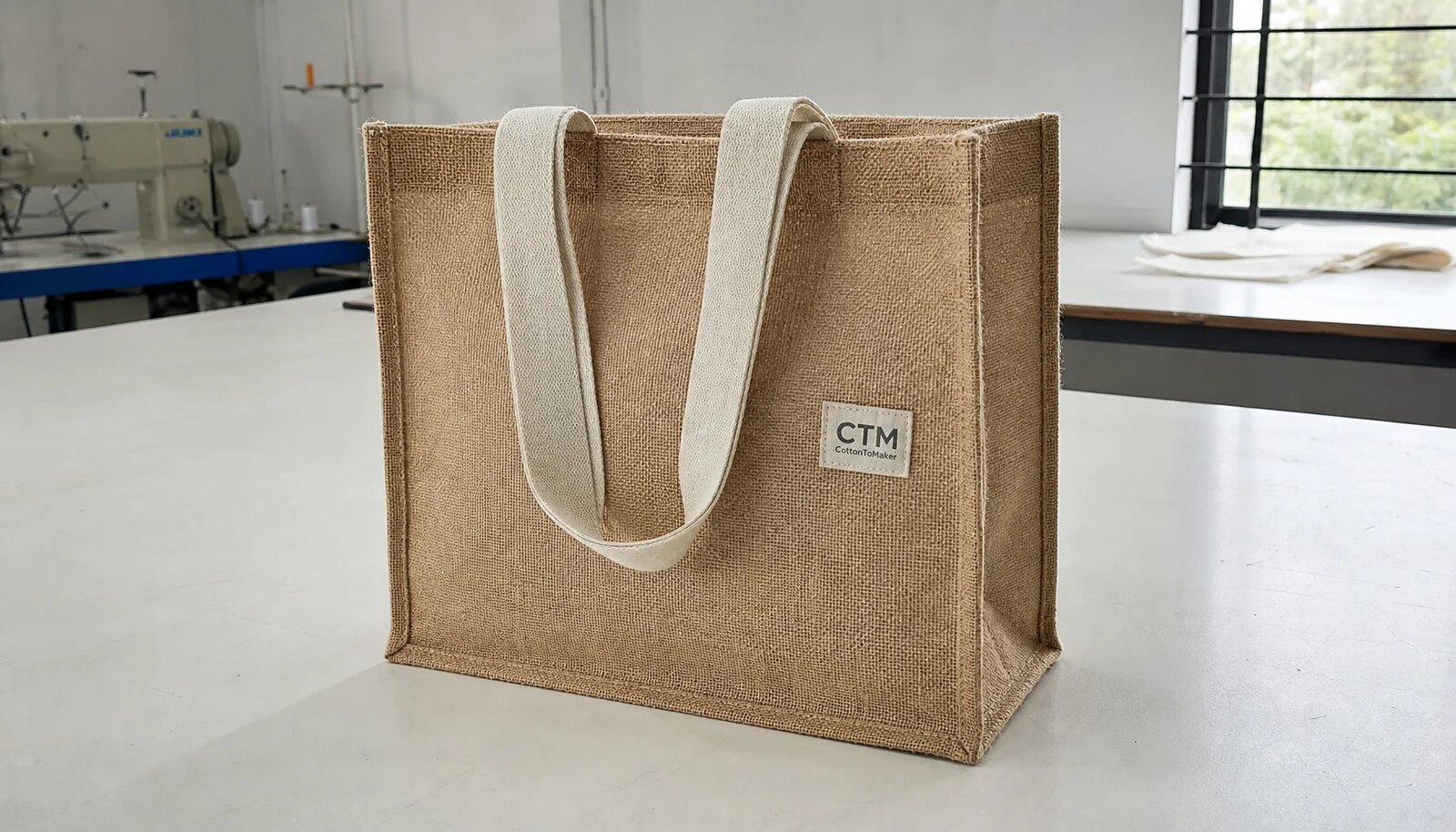
Start With The Bag Specification, Not The Logo File
For wholesale jute tote bags for event planners, logo placement is a production specification before it is a graphic design decision. Jute has a coarse natural weave, and the finished bag is not a flat rectangle. Panel size, gusset depth, top hem, handle anchors, side seams, bottom folds, lining, lamination, front pockets, sewn labels, and folding direction all affect where artwork can sit without distortion. A mockup may look balanced on screen, then shift visually once the tote is cut, sewn, folded into cartons, opened at the registration desk, and loaded with event materials.
Procurement teams should ask suppliers to quote from a bag drawing and a written specification, not from a logo file alone. The drawing should show finished width and height, front panel area, side gusset, top hem depth, bottom fold, handle anchor points, handle drop, pocket edge if any, and the safe print area. On many medium event totes, a front logo around 18-24 cm wide is practical, but that range is only a starting point. A narrow tote, deep gusset, tall handle anchor, short front panel, or added pocket can reduce the true logo area quickly.
The safest workflow is to freeze the bag construction first, then scale the logo to an approved placement map. If the supplier changes the bag size during sampling, the placement map should be updated before approval. This is especially important for sponsor programs where hierarchy matters. A 10 mm shift may make a lead sponsor feel off-center, push a co-brand too close to a seam, or place the logo where the bag curves when carried. The objective is not the biggest possible logo. It is a logo that is readable, repeatable, easy to inspect, and consistent across cartons.
- Request dimensioned front, side, bottom, and handle drawings before sample approval.
- Mark no-print zones for seams, handle anchors, top hem, bottom fold, pocket edges, and gusset curves.
- Do not approve artwork scale until finished bag dimensions and safe print area are confirmed.
- Use the same specification sheet for all suppliers so quotes compare the same bag, not similar-looking substitutes.
Match Construction To The Event Load
Jute totes are often described by GSM, but GSM alone does not prove performance. A 320 gsm tote with weak handle attachment can fail faster than a slightly lighter bag with better stitching and a proper base. A laminated or lined bag may stand upright and print more consistently, while raw jute may give a more natural look but show more slubs, shade variation, and print breakup. B2B buyers should treat construction as a system: jute GSM, finished bag weight, lining or lamination, handle type, stitch plan, gusset, base insert, and packing method.
For simple handouts, 280-320 gsm jute can work when the contents are light: leaflets, a lanyard, badge kit, or a thin welcome insert. For conference registration bags, exhibitor kits, sponsor welcome totes, and reusable attendee bags, 320-350 gsm with lining or lamination is usually a more practical middle range. It helps the tote hold shape on tables, reduces panel collapse around the logo, and gives the bag a more intentional feel. For VIP gifting or paid merchandise, a heavier jute body, reinforced base, wider handles, and a patch or label treatment may justify the higher material and freight cost.
Handle specification deserves the same attention as the front panel. Cotton webbing, jute handles, rope handles, and blended handles each affect comfort, appearance, and load performance. A short hand-carry handle may be suitable for gift bags, while a longer handle drop works better for attendees carrying the tote over a shoulder between sessions. Ask for handle length after sewing, not only cut length before attachment. A useful sample test is simple: load the bag with the heaviest realistic event contents and carry it for several minutes. This reveals handle bite, seam strain, bottom sag, and panel collapse that empty product photos cannot show.
- Specify GSM range and finished bag weight target together.
- Decide whether the tote is for light handouts, registration kits, sponsor gifts, or premium merchandise.
- Use a base insert when the bag will carry bottles, books, boxed gifts, dense catalogs, or rigid inserts.
- Test the sample loaded, carried, set down, and lifted again before approving bulk production.
Choose Logo Placement By Visibility, Handling, And Inspection Risk
Center-front placement is the default for event jute totes because it is visible, easy to inspect, and straightforward for factories to repeat. It works well for organizer branding, lead sponsor identity, product launches, and venue programs that need clear recognition. On a medium tote, the logo often looks best slightly above the visual center of the front panel because the lower section can curve outward or fold toward the base after loading. If the print is too low, it may disappear into the bottom fold. If it is too high, it can crowd the handle anchors or top hem.
Lower-corner placement is useful for a quieter, retail-style look or for programs where the event title or artwork occupies the main front area. This placement requires tighter control because small drift is easier to notice near seams and bottom folds. Fine sponsor names, thin taglines, narrow icons, and small dates can lose readability on coarse jute. For lower-corner marks, the RFQ should include minimum text height, minimum stroke width, distance from the side seam, distance from the bottom fold, and an alignment reference point.
Side gusset prints, sewn labels, cotton patches, and stitched tabs can give a premium or subtle brand impression. They are useful when the front panel should remain clean or when reuse matters more than one-day visibility. The tradeoff is inspection and presentation risk. Side logos may be hidden when bags are flat packed, and a narrow gusset can make artwork look rotated or crowded. If the bag will be stacked at registration tables, ask how the chosen logo location will appear in stacks, not only when one bag is standing upright for photography.
- Use center-front placement for main branding and sponsor visibility.
- Use lower-corner placement only after confirming text size, seam clearance, and bottom fold clearance.
- Use side labels, patches, or gusset marks for subtle reuse branding, not for logos that must be visible in every handout photo.
- Limit most event programs to one or two branding locations unless sponsor obligations require more.
Set Artwork And Print Method Rules Early
Screen printing is usually the strongest starting point for bulk jute event bags because it scales well, keeps unit economics clear, and suits bold logos. One-color screen print is often the most predictable option on natural jute. Two-color screen printing can work, but registration tolerance must be discussed early because jute is not as precise as coated paper or smooth cotton canvas. Tight outlines, small knocked-out text, delicate registration, and thin sponsor lockups should be tested on the actual production surface.
Heat transfer can be useful for full-color artwork, gradients, small runs, or designs with photo-like detail. The tradeoff is performance on a rough natural surface. Edges may lift, the jute texture may show through, or the transfer may crack or crease when folded tightly. If a supplier recommends heat transfer, ask for a fold test, rub test, carton packing test, and close-up photos after handling. A transfer that looks clean immediately after application may not stay clean after carton compression, sea freight, or hurried venue distribution.
Embroidery is rarely the best method for large primary branding on standard jute because the fabric can pucker and fine details become heavy. It is more reliable on a reinforced patch, cotton panel, or separate sewn label. Woven labels, printed cotton patches, leather-look patches, and fabric appliques can lift the presentation, but they are separate components with their own MOQ, color tolerance, lead time, and placement risks. The procurement rule is to approve the decoration method on the actual bag construction, not on a generic swatch.
- Start with one-color screen print for most volume event orders unless the artwork requires another method.
- Set minimum stroke width, minimum text height, reversed-type limits, and QR code rules before proofing.
- Ask how natural jute shade will affect ink color compared with Pantone, coated proofs, or digital mockups.
- Test heat transfer or patches for folding, rubbing, edge lift, and carton scuffing before bulk approval.
Use A Specification Table In Every RFQ
A strong RFQ makes assumptions visible. Many quote problems begin when one supplier prices a lighter jute body, another includes lamination, a third assumes shorter handles, and a fourth excludes packing. The unit prices then look comparable even though the bags are different. Event buyers should send a single specification table that defines the bag, branding, packing, inspection, and delivery requirements. Open items should be marked as open, not left blank for the supplier to guess.
The specification should include finished bag width, height, gusset depth, jute GSM range, lining or lamination, base insert, handle material, handle width, handle length after sewing, handle color, thread color, print method, number of colors, logo size, placement reference, label or patch details, packing format, carton quantity, carton marks, target delivery date, and shipping terms. For artwork, send vector files where possible and provide Pantone targets or approved color references. If the artwork includes small sponsor names, URLs, dates, QR support copy, or legal text, ask the supplier to confirm production risk before sampling.
Quote logic should also be part of the RFQ. Ask for pricing at 1,000, 3,000, 5,000, and 10,000 pieces, even if the first order is smaller. This shows where real economies of scale begin and whether setup charges are distorting the first quote. Separate blank bag cost, printing cost, setup charges, label or patch cost, sample cost, packing cost, carton cost, inland freight, export charges, and freight assumptions. For repeat event programs, ask which charges repeat and how long screens, reference samples, or component tooling will be retained.
- Send one spec table, one placement map, one artwork package, and reference photos together.
- Require suppliers to identify any cost change caused by GSM, lining, handle material, print size, or packing.
- Ask for volume breaks and repeat-order pricing, not only the first purchase quantity.
- Include carton dimensions, gross weight, net weight, quantity per carton, and total CBM for freight comparison.
Approve Samples With Production-Level Evidence
A useful sample proves the final product, not just the design idea. The pre-production sample should use production jute, the approved GSM range, final lining or lamination, real handle material, final stitch method, final print method, final logo size, final label or patch, and the intended packing approach. A digital proof can check spelling and approximate placement, but it cannot show ink gain, fiber slubs, shade variation, handle balance, stitch strength, print angle, or how the tote looks after being folded into cartons.
Ask for a physical pre-production sample whenever the order size, deadline, or sponsor visibility justifies it. If timing is tight, request a full factory photo set first, then approve the physical sample as soon as possible. The photo set should include front, back, both side gussets, bottom, inside, handle attachments, logo close-up with ruler, label close-up, loaded bag view, flat-packed view, bundle view, carton label, and open carton. A ruler or measurement marker in the placement photos helps remove ambiguity.
The approval record should be inspectable. Record approved logo width and height, distance from top hem, distance from side seam or centerline, print color target, handle length, handle width, bag dimensions, label position, packing method, carton quantity, and any allowed natural variation. Keep one sealed reference sample with the factory and one with the buyer or inspection partner. If the supplier changes jute roll, lamination, handle batch, screen, label stock, thread color, packing material, or print method after approval, treat it as a revision and ask for evidence before production continues.
- Approve samples made with production materials, not leftover fabric or approximate handles.
- Measure logo placement from fixed construction points instead of relying on visual comments.
- Keep duplicate sealed reference samples for factory QC and buyer-side inspection.
- Require written approval for any change to construction, artwork, print method, label, or packing.
Write Tolerances A Factory Can Actually Inspect
Quality control for jute event totes should separate natural-material variation from real defects. Jute normally has texture, shade movement, and occasional slubs. Those features do not automatically make a bag defective. However, wrong artwork, off-center logo placement, severe print bleed, broken handles, open seams, damp cartons, mold odor, missing labels, and mixed variants are not acceptable natural variation. Procurement buyers should define these issues before purchase order approval so the supplier cannot reinterpret them after production.
For logo placement, a common working tolerance is within 5 mm of the approved centerline for a standard front-panel print, but the right tolerance depends on logo size, placement, and bag construction. A small lower-corner mark may need tighter visual alignment because drift near a seam is obvious. A large rustic event graphic may tolerate minor weave-related variation but still needs a level baseline. Define left-right centering, top distance, bottom clearance, and rotation. If the artwork is rectangular, text-heavy, or sponsor-sensitive, include a maximum angle deviation or require comparison against the approved sample.
Stitching and load performance should be inspected as major quality items. Handle attachments should use bartacks, box stitching, cross stitching, or another reinforcement suitable for the intended load. Side seams, top hems, bottom seams, and gusset folds should remain intact after a practical load check. A simple written test can be enough: fill the tote with agreed contents or a specified weight, lift by both handles, hold, walk briefly, set down, and inspect handle anchors and seams. The exact load should match the event use, but the test should exist in writing.
- Classify wrong logo, wrong placement, broken handles, open seams, wet cartons, mold odor, and cracked print as major or critical defects.
- Define acceptable jute shade variation and weave slubs so they cannot be used to excuse functional defects.
- Inspect print centering, print angle, opacity, edge quality, color target, rub resistance, and fine-detail readability.
- Use a practical load test based on expected event contents or a stated weight and handling method.
Protect The Logo Through Packing And Freight
Packing affects landed cost, warehouse speed, carton volume, and brand presentation at the event site. Flat packing is efficient for bulk jute totes, but tight folds can crease printed panels, especially when artwork is large, dark, or placed near a fold line. If the print uses dense ink coverage or heat transfer, ask whether interleaving paper, tissue, or separators are needed to reduce scuffing and transfer. The added packing cost may be small compared with the cost of opening cartons full of rubbed sponsor logos.
Individual polybags, paper bands, counted bundles, inner cartons, and bulk loose packing serve different workflows. Individual packing keeps bags cleaner and suits VIP kits or resale programs, but it increases labor, material use, carton volume, and sometimes unpacking time. Counted bundles of 10, 25, or 50 often work well for registration teams because staff can count and distribute quickly. Bulk loose packing can be cheapest, but it may increase wrinkling, mixed variants, and on-site sorting time. Choose packing based on how the bags will be stored, moved, counted, and handed out.
Jute is sensitive to moisture and odor, so export packing deserves attention. Ask about dry cartons, carton liners, desiccant, container loading timing, and storage conditions before shipment. Damp jute can smell, stain, deform, or transfer odor to event materials. Carton marks should identify event name, SKU, artwork version, colorway, quantity, destination, carton sequence, and purchase order number. For multi-sponsor, multi-region, or multi-venue programs, carton labeling is a control point, not an administrative detail.
- Choose flat pack, counted bundles, individual packing, or bulk packing based on event distribution workflow.
- Use interleaving or separators when scuffing, transfer, or fold marks are realistic risks.
- Request carton dimensions, quantity per carton, gross weight, net weight, and total CBM before freight booking.
- Label cartons by event, SKU, print version, colorway, destination, and carton sequence.
Plan Lead Time Around Approvals And Inspection
Lead time for event tote orders is often lost in approvals, not only in sewing. Artwork questions, placement map revisions, sample transit, color comments, label changes, material substitutions, packing decisions, inspection booking, and freight booking can each add days. A supplier may quote 20-30 production days after sample approval, but that usually excludes RFQ clarification, sample making, sample shipping, buyer review, revision rounds, final inspection, customs, and local delivery. Event planners should schedule from RFQ release to venue delivery, not from production start to factory ship date.
A practical timeline starts with specification confirmation, artwork review, placement drawing, sample production, sample transit, sample approval, material booking, bulk printing, sewing, in-line QC, final inspection, packing, export handling, freight, customs clearance, and local delivery. Any change after sample approval should trigger a schedule update. Moving a logo, changing handle color, switching from screen print to transfer, or adding individual packing may affect screens, material availability, labor planning, carton size, or inspection timing.
Supplier structure also affects timing and accountability. A factory with in-house sewing and print control may respond faster to placement-sensitive issues because the production teams work from the same reference sample. A trading company may be useful for consolidated event kits, but technical feedback can take longer if printing or sewing is subcontracted. A domestic distributor may be fastest for stock blanks and local decoration, but construction choices may be limited. Choose the route based on deadline, order complexity, brand sensitivity, and who can take responsibility if the logo or bag construction is wrong.
- Build the schedule from RFQ to final delivery, not only from bulk production start.
- Ask for the last safe sample approval date for the event deadline.
- Add buffer for sample transit, revision rounds, final inspection, export handling, customs, and local delivery.
- Confirm who owns corrective action if print, sewing, packing, or carton labeling fails inspection.
Turn The Purchase Order Into A Control Document
The purchase order should do more than authorize spend. For wholesale jute tote bags for event planners, it should lock the version of the product that the supplier is allowed to make. Attach the final specification sheet, approved artwork, approved placement map, approved sample photos, packing instructions, carton mark template, inspection criteria, and delivery terms. If the PO only says “jute tote with logo,” the buyer has little leverage when a supplier ships a technically similar but commercially weaker bag.
The PO should name the approved sample date or sample number and define what requires written approval before change. Useful controlled items include bag dimensions, GSM range, handle material, handle length, print method, print color, logo size, logo placement, label or patch, lining or lamination, base insert, packing format, carton quantity, and carton marks. Include the defect categories agreed in the QC plan. If inspection will use AQL, state the inspection level and acceptance criteria. If the order is deadline-critical, state required pre-shipment photo evidence and final inspection timing.
For repeat event programs, keep the control document active after delivery. Record any approved deviations, inspection findings, carton damage, attendee feedback, warehouse issues, or sponsor comments. This gives procurement a clean starting point for the next order and helps separate real improvements from avoidable changes. A repeat order should not silently drift to a lighter fabric, different handle length, smaller logo, or cheaper packing. The strongest buying process is simple: specify clearly, sample against the specification, inspect against the sample, and reorder against the same controlled file.
- Attach the final spec sheet, artwork, placement map, sample approval, packing instructions, and QC criteria to the PO.
- State which changes require written buyer approval before production can continue.
- Use final inspection findings to update the controlled file for repeat orders.
- Do not allow repeat orders to proceed from an old invoice or casual reorder note alone.
Specification comparison for buyers
| Spec decision | Recommended option | When it fits | Buyer risk to check |
|---|---|---|---|
| Sourcing route | Direct factory controlling cutting, sewing, printing, packing, and final QC | 1,000+ pcs, repeat programs, sponsor-sensitive artwork, custom size, custom handles, or multiple logo positions | Confirm which steps are in-house, which are subcontracted, and who signs off on placement, color, seam quality, and carton counts |
| Sourcing route | Trading company with consolidated sourcing and one project manager | Mixed event kits, several bag styles, low-volume combined orders, or buyers needing one invoice across categories | Responsibility can blur if the print is off-center, fabric differs from the approved sample, or cartons are mixed by venue |
| Sourcing route | Domestic distributor or local decorator using stock blanks | Short deadlines, small replenishment runs, or simple one-color decoration where speed outweighs custom construction | Confirm blank bag dimensions, GSM, handle length, and seam quality match the approved sample, not only the catalog description |
| Bag body | 280-320 gsm jute, simple lining optional, no heavy base reinforcement | Light handouts, one-day programs, brochures, badge kits, and low-load giveaways | Avoid heavy catalogs, bottles, boxed gifts, or dense inserts unless a loaded sample passes the agreed handle and seam check |
| Bag body | 320-350 gsm jute with lining or lamination and optional base insert | Most conference totes, exhibitor bags, registration kits, welcome bags, and reusable sponsor merchandise | Check lamination edge finishing, odor, panel flatness, print breakup, and whether the bag stands acceptably when loaded |
| Bag body | 350+ gsm jute or structured construction with reinforced base and handle tabs | VIP gifting, retail-style event bags, paid merchandise, premium sponsor kits, or repeat-use programs | Higher material weight increases unit cost, carton weight, and freight cost; compare landed cost, not only factory unit price |
| Logo placement | Center-front print, commonly 18-24 cm wide on a medium tote | Main event branding, lead sponsor identity, launch logo, and high-visibility attendee bags | Keep critical artwork clear of handle anchors, top hem, side seams, bottom fold, pocket edges, and gusset curves |
| Logo placement | Lower-corner mark, small chest position, or secondary front mark | Discreet co-branding, retail-style presentation, multi-sponsor programs, or subtle organizer marks | Fine text can disappear into coarse jute; set minimum stroke width, minimum text height, and a tighter visual alignment standard |
| Logo placement | Side gusset, sewn label, cotton patch, or stitched brand tab | Premium presentation, resale programs, subtle reuse branding, and front-panel designs that should stay clean | Side marks may be hidden when flat packed; narrow gussets can make logos look rotated, crowded, or hard to inspect |
Buyer checklist before sampling
- Confirm finished bag width, height, gusset depth, handle length, handle webbing width, top hem depth, bottom construction, lining or lamination, and base insert before comparing suppliers.
- Ask for a dimensioned logo placement map showing safe artwork area after seam allowance, handle anchor clearance, top hem clearance, side gusset curve, bottom fold, and any pocket or label edge.
- Lock jute GSM range, finished bag weight target, lining or lamination type, thread color, handle material, handle color, handle attachment method, and label or patch specification before artwork approval.
- State print method, number of colors, Pantone or approved color target, minimum stroke width, minimum readable text height, reversed-type rules, and whether QR codes or fine sponsor names are acceptable.
- Approve a pre-production sample made with production jute, final handle material, final print method, final logo size, final label or patch, and the quoted packing format.
- Load the sample with realistic event contents such as brochures, badge kits, a bottle, a boxed gift, sponsor inserts, or catalogs before judging handle comfort, bottom sag, and seam strain.
- Set measurable tolerances for logo centering, distance from top hem, print angle, color variation, finished bag dimensions, gusset depth, handle length, stitch quality, and carton count.
- Define major defects before production: wrong artwork, wrong print position, wrong colorway, broken handles, open seams, cracked print, wet cartons, mold odor, missing labels, and mixed variants.
- Request approval photos from front, back, both sides, bottom, inside, handle attachment, label position, print close-up with ruler, packed bundle, carton label, and open carton view.
- Compare EXW, FOB, CIF, DAP, or DDP pricing with setup charges, sample charges, repeat setup fees, packing costs, carton dimensions, CBM, estimated carton weight, and freight assumptions in one quote sheet.
Factory quote questions to send
- What is the actual jute GSM range, finished bag weight, finished dimensions, gusset depth, top hem depth, handle width, and handle length after sewing?
- Is the jute raw, dyed, laminated, lined, or coated, and what variation in shade, odor, and weave slubs should be expected across the production lot?
- Is printing completed in-house or subcontracted, and who is responsible for screen setup, registration, ink curing, rub checks, and final print inspection?
- What print method do you recommend for this artwork on this jute surface, and what minimum stroke width, minimum text height, or reversed-type details should we avoid?
- What is the exact safe print area after clearance for seams, handle anchors, top hem, bottom fold, side gusset, pocket edge, label edge, and carton-folding direction?
- Can you provide a dimensioned placement drawing before sampling and revise it if the sample construction, handle position, gusset depth, or logo size changes?
- What are the MOQ, sample charge, setup charge, unit price, packing charge, carton specification, and repeat-order price at 1,000, 3,000, 5,000, and 10,000 pcs?
- Which costs are one-time and which repeat on reorder, including screens, artwork adjustment, labels, patches, cutting dies, packing materials, color matching, and sample freight?
- Can you make a pre-production sample using production jute, final handle material, final print method, final label or patch, final thread color, and quoted packing?
- What color matching standard do you use for the print, and what realistic variation should we expect on natural jute compared with Pantone or digital proof?
Quality-control points to confirm
- Logo centered within the agreed tolerance, commonly no more than 5 mm off the approved centerline for standard front-panel prints unless the artwork or bag size requires a tighter standard.
- Logo distance from top hem, side seams, bottom fold, and pocket or label edges matches the approved placement map, with no critical artwork entering restricted zones.
- Logo angle controlled so rectangular artwork, text, and sponsor names do not visibly tilt against the top hem, bottom edge, side seam, or gusset fold when the bag stands upright.
- Print opacity consistent across the run, with no obvious ink starvation, excessive bleed, smearing, ghosting, pinholes in solid areas, registration shift, or broken fine lines caused by the weave.
- Pantone or approved color target checked against the signed sample under consistent lighting, allowing only documented realistic variation for natural jute background shade.
- Minimum readable text size verified on actual jute, especially sponsor names, URLs, dates, QR support copy, venue names, and legal or sustainability statements.
- Handle stitching secured with bartacks, box stitching, cross stitching, or equivalent reinforcement at load points, with no skipped stitches, open seams, loose thread clusters, or weak anchors.
- Side seams, bottom seams, gusset folds, top hems, and base insert position intact after a practical load test using agreed event contents or a specified test weight.
- Finished bag dimensions, gusset depth, handle length, handle width, logo size, label position, and finished bag weight within the agreed tolerance from the approved pre-production sample.
- No open holes, broken fibers at stress points, exposed lamination edges, severe slubs across the logo, mold odor, dampness, oil marks, dirt, insect contamination, or visibly crushed cartons.