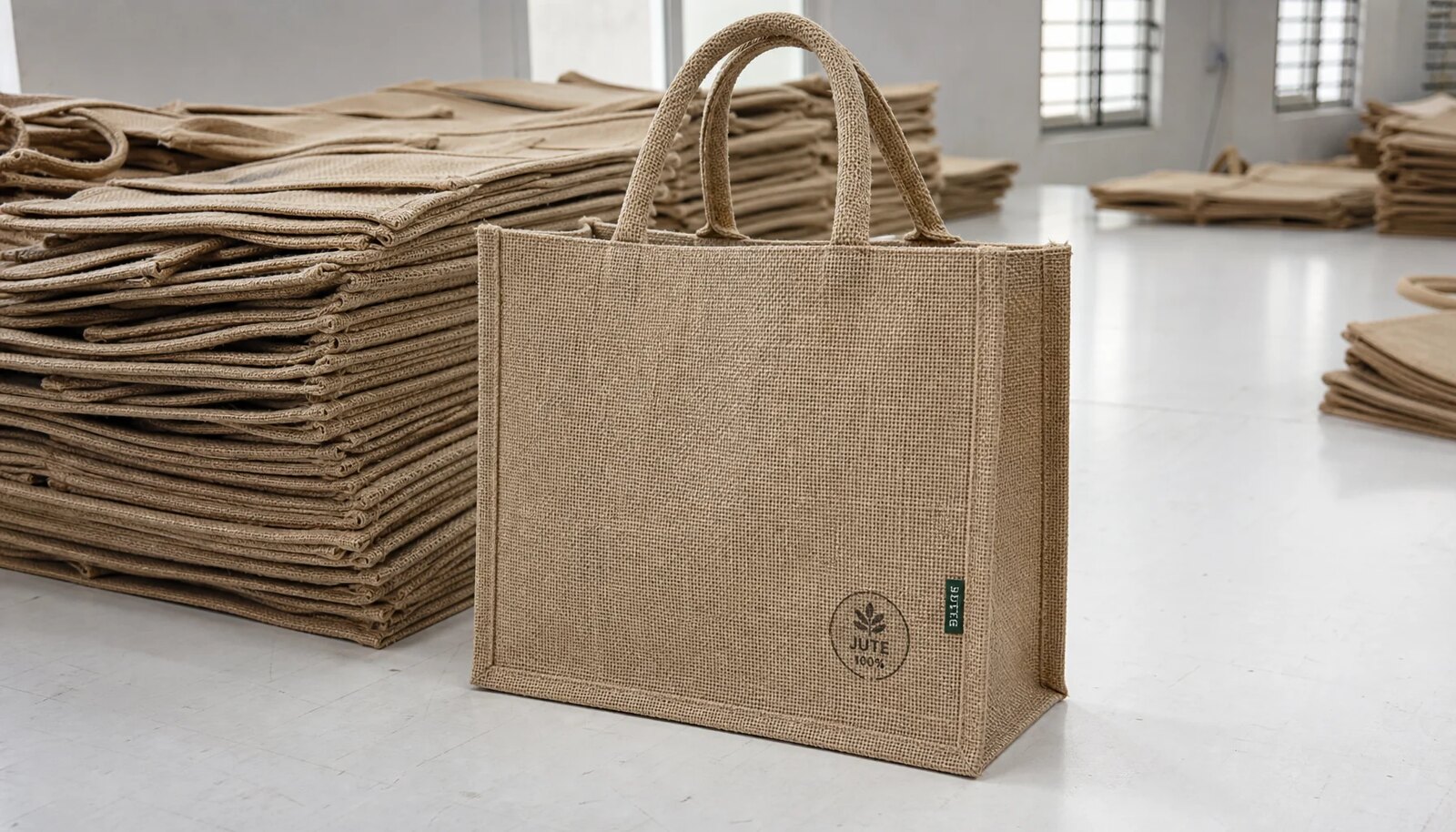
Plan the carton before the tote is finished
A jute tote order is not finished when the logo sample looks attractive. For event planners and procurement buyers, the same bag still has to be counted, packed, shipped, received, stored, moved to registration, and handed out on a fixed date. A low unit price can lose its advantage quickly if cartons are bulky, too heavy for venue staff, mislabeled for a destination split, or packed so tightly that the front print panel arrives creased.
Jute does not pack like smooth cotton canvas, polyester, or non-woven polypropylene. The weave has texture. The fiber can hold a fold. Handles create uneven stack points. Laminated panels may resist compression or show pressure marks. A 35 x 40 x 15 cm jute tote with cotton webbing handles will not behave like a thin convention giveaway bag, even if both are described as event totes in a catalog.
That is why wholesale jute tote bags for event planners shipping carton planning should be treated as one sourcing decision. The RFQ should ask for the bag specification and the packed carton specification at the same time. Buyers need pieces per carton, carton dimensions, gross weight, net weight, and total cube before they can compare landed cost or confirm that the goods fit the receiving plan.
Carton marks matter too. Event orders often ship to hotels, convention centers, agency warehouses, sponsor booths, or third-party logistics providers. Labels should be readable while cartons are stacked and should match the destination split on the purchase order. When packing details are left until the end, the factory may have to repack finished goods, relabel cartons, or reduce carton quantity to avoid damage. None of that is helpful when the event date cannot move.
- Request carton data with the first complete quote, not after production is finished.
- Ask suppliers to quote the same pieces per carton so landed-cost comparisons are fair.
- Treat packed condition as part of sample approval, especially for sponsor-visible logos.
- Include venue, 3PL, courier, or warehouse receiving rules in the supplier brief.
- Set a maximum carton gross weight if event staff or parcel carriers will handle cartons manually.
Translate event use into a measurable bag spec
The right jute tote starts with the actual contents. A registration giveaway with a folded program, pen, and badge insert does not need the same construction as a VIP gift bag holding a hardcover notebook, drink bottle, apparel item, and boxed sample. Before asking for price, procurement should ask the event team for the heaviest expected kit, the largest rigid item, and whether attendees are expected to carry the bag over the shoulder.
Write dimensions as finished measurements: width, height, gusset depth, handle length, handle drop, and handle width. The gusset is not a minor detail. Boxed gifts and bottles need depth, not just a large front panel. Handle drop also shapes the user experience. A short hand-carry handle may pack efficiently, but it will frustrate attendees if the bag is meant to sit on the shoulder during a long exhibition day.
Clarify how every measurement is taken. Handle drop may mean the distance from the top edge of the bag to the top of the handle loop, while handle length may refer to the full handle strip before attachment. Body size may be measured flat, open, loaded, or after the bag has rested outside the carton. Those differences sound small until a boxed insert no longer fits or a sponsor logo sits too close to the top edge.
Jute fabric weight should be stated in gsm. For light event handouts, 250-300 gsm is often practical. For premium kits, heavier inserts, or retail-style presentation, 320-400 gsm usually gives better structure. GSM is still only one part of the decision. Weave density, lamination, lining, handle material, and stitch reinforcement all affect durability and packed volume.
Tolerance belongs in the specification. Jute totes are cut-and-sewn products, so small variation is normal. Buyers may use the supplier's own tolerance, but body dimensions are often controlled around roughly +/- 0.5 cm to +/- 1.0 cm depending on bag size and construction. The useful step is to agree on the tolerance before sampling, then inspect against the same standard later.
- List the heaviest and largest event contents before choosing bag size.
- Specify width, height, gusset, handle length, handle drop, handle width, GSM, lining, and reinforcement.
- State whether measurements are taken flat, open, loaded, or after the bag relaxes from carton compression.
- Use 250-300 gsm for light giveaways and 320-400 gsm for more structured or heavier event kits.
- Get written dimensional tolerances before approving the pre-production sample.
Be precise about jute, lamination, and lining
Jute is a natural bast fiber, so some slubs, shade movement, and texture are expected. That natural character is part of the appeal. It also means procurement needs to separate acceptable variation from real defects. Major stains, mildew, oil marks, broken yarn bands, heavy odor, and severe shade difference should not be accepted as normal character for a sponsor-facing event bag.
The material structure should be written plainly. Unlaminated jute has a softer hand and often folds more easily. Laminated jute adds body and wipeability, helps some bags stand upright, and may give a more controlled print surface depending on the artwork and method. Cotton lining, non-woven lining, or laminated backing can improve finish, but each one adds thickness, cost, and packing volume.
Ask what the quoted GSM actually represents. A supplier may say 340 gsm, but the number could refer to raw jute, laminated jute, lined fabric, or a finished composite. That distinction affects comparison between factories. It also affects carton planning because lined and laminated constructions usually pack thicker than unlaminated jute.
Odor deserves practical attention. Natural jute can have an earthy smell, and lamination or adhesives can add chemical odor if material is not aired or cured properly. Event totes may be opened in hotel storage rooms, registration areas, sponsor suites, or small back-of-house spaces. A strong odor problem becomes noticeable fast. Include odor in sample review and final inspection instead of treating it as a soft preference.
Lamination also changes how cartons should be packed. A laminated panel may crease, crack, or hold pressure marks if folded sharply through the logo area. Lined bags may trap air or resist tight compression. If the bag must stand open on a registration table, lamination may help. If the priority is lower freight cube, lighter or unlaminated construction may be more efficient. The best answer depends on presentation and shipping together.
- Ask whether GSM is raw jute, laminated jute, lined material, or finished composite material.
- Define unacceptable defects: mildew, oil stains, heavy odor, broken yarn bands, severe shade variation, and exposed glue.
- Review lamination for bubbling, delamination, cracking, odor, and edge finish.
- Choose lined or laminated construction only after checking packed thickness and carton count.
- Complete air-out and odor checks before goods are packed for shipment.
Match logo artwork to jute print limits
Jute can make a brand feel tactile and natural, but it is not a smooth advertising surface. The weave interrupts fine detail. Ink can sit differently across yarns. Small type can lose sharpness. Procurement should require a production strike-off when artwork includes sponsor logos, thin rules, small legal lines, gradients, halftones, tight registration, or strict brand colors.
Screen printing is usually the most reliable route for bold one- or two-color event artwork. It is cost-effective, repeatable, and suitable for many conference marks and sponsor logos. The factory still needs the right mesh, ink deposit, curing process, and print pressure for the actual jute. A sample printed on cotton, polyester, or a generic panel does not prove the result on the production material.
Heat transfer or digital printing can be useful for multicolor artwork, detailed graphics, or short runs with many versions. Ask how the transfer bonds to textured jute, whether edges lift after flexing, and whether the finished surface looks glossy or patch-like against the natural fabric. For digital methods, close-up photos help, but a physical sample is better when brand presentation matters.
Placement should be specified in measurements, not only shown in a mockup. For example: centered on the front panel, 8 cm below the top edge, with an agreed tolerance from the top and side edges. Natural fabric movement and sewing variation make absolute precision unrealistic, but a written tolerance gives inspection a fair standard.
Print must also survive packing. Ink that looks fine on a table may scuff, offset, or pick up handle impressions once the bags are compressed in a carton. Check the printed panel after the packed sample has rested under normal carton pressure. This is when pressure lines, rubbing, and cure issues usually become visible.
- Use screen print for bold 1-2 color marks when artwork is simple and repeatable.
- Require a strike-off for fine detail, strict brand colors, gradients, or sponsor-heavy designs.
- Specify logo size, placement from edges, print color target, and placement tolerance.
- Check print cure, rub resistance, scuffing, and offset after packing compression.
- Approve the actual production material, not a generic textile print sample.
Build an RFQ that makes quotes comparable
A useful factory quote should read like a production document. It should identify bag construction, fabric weight, finished dimensions, handle material, stitch reinforcement, logo method, color count, sample terms, production lead time, packing method, master carton data, inspection expectations, and trade terms. If a quote includes only a unit price and a product photo, it is not ready for procurement comparison.
Separate costs wherever possible. Ask for finished bag unit price, logo setup charge, screen or plate charge, sample charge, inner packing cost, export carton cost, barcode or label application cost, destination sorting cost, and freight charge if the supplier is quoting delivered terms. This prevents a common sourcing problem: one supplier includes cartons and labeling while another quotes only standard bulk goods.
Artwork versioning should be visible from the start. One logo on one bag color is a different job from five sponsor versions packed by destination. Every version can affect screens, setup, MOQ, inspection time, carton labels, and packing list complexity. If the event has regional kits, VIP kits, staff kits, and attendee kits, the factory needs that structure before giving a final price.
Carton details should sit in the same RFQ table as product details. Ask for pieces per carton, carton length x width x height, gross weight, net weight, total carton count, and total cubic meters or cubic feet. If the buyer has a maximum carton weight or required barcode label, include it early. Late carton changes often become repacking work, and repacking is rarely free after the production line has moved on.
- Use one RFQ format for every supplier so product and carton data can be compared side by side.
- Separate unit cost, setup, sample, packing, labeling, sorting, carton, inspection, and freight charges.
- Include logo versions, destination splits, and barcode requirements before asking for final price.
- Avoid vague phrases such as standard packing unless the supplier defines carton quantity, dimensions, and marks.
- Ask for price breaks at several quantities with carton count and total cube shown for each quantity.
Use MOQ and price breaks as planning tools
MOQ is not just a supplier preference. It reflects material sourcing, cutting yield, printing setup, sewing line efficiency, packing labor, and carton configuration. A stock jute body with a custom logo can often support a lower MOQ because the factory already has the bag structure available. A full custom size, custom dyed fabric, special lining, rope handle, or multiple logo versions can raise MOQ because each variation adds setup and control points.
Event buyers should not automatically choose the lowest MOQ. A very low quantity may carry higher setup cost per unit, limited fabric availability, fewer print choices, and less efficient carton packing. For an urgent one-time event, that tradeoff may be acceptable. For an annual conference or recurring brand program, a higher MOQ with stable specifications and optimized cartons may reduce landed cost and make reorders easier.
Carton planning changes the economics. If a bag packs at 50 pieces per carton, a 1,000-piece order may ship in 20 cartons. If individual polybags, thicker handles, or a stiffer lining reduce packing to 30 pieces per carton, the same order becomes about 34 cartons. Even when the unit price looks similar, freight cube, receiving labor, warehouse storage, and venue handling can rise.
Ask suppliers to quote quantity breaks together with carton plans. Request 500, 1,000, and 2,500 pieces, each with MOQ assumptions, lead time, pieces per carton, carton dimensions, gross weight, total cartons, and total cube. This gives procurement an event-ready cost instead of a narrow ex-factory unit price.
- Ask for MOQ by bag size, fabric color, handle type, lining, print version, and destination sort.
- Compare price breaks together with total carton count, total cube, and receiving labor.
- Confirm whether individual polybags, hang tags, or inserts reduce pieces per carton.
- Order against attendee forecast, staff needs, sponsor obligations, display needs, and damage allowance.
- For repeat programs, prioritize stable specification and reorder consistency over the lowest first-order MOQ.
Approve samples in product and packed stages
Sample approval should cover both the tote and the shipping format. The pre-production sample confirms visible product details: fabric weight, weave character, color, dimensions, handle drop, handle reinforcement, logo placement, lining, edge finish, and odor. Measure it against the written specification with a ruler or tape. Photos are useful, but they do not replace measurement.
A print strike-off should come before bulk production when the artwork carries real risk. The strike-off becomes the standard for color, coverage, sharpness, and print behavior on the actual jute. If the buyer approves only a digital mockup, final inspection becomes subjective because the production team has no physical target for acceptable print.
The packed sample or packed photo set confirms shipping behavior. It should show final fold direction, pieces per carton, inner packing, carton dimensions, carton label, closure method, and sealed carton. If a physical packed sample is not practical, request enough photos to see how handles are placed, whether the logo is folded or protected, and how tightly the carton is filled.
For jute totes, packed review should look for creases through the front panel, handle pressure marks, lamination cracking, print scuffing, odor concentration, and whether the gusset opens correctly after unpacking. If inserts are pre-packed inside the bag, check corner pressure and weight distribution. A tote can look excellent on a sample table and still arrive poorly if the carton plan is wrong.
Approval notes should be specific. Instead of writing approved, record the approved fabric, print, dimensions, handle construction, lining, packing method, pieces per carton, carton label, and any correction required before bulk. Those notes become the reference for inspection and shipment release.
- Measure sample width, height, gusset, handle length, handle drop, and handle width.
- Record approved GSM, lining, lamination, handle stitch pattern, print method, and logo placement.
- Approve a strike-off on production jute for brand-critical artwork.
- Review packed condition before mass packing begins.
- Keep sample approval records available for final inspection comparison.
Engineer cartons for freight and receiving
The best carton is not simply the one with the highest piece count. It is the carton that protects the bags, uses freight space efficiently, stays within handling limits, and supports clean receiving. Event goods may pass through a freight forwarder, courier hub, warehouse, hotel dock, convention center, agency office, or temporary storage room. Every handoff is easier when carton count, labels, and weights are predictable.
Flat packing is usually efficient for jute totes, but fold direction matters. The front logo panel should not be sharply folded through the printed area unless the approved packed sample proves it recovers cleanly. Handles should be layered so they do not create a hard ridge that dents the bag body. If bags are individually polybagged, the added thickness may reduce carton quantity and increase plastic waste. If they are bulk packed, the carton must protect the bags from dirt and moisture.
Set carton weight deliberately. A carton under parcel carrier limits may still be awkward for venue staff if it is large and dense. Heavy cartons can split during manual handling, while underfilled cartons can collapse in stacking. Ask for both gross weight and net weight, then compare them with the receiving team's practical limit.
If the shipment will be palletized, request pallet count, pallet dimensions, stack height, and whether cartons can tolerate the planned stacking load. Sea freight, truck freight, and long warehouse dwell times may require stronger cartons, better sealing, moisture protection, or clearer pallet labels.
Carton labels should be operational, not decorative. At minimum, they should show buyer or project code, PO number, SKU, item description, quantity, gross weight, net weight, destination, and carton sequence such as 1 of 40. For split deliveries, destination names should be large enough to read while cartons are stacked. If the receiver uses barcodes, send the barcode file, label size, and placement instruction before packing starts.
- Confirm pieces per carton, carton dimensions, gross weight, net weight, total cartons, and total cube.
- Set a maximum carton gross weight based on freight route and receiving labor.
- Use destination, SKU, and carton-sequence labels for multi-venue or multi-version orders.
- Request sealed-carton photos before shipment release.
- Confirm palletization, stack height, moisture protection, and carton strength when shipping by sea or truck.
Control QC before shipment release
Quality control for jute totes should cover material, sewing, print, packing, and carton marking. Natural jute will show variation, so the inspection standard should focus on commercially meaningful defects: stains, odor, broken yarns, severe shade differences, loose threads, weak handles, poor print, wrong dimensions, wrong carton count, or labels that do not match the destination plan.
Incoming material checks reduce surprises. GSM should match the approved specification, and the inspector should know whether the target is raw jute or laminated composite. Fabric should be checked for mildew, oil marks, dampness, heavy odor, broken yarn bands, and inconsistent shade. Laminated or lined material should be reviewed for bubbling, exposed glue, delamination, and sharp edges.
During production, check dimensions, handle placement, handle reinforcement, stitch density, print placement, and print cure. For heavier event kits, ask the supplier to perform a simple loaded hang check on production samples using a weight that reflects the intended contents. This is not a substitute for a formal laboratory test when one is required, but it helps catch obvious handle or seam weakness before the order is packed.
Print QC should include color against the approved strike-off, coverage, edge sharpness, registration, cure, scuffing, and offset. Inspect across multiple cartons and production times, not only the first pieces prepared for photos. Jute surface variation can make print defects appear differently from bag to bag, so the agreed standard should separate minor texture show-through from unacceptable bleeding or missing coverage.
Final inspection must include carton-level checks. Open cartons from different parts of the lot, count pieces, verify SKU mix, confirm inner packing, read carton labels, and compare gross weights with the packing list. Shipment release should wait until product QC and packing QC both match the purchase order.
- Set AQL or another inspection sampling method before production if your company requires formal acceptance rules.
- Check material, sewing, print, lining, odor, inner packing, carton count, and carton labels.
- Inspect cartons from different positions in the lot, not only the top cartons prepared for photos.
- Compare final packing list against PO quantities, SKU versions, destination split, and carton sequence.
- Require correction photos or reinspection when label, count, or packing errors are found.
Protect the event schedule with milestones
Event orders are unforgiving because the delivery date is fixed. A supplier statement such as production takes 25 days is not enough. Procurement needs to know when that clock starts, what approvals must happen first, and which late decisions can block packing or shipment. Artwork approval, sample approval, carton label approval, and destination split approval can all sit on the critical path.
A practical schedule breaks the order into milestones: RFQ issue, quote confirmation, artwork file lock, deposit or payment confirmation, material booking, strike-off, pre-production sample, sample approval, bulk cutting, printing, sewing, packing trial, carton label approval, final inspection, shipment booking, export documents, and carrier handoff. Each milestone should have an owner and a target date.
Carton approval is often underestimated. The factory can finish the bags but still be unable to pack correctly if the buyer has not provided destination names, barcode files, carton sequence rules, or final quantity splits. For direct-to-venue deliveries, receiving windows and dock rules should be confirmed early. A convention center may require appointment delivery, pallet labeling, or specific receiving paperwork.
Buyers should define late-change rules before the order is under pressure. If artwork changes after strike-off, attendee count increases, a sponsor adds a logo version, or a venue changes receiving instructions, the team should know whether it will accept extra cost, reduce customization, approve partial shipment, or upgrade freight. Clear decision rules prevent slow internal debate when schedule buffer is already gone.
- Request a milestone schedule instead of one broad lead-time estimate.
- Lock artwork, strike-off, bag spec, carton labels, and destination splits before mass packing.
- Build buffer for multi-logo orders, custom lining, pre-kitting, destination sorting, and direct-to-venue delivery.
- Confirm the last inspection date and last carrier handoff date that still protects the event deadline.
- Keep packing information in the production timeline, not as an afterthought.
Specification comparison for buyers
| Spec decision | Recommended option | When it fits | Buyer risk to check |
|---|---|---|---|
| Finished bag size | Quote exact width x height x gusset in cm or inches, with measurement points and tolerance stated | Needed for boxed gifts, catalogs, drink bottles, apparel bundles, sponsor samples, and registration kits | Catalog names such as small, medium, or conference size are not controlled specifications; confirm whether size is measured flat, open, loaded, or after carton relaxation |
| Jute fabric weight | 250-300 gsm for light handouts; 320-400 gsm for premium kits or heavier contents | Use lighter jute for flyers, pens, badges, and simple giveaways; use heavier jute for notebooks, bottles, boxed samples, apparel, or resale presentation | Confirm whether GSM is measured before lamination, after coating, or on finished composite fabric; laminated material can be quoted misleadingly if layers are not separated |
| Dimensional tolerance | Agree typical sewing tolerance, often about +/- 0.5 cm for small measurements and +/- 1.0 cm for main body dimensions unless factory states otherwise | Useful when inserts, sponsor kits, retail boxes, or shelf-ready presentation require predictable fit | Without written tolerance, buyers may reject normal handmade variation or accept bags that do not fit the intended contents |
| Handle construction | Cotton webbing, self-jute, rope, or padded handle with box stitch, X-stitch, or bar tack reinforcement | Best for event kits that attendees carry for several hours or that contain bottles, books, apparel, or boxed samples | Handle drop affects shoulder carry and carton efficiency; ask for handle length, drop, width, stitch pattern, and a simple loaded hang-test method |
| Lamination or lining | Unlaminated for natural hand feel; laminated or lined for structure, wipeability, and better standing shape | Useful for premium registration desks, retail-style gift bags, sponsor suites, or bags that must stand open for fulfillment | Lamination changes odor risk, folding behavior, packed thickness, print appearance, and carton count; approve the final packed sample |
| Logo method | Screen print for bold 1-2 color marks; heat transfer or digital print only when artwork complexity justifies it | Best for sponsor logos, event marks, and repeat programs with controlled artwork | Fine type, gradients, small reverse text, and tight registration can fail on coarse jute; require a strike-off on actual production material |
| Packing method | Flat-packed in master cartons with confirmed pieces per carton, carton dimensions, gross weight, net weight, and label format | Best for receiving teams that must count, split, stage, and move goods quickly before an event | Overpacked cartons can crease print panels and bend handles; underpacked cartons increase freight cube and may collapse if boxes are not filled properly |
| Carton specification | Export carton with stated board quality if available, sealing method, carton marks, carton sequence, and maximum gross weight | Needed for sea freight, palletized freight, parcel networks, direct-to-venue shipping, and multi-destination orders | A weak carton can split, soften, or crush even when the bag itself is acceptable; confirm moisture exposure controls and tape strength for the route |
| MOQ route | Stock body plus custom print for speed or lower MOQ; full custom build for controlled GSM, size, lining, handles, and packing | Stock fits urgent events; full custom fits repeat programs, strict brand standards, and destination-sorted orders | Low MOQ may hide higher setup charges, limited print colors, inconsistent reorder stock, and fewer carton optimization choices |
Buyer checklist before sampling
- Write the finished bag specification as width, height, gusset depth, handle length, handle drop, handle width, fabric GSM, lining or lamination, and reinforcement method.
- State the measurement method for each dimension: flat, open, loaded, or after the bag has rested outside the carton for a defined period.
- Define acceptable dimensional tolerance in writing before sampling, and separate body dimensions from handle measurements because they are controlled differently in sewing.
- Confirm whether quoted GSM applies to raw jute fabric, laminated jute, lined material, or the finished composite construction.
- Provide final artwork files with logo size, color target, placement from top and side edges, print method, and acceptable placement tolerance.
- Ask for a print strike-off on actual production jute when artwork includes small type, sponsor marks, thin rules, reverse text, gradients, or tight brand colors.
- Request pieces per master carton, carton length x width x height, estimated gross weight, estimated net weight, total carton count, and total cubic volume before issuing the purchase order.
- Separate unit price, logo setup, sample charge, inner packing, export carton, carton label, barcode application, destination sorting, and freight cost in the quote.
- Specify whether bags are bulk packed, individually polybagged, tissue wrapped, tagged, barcoded, pre-kitted with inserts, or packed without plastic.
- Confirm maximum carton weight allowed by the receiving warehouse, venue, courier, freight forwarder, or event labor team.
Factory quote questions to send
- What is the exact jute fabric weight in gsm, and is it measured on raw jute, laminated jute, lined fabric, or the finished composite bag?
- What are the finished bag width, height, gusset, handle length, handle drop, handle width, and allowed tolerance for each measurement?
- What stitch reinforcement will be used at the handle attachment points: box stitch, X-stitch, bar tack, or another method?
- What simple load check do you perform for handles, and what estimated carried weight is suitable for this construction?
- Which print method do you recommend for this artwork on jute, and what setup charge, screen charge, transfer charge, or plate charge applies per color and per logo version?
- Can you provide a strike-off on the actual production jute before the pre-production sample is approved?
- What print placement tolerance can you hold from the top edge and side edges on this bag size and fabric?
- How many pieces per master carton can you pack without crushing the print panel, deforming handles, cracking lamination, or exceeding the agreed carton weight?
- What are the master carton dimensions, carton board specification if available, gross weight, net weight, and total cubic volume for the proposed packing plan?
- Can you provide a packed sample or a photo set showing final fold, carton count, carton label, inner packing, carton closure, and sealed master carton?
Quality-control points to confirm
- Fabric weight matches the approved specification, with the supplier clearly identifying whether GSM was checked before or after lamination or lining.
- Jute weave is commercially consistent across the lot, with no major thin spots, broken yarn bands, mildew, oil stains, heavy color shifts, or contamination.
- Finished width, height, gusset, handle length, handle drop, and handle width stay within the approved tolerance after the bag has relaxed from carton compression.
- Handle stitching uses the approved reinforcement method, with no skipped stitches, loose thread, weak knots, fraying, or misaligned attachment points.
- A simple loaded hang check or agreed handle pull check confirms the bag construction is suitable for the intended event contents.
- Print color matches the approved strike-off under the agreed light condition, allowing for the natural influence of jute base color.
- Print placement stays within the approved tolerance from top edge, side edge, and gusset, especially across sponsor versions or multi-logo orders.
- Print surface shows no major bleeding, pinholes, smearing, poor cure, transfer marks, scuffing, or misregistration beyond the agreed standard.
- Lining or lamination is bonded cleanly, with no bubbling, exposed glue, delamination, sharp internal edges, or strong chemical odor.
- Inner packing matches the purchase order: bulk pack, individual polybag, tissue, tag, barcode, insert, or no plastic as specified.