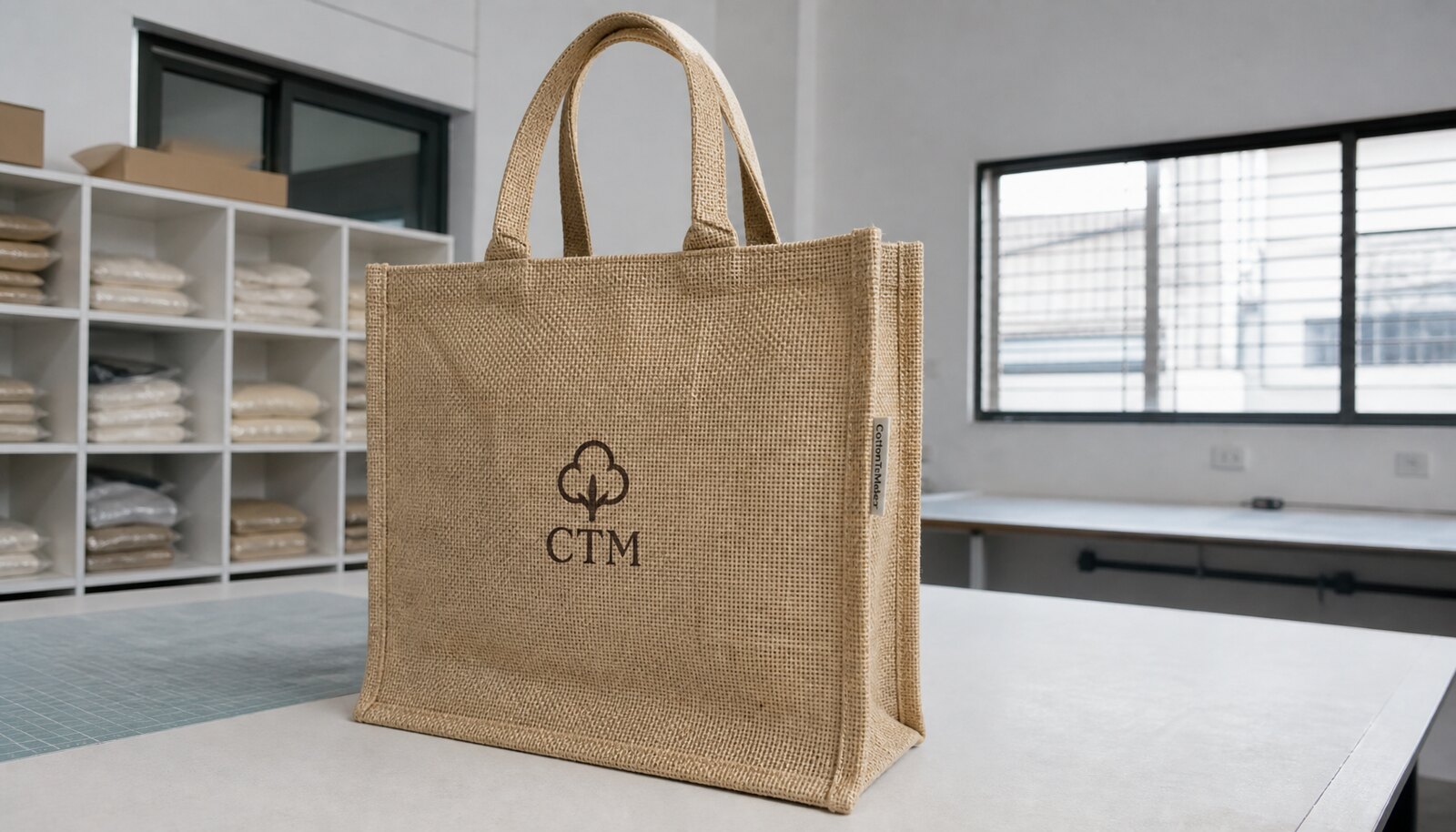
Start With the Winery Use Case
The wrong jute tote spec usually starts with a vague brief. A boutique winery bag can be a tasting-room retail item, a bottle carrier, a gift with purchase, or a branded event handout. Those are not the same product. A tote that only needs to hold a brochure and a small bottle can be lighter, softer, and cheaper. A tote that carries two full bottles needs a firmer base, better handle reinforcement, and a construction that does not collapse when the customer sets it down.
Before you talk to suppliers, define the exact use case in one sentence and keep it in the RFQ. That sentence should tell the factory the bottle count, whether the bag must stand upright, and whether it needs a premium shelf appearance or just functional transport. The more clearly you define the job, the easier it is to compare quotes on the same basis instead of comparing one supplier's light promo bag with another supplier's reinforced retail tote.
- State the bottle count and approximate filled weight.
- Say whether the tote will be sold, gifted, or used only for events.
- Tell the supplier if the bag must present well on retail shelving.
Use GSM To Match Strength, Not Just Price
Jute fabric weight matters because it changes the bag's shape, feel, and usable life. For wholesale jute tote bags for boutique wineries, a common buying range is roughly 280 to 450 GSM, but the right number depends on what the tote carries. Around 280-320 GSM works for light retail items and simple promo use. It is lower cost and easier to fold, but it can look soft or underbuilt if the bag is expected to support glass bottles. Around 340-380 GSM is usually the better middle ground for winery retail, because it gives the tote enough body without turning it into a stiff board.
When the program is premium or the tote must carry multiple bottles, consider 380-450 GSM or a reinforced build. That higher weight helps the bag stand better on display and feel more substantial in hand. The tradeoff is real: more GSM means more material cost, more freight weight, and often a larger carton cube. Do not let a supplier quote only the raw fabric weight. Ask for the finished bag weight and the exact construction, because a 320 GSM bag with reinforcement can outperform a plain 380 GSM bag in the wrong design.
- 280-320 GSM: light use, promo packs, lower unit cost.
- 340-380 GSM: balanced option for winery retail and gift sets.
- 380-450 GSM: premium presentation, multi-bottle carry, stronger shelf presence.
Choose the Construction Before You Choose the Print
On jute, construction decisions often matter more than decoration. A coarse weave can make fine logos look uneven, so the bag needs to be built for the artwork instead of the other way around. For most winery programs, a straight screen print with one or two colors is the most practical option. It is cost-efficient, repeatable, and readable on a rough natural surface. If the logo has small type, fine lines, or a premium brand mark that must stay crisp, a woven label, stitched patch, or a contrasting side panel may give better results than trying to force detail into a direct print.
Handles deserve the same discipline. Jute tape handles look natural, but they can feel rough in the hand. Cotton webbing is softer and often better for retail carry. A self-fabric handle can look clean, but it needs stronger reinforcement if the bag will carry bottles. Ask for bar tacks or X-box stitching at the stress points, and make sure the handle length suits the intended use. If customers will carry the bag on the shoulder, a short handle is a functional mistake, not a style choice.
- Use screen print for bold, low-detail artwork.
- Use a woven label or patch when small text must remain legible.
- Specify handle material, handle drop, and stress-point reinforcement in writing.
Compare Sourcing Routes, Not Just Supplier Names
A direct factory quote, a trading company quote, and a stock importer quote are not comparable unless the sourcing route is clear. A direct factory is usually the best route for stable repeat orders because the spec can be controlled from fabric to carton. A trading company can be useful if you need multiple bag constructions or lower launch risk, but you should still identify the actual factory making the bag. A stock importer is useful when time matters more than exact control, but the design choices are usually limited and the quote may hide what was changed from the original product spec.
For boutique wineries, the best route depends on launch timing and brand risk. If the tote will be part of a permanent retail program, use a factory that can hold GSM, print, and trim consistent across reorders. If you are testing a seasonal gift set, a trading company may be acceptable because it can simplify mixed sourcing. If you need a fast event fill, stock inventory can work, but only if you can accept a more generic look. The cheapest quote is often the one that leaves out printing, reinforcement, or export packing until you add those items back later.
- Direct factory: best for repeatable specs and tighter QC.
- Trading company: useful for flexibility, but verify the real maker.
- Stock importer: fast, but limited in size, color, and branding control.
Build the Quote Around Real Cost Drivers
A useful quote should show more than a unit price. Ask the supplier to break out fabric weight, handle material, print method, label or patch cost, sample fee, and packing method. That separation tells you where the money is going and whether the supplier understood the brief. If two quotes look close on paper, the differences are often hidden in reinforcement, carton count, or print setup. One supplier may have quoted a bare bag, while another included a better handle and a more durable print application.
MOQ logic should also be transparent. A low MOQ is not automatically better if the supplier is building a custom screen, buying a special liner, or sourcing a specific handle tape for you only. Ask how the price changes at a few quantity breakpoints so you can see whether the order should be split by channel or merged into one SKU. For wineries, it is common to overpay for a tiny launch order and then discover that the cost drops sharply at the next break. That is useful information, but only if the supplier shows it clearly.
- Request separate pricing for bag body, handles, print, label, and packing.
- Ask for quantity breaks at launch volume and at the next production tier.
- Make sure the quote names the Incoterm and excludes no hidden setup fee.
Approve Samples Against the Final Fabric
A digital mockup is not a sample. Jute changes the look of a logo because the surface is rough, absorbent, and naturally uneven. That means sample approval has to be done on the actual GSM and actual construction you plan to buy. The sample should show the final print method, seam reinforcement, handle material, and label placement. If the supplier swaps fabric weight or changes the print setup after approval, you do not have a real approval, only a visual reference.
Use the sample to settle the decisions that usually trigger rework later. Check whether the print reads clearly from retail distance, whether the tote stands the way the brand expects, and whether the handle length feels practical when the bag is loaded. If the bag is for bottles, fill it with the same bottle count or a realistic weight equivalent. Look at distortion at the side seams, print cracking at the folds, and whether the bottom panel stays flat. A sample that fails these points is a manufacturing warning, not a design preference.
- Approve sample on final fabric weight, not a substitute fabric.
- Test the bag with real bottle weight before sign-off.
- Get one signed reference sample and one retained factory sample.
Set Packing Rules That Protect the Jute
Packing is easy to ignore until the bags arrive warped, dirty, or damp. Jute is a natural fiber, so moisture control matters, especially on sea freight. The right packing method depends on the finish and the route. For premium retail bags, a clean fold, size-stable carton pack, and a basic moisture barrier approach are usually worth the small cost. For simpler promo bags, tight carton packing may be enough if the transit time is short and the destination climate is dry. Either way, the carton count and fold direction should be agreed before production starts.
Also pay attention to how the bags are packed per inner bundle. Too many bags in one compressed pack can leave permanent fold marks or distort the handle shape. Too few bags per carton can create unnecessary freight volume. The factory should tell you the inner pack count, master carton dimensions, and whether the bags are inserted with tissue, polybag, or nothing at all. If the winery uses the tote as a gift item, the unpacking experience matters. A bag that arrives neat and odor-free will sell better than a bag that looks like it came off a warehouse pallet.
- Agree carton pack count before the PO is released.
- Specify whether moisture protection is required for sea freight.
- Keep fold marks, crush, and odor under control for retail presentation.
Plan Lead Time Around Sample Approval, Not the Calendar
Lead time is usually missed because buyers count production days before the sample is approved. That is the wrong starting point. A jute tote order usually needs time for artwork confirmation, sample build, correction if needed, and then bulk production. If the print is simple and the fabric is standard, the schedule can move quickly. If the bag uses a special handle, lining, or a new label style, the calendar stretches. The factory should be able to tell you where the critical path is, and which decisions are still blocking the run.
Schedule risk rises when the winery launch date is fixed but the spec is still moving. Avoid changing GSM, handle type, or print method after the sample is already in motion. Those changes can reset the order or force a partial rework. Build your calendar backward from the retail need date and leave enough time for inspection and freight booking. If the bags are tied to a seasonal release or harvest event, create a buffer for artwork corrections and carton re-labeling. Late changes are expensive because they affect both production and shipping.
- Treat sample approval as part of the lead time, not an extra step.
- Lock artwork, GSM, and packing before bulk material is cut.
- Leave buffer time for inspection and freight booking.
Compare Landed Cost Before You Choose the Supplier
The real buying decision is landed cost, not just factory price. A thicker jute bag may be more expensive at the factory, but a better construction can reduce damage, returns, and brand complaints. On the other hand, an overbuilt tote can add freight cost because of weight and carton volume. That matters for winery programs where margins are already tied to seasonal retail demand. When you compare suppliers, include sample cost, print setup, carton configuration, freight mode, and destination duty assumptions in the same worksheet.
The most common sourcing mistake is choosing the lowest unit price and then discovering the bag needs extra packing, rework, or a second print pass. Compare quotes by the same spec sheet and the same delivery terms. If one route is slower but cheaper, check whether the timing still fits the launch. If one route is faster but includes a generic stock bag, calculate the brand impact before you approve it. A practical procurement decision is the one that balances retail appearance, production risk, and landed cost without forcing compromises that the customer will notice.
- Compare all quotes on one spec sheet and one Incoterm.
- Include freight, duty, sample cost, and setup fees in the total.
- Do not trade away bag quality just to win a lower unit quote.
Specification comparison for buyers
| Spec decision | Recommended option | When it fits | Buyer risk to check |
|---|---|---|---|
| Direct factory in a jute-producing region | Best for custom GSM, handle, and print control | You need repeatable specs, controlled lead time, and a stable SKU program | Minimum order may be higher and sample iteration can take longer than stock sourcing |
| Trading company with multiple bag factories | Use when you need flexibility across styles or smaller launch volumes | You are testing a new winery assortment or need mixed materials in one PO | Confirm the real factory, not just the trading office, and lock the spec sheet early |
| Stock importer with local inventory | Best for very small runs or urgent store openings | You need a fast fill for seasonal retail or event kits | Color, size, and print options are limited and your brand may inherit someone else’s spec |
| 280-320 GSM unlined jute | Use for light retail gifts, brochures, and single-bottle carry without heavy contents | The bag is part of a price-sensitive promo, not a premium gift set | The bag can slump, pill, or show bottle edges if the bottom is underbuilt |
| 340-380 GSM reinforced jute | Best balance for boutique winery retail and gift shop programs | You want a sturdier hand feel without making the tote bulky | Check handle seam reinforcement and actual finished weight, not just fabric claim |
| 380-450 GSM or lined construction | Use for premium presentation or multi-bottle sets | The tote must stand upright on shelf and survive repeated customer use | Higher GSM can increase stiffness, carton weight, and freight cost |
| Screen print directly on jute | Best for 1-2 colors and high-volume repeat artwork | Your logo has bold lines and you want clean unit economics | Fine detail can fill in on coarse weave, so approve a strike-off on actual fabric |
| Woven label, patch, or side branding panel | Use when the logo needs better legibility on rough jute | Your mark has small text or a premium retail story | A label adds cost and sewing time, and the panel must still survive seam stress |
Buyer checklist before sampling
- Define the use case first: one bottle, two bottles, gift set, tasting-room retail, or event giveaway.
- State the target GSM range and whether the bag should be unlined, partially lined, or fully lined.
- Specify finished size, gusset depth, handle length, and whether the base must stand upright.
- Choose one primary print method and provide vector artwork with ink color expectations.
- Ask the supplier to quote the bag, handle, print, label, sample fee, packing, and carton data separately.
- Set an acceptance rule for natural jute variation, including shade tolerance and fiber slub expectations.
- Require pre-production sample approval against the final material, not only against a digital mockup.
- Confirm carton pack count, master carton dimensions, and moisture protection for sea freight.
Factory quote questions to send
- What GSM do you propose for this bag, and can you show the basis weight tolerance from your incoming fabric?
- Is the quoted construction unlined, lined, or reinforced at the bottom and handle points?
- Which print method are you pricing, and what is the maximum line thickness or text size you recommend for jute?
- What is the MOQ for this exact spec, and how does the price change at 1,000, 3,000, and 5,000 units?
- What are the sample charges, plate or screen fees, and can any of them be credited against bulk?
- What is the packing method per bag and per carton, and do you add desiccant or moisture barrier packing?
- What lead time do you need for sample approval, bulk production, and ready-for-ship cartons?
- Which inspection photos, size reports, and carton labels will you provide before shipment?
Quality-control points to confirm
- Measure finished size, gusset depth, and handle length on a packed sample, not only on a flat sample sheet.
- Confirm fabric weight, weave consistency, and color tone against the approved swatch or signed sample.
- Inspect handle attachment points, bar tacks, and seam density at stress areas for pull resistance.
- Check print registration, ink coverage, and edge sharpness on the coarse jute surface.
- Verify that the bag stands or folds as intended after filling with the agreed bottle load or gift set weight.
- Review odor, dust, and lint level, especially if the bags will touch food, wine bottles, or premium packaging.
- Open random cartons to confirm fold direction, count accuracy, and label placement.
- Record any acceptable natural variation range so the supplier does not treat defects as standard.