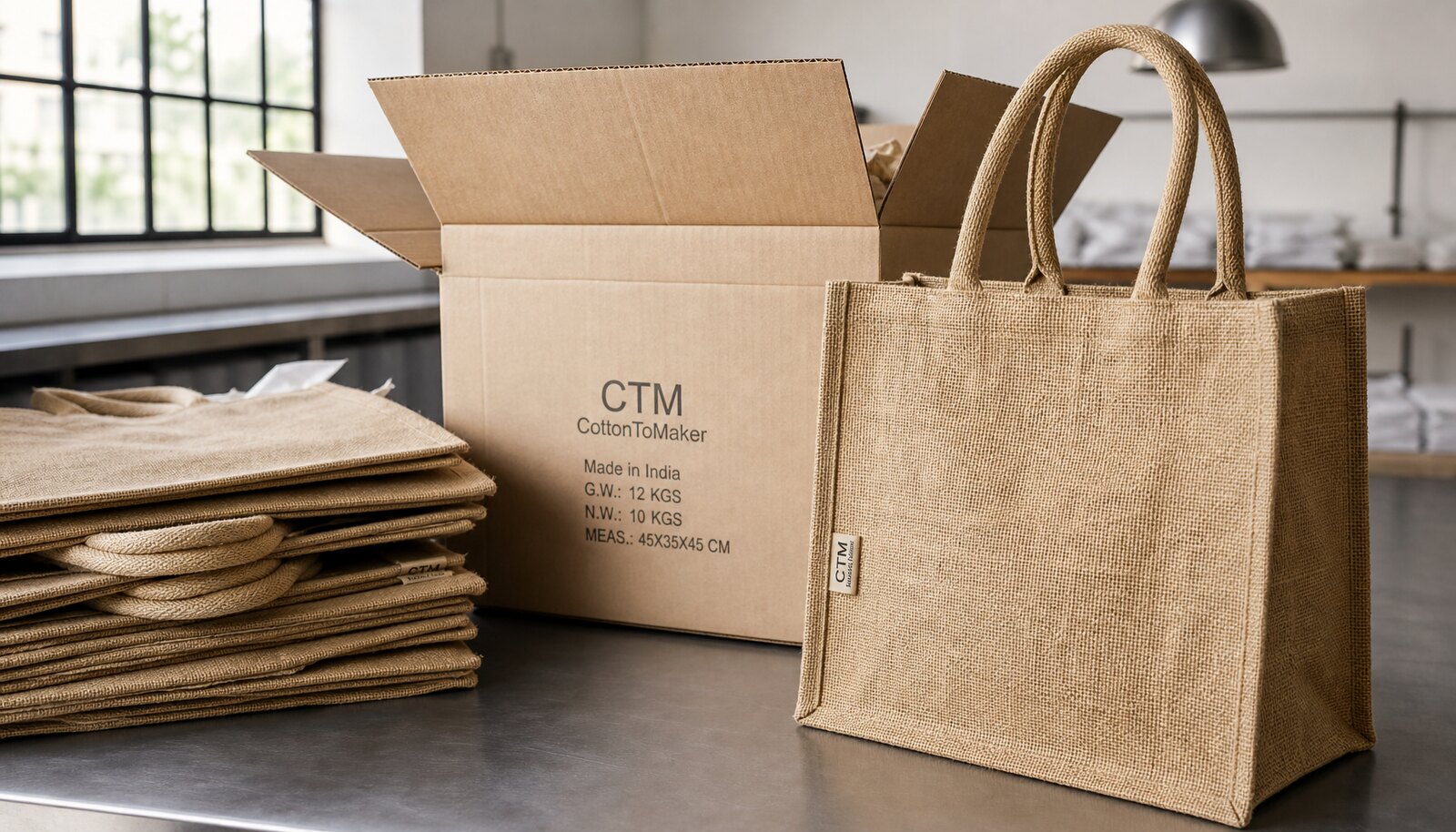
Why carton packing matters more on jute tote orders than buyers expect
For boutique wineries, the bag is not just a giveaway. It usually carries glass, performs on the tasting-room floor, and sits on retail shelves where first impression matters. That means carton packing is not an afterthought. It affects crush damage, print scuffing, freight cost, warehouse receiving, and the condition in which the bag reaches a shop or distributor.
On wholesale jute tote bags for boutique wineries, many buyers focus on size, logo, and unit price, then accept whatever packing the supplier usually uses. That is where mistakes start. A bag that looks fine in a sample photo may arrive with bent corners, marked print, or cartons too heavy for easy handling. The goal is to define a packing plan that works for both export and retail distribution.
- Packing has to protect the bag structure, not just keep the pieces together.
- Carton density affects freight, receiving labor, and damage rate.
- A good packing plan reduces quote variance because suppliers know exactly what labor and materials are included.
Start with the use case: tasting-room carry, gift retail, or distributor fulfillment
The right jute tote spec changes depending on how the winery will sell or use it. A tasting-room bag that carries one bottle and a brochure can stay lighter and open-top. A retail gift bag holding two bottles or a boxed set needs stronger handles, more consistent side gussets, and a carton layout that avoids creasing the front panel. Distributor fulfillment usually adds barcode, carton mark, and pallet rules that the factory must follow from the beginning.
Do not write an RFQ that says only “custom jute tote bag for winery.” That invites assumptions. A supplier will quote a promotional bag if the use case is unclear, then add charges later when you ask for lining, reinforcement, or retail-quality packing. Your packing plan should be built from the final loading condition and the destination channel.
- Single-bottle carry: prioritize handle strength and base support.
- Two-bottle gift: prioritize gusset width, bottom seam strength, and carton count per inner pack.
- Retail shelf item: prioritize print clarity, shape retention, and abrasion control in cartons.
Spec choices that affect packing cost and carton density
Jute weight is the first variable that changes the packing plan. A typical wholesale retail bag sits around 250–320 gsm, depending on size, lining, and whether the buyer wants a softer promotional feel or a more structured retail look. If you go too light, the bag collapses and wrinkles in carton. If you go too heavy, carton count drops and freight rises. For many boutique winery buyers, a mid-range 280–320 gsm body with reinforced handles is the practical middle ground.
Handle construction also changes how the bag packs. Cotton webbing handles lie flatter than bulky rope or layered jute handles, which can reduce carton height and improve outer carton fill. Lined bags need more space than unlined ones, but lining can reduce lint transfer and improve print appearance. The factory should quote the bag and the carton plan together because the same bag may pack 10 pcs or 20 pcs per carton depending on handle style and folding method.
- Typical workable body range: 250–320 gsm for retail winery jute totes.
- Handle options: cotton webbing for flatter pack, self-jute for a more natural look, reinforced ends for bottle load.
- Lining choices: none, cotton, or thin laminated backing, each with different bulk and cost.
Comparison table: sourcing routes and packing control for winery jute totes
The cheapest quote is not always the cheapest landed result. For this product, sourcing route affects whether you get real control over carton packing, print placement, and repeat order consistency. Compare the route by how well it protects the bag in transit and how clearly the factory can control pack count and carton dimensions.
Make suppliers separate base unit price, setup fee, sample fee, label or packing cost, and freight handover term. MOQ should be tied to real drivers such as fabric dye lot, print setup, trim sourcing, carton rules, or inspection depth.
- Write decisions in measurable language, not only descriptive wording.
- Ask for sample photos plus one physical approval sample for important orders.
- Keep quotation, sample approval, and inspection notes tied to the same spec version.
How MOQ logic changes when you add print, lining, and carton rules
MOQ is usually not a single number; it moves with construction choices. A simple unlined jute tote with one-color screen print may have a lower MOQ than a lined, reinforced, multi-color version because cutting, stitching, and print setup increase labor and material waste. If you need special carton marks or retail pack inserts, the factory may also need extra setup for each carton line.
Buyers often ask for a low MOQ while also requesting five print colors, lining, woven labels, and individual polybags. That combination is possible, but it changes the economics. A useful RFQ should separate base bag MOQ from decoration MOQ and carton packaging MOQ. Some factories can support a small trial run if the structure is simple, but carton packing consistency becomes more important on a smaller order because there is less room for random packing variation.
- Plain bag MOQ is often lower than decorated retail MOQ.
- Complex artwork or woven labels can require a separate setup threshold.
- Carton mark changes and retail insert requirements may trigger added labor or a higher minimum.
Print method choices: what survives on textured jute and what does not
Jute is textured, open-weave, and less forgiving than smooth cotton canvas. That makes print method selection critical. For boutique wineries, one or two-color screen print usually gives the best balance of clarity and cost. It can read well from a distance and keeps the quote controlled. If the brand wants a premium feel, a woven label or sewn side label can work better than trying to print small detail into a rough fiber surface.
Heat transfer and full-color effects are possible, but they often show weaker durability on jute fibers and may not age as nicely after folding and shipping. If the logo has thin serif text or a small crest, ask for a print strike or digital proof on actual jute, not just on art paper. The approval standard should be: readable logo, clean edges, no skipped weave pattern at key brand elements, and no migration onto the reverse side.
- Best value: 1–2 color screen print.
- Best premium control: woven label or sewn side label.
- Use actual-fabric strike-offs for fine text, not only digital mockups.
Sample checks that prevent carton packing disputes later
The pre-production sample should not be treated as a casual approval. For this item, the sample needs to represent the real bag, the final print, and the planned fold. If the supplier only sends a loose bag sample, you are missing the most important part: how the bag sits in a carton. A proper sample review includes a packed sample carton, carton marks, and confirmation of how many bags fit without bending the handle tops or crushing the logo panel.
A useful sample check list should include a hand-load test, print alignment, fold memory, and carton closure test. If the bag uses a liner, inspect whether the lining twists or pulls at the seam after folding. If the bag has cotton handles, make sure the handle lengths remain even after packing because minor mismatch becomes obvious on retail shelves.
- Approve the exact fold direction before bulk production.
- Review one packed carton, not only one loose bag.
- Check whether handles spring back and deform the top edge after compression.
Carton packing plan: protect the bag without paying for empty space
For wholesale jute tote bags for boutique wineries carton packing plan work, the target is stable stacks, manageable carton weight, and minimal scuffing. Most factories can pack 10–20 pcs per carton, but the right count depends on bag size, handle type, and whether the bags are folded with tissue or interleaf paper. More pieces per carton reduce carton count but may increase edge crush and top-panel distortion. Fewer pieces per carton improve appearance but raise freight cost and warehouse handling time.
Ask the factory to quote at least two packing options if your order is not large. Example: 10 pcs per carton for retail-ready protection versus 20 pcs per carton for lower freight cost. Then compare gross weight, carton dimensions, and cubic meter impact. The best option is not always the lightest or the densest; it is the one that keeps the product saleable after a long transit cycle.
- Keep carton gross weight practical for manual receiving.
- Avoid cartons that bulge after sealing; that usually means the pack count is too high or the fold is wrong.
- Use interleaf paper or a thin sleeve only when abrasion risk justifies the extra volume.
Quote data to request so you can compare suppliers fairly
A clean quote for this product should not be a single unit price. It should show bag construction, print method, carton pack count, and lead time separately. If two suppliers quote the same bag but one includes reinforced handles, the same carton count, and carton marks while the other omits them, the lower price is not comparable. Request the actual price build-up so you can see where the difference comes from.
The following quote data is usually enough to compare offers without forcing the factory into a spreadsheet exercise: bag size, GSM, handle material, liner type, print colors, setup charge, sample fee, MOQ, carton quantity, carton dimensions, gross weight, production days, and packaging inclusions. If you ship to a distributor or retailer, add barcode and case pack requirements. That prevents back-and-forth after the quote arrives.
- Unit price alone is not enough.
- Carton dimensions and gross weight matter for freight comparison.
- Sample fee and setup charge should be separated from piece price.
Landed-cost comparison: where buyers usually lose money
The landed cost of a jute tote is often shaped by freight and packing more than by the bag unit price. A slightly cheaper bag that ships in a larger carton can cost more by the time it reaches the warehouse. Similarly, a bag that requires extra tissue, double cartons, or oversized boxes may damage cube efficiency and raise per-unit transport cost. This is why the carton plan belongs in the RFQ, not after pricing.
Compare suppliers using a landed-cost lens: unit price, setup, packing material, carton count, estimated gross weight, and cubic meter volume. If the product is moving by ocean, carton density matters. If it is moving by air or urgent courier, gross weight and dimensional weight can overwhelm a small unit-price difference. Use the same packing assumptions across quotes or the comparison becomes misleading.
- Low unit price with poor carton density can still lose on freight.
- Extra inner packing should earn its keep by reducing scuff or deformation.
- Ask for a carton-size sample if your receiving team has strict pallet rules.
Specification comparison for buyers
| Spec decision | Recommended option | When it fits | Buyer risk to check |
|---|---|---|---|
| Bag body weight | 250–320 gsm jute with lined handle zones | Boutique winery retail gifts, bottle carry, repeat store sale | Too light will sag around bottles; too heavy raises freight and carton count |
| Handle construction | Cotton webbing or self-jute handle with reinforced bar-tack | When customers will carry wine bottles or heavier tasting-room purchases | Short handles and weak bar-tacks fail under point load |
| Print method | 1–2 color screen print or woven label for premium look | Simple winery logos, lower art complexity, stable repeat orders | Fine gradients and small type may fill in on textured jute |
| Lining choice | Unlined for low-cost promo, laminated or cotton-lined for retail bag value | Depending on required hand feel, dust control, and rigidity | Unlined bags can shed fibers and show back-through on dark prints |
| Carton pack count | 10–20 pcs per carton with tissue/interleaf for scuff control | Retail-ready bulk export where cartons must stay under manageable gross weight | Overpacked cartons crush edges; underpacked cartons inflate freight cost |
| Closure style | Open top for tasting-room carry, zipper or button flap only for premium gift sets | Where product presentation matters or contents need security | Extra closures add labor and parts, extending lead time and cost |
| Supplier route | Direct factory with packaging specification control | When carton layout, print placement, and repeat QC matter | Agents may hide actual packing limits or mix lots without clear traceability |
| Sample approval level | Pre-production sample with packing mock-up and carton mark approval | Any order where outer carton appearance affects retailer receiving | Ignoring packing approval causes label mismatch, wrong carton strength, or missing barcodes |
Buyer checklist before sampling
- Define the bottle load: single bottle, two-bottle gift, or mixed tasting-room purchase, because handle and seam spec depend on actual weight.
- State bag size in mm, not only inches, and include the internal usable width after seam allowance.
- Choose jute GSM range and liner type before quoting so suppliers do not compare different constructions.
- Lock print method, number of colors, and logo position; textured jute changes artwork readability.
- Specify carton pack quantity, carton size limit, and whether inner polybag or tissue is required.
- Request pre-production sample with actual carton mark, not only a loose bag sample.
- Ask for gross weight per carton and estimate palletization before approving the quote.
- Confirm barcode placement, country-of-origin marking, and retail label needs if cartons go directly to distribution centers.
Factory quote questions to send
- What jute GSM, handle material, and reinforcement method are included in your quotation?
- Is the printed price based on one color, two colors, or a woven label, and what is the setup charge?
- What carton pack count and carton dimensions are you using in the quote, and what is the estimated gross weight per carton?
- Will the pre-production sample include the real print, stitching, and carton mark layout?
- What is your MOQ by construction, and does the MOQ change if we switch from unlined to lined bags?
- How many production days after sample approval, and what parts of the schedule are controlled by fabric or print booking?
- Can you share photos or a packing record from a recent order with similar size and carton packing density?
- What QC standard do you use for stitch strength, print alignment, and carton compression resistance?
Quality-control points to confirm
- Jute fabric thickness and weave consistency should stay within the agreed GSM range; thin spots at edges or handles are not acceptable.
- Handle attachment must survive a practical hand-load test with a filled bottle or equivalent weight without seam tearing or visible distortion.
- Print registration should remain centered on the bag panel and readable after the fabric is handled and folded.
- Stitch density should be even at stress points, especially handle ends, bottom seams, and any gusset intersections.
- Cartons should close flat without bulging; crushed corners, split flutes, or oversize voids indicate poor pack planning.
- Each carton should carry the correct product code, quantity, and carton mark; mixed color lots need clear separation.
- If inner packing is used, it should prevent abrasion without trapping moisture or adding unnecessary volume.