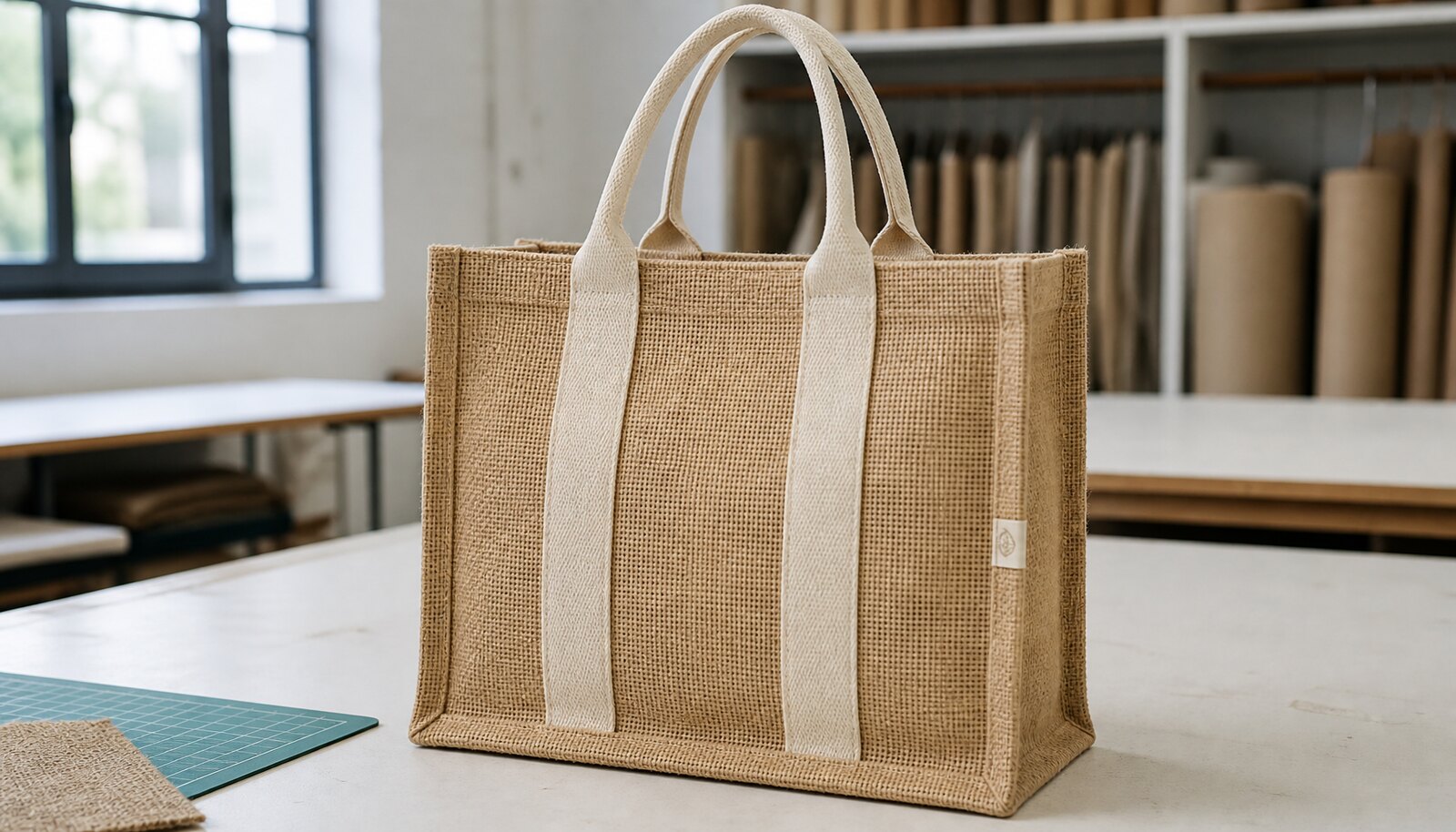
Define the Tote by the Wine Program, Not by the Bag Category
For boutique wineries, a jute tote is not just packaging. It is a carrier, a gift presentation, and part of the tasting-room brand experience. That means the sourcing brief has to start with the use case, not with a generic bag description. A tote for a two-bottle holiday bundle has different structural needs than a lightweight single-bottle giveaway. If the buyer does not define the job up front, the factory will default to the cheapest build that can technically hold a bottle, which is rarely the right commercial choice.
The first decision is the bottle format. Standard Bordeaux bottles are easier to fit and support than Burgundy or sparkling bottles, and mixed-SKU programs are harder because the bag has to tolerate the tallest or widest SKU in the set. The second decision is whether the bag must stand upright on a retail shelf. If the answer is yes, the bottom panel, gusset, and fabric weight matter more than they do in a short-life promotional bag. The third decision is whether the bag should read as premium retail packaging or as a reusable utility carrier. Those two goals overlap, but they do not use the same construction or price structure.
Procurement teams should translate those use cases into measurable requirements before asking for a quote. The bag size should be driven by the bottle dimensions plus clearance for hand insertion and any protective sleeve, not by whatever stock size the supplier already has. If the winery plans to use the tote for point-of-sale gifting, the printed face, label placement, and handle finish should be treated as visible brand assets. If the tote is for bulk event distribution, then strength, stackability, and pallet efficiency may matter more than decorative detail. Clear intent at this stage improves both pricing accuracy and supplier accountability.
- Start with bottle dimensions, bottle count, and whether the tote must stand on shelf.
- Separate premium retail presentation from low-cost promotional use because they do not need the same build.
- Write the target use case in the RFQ so suppliers do not quote a generic catch-all bag.
Choose the Build That Protects the Bottle and the Margin
Fabric weight should be matched to load and presentation. For a light single-bottle tote, 280-320 gsm can be acceptable if the bag is not expected to support repeated heavy handling. For a more premium winery program, 340-400 gsm usually gives better body, better shelf presence, and less collapse at the base after the bottle is inserted. Below that range, the tote can look flat and soft before filling and tired after the first use. Above that range, cost and stiffness rise quickly, and the bag may start to feel overbuilt for the category.
Handle construction is the next cost and quality lever. Cotton webbing is usually the most comfortable and consistent for load-bearing use, because it spreads pressure and tends to hold its shape. Jute handles preserve a fully natural look but can be rougher in hand and less forgiving under load if reinforcement is weak. For bulk buying, the useful question is not whether the handle is natural or not. It is whether the anchor point has enough reinforcement to carry the intended bottle weight without seam distortion or handle twist.
Lining and lamination are options, not defaults. A light liner can reduce fiber shedding and make the interior look cleaner, while a thin lamination can improve structure or wipeability. Both can also introduce problems if the material is too stiff, poorly applied, or not heat-stable. Over-lamination can create bubbling at folds or a chemical odor that is unacceptable in a winery environment. The buyer should specify whether a base board, lining, or wipe-clean interior is allowed, required, or prohibited, because each choice changes both the quote and the shipping profile.
- Use 280-320 gsm only for lighter single-bottle runs with modest handling demands.
- Use 340-400 gsm for premium retail or two-bottle use where shape retention matters.
- Specify handle material, handle width, and reinforcement pattern instead of asking for a generic handle.
- Treat lining or lamination as a functional choice tied to odor, shedding, and structure, not just appearance.
Build a Pricing Plan Around Volume Breaks and Landed Cost
A bulk pricing plan should reflect production behavior, not a single unit rate. Jute tote pricing typically changes at the points where setup costs are diluted across more units and where cutting, printing, and sewing become more efficient. If a supplier gives one flat price for 500 units and 5,000 units, the quote is probably masking setup charges, using a loose spec, or assuming a different material than the one in the sample. Procurement should ask for real quantity breaks, not just a best-case headline number.
The right way to compare offers is to model landed cost, not ex-factory cost alone. That means separating material, cutting, stitching, reinforcement, printing, packing, export documentation, and freight. A quote that looks cheaper at source can become more expensive after carton inefficiency, weak packing density, or expedited freight. For winery buyers, these hidden costs matter because jute has a low unit value but a relatively bulky cube. Air freight, underfilled cartons, and extra handling can erase the apparent savings very quickly.
A practical way to review supplier pricing is to ask for three levels of visibility. First, ask for the base production price at the same spec across quantity bands such as 500, 1,500, and 5,000 units. Second, ask for the setup fees, print fees, and any color-change or tooling fees. Third, ask for the delivered cost by incoterm so you can compare suppliers on the same basis. This prevents a common mistake: choosing the lowest unit price without understanding whether the factory is subsidizing the first order and recovering margin later through change fees or poor packing efficiency.
- Request pricing at multiple quantity tiers that reflect actual production efficiency.
- Compare quotes only after normalizing the incoterm, carton count, and setup charges.
- Model landed cost using freight cube, not just unit price, because jute is bulky.
- Treat unusually flat pricing across volume bands as a risk signal, not a bargain.
Compare Supplier Routes Before You Negotiate the Price
Not every supplier route gives the same control, even when the bag looks identical. A direct factory is usually the most defensible choice when the winery needs repeat quality, precise construction, and clear ownership of the sample-to-bulk match. That route is best when the bag is part of an ongoing brand program and the buyer wants the same result season after season. The tradeoff is that the buyer must be more disciplined about specification, lead time, and artwork finalization, because the factory will price revision cycles into the order.
A trading company or broker can be useful when speed matters or when the order combines several packaging items. The advantage is sourcing convenience; the downside is that the buyer may not know where the work is actually done, which makes it harder to control revisions and harder to trace quality issues back to the root cause. Domestic stockists are the fastest option, but they usually limit flexibility on exact GSM, handle build, and printed placement. They work best when the winery needs a quick refill or a short seasonal window, not when the program depends on a custom retail look.
Integrated converters sit between those extremes. They may be able to manage bag, label, and carton coordination better than a bare factory, but only if the buyer confirms which steps are truly in-house. Local decorators on blank stock can also be effective for very simple programs, especially when the winery only needs a logo and a rapid turnaround. The practical procurement decision is a tradeoff between price, control, speed, and spec accuracy. If the tote is going to represent a premium bottle at point of sale, spec accuracy and repeatability are usually worth more than a small unit savings.
- Direct factory: best for repeat programs and tighter control over construction.
- Trading company or broker: useful for complexity or speed, but verify the actual maker.
- Domestic stockist: useful for urgent demand, but limited on custom construction.
- Local decorator on blank stock: fastest for simple branding, but weakest on fit and spec control.
Choose Branding That Fits Coarse Jute and Holds Up in Use
Branding on jute has to work with the texture, not fight it. A simple one- or two-color screen print is usually the most practical option when the logo is bold and the volume is meaningful. It keeps the quote manageable, is easier for the factory to repeat, and usually looks better on coarse fibers than a detailed print that tries to capture too much line work. If the brand mark is small, delicate, or visually quiet, a woven label or stitched patch can deliver a cleaner premium finish than forcing too much detail into the jute surface.
The key is to match the decoration to how the bag will be handled after packing. A tote that will be folded, shipped, stacked, and reopened many times should be tested for rub resistance and fold durability. Print that looks clean on a flat sample can crack or lose clarity on a crease line. Dense solid fills can also look patchy on coarse fabric if the ink coverage is not tuned to the exact material lot. For that reason, buyers should require an approval sample on the same fabric and print method, not a generic proof or digital mockup.
Wineries that want a premium feel should also be careful with placement. Centered front graphics are not always the best solution if the logo competes with handle anchors or seam lines. A side label, hem tag, or stitched patch can feel more restrained and more expensive in hand. The design decision should support the retail story: visible enough for recognition, but not so loud that it makes the tote feel like a giveaway item instead of a reusable brand asset.
- Use screen print for bold logos and repeat production runs.
- Use woven labels or stitched patches when the logo is fine, small, or meant to feel understated.
- Require fold-line and rub testing on the approved sample if the bag will be reused often.
- Keep artwork away from seams and stress points whenever possible.
Approve Samples as a Production Gate, Not a Design Review
Sample approval should test the exact product that will be made in bulk, not just a similar-looking version. Ask for a pre-production sample using the same fabric lot, handle material, print method, and packing format as the production order. If the winery plans to use a specific bottle SKU, the sample should be fitted with that exact bottle, not with a substitute. Many tote failures are fit failures, and those are much cheaper to catch at sample stage than after the full order is sewn.
A buyer-grade sample review should cover both appearance and function. Measure the finished dimensions and compare them to the tolerance band in the PO. Check handle symmetry, anchor placement, seam alignment, and whether the tote stands correctly when loaded. Open and close the bag several times, then inspect the print for cracking or smearing on the fold points. If the bag includes a liner or insert, confirm that it does not bunch, shift, or create a sharp edge that could damage packaging or discomfort the customer. Strong odor, heavy fiber shedding, or a rough internal finish should block approval until corrected.
Keep one golden sample sealed and signed by both sides. That sample becomes the reference for bulk production, dispute resolution, and incoming inspection. The goal is to make sample approval a hard gate, not a casual yes/no after a photo. A weak sample process usually creates the same expensive outcome later: corrections at scale, freight delays, and a fight over what was actually agreed.
- Test the tote with the final bottle SKU, not a substitute bottle.
- Measure and record the approved dimensions, print placement, and handle drop.
- Keep a signed golden sample for production and receiving reference.
- Reject samples with strong odor, excessive shedding, crooked handles, or unstable stand-up behavior.
Set QC Limits That a Factory and Inspector Can Actually Use
Production quality control needs specific thresholds. A useful spec should define what counts as pass, minor defect, and major defect. For example, a small shade variation in natural jute may be acceptable across batches, but a visible stain on the front panel or a handle that twists under normal load should fail. The same logic applies to stitch quality. Random fiber variation is expected in jute; structural failure is not. The buyer's job is to decide where natural variation ends and unacceptable variation begins.
The most useful test methods are simple and repeatable. Measure dimensions with a ruler or template against the approved tolerance band. Perform a loaded carry test using the target bottle and a realistic handling cycle. Check the handle anchors visually and by light pull, looking for loose threads, skipped stitches, or seam movement. Review print placement against a placement board or printed spec sheet. If the bag is lined or laminated, inspect the fold areas for bubbling, delamination, or stiffness that interferes with closing or packing. These are not theoretical checks; they are the failures that show up in warehouses and at the retail counter.
Carton-level inspection matters just as much as unit-level inspection. A bag can pass on the sewing table and still arrive damaged if the carton count is wrong, labels are inconsistent, or the packing method crushes the handles. Require carton labels to show SKU, color, quantity, PO number, and carton sequence if relevant. Check carton dimensions and gross weight against the freight booking. For export moves, inspect at least one carton per lot for moisture, crush damage, and count accuracy before release. If the order is large, use AQL sampling and assign clear major and minor defect thresholds in the purchase order so the factory knows what is non-negotiable.
- Write pass, minor, and major defect definitions before mass production starts.
- Use a loaded carry test with the actual bottle SKU and realistic handling cycle.
- Treat open seams, weak handle anchors, and print misplacement as major defects.
- Audit carton labels, carton count, and gross weight, not only the bag itself.
Work the Packing, Carton, and Warehouse Math Before You Book Freight
Packaging decisions affect both damage risk and freight cost. Jute totes are bulky and often do not compress cleanly without flattening the base or wrinkling the visible face. If the bags are intended for retail presentation, individual tissue or polybag wrapping can protect the finish, but it should not be used blindly. Extra wrapping increases labor, adds waste, and can slow replenishment at the store. If the bags are destined for a winery warehouse or export consolidation point, a tighter inner pack with moisture control may be the better choice, especially if the cartons will sit before opening.
The carton spec should be part of the sourcing discussion, not a late-stage logistics detail. Ask for units per inner pack, units per carton, carton dimensions, gross weight, and pallet layout. That allows the buyer to estimate freight cube and receiving labor in advance. Oversized cartons, poor stacking, and inconsistent pack counts are common causes of avoidable cost. If the route includes humidity or long storage, add a moisture barrier or desiccant only if the buyer accepts the incremental cost and the factory can show that it improves the condition of the bags on arrival.
Compliance should also be considered at the packaging stage. If the destination market expects fiber content labeling, country-of-origin marking, or carton warning marks, those details must be written into the RFQ. Even when the bag itself is simple, the packaging can cause delays if labels are missing or incorrect. The procurement team should confirm whether the supplier will provide shipping marks, pallet labels, and any required documentation for customs or warehouse receiving. That reduces friction at destination and helps the order flow through the supply chain without manual correction.
- Confirm carton count, carton dimensions, gross weight, and pallet configuration before freight booking.
- Choose retail wrapping only when the presentation benefit exceeds the extra handling and waste.
- Add moisture control only when the route or storage window justifies it.
- Write required carton markings and country-of-origin needs into the PO and RFQ.
Close the RFQ With the Questions That Expose Real Cost Drivers
A useful RFQ does more than ask for a price. It forces the supplier to show the assumptions behind the quote. The buyer should ask for the exact fabric weight, the handle build, the reinforcement method, the print method, the carton pack, and the production timeline. It should also ask what is excluded. If the supplier omits sample fees, color-change fees, or special packaging, those items often reappear later as change orders. The most reliable quote is not the lowest one; it is the one that makes future disputes unlikely.
Procurement teams should also ask the supplier-side questions that reveal cost drivers. Is the fabric already in stock or has it been reserved for another program? Is the print setup simple, or does it require screens, plates, or alignment work that affects the first run? Are there constraints on handle material availability? What happens if the logo changes after approval? These questions matter because winery orders are often seasonal, and seasonality increases the cost of rush work, revisions, and split shipments. A supplier that can explain those drivers clearly is usually easier to manage when the order scales.
For a boutique winery program, the best commercial outcome is usually a repeatable tote spec with a stable landed cost and enough quality control to protect the brand. The goal is not to win the lowest sticker price. It is to buy a bag that fits the bottle, ships efficiently, arrives clean, and still looks deliberate after customers carry it home. That is what makes the bulk pricing plan useful rather than merely cheap.
- Ask the supplier to separate material, setup, printing, sewing, packing, and freight assumptions.
- Ask what changes the price most: fabric availability, print complexity, handle type, or packaging.
- Require the supplier to state exclusions so hidden costs do not appear after approval.
- Use one RFQ format for every supplier so the comparison stays clean.
Specification comparison for buyers
| Supplier option | Typical price behavior | Best fit for winery buyers | Tradeoff to check before ordering |
|---|---|---|---|
| Direct factory | Lowest price at higher volumes, but setup and sample costs are more visible | Repeat programs with stable specs, custom sizing, and repeat orders | Confirm who owns cutting, printing, stitching, and final QC; hidden subcontracting can change quality |
| Trading company or broker | Quote may look convenient, but margin is embedded in the unit price | Small orders, mixed packaging programs, or buyers who need sourcing support | Ask for the actual factory name, country of origin, and whether revisions pass through multiple layers |
| Domestic stockist | Higher unit price but short lead time and simpler logistics | Urgent events, replenishment, or buyers who need fast in-country delivery | Inventory may not match your exact GSM, handle build, or logo placement |
| Integrated converter | Mid-to-high pricing with better coordination across bag, label, and carton spec | Programs that need printed packaging, inserts, and coordinated presentation | Check whether all components are truly made in-house or only assembled there |
| Local decorator on blank stock | Fastest turnaround on simple decoration, usually with the smallest MOQ | Promotional runs and trial sell-through tests | Blank stock limits size, structure, and bottle fit; decoration options are narrower |
| Material | laminated or unlaminated jute, cotton-jute blend, inner coating, odor control, yarn thickness, and color shade variation | Before price comparison | Different cloth weights, backing, or certification claims make quotes hard to compare |
| Construction | handle stitching, side gusset, lamination edge control, inner seam cover, and fiber shedding tolerance | Before sampling | Weak stress points create returns and failed inspections |
| Decoration | screen print, transfer patch, cotton label, or embroidery selected for rough fiber texture and ink holdout | Before artwork approval | The wrong method can crack, bleed, pucker, or fail on the chosen fabric |
Buyer checklist before sampling
- Define the bottle format first: Bordeaux, Burgundy, sparkling, or mixed pack, plus exact height and diameter.
- Lock finished bag dimensions, gusset depth, handle drop, and whether the bag must stand upright on shelf.
- Specify fabric weight, weave, handle material, reinforcement method, and whether a lining, lamination, or base insert is allowed.
- Choose print method, artwork color count, ink coverage expectations, and whether the logo must survive fold points.
- State packaging requirements: units per inner pack, cartons per pallet, moisture control, labeling, and retail presentation.
- Request pricing at multiple quantity breaks and ask for the setup charges behind each break.
- Ask for a pre-production sample made from the same fabric, same print method, and same handle construction as bulk.
- Set written QC limits for dimensions, stitch quality, print placement, odor, fiber shedding, and carton condition.
- Build schedule buffer for artwork changes, sample approval, carton testing, and freight booking.
- Request incoterm-specific pricing so landed cost can be modeled before PO release.
Factory quote questions to send
- Are you the direct factory, and which steps, if any, are subcontracted to other sites?
- What is the exact fabric weight in gsm, and what weave or finish will you use?
- What are your pricing breaks at 500, 1,000, 3,000, and 5,000 units, or your actual production tiers?
- Please separate material cost, print setup, sewing, reinforcement, packing, and any other setup charge.
- Which print method is included, how many colors are covered, and what are the limits on logo size or line detail?
- What handle construction is included: cotton webbing, jute handle, stitched patch, or a combination?
- What is the approved carton pack, carton size, gross weight, and pallet count?
- Can you quote EXW, FOB, and CIF, and show freight, document fees, and export handling separately?
- What is the sample lead time, bulk lead time, and the latest artwork approval date that protects the ship date?
- What defects do you classify as major versus minor, and which standard do you inspect against?
Quality-control points to confirm
- Dimensions: set an allowed variance for height, width, and gusset depth, typically no more than plus or minus 5 mm on visible retail dimensions and tighter on any bottle-fit critical measurement.
- Load test: each approved sample should carry the target bottle load for at least 30 minutes with no seam opening, handle slippage, or base collapse; recheck after the bag is lifted and set down repeatedly.
- Handle anchoring: require symmetrical placement, full bar-tack or box-stitch reinforcement, and no loose ends longer than 3 mm on retail-facing bags.
- Stitching: no skipped stitches on critical seams, no seam opening, and no broken thread in the load path; classify any structural stitch failure as a major defect.
- Print quality: verify artwork location, color density, and edge clarity against the signed sample; no bleeding into seam allowance and no visible cracking after folding at the base and handle lines.
- Surface condition: define an acceptable limit for stains, oil marks, foreign fibers, and fiber shedding; any visible mark on the main panel should be treated as a major defect.
- Odor and finish: strong chemical odor, wet-mold smell, or harsh coating odor should fail the sample until corrected; if lining or lamination is used, it must lie flat with no bubbling or delamination at folds.
- Carton-level inspection: verify SKU label, quantity, carton dimensions, net and gross weight, and pallet configuration; mixed SKU cartons should be prohibited unless specifically approved.
- Packing condition: inner packs must protect the print and handles from crush damage; any carton with crushed corners, burst tape, or moisture intrusion should be rejected at receipt.
- Inspection method: use a signed golden sample, in-process checks, and AQL final inspection, with a separate carton audit for label accuracy and count accuracy before release.