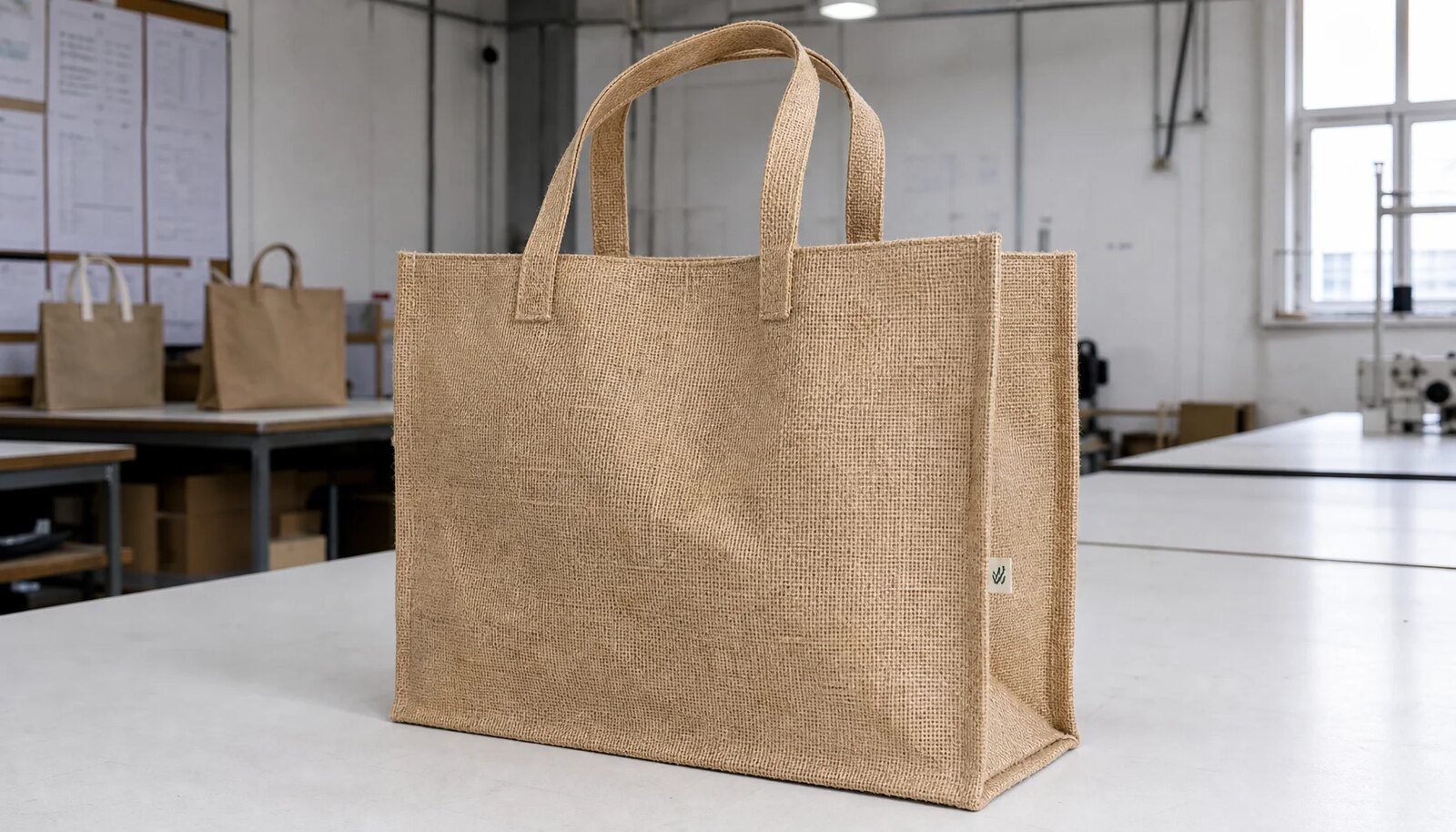
Start With the Selling Job, Not the Material
For wholesale jute tote bags for farmers market vendors, the first sourcing mistake is treating the bag as a generic tote. The bag is only the object. The buying job is more specific: a vendor giveaway, a retail resale item, a shopper carry bag, a produce carrier, or a branded membership item. Those use cases do not need the same fabric weight, handle length, structure, or packing method. A tote that must sit upright on a market table has a different build than one that folds flat in a car trunk and gets reused every weekend.
Write the use case into the RFQ before you talk about price. If the bag is for farmers market shoppers, say whether it must carry produce, fit over a shoulder, stand on its own, or simply look premium enough to sell at checkout. Then turn that use case into a minimum spec the factory can actually build. Most sourcing problems start when the buyer says jute tote and the supplier fills in the blanks with its own assumptions. Those assumptions create quote gaps, sample rework, and preventable disputes later.
- Define the primary use case before discussing MOQ.
- State whether the tote is for resale, vendor distribution, or shopper carry.
- Tell the supplier if structure or low price is the top priority.
- Avoid mixing giveaway expectations with retail-quality expectations in the same brief.
Translate the Use Case Into a Build Spec
Pricing starts with the physical build. Fabric weight is the easiest line item to move, but it is not the only one that changes the product. A 12 oz/yd2 class jute body is a reasonable starting point when you need a lower entry price, lighter carry, or a first pilot run. A 14 oz/yd2 class body usually gives a more substantial handfeel and better structure, which is often a better fit for a retail-facing farmers market tote. If the bag will be seen on a shelf or sold in a checkout lane, the heavier cloth usually supports perceived value even when it raises the unit price.
Construction details matter just as much as cloth weight. Handle style, gusset depth, side seams, base construction, and lining all add material and labor. A self-fabric handle can look cohesive, but it exposes stitching quality more clearly. Webbing handles are usually easier to source and more consistent to run. A boxed bottom improves stability, but it adds pattern complexity and more sewing time. Lining or lamination changes the feel, the weight, and the packing method. The RFQ should not just say jute tote. It should state finished size, gusset depth, handle drop, opening style, and whether the bag should fold flat, hold shape, or stand on its own when filled.
When the spec is still open, ask the supplier for a priced alternate rather than an unbounded revision. For example, request the same bag in two fabric weights, or the same body with and without lining. That gives procurement a real tradeoff instead of a vague opinion. It also exposes which differences are driving cost. A small change in the build can move the MOQ more than a hard negotiation ever will.
- State fabric weight in oz/yd2 or GSM so the factory cannot quietly substitute a lighter cloth.
- Lock finished dimensions, gusset depth, and handle drop before asking for final pricing.
- Specify whether the bag is unlined, lined, or laminated.
- Decide whether the tote must fold flat or keep a structured shape after filling.
Know Which Supplier Route You Are Actually Buying
MOQ is not just a quantity number. It is the supplier's way of recovering setup cost, line efficiency, and material risk. A direct factory with in-house cutting, sewing, printing, and packing is usually the best route when you want repeatability. That route gives you one team managing the bag from start to finish, which makes it easier to reuse patterns, screens, packing standards, and approved samples on reorder. It is usually the strongest option when the artwork is stable and the buyer expects a second or third run.
A trading company can help when you need a smaller pilot order, mixed sourcing, or broader category support, but the tradeoff is visibility. You need to know the actual factory name, production location, and whether the reorder will go back to the same line. A local decorator using imported blanks can work when the blank body already matches the market expectation and only the branding changes. The mistake is comparing those suppliers as if they are quoting the same production route. They are not. The right way to negotiate MOQ is to simplify the route first, then ask for flexibility on the simplest build that still meets the brief.
If the supplier has multiple manufacturing paths, force them to name the path in the quote. Ask whether the bag is cut and sewn from raw jute, converted from a standard blank, or finished in a separate decoration step. That one clarification can explain large price swings. It also helps you avoid accepting a cheap first quote that cannot repeat cleanly at reorder.
- Choose the supplier route that matches the reorder plan, not just the first quote you receive.
- Separate setup costs from recurring unit cost so the MOQ discussion stays realistic.
- Ask who owns the pattern, screen, label, or artwork files if the order may repeat.
- Do not compare suppliers until the print scope, packing scope, and fabric weight are identical.
Write an RFQ That Produces Comparable Quotes
A useful RFQ makes the supplier do less guessing. The best one contains the bag spec, the print spec, the packing spec, the commercial terms, and the approval path in one place. That lets the factory answer with a real unit price instead of building a quote around assumptions. If you are comparing wholesale jute tote bags for farmers market vendors across multiple sources, this is where quote quality is decided. A vague RFQ produces vague pricing. A specific RFQ produces a real purchasing decision.
A clean RFQ should break the bag into understandable cost blocks. Ask for the base bag, the print setup, any label or patch, any packing materials, and any additional freight or handling charge the supplier expects to recover. If a vendor cannot itemize the quote, you cannot tell whether the difference is fabric weight, labor efficiency, print method, or margin padding. Ask for the same line items from every bidder, then normalize the quotes to the same size, fabric, print scope, and delivery basis. That is the only defensible way to compare landed cost and negotiate MOQ without arguing about irrelevant differences.
The RFQ should also tell the supplier what success looks like after production. State whether you want a concept sample first, then a pre-production sample, then a gold sample, or whether one controlled sample stage is enough. Include the approval owner, the due date for sample review, and the rule for shipment release. When the quote includes the approval path, the supplier is less likely to treat sample cost as a surprise later.
- Separate one-time setup charges from the recurring unit price.
- Ask every bidder for the same line items.
- State the exact print location, print size, and file format requirements.
- If alternates are allowed, require them to be quoted separately from the base offer.
Negotiate MOQ by Reducing Production Friction
The best way to lower MOQ is to make the order easier to run. Factories are more flexible when the tote uses one body style, one fabric weight, one print position, and one standard packing method. If the line does not have to stop for multiple color changes, handle variations, or special folding instructions, the setup burden drops. That is the real lever behind MOQ, not pressure and not vague promises. If your concept adds extra branding elements, be honest about the tradeoff: more complexity usually means a higher minimum or a higher setup charge.
A better commercial tactic is to use a pilot-to-reorder structure. Place a quantity that proves the tote, the print, and the packing standard, then leave a clear path to a reorder if the program performs. Suppliers understand first-order caution if the follow-on business is credible. If you can say that the same tote may be reordered for the next farmers market season, a membership campaign, or a retail rollout, that helps. But the first order still needs to be simple enough for the factory to run efficiently. If the first run is also the most complicated version of the bag, the minimum usually stays high and the risk stays with the buyer.
When a supplier will not move on MOQ, ask for a structured alternative instead of a blunt discount. Two useful options are a simpler build with lower setup cost, or a tiered quote with a better unit price at the next volume break. Both are more actionable than a yes-or-no demand. They also reveal whether the supplier is protecting margin, protecting capacity, or protecting a complicated setup.
- Trade complexity for MOQ rather than trying to win a lower number on a complicated spec.
- Keep one core SKU instead of many construction variants.
- Ask for price breaks at two or three volume tiers so the next-order path is visible.
- Use a pilot-to-reorder structure if the supplier needs confidence in future volume.
Control Samples Before You Approve Bulk
The sample stage is where you protect the bulk order. On a jute tote, a sample should confirm more than artwork. It should confirm the finished size, handle drop, boxiness or slouch, stitching quality at the corners, and the way the print sits on the weave. If the supplier sends only a visual mockup and not the actual production construction, treat it as a concept reference, not a production sign-off. That distinction matters because many post-order disputes start when a concept sample gets mistaken for a gold sample.
Natural jute varies, and the approval standard should reflect that. Minor shade differences, fiber slubs, and slight texture variation are normal. Crooked handle attachment, weak corner stitching, distorted panels, patchy ink coverage, or misaligned labels are not. Keep two artifacts together: the signed gold sample and the approved spec sheet. The gold sample shows what passed. The spec sheet shows what was measured, what was tolerated, and what was required. Without both, the bulk team often inherits a weak approval record and cannot tell whether a deviation is a defect or normal variation.
Do not let sample approval drift into general approval language. Use a yes or no decision against the exact spec. If the handle drop is off, note it. If the print needs to move, mark it. If the bag needs more body so it stands properly, say that before bulk starts. Clear sample comments are cheaper than a corrected bulk run.
- Approve color against a physical sample or Pantone reference, not only a screen image.
- Measure finished size, handle drop, and gusset after the sample is stuffed or lightly loaded.
- Keep a signed gold sample and the approved spec sheet together for bulk comparison.
- Treat concept samples as design references, not as production approval.
Treat Print, Labels, and Artwork as Manufacturing Decisions
For jute, print is a production issue, not just a design choice. One-color screen print is usually the most practical method because it keeps setup manageable and handles the coarse surface better than fine-detail graphics. Jute is not smooth. Thin lines, tiny type, and subtle gradients can break up, fill in, or lose contrast when the ink hits the weave. If the logo is simple, screen print is usually the safest option. If the brand needs a more premium identity, a woven label, sewn patch, or side tag is often a more reliable way to communicate value than forcing the print to do too much.
Set the artwork rules early. Confirm the maximum print area, the minimum line weight, the approved font size for any text, and whether artwork must be supplied as vector files. If you expect the supplier to alter the logo for printability, say so in writing and ask them to submit the revised file for approval. That avoids a situation where the factory optimizes the artwork without telling the brand team.
Packing needs the same discipline. A tote meant for retail display may need a defined fold, a retail insert, or a hangtag that stays visible when the carton is opened. A tote for distribution or market giveaway can be bulk packed, but then the carton needs to protect the print face and avoid crushing the handle area or the base. If the product will be unpacked and resold, ask the factory to show how the bag looks after the first fold release. If the bag must sit on a shelf or hook cleanly, the fold standard and label placement are part of the product definition, not just the shipping plan.
- Ask for print alignment tolerance in millimeters before approving artwork.
- Confirm whether a second decoration position changes MOQ or only adds unit cost.
- Decide in advance whether the bags need individual polybags or only master cartons.
- Verify label placement on the sample so it does not interfere with the print area.
Use QC Targets That Match the Material and the Order Size
A good quality-control plan for wholesale jute tote bags for farmers market vendors focuses on the defects that matter in use, not just cosmetic uniformity. The main checks are stitching integrity, size consistency, print legibility, handle strength, seam alignment, carton packing, and cleanliness. Jute is a natural material, so your inspection should separate acceptable fiber variation from workmanship defects. That distinction keeps the supplier honest and keeps your team from rejecting normal texture variation that does not affect function.
The inspection checklist should be tied to the approved sample and spec sheet. A practical procurement target is plus or minus 1/4 in on finished body dimensions and plus or minus 1/2 in on handle drop unless the bag design needs tighter control. Print placement usually needs a tighter tolerance, often around plus or minus 1/8 to 1/4 in depending on the method and artwork size. Check that the handle attachment points are evenly stitched and that the corners do not show skipped stitches or loose ends. Review the print for centered placement and clear readability on the weave. Then check carton counts, fold method, and outer marks against the packing instruction. If the order is large enough to justify an inspection report, retain a gold sample in the shipment record so the inbound team has a direct reference.
For larger runs, build a simple pass-fail matrix before the goods leave the factory. Mark the defects that are acceptable, the ones that are reworkable, and the ones that are shipment blockers. That gives the inspector, the factory, and the buyer the same rule set. It also stops one person from making a subjective decision that everyone else has to live with later.
- Check seam strength at handle stress points, not only along the visible body seams.
- Measure the bag after stuffing if the final use depends on shape or load bearing.
- Confirm that carton counts and outer marks match the packing instruction exactly.
- Retain one gold sample from the approved run for future reorders and dispute resolution.
- Reject printing defects that affect readability or brand clarity, not harmless fiber variation.
Build Landed-Cost Comparisons Around the Same Assumptions
The lowest quoted unit price is not automatically the lowest total cost. A cheaper quote can become more expensive once you add a different fabric weight, extra packaging, a larger freight cube, or a higher reject rate. For procurement, the question is not just what the bag costs at the factory door. The question is what a sellable unit costs after packing, freight, handling, and any rework are included. That matters for farmers market programs because margin is often tight and demand is seasonal.
To compare landed cost properly, normalize every quote to the same bag size, fabric weight, print scope, label scope, packing method, and delivery basis. If one supplier quotes EXW and another quotes FOB, convert them to the same basis before comparing. If one supplier includes a woven tag and another does not, add the cost difference before deciding. If one option ships in bulk cartons and another in retail-ready packs, the freight and handling impact may be enough to flip the decision. Keep a fallback spec ready if the preferred version pushes margin too far. That is not a quality compromise. It is a commercial control.
It also helps to ask suppliers for a quote ladder. Two or three volume breaks show where the fixed costs flatten out and where the unit price actually moves. That makes the negotiation concrete. You can see whether the next price tier is realistic or whether the supplier is using the quote structure to protect a number that will not improve until volume is materially higher.
- Normalize all quotes to the same bag size, fabric weight, and print scope.
- Convert freight and packing into landed cost per sellable unit.
- Keep a fallback spec ready if the preferred version pushes you outside margin.
- Compare suppliers only after you have matched the commercial assumptions.
Plan Reorders, Tool Ownership, and Exit Criteria
The last step in a good MOQ negotiation is deciding what happens after the first order. If the tote is likely to repeat, ask who owns the pattern, screen, label tooling, and approved packaging artwork. If those assets sit with the factory, the reorder path may be easier, but you need to know whether they can be reused without a new charge. If they are not reusable, the apparent cheap first run may not be the best long-term source. Procurement teams should also ask what triggers a new setup fee: new artwork, new size, new color, or simply a new calendar year.
Set a clear walk-away line. If a factory will only reduce MOQ by weakening the spec, changing the material without notice, or dropping the inspection standard, the better choice may be to hold the quantity and protect the product. The point of MOQ negotiation is not to buy the smallest possible run at any cost. It is to get a production plan that is commercially viable and operationally stable. For a farmers market vendor program, that means a tote that looks right, holds up in use, can be reordered cleanly, and does not create avoidable exceptions for the warehouse or the sales team. Write the approved spec, sample status, target MOQ, tiered pricing request, and reorder assumptions into the final RFQ so the next buyer can reuse the same logic.
If the tote is part of a broader seasonal program, document whether the same factory can keep the same body shape and artwork placement on reorder. Reorders fail when the original order was approved informally and no one can reconstruct the exact version later. A clean handoff file avoids that problem.
- Clarify whether patterns, screens, and artwork files are reusable on reorder.
- Ask what changes trigger a new setup charge or a new MOQ.
- Set a walk-away line for any quote that protects price by reducing the bag below the required standard.
- Write the reorder assumptions into the RFQ so the next buyer can reuse the same sourcing logic.
Specification comparison for buyers
| Spec decision | Recommended option | When it fits | Buyer risk to check |
|---|---|---|---|
| Supplier route | Direct factory with in-house cutting, sewing, printing, and packing | You expect repeat orders and need stable control over artwork, stitch quality, and packing | Confirm whether any step is subcontracted and who signs off the final inspection |
| Supplier route | Trading company or sourcing agent with named factory disclosure | You need a small pilot order, mixed sourcing, or help coordinating multiple components | Ask for the actual factory name, production location, and reorder consistency |
| Fabric weight | 12 oz/yd2 class jute | You want an entry-price tote, lighter carry, or a promotional first order | Risk of a softer body, more wrinkling, and less shelf presence |
| Fabric weight | 14 oz/yd2 class jute | You need better structure, stronger perceived value, and a more retail-ready look | Confirm handle attachment, base seams, and gusset construction are reinforced |
| Body build | Unlined single-layer tote | You want lower cost, simpler production, and easy flat packing | Check print show-through, seam visibility, and whether the bag still holds shape enough for resale |
| Body build | Lined or laminated tote | You need a more premium feel, better structure, or a cleaner interior finish | Confirm added weight, extra MOQ, and whether lining changes drying or moisture behavior |
| Handle construction | Webbing or self-fabric handles with box-X or bartack reinforcement | The bag is meant for regular use or shoulder carry | Check handle drop, stitch consistency, and stress points at the top seam |
| Decoration | One-color screen print | Artwork is simple and the surface is coarse jute | Fine lines under 1 mm and small text under 6 pt may break up on the weave |
| Decoration | Woven label or sewn patch with limited print | The brand needs a more premium finish or the print area is small | Confirm label MOQ, placement consistency, and whether it changes unit cost |
Buyer checklist before sampling
- Finished size, gusset depth, and handle drop written in the RFQ, with the target tolerance band stated in inches or millimeters
- Fabric weight stated in oz/yd2 or GSM, plus whether the bag is unlined, lined, or laminated
- Print method, number of colors, print size, and exact print placement confirmed before quoting
- One reference photo, sketch, or physical sample attached so the supplier can match shape and proportion
- Target MOQ, price tiers, and all setup charges listed separately from the recurring unit price
- Sample type defined as concept sample, pre-production sample, or gold sample
- Packing method stated clearly: bulk carton, retail polybag, insert card, hangtag, or mixed packing
- Incoterm, destination port, or delivery point stated before quote comparison starts
- Acceptable tolerances for size, print placement, stitching, and packing count written down
- Reorder terms, tooling ownership, and artwork file ownership clarified if the program may repeat
Factory quote questions to send
- What fabric weight, weave, and finish is your unit price based on?
- Is the MOQ tied to one color, one print location, one label, or the full combined design setup?
- Which charges are one-time setup costs, and which charges repeat on every reorder?
- Can you quote the same bag at 12 oz/yd2 and 14 oz/yd2 so we can compare landed cost?
- What handle construction do you recommend for this load, and what handle drop will you hold to?
- What print method will reproduce this artwork cleanly on coarse jute, and what line detail will not print well?
- What sample type will you provide before bulk, and how many days does the sample stage usually take?
- How will the bags be packed for shipment, and does the packing change carton dimensions or freight cube?
- Will any cutting, printing, or finishing be subcontracted, and where is the final quality check performed?
- Can you quote at two or three volume breaks so we can see the path to the next price tier?
Quality-control points to confirm
- Finished size, handle drop, and gusset depth match the approved spec within the agreed tolerance, commonly around plus or minus 1/4 in for the body and plus or minus 1/2 in for the handle drop unless the buyer specifies tighter control
- Fabric weight matches the approved standard and the weave does not show weak open spots in the stress areas
- Print registration is centered and readable on the coarse jute surface, with no major ink patching, smearing, or broken coverage
- Small text, thin strokes, and logo edges remain legible at the approved size; anything below about 1 mm line weight should be reviewed carefully before bulk
- Handle attachment points show even stitching, no skipped stitches, and no loose seam ends at the stress corners
- Corners, base, and side seams are symmetrical and the bag sits flat or stands as specified in the approved sample
- Labels, woven tags, or side seams are placed consistently and do not interfere with the print area or handle seam
- Carton counts, fold method, and outer marks match the packing instruction and do not crush the bag shape
- Bulk shipment includes a retained gold sample and a final inspection record tied to the approved spec sheet and artwork version
- No odor, dampness, oil stain, mold, or visible contamination is present on the bag surface, lining, or packing materials